鲜活现炒

Search documents
酸菜鱼不香了?太二“爆改”闯川菜红海
凤凰网财经· 2026-01-03 12:37
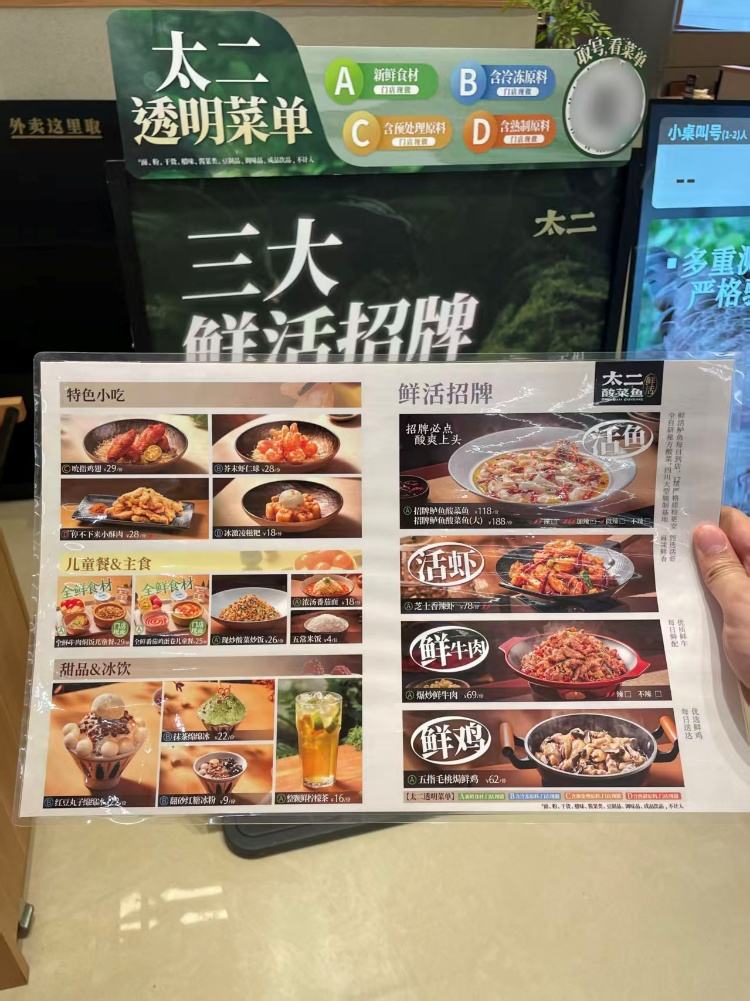
Core Viewpoint - The article discusses the transformation of the restaurant brand "Tai Er" from a focus on "sauerkraut fish" to a broader identity as "New Tai Er · Fresh Material Sichuan Cuisine," driven by declining performance and market pressures [1][9]. Group 1: Brand Transformation - Tai Er has replaced its iconic "sauerkraut fish" signage with "New Tai Er · Fresh Material Sichuan Cuisine" in several locations, indicating a significant brand overhaul [5][6]. - The new branding includes an expanded menu with over 20 new dishes, focusing on fresh ingredients like live fish, shrimp, beef, chicken, and pork, while the original sauerkraut fish remains but is less emphasized [6][7]. - The restaurant's atmosphere has been updated to appeal to family dining, featuring a more inviting design and an open kitchen concept to enhance transparency about food preparation [6][8]. Group 2: Financial Performance - Tai Er's parent company, Jiu Mao Jiu Group, reported a 10.14% decline in revenue and a 16.05% drop in net profit for the first half of 2025, with Tai Er's revenue specifically down by 13.3% [9][10]. - The restaurant's table turnover rate has halved from 4.9 times per day in 2019 to 2.2 times in the first half of 2025, reflecting decreased customer traffic [10][12]. - The number of Tai Er locations has decreased by over 60 in the past year, indicating challenges in maintaining its previous growth trajectory [10][12]. Group 3: Market Challenges - The decline in popularity of the sauerkraut fish category is evident, with a reduction in the total number of related restaurants since 2022, alongside increased competition from lower-priced fast-casual brands and retail offerings [12][13]. - Tai Er's pricing strategy, with an average customer spend of 70-80 yuan, is seen as a disadvantage compared to both budget and premium Sichuan restaurants [14][15]. - The shift to a "fresh and live" concept is expected to increase supply chain costs by over 15%, with significant renovation costs for restaurants, posing a financial challenge for the company [13][15].


率先实现正餐全菜单透明化 “爆改”后的太二如何重塑餐饮信任?
Xin Jing Bao· 2025-12-19 04:44
Core Insights - The article discusses the transformation of the restaurant industry in China, particularly focusing on the brand "Tai Er" and its commitment to transparency and freshness in food preparation [1][5][12] Group 1: Company Initiatives - Tai Er has launched a comprehensive menu transparency initiative, categorizing dishes based on ingredient freshness and pre-processing levels into four classes, with Class A representing the freshest ingredients [1][4] - The brand's "5.0 Fresh Model" was initiated in March 2023, and by December 2025, Tai Er aims to have over 200 restaurants operating under this model, up from an initial target of 150 [5][12] - The company emphasizes that all dishes are 100% made in-house, with a visible kitchen setup allowing customers to observe the cooking process [5][10] Group 2: Industry Trends - The chain restaurant penetration rate in the dining industry has increased from 18% in 2021 to 23% in 2024, reflecting a growing consumer demand for freshness [3][7] - The Chinese dining market is projected to reach 5.5 trillion yuan in revenue by 2024, with a year-on-year growth rate of 5.3%, surpassing the growth of retail sales [7] - Consumer preferences are shifting towards a more cautious approach, valuing authentic experiences over mere affordability, with a significant increase in searches for "fresh" and "live" food options [7][8] Group 3: Operational Challenges - The implementation of the "Fresh Strategy" poses challenges for Tai Er, particularly in managing the supply chain for fresh ingredients, which requires high standards for cold chain logistics and inventory turnover [11][12] - The company has adopted a "batch killing" method for fish to balance efficiency and freshness, ensuring that customers do not experience long wait times while maintaining quality [10][12] - Despite the positive reception of upgraded stores, the increased costs associated with fresh ingredients have led to a decline in profit margins for new store formats [12]