黄金定价权争夺

Search documents
不只是涨价!黄金税改的逻辑,国家在为你规划一条安全的投资赛道
Sou Hu Cai Jing· 2025-11-07 10:59
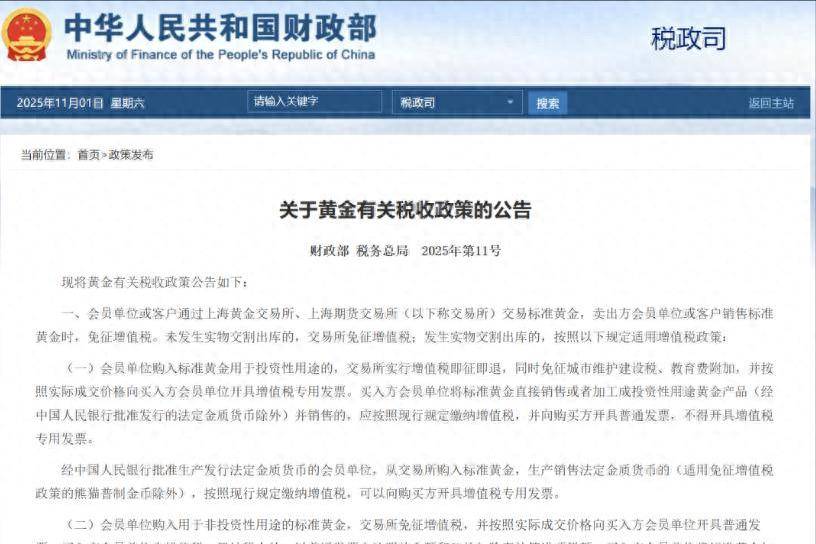
Core Viewpoint - The recent tax policy changes regarding gold are part of a broader strategy by the Chinese government to enhance its global financial influence and establish a more regulated gold market [3][24]. Group 1: Tax Policy Changes - The new tax policy separates the "investment" and "consumption" attributes of gold, applying different VAT rules to each [3][10]. - Only standard gold transactions through the Shanghai Gold Exchange and Shanghai Futures Exchange will enjoy VAT exemptions, encouraging institutional and bulk traders to engage in compliant trading [5][6]. - Consumption gold, such as jewelry and industrial gold, will incur VAT during transactions, while businesses can deduct input tax when processing and selling these gold products [9][10]. Group 2: Market Implications - The policy aims to increase the liquidity and scale of on-exchange trading, thereby establishing the authority of "Shanghai Gold" [7][12]. - The shift towards compliant trading channels indicates a future where non-compliant trading options will diminish, leading to a more regulated gold market [12][26]. - The tax reform is closely linked to China's goal of becoming a financial powerhouse as outlined in the "14th Five-Year Plan" [12][24]. Group 3: Internationalization of the Renminbi - The changes are a significant step in the strategy to internationalize the Renminbi, as China seeks to establish its own gold pricing mechanism rather than relying on Western markets [14][18]. - The recognition of "Shanghai Gold" in global markets will enhance the credibility and attractiveness of the Renminbi, reducing dependence on the US dollar [18][20]. - This process is gradual but essential for China's long-term financial strategy, aiming to challenge the existing global monetary system [20][24]. Group 4: Investor Guidance - Investors are advised to utilize compliant channels such as bank paper gold, products from the Shanghai Gold Exchange, and compliant gold ETFs, avoiding non-regulated options that carry higher risks [22][24]. - Understanding the different value logic between investment gold and consumption gold is crucial for investors to avoid losses [22][24]. - The new tax policy represents a significant transformation from broad regulation to precise governance, reflecting the ambition to secure global gold pricing authority and strengthen the foundation for Renminbi internationalization [24][27].

华安基金陈瑜:黄金中长期支撑逻辑未变,配置价值不应被短期波动掩盖
Hua Xia Shi Bao· 2025-10-28 09:58
Core Viewpoint - Recent fluctuations in the gold market are seen as a natural correction following previous excessive gains, with the long-term macroeconomic support for gold remaining intact [2][3]. Market Analysis - The recent significant decline in international gold prices indicates a short-term adjustment phase, with spot gold hitting a low of $4,072.84 per ounce and COMEX gold futures at $4,090.20 per ounce as of October 27 [2]. - The volatility in the gold market was anticipated, as the trading crowding had reached historical highs, prompting a risk warning from the investment team on October 15 [3]. Long-term Support Factors - A profound shift in the global currency landscape is occurring, with the dollar's reserve status weakening and gold's share in global central bank reserves increasing from 10% in 2019 to 23% by Q2 2025, reflecting concerns over the uncertainty of the global monetary system [3][4]. - Central banks globally are continuing to purchase gold, driven primarily by emerging market central banks, with total gold reserves exceeding 36,000 tons as of Q2 2025, showing a net increase of 19 tons in August alone [3]. - Ongoing issues with U.S. credit, including a national debt surpassing $38 trillion, are enhancing gold's appeal as a hedge against inflation and credit risk, especially in light of declining purchasing power of fiat currencies [4]. Investment Strategy - Investors are advised to view gold as a long-term asset for macro hedging and value storage rather than a short-term speculative tool, emphasizing its low correlation with traditional assets during systemic risks [5]. - For those who believe in the long-term support for gold, the current market correction presents a potential buying opportunity, while risk-averse investors should exercise caution due to ongoing market volatility [5]. - A systematic investment approach, such as dollar-cost averaging, is recommended for smaller investors to mitigate the psychological impact of short-term fluctuations [5]. Strategic Considerations - A common mistake among investors is conflating long-term allocation with short-term trading, which can lead to losses from trying to time the market [6]. - The analysis of gold investment should now incorporate multiple variables beyond just Federal Reserve policies, including geopolitical risks and central bank purchasing trends, to provide a more comprehensive market outlook [6].