
标准金条

Search documents
金价可能大跌开始了,2026年1月16日黄金跌价
Sou Hu Cai Jing· 2026-01-16 15:56
Core Viewpoint - The article highlights a significant divergence in gold pricing between retail brands and the Shenzhen Shui Bei wholesale market, indicating a potential collapse of the pricing system in the gold market [1][3]. Group 1: Price Discrepancies - Retail gold prices from brands like Chow Tai Fook and Lao Feng Xiang remain above 1320 CNY per gram, while Shenzhen Shui Bei's wholesale price has dropped to around 1208 CNY per gram, creating a price gap exceeding 200 CNY per gram [1]. - The price of gold bars in retail remains around 990 CNY, while Shui Bei's wholesale price has approached 980 CNY, further illustrating the disparity [1]. Group 2: Market Dynamics - The recent price drop was triggered by a significant sell-off of approximately 6.5 billion USD worth of gold due to automated trading programs responding to adjustments in global commodity indices [3]. - The strengthening of the US dollar, which surpassed an index of 99, has made gold more expensive for holders of other currencies, contributing to the decline in gold prices [3]. - The market has seen a shift where investment demand has overtaken decorative demand, with spending on gold bars and coins surpassing that on gold jewelry for the first time in 2025 [5]. Group 3: Recovery and Consumer Behavior - The recovery price for 999 gold nationwide is stable around 960 CNY per gram, while Shui Bei offers the highest recovery price at 966 CNY, reinforcing its position as a price leader [5]. - Consumers are increasingly opting for lower-cost gold options, such as small gold pieces, rather than traditional jewelry, reflecting a shift towards value-driven purchasing [7]. - The cautious approach of central banks, including a slowdown in gold purchases by the Chinese central bank, indicates a potential shift in the overall market sentiment towards gold [7]. Group 4: Future Outlook - The article questions whether the traditional perception of gold as a "safe haven" asset has been undermined by recent market dynamics and digital trading practices [9]. - The disparity in gold prices at different retail locations raises concerns about the underlying value and trust associated with gold as an investment [9].

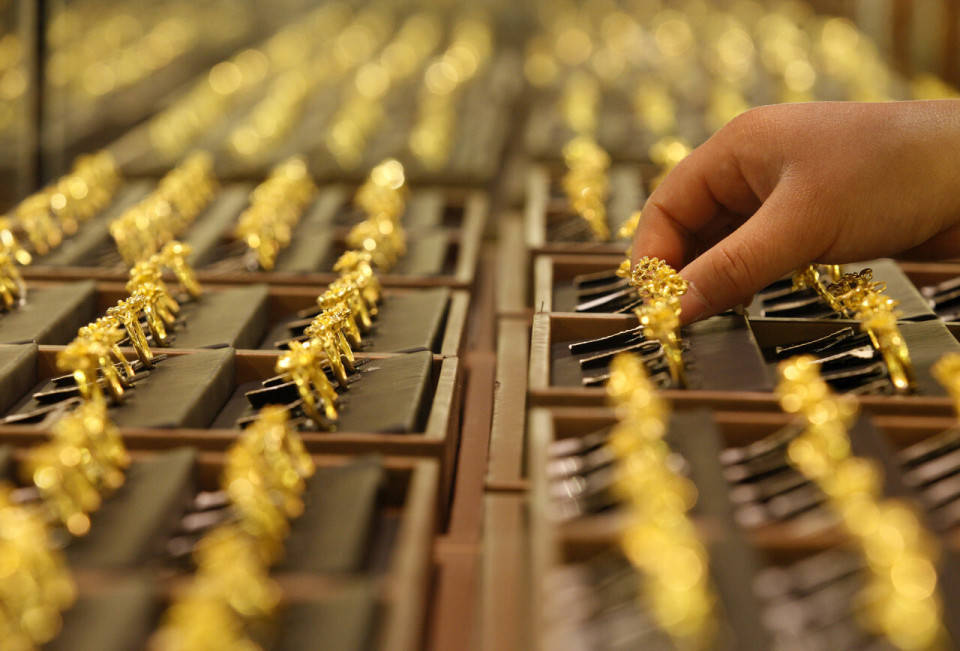
“想买的不敢买,想卖的不敢卖”!直击税改冲击下的水贝黄金市场:买卖价差拉大至151元
Hua Xia Shi Bao· 2025-11-12 10:32
Core Viewpoint - The new tax policy on gold transactions has significantly impacted the market, leading to decreased trading activity and increased price volatility as both buyers and sellers adopt a wait-and-see approach [1][4][6]. Summary by Sections Market Reaction - Following the implementation of the new tax policy on November 1, the trading volume in the Shenzhen Shui Bei gold market has noticeably decreased compared to September, with fewer customers visiting the stalls [1][4]. - The current gold price is reported at 1084 yuan per gram, which includes approximately 70 yuan per gram in taxes, resulting in a widened buy-sell price gap of 151 yuan per gram, compared to only 22 yuan three months prior [4][6]. Tax Policy Changes - The new tax policy differentiates between "investment" and "non-investment" gold, increasing the tax burden on non-investment transactions, which is expected to stabilize the market in the long run by addressing previous issues like false invoicing [1][6]. - The input tax for non-investment gold has decreased from 13% to 6%, leading to an effective tax burden increase of about 7 percentage points for small and medium-sized businesses in the Shui Bei market [6]. Industry Adaptation - In response to the new regulations, some merchants are promoting a "material exchange" settlement method, where customers provide old gold for processing, thus avoiding tax implications [7][9]. - The market is witnessing a shift towards "old-for-new" transactions, as consumers consider trading in old gold to offset the high prices of new jewelry, which may lead to a more vibrant secondary market [9]. Long-term Implications - The new tax structure is expected to enhance market transparency and encourage transactions through compliant channels like the Shanghai Gold Exchange, while reducing the scale of off-market transactions [6]. - The high gold prices combined with increased tax costs are altering consumer purchasing behavior, with many opting for investment-grade gold products or delaying purchases altogether [9].

不只是涨价!黄金税改的逻辑,国家在为你规划一条安全的投资赛道
Sou Hu Cai Jing· 2025-11-07 10:59
Core Viewpoint - The recent tax policy changes regarding gold are part of a broader strategy by the Chinese government to enhance its global financial influence and establish a more regulated gold market [3][24]. Group 1: Tax Policy Changes - The new tax policy separates the "investment" and "consumption" attributes of gold, applying different VAT rules to each [3][10]. - Only standard gold transactions through the Shanghai Gold Exchange and Shanghai Futures Exchange will enjoy VAT exemptions, encouraging institutional and bulk traders to engage in compliant trading [5][6]. - Consumption gold, such as jewelry and industrial gold, will incur VAT during transactions, while businesses can deduct input tax when processing and selling these gold products [9][10]. Group 2: Market Implications - The policy aims to increase the liquidity and scale of on-exchange trading, thereby establishing the authority of "Shanghai Gold" [7][12]. - The shift towards compliant trading channels indicates a future where non-compliant trading options will diminish, leading to a more regulated gold market [12][26]. - The tax reform is closely linked to China's goal of becoming a financial powerhouse as outlined in the "14th Five-Year Plan" [12][24]. Group 3: Internationalization of the Renminbi - The changes are a significant step in the strategy to internationalize the Renminbi, as China seeks to establish its own gold pricing mechanism rather than relying on Western markets [14][18]. - The recognition of "Shanghai Gold" in global markets will enhance the credibility and attractiveness of the Renminbi, reducing dependence on the US dollar [18][20]. - This process is gradual but essential for China's long-term financial strategy, aiming to challenge the existing global monetary system [20][24]. Group 4: Investor Guidance - Investors are advised to utilize compliant channels such as bank paper gold, products from the Shanghai Gold Exchange, and compliant gold ETFs, avoiding non-regulated options that carry higher risks [22][24]. - Understanding the different value logic between investment gold and consumption gold is crucial for investors to avoid losses [22][24]. - The new tax policy represents a significant transformation from broad regulation to precise governance, reflecting the ambition to secure global gold pricing authority and strengthen the foundation for Renminbi internationalization [24][27].
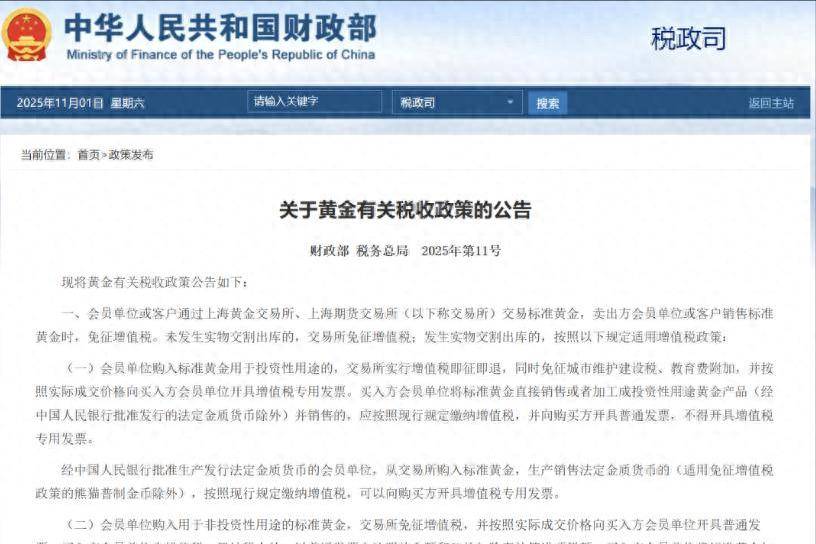
黄金征税48小时,商家火速下架金条,不想消费者买实体黄金?
Sou Hu Cai Jing· 2025-11-04 08:10
Core Viewpoint - The new tax policy on gold purchases aims to regulate the market by encouraging transactions through formal channels, rather than restricting gold buying altogether [3][8][23] Summary by Sections Tax Policy Impact - The announcement of the tax policy on November 1, 2025, led to immediate reactions from banks and merchants, with major banks like ICBC and CCB suspending gold accumulation services [1][9] - The policy specifies that purchasing "standard gold" through the Shanghai Gold Exchange or Shanghai Futures Exchange is exempt from a 13% value-added tax, while purchases through other channels incur the full tax [3][5] Market Reactions - Merchants and banks reacted swiftly to the new policy, with many choosing to suspend sales and remove gold products from shelves due to uncertainties regarding existing inventory and tax implications [9][11] - The price of standard gold bars purchased through banks remained stable initially, but the rush to buy led to rapid sellouts, highlighting market volatility [11][13] Consumer Guidance - The policy primarily affects investment-grade gold bars and ingots, while the prices of gold jewelry, which already include taxes, are not significantly impacted [15][17] - Consumers are advised to wait for market stabilization and clearer policy details before making investment decisions in gold, as current fluctuations may lead to overpaying [17][19] Future Market Outlook - The new tax policy is expected to lead to a restructuring of the gold market, favoring compliant businesses and potentially phasing out non-compliant sellers by the end of 2027 [21][23] - The overall goal of the policy is to create a more regulated and transparent gold market, which will ultimately benefit consumers and investors in the long run [21][25]

黄金税收新规来了!金饰会涨价吗、手里的黄金变现要缴税吗?
Huan Qiu Wang· 2025-11-04 07:17
Core Viewpoint - The new tax regulations on gold transactions, effective from November, focus on investment gold trading and are expected to influence the retail gold market and trading behaviors [1][2]. Group 1: Tax Regulations Impact - The new regulations include 13 tax rules specifically targeting investment gold transactions, which may affect off-exchange trading and short-term arbitrage [1]. - The tax changes do not directly impact consumers purchasing gold jewelry, as these items remain classified as consumer goods [1][2]. - However, there may be indirect effects on gold jewelry prices due to potential increases in production costs if investment gold demand shifts towards exchange-traded products [1][2]. Group 2: Individual Tax Responsibilities - Individuals holding gold do not need to worry about taxes when liquidating their assets, as the new rules apply only to businesses [1][2]. - Some gold buyers may attempt to pass on tax burdens by lowering purchase prices; individuals are advised to wait before selling in such cases [1][2]. Group 3: Investment Options - For those looking to invest, "paper gold" and gold ETFs remain unaffected by the new regulations, making them a more convenient option [2]. - When considering physical gold investments, it is recommended to purchase standard gold bars from reputable exchanges to ensure better liquidity and compliance with tax regulations [2]. - Non-standard gold bars from smaller shops may face lower buyback prices due to the new tax burdens on sellers, potentially reducing their liquidity [2]. Group 4: Market Development - The core aim of the new tax regulations is to guide funds towards regulated trading channels, promoting high-quality development in the gold market [2]. - Consumers are encouraged to monitor raw material price trends when purchasing gold jewelry and to prioritize products from exchange member units for optimal asset allocation and consumption needs [2].

黄金税收新规来了!金饰会涨价吗?黄金变现要缴税吗?一文看懂
Bei Jing Ri Bao Ke Hu Duan· 2025-11-04 06:23
Core Viewpoint - The new tax regulations on gold transactions, effective from November, aim to guide funds towards regulated trading channels and promote high-quality development of the gold market [1][3]. Group 1: Tax Policy Impact - The new regulations consist of 13 tax rules focused on investment gold transactions, affecting off-exchange trading and short-term speculation [1]. - The retail gold market has recently experienced fluctuations due to these policy changes [1]. Group 2: Consumer Behavior and Market Dynamics - The new tax policy does not directly impact the purchase of gold jewelry, as it primarily targets investment gold transactions; however, there may be indirect effects on production costs if demand shifts towards exchange-traded gold [2]. - Individuals do not need to worry about taxes when liquidating personal gold, as the new rules apply only to businesses [2]. - For investment purposes, "paper gold" and gold ETFs remain unaffected by the new regulations, making them a more convenient option compared to physical gold [2][3]. Group 3: Recommendations for Gold Purchases - Consumers are advised to purchase standard gold bars from regulated trading entities to ensure better liquidity and compliance with the new tax rules [2][3]. - While purchasing from small gold shops is acceptable for personal use or collection, those looking to invest for appreciation should prefer standard gold bars from reputable sources [2].
点评报告:国家黄金税收政策变化解读
Guang Fa Qi Huo· 2025-11-03 14:31
Report Summary 1. Report Industry Investment Rating No information provided. 2. Core Viewpoints of the Report - The new gold tax policy aims to address tax regulatory pressures in the current "gold - buying boom" by implementing refined tax management and distinguishing between "investment" and "non - investment" uses of gold, plugging "tax arbitrage" loopholes [4]. - The policy may lead to increased costs for non - exchange physical gold transactions, potentially causing investment demand to shift to virtual trading markets and affecting the scale of the spot market [4]. - Due to the lack of implementation details, market participants are in a wait - and - see state, and short - term trading volume may be affected [4]. - In the long run, global macro - economic, fiscal and monetary policies, and geopolitical events are the core factors affecting gold prices, but the new policy may dampen market enthusiasm in the short term [5]. - The new policy can enhance the international competitiveness of China's gold market and contribute to the internationalization of the RMB [5]. 3. Summary by Related Content Policy Core - For gold transactions on the Shanghai Gold Exchange and Shanghai Futures Exchange, when the seller sells standard gold, VAT is exempted. For physical delivery, different VAT policies apply based on the use of the gold [1]. - For investment - use standard gold purchased by member units, the exchange implements VAT immediate refund, exempts urban maintenance and construction tax and education surcharges, and issues VAT special invoices. The buying member unit pays VAT when reselling and can only issue ordinary invoices [1]. - For non - investment - use standard gold purchased by member units, the exchange exempts VAT and issues ordinary invoices. General VAT - paying member units can calculate input tax at a 6% deduction rate and can issue VAT special invoices when reselling [2]. - For standard gold purchased by customers, the exchange exempts VAT and issues ordinary invoices. General VAT - paying customers can calculate input tax at a 6% deduction rate and can issue VAT special invoices when reselling [2]. Specific Policy Changes - Investment gold is not tax - exempt when sold to individual investors, and downstream cannot obtain special invoices for deduction. Non - investment gold can have 6% of its VAT deducted in the processing link and is sold at a VAT - included price in the retail link [3]. - Member units or customers need to clearly indicate the type of gold use on invoices. If the use of gold changes, member units should report to the exchange within 6 months and can only apply for a change once [3]. Impact on the Market - The policy helps plug tax loopholes, forcing enterprises to choose between "investment gold" and "consumer goods" tracks and refine their financial and tax management [4]. - Non - exchange physical gold transactions may face cost increases, leading to a potential shift of investment demand to virtual trading markets. Non - investment gold products still face at least 7% VAT cost [4]. - Due to the lack of implementation details, short - term trading volume may be affected as market participants are in a wait - and - see state [4]. - The new policy may dampen short - term market enthusiasm during a gold bull market, but in the long run, macro - factors are the core determinants of gold prices [5]. - The policy can enhance the international competitiveness of China's gold market and contribute to RMB internationalization [5].
金价震荡叠加税负调整,投机资金短期抛压或加剧
Di Yi Cai Jing· 2025-11-02 12:08
Core Viewpoint - The adjustment of gold trading tax policies in China aims to refine and standardize the tax system, impacting the cost structure for different market participants and potentially benefiting long-term investors while reducing speculative trading opportunities [1][5][7]. Tax Policy Changes - The new tax regulations, effective until December 31, 2027, differentiate between "investment gold" and "non-investment gold," with specific tax treatments for each category [2][4]. - Transactions involving standard gold through designated exchanges will be exempt from VAT upon sale, while non-investment gold will have different tax implications based on its usage [2][3]. Impact on Market Participants - The refined tax rules are expected to increase compliance costs for gold retailers and manufacturers, as they will need to adapt to the new VAT treatment and reporting requirements [6][7]. - The changes may lead to a consolidation in the gold market, favoring larger, compliant firms over smaller traders who previously exploited tax loopholes [5][6]. Investor Behavior and Market Dynamics - The increase in tax costs could lead to a tightening of market liquidity, as speculative investors may choose to liquidate positions if gold price increases do not offset the tax burden [7][8]. - Long-term investors may benefit from the new regulations, as they encourage a shift towards more stable investment vehicles like gold ETFs, reducing reliance on high-premium non-investment products [7][8].
16家商家卷走260公斤黄金跑路?记者实探深圳水贝
Zheng Quan Shi Bao· 2025-09-17 12:30
Core Viewpoint - The news highlights a significant incident in the gold industry where 16 gold material merchants in Shui Bei reportedly went missing, allegedly taking away 260 kilograms of gold raw materials, impacting over a hundred downstream wholesale merchants [2]. Group 1: Incident Overview - The incident involves 16 gold material merchants who are said to have disappeared, leading to substantial financial losses for downstream merchants who had prepaid funds [2]. - One of the affected companies, Yue Baoxin Precious Metals Co., was found closed with its items cleared out, and customers have been seeking redress at local police stations [2]. - Reports indicate that a gold shop in Henan lost approximately 900,000 yuan worth of gold raw materials due to its dealings with Yue Baoxin [2]. Group 2: Business Model and Risks - Gold material merchants primarily engage in trading and supplying gold raw materials, with their clients being gold retailers, jewelry factories, and gold processing shops [3]. - The business model typically involves clients placing orders and paying upfront, allowing merchants to profit from the price difference between buying and selling gold [3]. - The incident is attributed to a risky pricing model where merchants could control large amounts of gold with minimal upfront capital, leading to potential financial instability if gold prices fluctuate unfavorably [4]. Group 3: Market Context and Regulatory Concerns - The recent surge in international gold prices has exacerbated the situation, with local gold prices surpassing 830 yuan per gram [4]. - Previous incidents in the industry, such as a case involving "Qianbaiwan Jewelry," highlight ongoing issues with speculative practices and the need for regulatory oversight in the gold market [4].
当黄金成为谷子:情绪消费推高溢价 机构提示隐忧
Zhong Guo Zheng Quan Bao· 2025-09-06 01:34
Core Viewpoint - The rise of "pain gold," a combination of anime, gaming IPs, and gold jewelry, is becoming popular among young consumers, seen as a more valuable alternative to traditional merchandise [1][2][5]. Group 1: Market Trends - "Pain gold" has gained traction on social media and is viewed as a new growth point for jewelers, reflecting a shift in consumer spending towards personal enjoyment and emotional value [1][5]. - The average price of "pain gold" ranges from 1800 to 2000 yuan per gram, significantly higher than the typical gold jewelry price of around 1000 yuan per gram, indicating a substantial premium for these products [5][6]. Group 2: Consumer Behavior - Young consumers are increasingly willing to pay for emotional and nostalgic value, often associating their purchases with personal interests and childhood memories [3][4]. - The trend is supported by a growing number of discussions on social media, with over 20,000 posts and nearly 3 million views related to "pain gold," primarily from consumers born in the 1990s and 2000s [3][5]. Group 3: Industry Insights - The jewelry industry is adapting to the changing preferences of younger consumers, who prioritize design, emotional connection, and social attributes in their purchases [4][9]. - The integration of IP with gold jewelry is seen as an innovative direction for the traditional jewelry market, although concerns about the sustainability of this trend exist due to the varying lifespans of popular IPs [6][9]. Group 4: Pricing and Investment Perspective - Analysts caution that the high premiums associated with "pain gold" may not be justified from an investment standpoint, suggesting that traditional gold bars or coins are more rational choices for value retention [1][6]. - The liquidity of "pain gold" is also questioned, as its resale value may only reflect the gold price rather than any additional IP value, making it less attractive for investment purposes [5][6].