60法则

Search documents
2026年全球医疗健康行业私募股权报告(英文版)
Sou Hu Cai Jing· 2026-01-25 02:40
Core Insights - The global healthcare private equity market is experiencing a significant recovery and record growth, with total deal value expected to exceed $191 billion in 2025, marking a historical high [11][12][16] - The market shows clear regional differentiation, with Europe leading in biopharma and healthcare services, North America maintaining stability despite policy impacts, and Asia-Pacific demonstrating broad growth resilience [11][25][27] Market Performance - In 2025, healthcare private equity saw a record performance with disclosed deal value surpassing $191 billion and 445 buyouts, making it the second-highest annual total on record [11][12] - The exit value surged from $54 billion in 2024 to an expected $156 billion in 2025, driven by an increase in large deals [15][16] Regional Analysis - Europe experienced a doubling of deal value to approximately $59 billion, primarily driven by biopharma and healthcare provider deals [25] - North America faced a temporary pullback in the second quarter but still achieved a healthy year with an expected exit activity of $90 billion, significantly higher than 2024 [26] - Asia-Pacific set a record for deal value, exceeding 2021's high by over 30%, with notable growth in biopharma, medtech, and healthcare IT [27][28] Sector Trends - Biopharma remains a cornerstone of investment, with deal value rising from $55 billion in 2024 to an estimated $80 billion in 2025, accounting for about 30% of overall deal volume [33] - Provider and related services deal value increased by 57% to an estimated $62 billion, driven by technology-enabled assets and healthcare IT [38] - Medtech is emerging as a new growth engine, with investors focusing on revenue growth and margin expansion [39] Investment Strategies - The investment logic in healthcare IT is shifting towards revenue and profit expansion through refined pricing and generative AI applications, with the "60 rule" becoming a new performance benchmark [3] - Investors are adopting a "barbell strategy" in pharma services, focusing on high-quality assets with scale advantages and potential operational improvements [3]


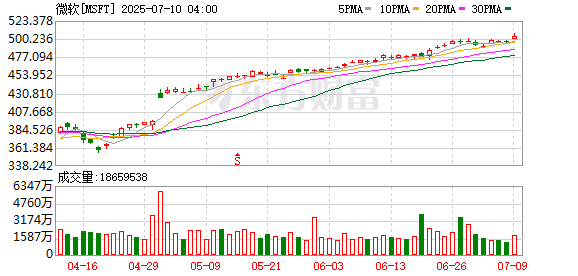
被低估的AI巨头?微软获上调评级 目标价上看600美元
Jin Shi Shu Ju· 2025-07-10 08:42
Core Viewpoint - Oppenheimer analysts upgraded Microsoft's stock rating to "Outperform" due to the ongoing expansion of its cloud business and increasing market enthusiasm for its AI revenue [2] Group 1: Microsoft Cloud and AI Business - Microsoft's Azure cloud platform continues to show strong growth momentum, supporting current valuations and providing greater upside potential [2] - Analysts believe Microsoft's AI business is experiencing "sustained and strong growth," which is not yet fully reflected in the current stock price [2] - The Azure cloud computing business is expected to see a re-acceleration of growth in fiscal year 2026, which is also not fully priced in by the market [2] Group 2: Financial Metrics and Valuation - Microsoft is one of the few companies in the software industry that can achieve the "Rule of 60," where the sum of revenue growth rate and EBITDA margin reaches 60 [2] - This business characteristic supports a valuation premium for Microsoft [2] - Oppenheimer set a target price of $600 for Microsoft, approximately 20% higher than the closing price on Tuesday [2] Group 3: Risks and Market Perception - Analysts warned that key risks in AI may arise from the Copilot product line, which currently has disappointing value propositions and use cases [3] - If enterprise software customers perceive that the AI technology they invested in has not truly materialized, the overall adoption speed of AI may slow down [3] - There may be a cautious outlook on fiscal year 2026 performance guidance due to current macroeconomic uncertainties [3] Group 4: Long-term Investment Perspective - Oppenheimer views Microsoft as a "strong and strategically advantaged software vendor in AI," with potential for accelerated growth in its commercial products and Azure platform as autonomous AI agents become more prevalent [3]