Azure云平台

Search documents
纳德拉交棒背后:AI正在重新定义CEO的生死线
财富FORTUNE· 2026-03-25 13:08
Core Insights - Microsoft CEO Satya Nadella announced he will no longer oversee the company's commercial business to focus more on technology development, particularly in artificial intelligence (AI) [1] - Nadella's leadership has seen Microsoft's stock price increase by 11 times, helping the company reach a market valuation of over $3 trillion [2] - The average tenure of CEOs globally has decreased to 7.2 years, with AI becoming a critical factor in evaluating their performance [3] Group 1: Leadership Changes and AI Impact - Nadella's decision reflects a broader trend where CEOs must master AI technology to maintain their influence and competitiveness [2][3] - The rise of AI is expected to lead to a younger demographic of CEOs, as boards seek leaders proficient in AI [3] - Companies are increasingly prioritizing CEOs who can adapt to rapid changes brought by AI, with a focus on their ability to respond to industry transformations [4] Group 2: Industry Adaptation and CEO Responsibilities - Major tech companies are integrating AI into their core strategies, with Google and Apple facing different challenges in this regard [6][7] - CEOs are expected to possess a forward-thinking mindset and the ability to foresee industry and customer needs in the context of AI [9] - The rapid evolution of AI technologies necessitates that CEOs regularly reassess and potentially overhaul their business models [11] Group 3: Broader Implications for Various Industries - AI is reshaping operations across multiple sectors, including retail and aviation, where companies are leveraging AI for customer insights and operational efficiency [7][8] - Traditional industries in China must also adopt AI-oriented thinking to restructure their supply chains and business models [12] - The demand for CEOs with a "growth mindset" and adaptability is becoming a standard across industries, not just in tech [10]





早报 | 美联储宣布不降息;伊朗最高领袖誓言“血债将很快得到清算”;美团回应“北大毕业送外卖”;科大讯飞辟谣向政府备案裁员30%
虎嗅APP· 2026-03-19 00:21
Economic Outlook - Federal Reserve Chairman Jerome Powell stated that the U.S. economic outlook is "extremely uncertain," with rising inflation and various geopolitical factors disrupting the inflation decline [2] - The Federal Reserve decided to maintain the federal funds rate target range at 3.5% to 3.75%, marking the second consecutive meeting without a rate change, reflecting caution regarding potential inflation risks [2] - Powell projected the U.S. PCE inflation rate for February at 2.8% and core PCE at 3.0%, acknowledging that recent inflation expectations have risen due to increasing energy prices [2] Geopolitical Developments - Iranian Supreme Leader Ali Khamenei condemned the assassination of security official Larijani, vowing that "blood debts will soon be settled" [3] - Iran launched a large-scale missile attack on U.S.-related oil and energy facilities in retaliation for attacks on its energy infrastructure, indicating a new phase of conflict [5] Market Reactions - U.S. stock indices fell over 1%, with the Dow Jones down 1.63% and the S&P 500 down 1.36%, both reaching new lows since November [10] - International oil prices rose significantly, with U.S. crude oil up 3.68% to $99.05 per barrel and Brent crude up 6.8% to $106.15 per barrel [12] Corporate Developments - Microsoft is considering legal action against Amazon and OpenAI over a $50 billion cloud deal that may violate its exclusive partnership with OpenAI [6] - Tencent reported a 13% year-on-year revenue growth in Q4, reaching 194.37 billion yuan, with an annual revenue of 751.77 billion yuan and operating profit exceeding 280.66 billion yuan [14] - Alibaba Cloud and Baidu Smart Cloud announced price increases due to surging global AI demand and rising costs of core hardware [13]




继谷歌之后微软(MSFT.US)也遭“敲门“:日本反垄断风暴升级,科技巨头云业务面临合规考验
智通财经网· 2026-02-25 11:48
Core Viewpoint - The Japan Fair Trade Commission (JFTC) has initiated an on-site inspection of Microsoft's Japan headquarters to investigate potential anti-competitive practices related to its Azure cloud platform, leveraging its dominance in operating systems and office software [1][2]. Group 1: Regulatory Actions - The JFTC is concerned that Microsoft may be using its software licensing advantages to force users to adopt Azure services, which could harm competition in the cloud market and increase long-term costs for digital transformation [2]. - This action reflects a global trend of regulatory scrutiny against large tech companies, particularly regarding "vendor lock-in" practices [1][2]. - The JFTC's intervention aligns with similar actions taken by regulatory bodies in the EU and the US, indicating a growing consensus among major economies on ensuring fair access to cloud infrastructure [2]. Group 2: Market Dynamics - Microsoft is in fierce competition with Amazon's AWS and Alphabet's Google Cloud for customers in the cloud services and AI sectors, with Japan being a critical market due to its large corporate and banking sectors [1]. - The cloud services market is expected to accelerate its expansion, driven by the rapid development of generative AI, which relies heavily on high-performance server clusters [2]. - IDC predicts that Japan's cloud computing market will reach 19 trillion yen (approximately $121 billion) by 2029, nearly doubling from the total in 2024 [2].
就在明晨,英伟达大考来临;日本反垄断机构“突袭”微软办公室;三大期指齐涨;美伊谈判即将召开,油价反弹【美股盘前】
Mei Ri Jing Ji Xin Wen· 2026-02-25 11:28
Group 1 - Major stock index futures are showing slight gains, with Dow futures up 0.11%, S&P 500 futures up 0.14%, and Nasdaq futures up 0.20% [1] - Nvidia's stock is up 0.34% in pre-market trading ahead of its Q4 earnings report scheduled for February 25, with analysts expecting strong growth following a previous revenue of $57.01 billion, a 62.5% year-over-year increase [1] - Cryptocurrency-related stocks are experiencing a pre-market rally, with BMNR up nearly 3%, SoFi Technologies, Strategy, and Circle up over 2%, and Coinbase and MARA Holdings up over 1% [1] Group 2 - HP's stock is down over 5% in pre-market trading after the company projected a double-digit decline in PC shipments for 2026, leading Morgan Stanley to lower its target price from $21 to $19 [1] - TSMC's stock is up over 1% following reports that Apple plans to purchase over 100 million advanced chips produced by TSMC in 2026 [2] - Microsoft is under investigation by Japan's antitrust agency for potentially obstructing Azure customers from using other cloud services, following a raid on its Japanese office [2] Group 3 - Reports indicate that Apple is preparing to launch a touchscreen MacBook Pro, with the first models expected to be released by the end of the year, although they will not be featured in the upcoming product announcement [2] - SanDisk's stock is slightly down in pre-market trading after a well-known short-selling firm, Citron Research, announced it is shorting the company, citing a "supply illusion" in the current storage chip market [2] - International oil prices are rebounding ahead of upcoming indirect talks between the U.S. and Iran, with Brent crude prices rising above $71 per barrel and WTI crude prices exceeding $66 per barrel [3]
【美股盘前】英伟达Q4财报明早公布;日本反垄断机构“突袭”微软办公室;苹果触屏版MacBook Pro被曝或将面世;惠普跌超5%;加密货币概念股普涨
Mei Ri Jing Ji Xin Wen· 2026-02-25 09:56
Group 1 - US stock index futures are showing slight gains, with Dow futures up 0.11%, S&P 500 futures up 0.14%, and Nasdaq futures up 0.20% [1] - Nvidia is set to release its Q4 earnings report on February 25, with a pre-market increase of 0.34%. The company previously reported Q3 revenue of $57.01 billion, a 62.5% year-over-year increase, and expects Q4 revenue of $65 billion, with a GAAP gross margin of 74.8% [1] - Cryptocurrency-related stocks are experiencing a pre-market rally, with BMNR up nearly 3%, SoFi Technologies, Strategy, and Circle up over 2%, and Coinbase and MARA Holdings up over 1% [1] - HP shares are down over 5% in pre-market trading after the company projected a double-digit decline in PC shipments for 2026. JPMorgan has lowered HP's target price from $21 to $19 [1] - TSMC shares are up over 1% in pre-market trading, with reports indicating that Apple will purchase over 100 million advanced chips produced by TSMC in 2026 [1] Group 2 - Japan's antitrust agency has conducted a raid on Microsoft's Japan office to investigate whether the company has unfairly hindered Azure cloud platform customers from using other cloud services. The Japan Fair Trade Commission is looking into potential violations of antitrust laws [2] - Apple is rumored to be preparing to launch a touchscreen MacBook Pro, incorporating the iPhone's "Dynamic Island" feature into the Mac interface. However, this model is not expected to be unveiled in the upcoming March product launch [2] - SanDisk shares are experiencing a slight decline in pre-market trading after a well-known short-selling firm, Citron Research, announced it is shorting the stock, claiming the current boom in the storage chip market is a "supply illusion" [2] Group 3 - International oil prices are rebounding ahead of upcoming indirect talks between the US and Iran, with Brent crude prices rising above $71 per barrel and WTI crude prices exceeding $66 per barrel [3]
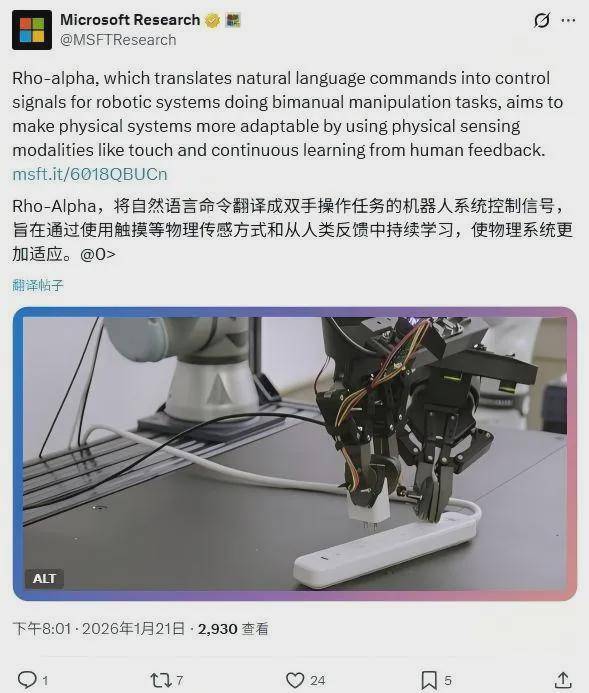
微软Rho-alpha模型能否把机器人真正带入物理智能的世界?
Sou Hu Cai Jing· 2026-01-29 16:14
Core Insights - Microsoft has launched its first robot-specific Rho-alpha model, which innovatively incorporates a tactile perception module alongside visual and language capabilities, marking a significant advancement in physical intelligence for robots [1][4][6] Group 1: Model Capabilities - Rho-alpha is designed to convert natural language instructions into control signals for robots, enabling them to perform complex tasks that require coordinated hand movements [4][6] - The model aims to break the limitations of robots operating only in highly controlled environments, allowing them to work in real-world scenarios filled with uncertainty [6][10] - Rho-alpha integrates tactile feedback into its decision-making process, allowing robots to adjust their actions based on physical contact, which is a significant departure from traditional models that primarily rely on visual information [7][8] Group 2: Training and Learning - The model employs a novel training approach that combines real robot demonstration data, simulation task data, and large-scale visual question-answering data, addressing the long-standing data scarcity issue in robotics [9] - Rho-alpha features strong continuous learning capabilities, enabling it to optimize its performance based on human feedback during actual operations [9] Group 3: Industry Implications - The introduction of Rho-alpha signifies a fundamental shift in the focus of humanoid robotics from hardware and control algorithms to foundational models as the new competitive core [10][12] - The industry is witnessing a competitive landscape where major players like Tesla, Google, and Microsoft are pursuing different technological routes, with Microsoft emphasizing a "foundation model + cloud + ecosystem" strategy [12] - As the robotics sector evolves, the ability to define the next generation of foundational models will be crucial for companies to secure their future in the market [12]

Wedbush唱多科技股:Q4财报季将发出“肯定信号”,2026年成AI革命转折之年
Zhi Tong Cai Jing· 2026-01-16 13:37
Group 1 - The core viewpoint is that the upcoming earnings season for technology companies will serve as a bullish signal for artificial intelligence, led by major tech firms [1] - Analysts believe that 2026 will be a pivotal year for the AI revolution, with significant investments required from both enterprises and consumers, amounting to trillions of dollars [1][2] - The demand for AI from cloud computing giants like Microsoft, Alphabet, and Amazon is reported to be very strong in the current quarter [1] Group 2 - The analyst team emphasizes that the ongoing fourth industrial revolution is still in its early stages, led by companies such as Nvidia, Microsoft, and others [2] - There is an expectation that the upcoming earnings season will further influence investors, with over $550 billion in capital expenditures being gradually implemented [2] - The application scenarios for AI are believed to be expanding rapidly, with the enterprise consumption phase anticipated to begin by 2026 [2] Group 3 - Analysts estimate that for every dollar invested by Nvidia, there is an $8 to $10 multiplier effect across the tech ecosystem [3] - Microsoft is seen as accelerating its AI strategy, with its Azure cloud platform expected to be a key player in this initiative [3]
微软CEO纳德拉呼吁别纠结AI“劣质品”, 结果“Microslop”在社交平台火了
Sou Hu Cai Jing· 2026-01-04 04:31
Core Viewpoint - Microsoft CEO Satya Nadella emphasizes the need for society to move beyond the debate over "AI slop" and focus on developing a new equilibrium that recognizes the potential of artificial intelligence as a cognitive amplifier [1][5]. Group 1: Microsoft's AI Strategy - Microsoft is heavily invested in artificial intelligence, with its Azure cloud platform serving as a critical foundation for OpenAI's ChatGPT [1]. - The company has integrated the ChatGPT-powered Copilot assistant into nearly all its products, leading to significant backlash on social media [1][3]. - Nadella's recent comments have reignited discussions about the public's readiness to accept AI technology, highlighting a disconnect between tech companies' visions and consumer needs [3][9]. Group 2: Public Reaction and Criticism - The term "Microslop" has gained traction on social media platforms as users criticize Microsoft's AI development strategy [3][8]. - There is a growing sentiment that current AI applications are often associated with misinformation and misuse, undermining public trust [3][13]. - Nadella's call to stop labeling AI as "slop" has backfired, leading to increased visibility of the term and further criticism of Microsoft [11].

Linux之父:Vibe编程是入门编程的绝佳方式
量子位· 2025-12-10 10:54
Core Viewpoint - The discussion highlights the evolving role of AI in programming, emphasizing that while AI-assisted coding can be beneficial for beginners, it poses challenges for long-term code management and maintenance [3][4]. Group 1: AI and Programming - Linus Torvalds views AI-assisted Vibe programming as an excellent entry point for beginners in coding [3]. - However, he warns that using AI-generated code in real-world applications can lead to difficulties in long-term management and repair [4]. - Torvalds asserts that programmers will not be replaced, as there is a continued need for individuals who understand code maintenance [5]. Group 2: Hardware Preferences - During a conversation about hardware, Torvalds expressed a preference for systems with ECC (Error-Correcting Code) memory, criticizing machines without it [11][19]. - He shared a personal experience where a non-ECC memory issue led to significant troubleshooting time, reinforcing his principle of avoiding machines lacking end-to-end ECC protection [19][21]. Group 3: Productivity Metrics - Torvalds criticized the practice of measuring programmer productivity by the number of lines of code written, suggesting that such metrics are not suitable for tech companies [26][28]. - He emphasized that his current role involves more reading and decision-making regarding code merges rather than writing code [22][23]. Group 4: Relationship with Microsoft - The historical tension between Linus and Microsoft has evolved, with both parties now on amicable terms, largely due to the integration of Linux in Microsoft's cloud services [34][38]. - The shift in Microsoft's approach to open source, especially under CEO Satya Nadella, has led to a collaborative relationship, with Microsoft contributing significantly to the Linux kernel [34][36].

芯片,突传重磅!
证券时报· 2025-11-19 23:44
Group 1: AI Investment and Valuation - Microsoft and NVIDIA plan to invest up to $15 billion in AI startup Anthropic, raising its valuation to $350 billion from $183 billion in September [2][3] - Anthropic will purchase $30 billion worth of computing power from Microsoft's Azure cloud platform, committing to a capacity of up to 1 billion watts [2][3] - This investment reflects the growing interconnection between cloud computing, chip suppliers, and leading AI developers, raising concerns about a potential valuation bubble [3] Group 2: GlobalFoundries Acquisition - GlobalFoundries announced the acquisition of Singapore-based silicon photonics chip manufacturer AMF, aiming to become the largest silicon photonics chip manufacturer globally [5][6] - The acquisition will enhance GlobalFoundries' technology portfolio and production capabilities, integrating AMF's assets and expertise to meet the growing demand in AI data centers and telecommunications [5][6] - Silicon photonics technology is expected to replace traditional optical modules, with market share projected to increase from 30% in 2025 to 60% by 2030 [6] Group 3: Arm and NVIDIA Collaboration - Arm announced the integration of its Neoverse platform with NVIDIA's NVLink Fusion technology, facilitating easier pairing of Arm-based CPUs with NVIDIA's GPUs for large-scale data center operators [7][8] - This collaboration aims to set new standards for AI infrastructure, with Arm's Neoverse platform expected to capture 50% of the global market share in top-tier data centers by 2025 [7][8] - The partnership reflects NVIDIA's strategy to open its NVLink platform for integration with various custom chips, reinforcing its central position in the AI industry [8]