
AI+城市

Search documents
2026年联合国人居署中国未来城市顾问委员会大会举行,多位院士共议“AI+城市”新范式
Xin Lang Cai Jing· 2026-01-18 03:58
Core Insights - The conference focused on the theme of "AI Empowering Urban Sustainable Development," discussing the evolution of urban intelligence, technological pathways, and governance frameworks [1][4]. Group 1: Urban Intelligence and AI - Wang Jian, an academician, emphasized that urban development under AI is distinct from traditional smart cities, advocating for viewing cities as organic entities that evolve to express their intelligence [1][4]. - Data is highlighted as a natural resource in the digital age, comparable to land and water, and is essential for the intelligent operation of cities [5]. - The past six to seven years of disruptive AI technology development have made the realization of urban intelligence possible, transitioning from concept to reality [5]. Group 2: Climate Challenges and Urban Resilience - Zheng Qinghua pointed out that China faces significant risks from extreme climate events, which challenge urban infrastructure such as drainage, power supply, and transportation [2][5]. - The Chinese government's urban development strategy emphasizes creating a human-centered, inclusive, green, low-carbon, and resilient urban system, with AI playing a leading role in various sectors [5][6]. Group 3: Knowledge Systems and Urban Evolution - Wu Zhiqiang discussed the importance of collective knowledge formation, storage, and dissemination in urban systems, which will become a crucial public platform for society [3][6]. - The evolution of cities is described as an active restructuring in response to new technologies, focusing on transforming technology into urban capabilities for long-term resilience [3][6]. - Urban planning concepts are evolving from utopian and functionalist approaches to organic and intelligent life stages, which is vital for addressing future urban challenges [3][6].
从城市轨道到立体交通:一家中国科技公司的交通全景蓝图
Xin Hua Cai Jing· 2025-12-12 09:15
Group 1 - The core business of the company is urban cluster three-dimensional transportation, aligning with national policies on new infrastructure and urban renewal [2] - The company is expanding from subways to urban, intercity, and high-speed rail, as well as ground urban transportation and highway networks, with plans to extend into low-altitude fields for comprehensive coverage [2] - The company maintains a research and development investment intensity of no less than 10% of its intelligent revenue annually to establish a first-mover advantage in various sectors [2] Group 2 - The company has introduced a lifecycle approach to construction and operation, using operational data to optimize design parameters and details, which has shown significant efficiency improvements in projects like the Guangzhou and Changsha subways [3] - The overseas market is becoming a crucial growth point for the company, focusing on Southeast Asia and the Middle East, where there are opportunities for both upgrading old lines and constructing new ones [3] - The company anticipates two major trends in the "AI + city" sector over the next 3-5 years: AI will reconstruct traditional processes and operational logic, and the model will shift from "human + machine" to "AI + human" [3]


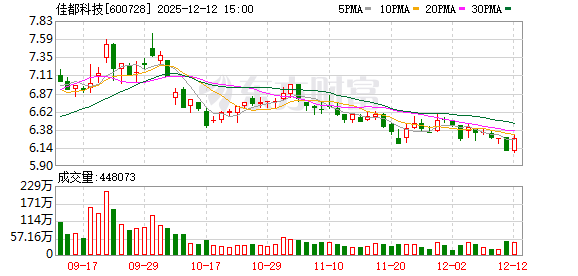
【财经面对面】从城市轨道到立体交通:一家中国科技公司的交通全景蓝图
Zhong Guo Jin Rong Xin Xi Wang· 2025-12-12 09:11
Group 1 - The core business of the company is urban group three-dimensional transportation, aligning with national policies on new infrastructure and urban renewal [1] - The company is expanding from subways to urban, intercity, and high-speed rail networks, as well as ground urban transportation and highway networks, with plans to extend into low-altitude fields [1] - The company maintains a research and development investment intensity of no less than 10% of its intelligent revenue annually to establish a first-mover advantage in multiple sectors [1] Group 2 - The company has adopted a full lifecycle approach to optimize technical parameters and design details by feeding operational data back into the construction phase, which has shown significant effectiveness in projects like the Guangzhou and Changsha subways [2] - The overseas market is becoming a crucial growth point for the company, focusing on Southeast Asia and the Middle East, where there are opportunities for both upgrading old lines and constructing new ones [2] - In the next 3-5 years, the company anticipates two major trends in the "AI + city" sector: AI will reconstruct traditional processes and operational logic, and the model will shift from "human + machine" to "AI + human" [2]
财经面对面|从城市轨道到立体交通:一家中国科技公司的交通全景蓝图
Xin Hua She· 2025-12-11 11:10
Core Insights - The article discusses the strategic initiatives of Jiadu Technology Group Co., Ltd. in the smart transportation sector, emphasizing its commitment to technological innovation and market expansion in response to policy support and industry competition. Group 1: Business Strategy - Jiadu Technology's core business segment is urban transportation, aligning with national policies on new infrastructure and urban renewal [1] - The company is expanding its services from subways to regional, urban rail, and high-speed rail networks, as well as ground urban transportation and highway networks, with plans to explore low-altitude transportation [1] Group 2: Technological Innovation - To address industry homogenization, Jiadu Technology maintains a research and development investment of no less than 10% of its revenue annually, aiming to establish a first-mover advantage across multiple sectors [1] - The company has adopted FP8 mixed-precision training technology to enhance training efficiency while reducing GPU memory usage without sacrificing accuracy [1] Group 3: Operational Efficiency - Jiadu Technology has introduced a lifecycle approach to construction and operation, using operational data to inform construction phases, thereby optimizing technical parameters and design details [2] - This model has been successfully implemented in metro projects in Guangzhou and Changsha, resulting in significant efficiency improvements [2] Group 4: Market Expansion - The overseas market is becoming a crucial growth area for Jiadu Technology, focusing on Southeast Asia and the Middle East, where there are opportunities for both upgrading old lines and constructing new ones [2] - The company faces challenges such as cultural differences and risk identification but believes it has a competitive edge in scenario accumulation and technological innovation [2] Group 5: Future Trends - In the next 3-5 years, the "AI + city" sector is expected to see two major trends: the restructuring of traditional processes and operational logic by AI, and the transition from a "human + machine" model to an "AI + human" model [2] - This shift will allow intelligent systems to handle more basic tasks, enabling humans to focus on higher-level judgment and thinking, particularly in transportation scenarios [2]
【高端访谈】锚定城市群立体交通 探寻“AI+城市”领域的未来发展方向—访佳都科技董事长、执行总裁陈娇
Xin Hua Cai Jing· 2025-11-25 07:27
Core Viewpoint - The article discusses the strategic transformation and technological innovations of Jiadu Technology, emphasizing its role in the "AI + Urban" sector and the development of the "Traffic Jiahong" operating system based on the HarmonyOS, which aims to redefine future station operations and enhance the efficiency of urban transportation systems [1][2]. Group 1: Company Strategy and Development - Jiadu Technology has consistently aligned its strategic transformations with national policies, technological trends, and its core capabilities, which has been crucial for its sustained growth [2][3]. - The company has focused on digital economy, new infrastructure, and the national strategy of building a strong transportation system, particularly following the government's recent initiatives on "AI +" [2][3]. - Jiadu Technology's self-developed "Zhixing Transportation Model" is noted as the world's first large model in the transportation sector, with plans to release the "Traffic Jiahong" operating system in 2025 [2][3]. Group 2: Technological Innovations - The company is addressing industry challenges through high R&D investment and strategic mergers and acquisitions, creating a competitive edge by integrating technology and capital [3][4]. - Jiadu Technology is developing a digital foundation for transportation, focusing on creating a domestic operating system and basic software to enhance industry capabilities [4][5]. - The introduction of the "Zhixing Transportation Model 3.0" utilizes FP8 mixed precision training technology to improve training efficiency without sacrificing accuracy [5]. Group 3: Application and Impact - Jiadu Technology's innovations have been successfully implemented in various benchmark projects, such as the Guangzhou Metro and Chengdu's smart city traffic management, achieving significant efficiency improvements [7][9]. - The company is expanding its services beyond government sectors to include digital upgrades for businesses in finance, healthcare, and retail, with over 10,000 successful delivery cases [9][10]. - Jiadu Technology plans to initiate its global expansion in 2024, targeting regions with high infrastructure demand, such as countries along the Belt and Road Initiative and RCEP [10]. Group 4: Future Outlook - The company anticipates a shift in the "AI + Urban" landscape towards a more integrated model, leveraging key technologies like urban large models and digital twins for comprehensive urban management [10]. - Jiadu Technology aims to enhance its R&D investments in frontier technologies and deepen the integration of digital technology with the real economy to create measurable customer and social value [10].

时报数说 深圳“AI+城市”应用场景密集落地激发公共服务新活力
Zheng Quan Shi Bao· 2025-08-17 23:21
Core Insights - The article highlights the rapid implementation of "AI + city" applications in Shenzhen, which is invigorating public services and enhancing urban management efficiency [1] Group 1: AI Applications in Urban Management - Shenzhen has launched multiple AI-driven projects aimed at improving public services, including smart traffic management and public safety systems [1] - The integration of AI technologies is expected to streamline operations and reduce response times in various public service sectors [1] Group 2: Economic Impact - The deployment of AI applications is anticipated to boost local economic growth by attracting investments and fostering innovation within the tech sector [1] - Enhanced public services through AI are likely to improve the quality of life for residents, making Shenzhen a more attractive place for talent and businesses [1]
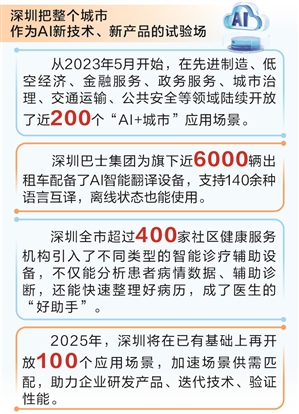
深圳:“AI+城市”应用场景密集落地激发公共服务新活力
Xin Hua She· 2025-08-17 09:42
Core Insights - Shenzhen is actively integrating AI technology into various public service sectors, enhancing efficiency and user experience [1][2][4] - The city has opened nearly 200 "AI+ urban" application scenarios across multiple industries, including transportation, healthcare, and environmental protection [2][3] - Legislative measures have been implemented to promote AI applications, encouraging government and public enterprises to adopt AI products and services [4] Group 1: Transportation - Shenzhen Bus Group has equipped nearly 6,000 taxis with AI translation devices, facilitating communication between drivers and foreign passengers [1] - The AI translation device supports over 140 languages and can operate offline, providing route planning and tourist information [1] Group 2: Healthcare - AI technology is being utilized in community healthcare services, with over 400 health service institutions adopting smart diagnostic tools [2] - The AI clinical assistant alerts doctors to potential diagnoses, improving patient care and reducing misdiagnosis risks [2] Group 3: Environmental Protection - An AI-based management platform for mangrove wetlands has been developed, capable of identifying various wildlife species and generating monitoring reports [3] Group 4: Judicial System - The AI-assisted trial system in Shenzhen courts has streamlined the judicial process, automating key tasks such as case management and document preparation [3] Group 5: Future Developments - Shenzhen plans to open an additional 100 AI application scenarios by the end of 2025, further enhancing the integration of AI in urban services [3][4]
深圳放宽市场准入24条特别措施将加快实施 实施“AI+城市”“AI+千行百业”
news flash· 2025-06-13 05:41
Core Viewpoint - Shenzhen government is accelerating the implementation of 24 special measures to relax market access, focusing on artificial intelligence, smart connected vehicles, and pharmaceuticals and medical devices [1] Group 1: Market Access Measures - Shenzhen will implement 24 special measures to relax market access, aiming to enhance innovation and openness in various sectors [1] - The city will explore a "sandbox regulatory" mechanism in fields such as artificial intelligence and smart connected vehicles [1] Group 2: AI Integration - The initiative "AI + City" and "AI + Various Industries" will be promoted to integrate artificial intelligence into urban management and multiple sectors [1] - The government aims to align drug and medical device evaluation, inspection, and clinical trial rules with international standards [1] Group 3: Charging Infrastructure - The comprehensive launch of "Supercharging City 2.0" will accelerate the application of high-power charging and swapping technologies for heavy trucks and passenger vehicles [1]