
AI技术出口管制

Search documents
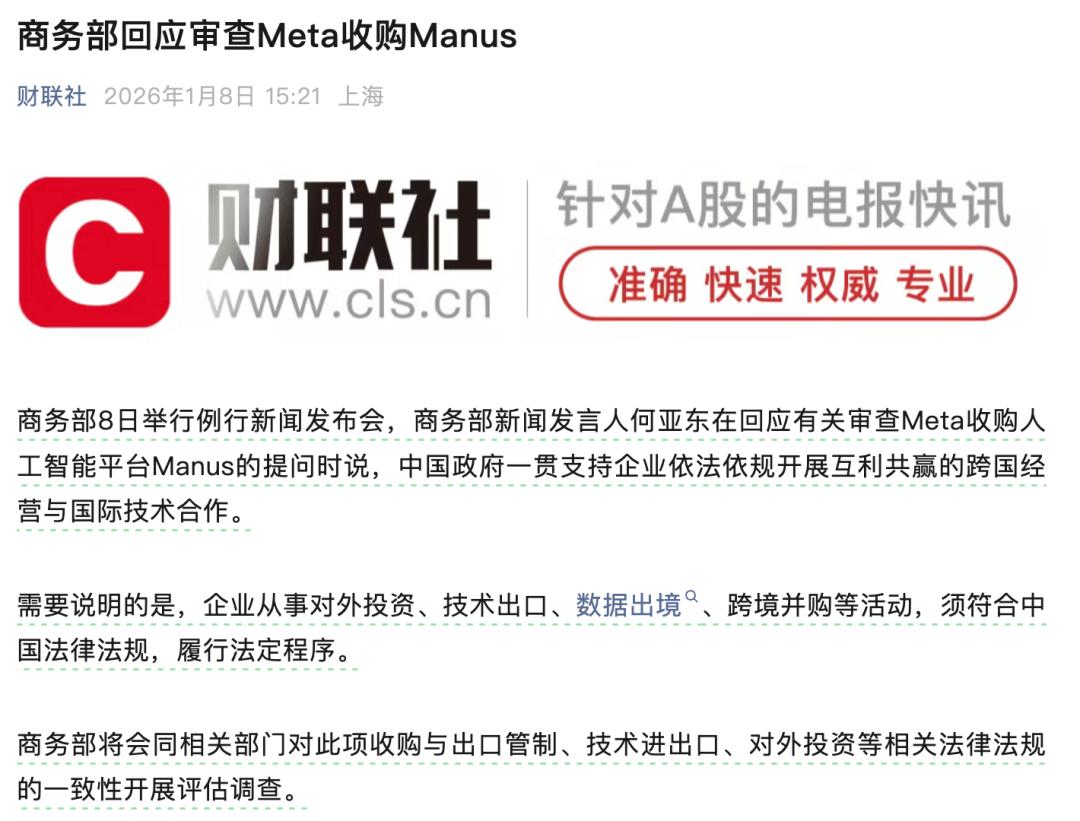
Meta收购Manus最新进展:商务部介入,启动评估调查
3 6 Ke· 2026-01-08 09:54
Core Viewpoint - The acquisition of Manus by Meta, valued at several billion dollars, is facing new uncertainties due to an evaluation investigation initiated by China's Ministry of Commerce regarding compliance with relevant laws and regulations [1][3][45]. Group 1: Regulatory Context - The Ministry of Commerce will assess the acquisition in relation to export controls, technology imports and exports, and foreign investment laws [1][4][5]. - The terminology used by the Ministry indicates an "evaluation investigation," which may imply either a routine compliance check or a more in-depth investigation [4]. - AI technology is categorized under "restricted export," meaning that transferring such technology to foreign entities requires prior approval from the Ministry [10][11]. Group 2: Compliance Requirements - Companies must apply for a technology export license if they wish to transfer AI technology to foreign companies, which includes various forms of technology transfer [11][16]. - User data collected in China must undergo a "security assessment" before being transferred abroad, which is particularly relevant for Manus as it processes significant amounts of user data [19][20]. Group 3: Potential Outcomes of the Investigation - Scenario One: If the evaluation concludes that the acquisition complies with Chinese laws, the transaction will proceed as planned, allowing Meta to acquire Manus and its team [23]. - Scenario Two: If procedural flaws are identified but deemed remediable, the transaction may be delayed while necessary compliance steps are taken [24]. - Scenario Three: If substantial violations of export controls are found, the transaction could be halted or require significant adjustments [25]. Group 4: Manus Development Timeline - Manus was founded in 2022 in Beijing, initially focusing on an AI browser plugin product [27]. - The company transitioned to developing a general-purpose AI agent product, Manus, in late 2024, which gained significant attention upon its release in March 2025 [28][30]. - By December 2025, Manus achieved an annual recurring revenue of $125 million and was valued at $2 billion while being acquired by Meta [38][41][42].


重磅!黄仁勋游说成功,美国国会将否决AI芯片出口法案
美股IPO· 2025-12-04 00:55
Core Viewpoint - Nvidia's lobbying efforts have successfully led to the exclusion of the GAIN AI Act from the annual National Defense Authorization Act (NDAA), which aimed to restrict the sale of advanced AI chips to certain overseas markets, indicating a significant victory for the company and the semiconductor industry [1][3][4] Group 1: Legislative Developments - The GAIN AI Act, which would have required chip manufacturers like Nvidia and AMD to prioritize U.S. customer demands before exporting to restricted countries, is not included in the NDAA's final text [3][12] - Nvidia's CEO Jensen Huang described the decision to exclude the GAIN AI Act from the NDAA as "wise," emphasizing the potential dangers the act posed to the U.S. [4][6] - The White House played a crucial role in this legislative battle, with key officials pressuring Congress to exclude the GAIN AI Act, reflecting a cautious approach towards tightening AI chip export policies [11] Group 2: Industry Implications - The shelving of the GAIN AI Act marks the end of a fierce lobbying battle over AI technology export controls, which is seen as a positive signal for the semiconductor industry [7] - Supporters of the GAIN AI Act included lawmakers with strong national security stances, while opponents, including Nvidia, argued that such restrictions could stifle global competition and harm U.S. market positions [8][9] - Nvidia contended that the GAIN AI Act was unnecessary, asserting that the company would not sacrifice U.S. customer supply and that restrictive trade policies would hinder innovation [10] Group 3: Market Reactions - The failure of the GAIN AI Act to make it into the NDAA is viewed as good news for Nvidia and other semiconductor companies, alleviating market concerns about new export controls disrupting global revenue streams [13]


报道:黄仁勋游说成功,美国国会将否决AI芯片出口法案
Hua Er Jie Jian Wen· 2025-12-04 00:25
Core Insights - Nvidia's lobbying efforts have successfully led to the exclusion of the GAIN AI Act from the upcoming National Defense Authorization Act (NDAA), which would have imposed restrictions on the sale of advanced AI chips to certain foreign markets [1][4] - Nvidia's CEO Jensen Huang described the decision to exclude the GAIN AI Act as "wise," emphasizing the potential dangers the act posed to the U.S. [1][2] Group 1: Legislative Developments - The GAIN AI Act aimed to require chip manufacturers like Nvidia and AMD to prioritize U.S. customer demands before exporting powerful AI chips to restricted countries [1][6] - Huang's visit to Washington, where he met with key lawmakers, was pivotal in influencing the legislative outcome [2][4] - The White House played a crucial role in the legislative process, with officials pressuring Congress to exclude the GAIN AI Act from the NDAA [4] Group 2: Industry Reactions - The GAIN AI Act's shelving marks the end of a fierce lobbying battle over AI technology export controls, with supporters advocating for national security and opponents, including Nvidia, warning against stifling global competition [3][6] - Nvidia argued that the GAIN AI Act was unnecessary, asserting that the company would not sacrifice U.S. customer supply in favor of foreign sales, and that restrictive trade policies could hinder innovation [3][6] Group 3: Implications for the Semiconductor Industry - The GAIN AI Act's exclusion from the NDAA is seen as positive news for Nvidia and other semiconductor companies, alleviating concerns over new export controls disrupting their global revenue streams [6]