AI代理

Search documents
战火错杀后的最强修复线浮现,英伟达领衔的“AI算力天团”蓄势猛攻
Zhi Tong Cai Jing· 2026-03-31 03:14
Core Viewpoint - Oppenheimer identifies Nvidia, Broadcom, Monolithic Power Systems, and Marvell Technology as top semiconductor stocks, driven by strong performance certainty and high beta attributes, alongside ongoing global AI spending expansion [1][11] Semiconductor Sector Insights - The semiconductor stocks related to AI computing infrastructure, particularly Nvidia and Broadcom, are expected to be the most sensitive and responsive to market rebound scenarios, making them key bullish targets [2][11] - The AI arms race is accelerating, with cloud service providers' demand for AI computing infrastructure far exceeding supply, a trend expected to continue until at least 2027 [5][11] Investment Trends - Major tech companies, including Amazon, Alphabet, Meta, Oracle, and Microsoft, are projected to spend approximately $650 billion on AI-related capital expenditures by 2026, with some estimates exceeding $700 billion, indicating a year-over-year increase of over 70% [4][11] - The global AI infrastructure investment wave is anticipated to reach $3 trillion to $4 trillion by 2030, driven by unprecedented demand for AI computing resources [4][11] Market Dynamics - Nvidia's AI server cabinets are expected to exceed 75,000 units this year, with conservative pricing estimates approaching $7 million per unit, reflecting strong demand and pricing power in the AI chip market [6][11] - The semiconductor sector is experiencing a supply shortage, particularly in advanced wafer manufacturing and high-end memory systems, leading to rising chip prices that may be passed on to customers [5][11] Future Projections - The AI agent market is projected to reach $53 billion by 2030, with a compound annual growth rate (CAGR) of 46% starting in 2025, indicating a significant shift towards AI applications as productivity tools [10][11] - The semiconductor industry is expected to see revenue growth exceeding 30% in 2026, surpassing the $1 trillion milestone, primarily driven by the demand for AI training and inference computing resources [10][11]


至少营收1万亿美元!黄仁勋演讲炸场GTC,英伟达重新掌控AI生死局(附两万字实录)
Xin Lang Cai Jing· 2026-03-17 03:17
Core Insights - NVIDIA CEO Jensen Huang announced that the new AI chip architecture, Blackwell, and the next-generation Rubin products are expected to generate at least $1 trillion in revenue by the end of 2027, significantly exceeding previous forecasts of $500 billion [2][3][36] - Huang's confidence is backed by NVIDIA's latest financial report, which showed data center revenue reaching $62.3 billion, a 75% year-over-year increase, despite a recent decline in stock price [3][18] Group 1: Product Launches and Innovations - The Vera Rubin system was officially launched, featuring the NVL72 model with 72 GPUs interconnected via NVLink 6, emphasizing a modular design that reduces installation time from two hours to five minutes [5][6] - The Vera CPU will be sold as a standalone product, expected to contribute billions in revenue, with the first system already operational on Microsoft Azure [6] - NVIDIA's acquisition of Groq for approximately $20 billion has led to the introduction of the Groq 3 LPU, designed to accelerate inference tasks, achieving a memory bandwidth of 22 TB/s, significantly faster than competing GPUs [7][8] Group 2: Market Position and Strategy - Huang emphasized that NVIDIA is not just a chip company but a comprehensive platform provider, extending its reach into AI agents, software security, and autonomous driving [11][15] - The company is building a moat through a full-stack hardware approach (GPUs, LPUs, CPUs, DPUs) and a robust software ecosystem, which is becoming a significant competitive advantage [17][18] - NVIDIA's partnerships with major companies like Uber for autonomous vehicles and collaborations with various automotive manufacturers highlight its expanding influence in the automotive sector [14][15] Group 3: Financial Market Reactions - Following Huang's announcements, NVIDIA's stock price rose approximately 1.65%, indicating a positive market response, with analysts expressing renewed confidence in the company's growth trajectory [18][19] - Analysts from Wedbush and Cantor Fitzgerald highlighted the potential for NVIDIA to dominate the AI infrastructure market, with expectations of significant demand from enterprises, governments, and AI-native companies [18][19] Group 4: Future Outlook and Roadmap - Huang outlined a roadmap for future architectures, including the Feynman architecture set to launch in 2028, which will feature new GPUs, LPUs, and CPUs [12][13] - The company is also exploring the development of space-based AI data centers, aligning with trends from other tech giants [12][13] - The anticipated demand for AI infrastructure is expected to grow exponentially, with Huang projecting a $1 trillion market by 2027, driven by the increasing need for computational power in AI applications [36][38]
今年暴涨46%!地缘政治冲突下币圈概念股随走强, Circle获投行上调目标价至136美元!
美股IPO· 2026-03-17 00:25
Core Viewpoint - The article highlights the strong performance of companies related to stablecoins and digital assets, particularly Circle, amid ongoing geopolitical tensions in the Middle East and a rebound in cryptocurrency prices [1]. Group 1: Circle's Performance - Circle's stock has been upgraded from "hold" to "buy" by Clear Street, with a target price increase from $92 to $136, reflecting a significant rise in the adoption rate of the USDC stablecoin since early February [3]. - Circle's stock price rose by 9% to $125.83, marking the highest level since October of the previous year, with a year-to-date increase of approximately 46% [3]. - The circulation of USDC reached a historical high of around $79 billion recently, recovering from a dip to about $70 billion at the end of January [3]. Group 2: Stablecoin Applications - The use cases for stablecoins are expanding, with more institutions tokenizing funds and utilizing USDC as a primary settlement currency due to its strong compliance and compatibility [4]. - The growth of prediction markets, such as Polymarket, which facilitated around $22 billion in transactions last year, is expected to further increase the demand for USDC [4]. Group 3: AI and Regulatory Environment - The development of AI agents is a new trend, with Circle working on the Arc blockchain protocol to support payment infrastructure for these agents, indicating a shift towards automated financial transactions [5]. - The regulatory landscape, particularly the progress of the CLARITY Act in the U.S., is crucial for institutional investment in digital assets, with expectations for clearer regulations by late summer [5]. Group 4: Broader Market Trends - The rebound in cryptocurrency prices has positively impacted related stocks, with companies like MicroStrategy disclosing a purchase of approximately $1.57 billion in Bitcoin [6]. - Bitcoin's price has recently increased by about 3.8% to approximately $74,000, reflecting a cumulative rise of around 10% since the onset of geopolitical tensions on February 28 [6].


地缘政治冲突下币圈概念股随比特币走强 Circle(CRCL.US)今年至今累涨46% 获机构上调目标价至136美元
Zhi Tong Cai Jing· 2026-03-16 22:21
Group 1: Core Insights - The ongoing tensions in the Middle East and the rebound in cryptocurrency prices have led to a general increase in the stock prices of companies related to stablecoins and digital assets, with Circle (CRCL.US) being a notable winner [1] - Clear Street upgraded Circle's stock rating from "Hold" to "Buy" and raised the target price from $92 to $136, citing a significant increase in the adoption rate of the USDC stablecoin since early February [1] - Circle's stock price rose by 9% to $125.83, marking the highest level since October of the previous year, with a year-to-date increase of approximately 46% [1] Group 2: Market Dynamics - Analysts suggest that the financial disruptions caused by the Middle East conflict may have driven an increase in stablecoin demand, particularly for USDC, which is widely used for remittances and cross-border payments [2] - The market is witnessing a growing trend of tokenization in the financial sector, with more institutions digitizing assets for blockchain trading, and USDC is becoming a primary settlement currency due to its strong compliance and compatibility [2] - The development of prediction markets, such as Polymarket, which plans to expand in the U.S. and primarily uses USDC for transactions, is expected to further boost USDC demand [2] Group 3: Technological Trends - The emergence of Agentic AI is noted, with expectations that AI agents will automate tasks requiring digital wallets and instant settlement systems, for which Circle is developing the Arc blockchain protocol [3] - The growth of the stablecoin business indicates that Circle's business model is not solely dependent on Bitcoin price fluctuations, as the demand for payment-oriented stablecoins is driven by upgrades in financial infrastructure and digital payment needs [3] Group 4: Broader Market Impact - The rebound in digital asset prices has led to a simultaneous rise in stocks related to cryptocurrencies, with companies like MicroStrategy (MSTR.US) disclosing significant Bitcoin purchases [4] - Bitcoin's price has recently rebounded amid geopolitical tensions, increasing by approximately 3.8% to around $74,000, and has risen about 10% since the U.S. initiated attacks on Iran [4]
Circle 推出开源工具 Circle Skills,支持 AI 代理集成稳定币支付与跨链功能
Xin Lang Cai Jing· 2026-03-13 19:34
Core Viewpoint - Circle has launched an open-source tool called Circle Skills to assist developers and AI agents in integrating stablecoin functionalities on its developer platform [1] Group 1: Product Features - Circle Skills supports interaction with USDC, EURC, and Arc components [1] - The tool can be utilized in AI tools that support skills, such as Cursor, Claude Code, and OpenAI Codex, to generate integrated code for stablecoin payments, cross-chain transfers, wallet operations, and smart contract logic [1]
“龙虾之父”Peter Steinberger:要以玩乐的心态用AI
阿尔法工场研究院· 2026-03-13 08:04
Core Insights - The article discusses how AI agents, particularly the OpenClaw project, are transforming software development and workflows, emphasizing the shift from coding to interacting with AI to express intentions [1][3] Group 1: AI Agents and Their Impact - AI agents like OpenClaw represent a significant leap in technology, enabling developers to transition from writing code to conversing with AI and defining their intentions [1] - The ability of AI to autonomously solve problems and execute complex tasks marks a paradigm shift in software development, allowing for rapid realization of ideas [1] Group 2: Embracing a Playful Mindset - A playful approach to using AI tools is essential, as it encourages exploration and learning, similar to mastering a musical instrument [2] - Engaging with AI in a fun and curious manner can lead to discovering new possibilities and inspiring creativity [2] Group 3: Simplified Workflows and Community Engagement - The workflow for developers has become significantly simplified, focusing more on problem-solving rather than complex code management, facilitated by ongoing dialogue with AI [3] - The success of OpenClaw is attributed to extensive prior exploration and community involvement, highlighting the importance of user feedback and engagement in validating product-market fit [3] Group 4: Future Vision and Challenges - The vision for OpenClaw includes making it user-friendly and customizable, allowing users to modify the AI agent's source code through dialogue [4] - Challenges such as security concerns and the need for expert guidance in open-source projects are acknowledged, emphasizing the balance between flexibility and safety [4] - The article illustrates a new era for personal developers, where the barriers to creation are lowered, and the role of developers evolves into that of problem definers and collaborators with AI [4]

龙虾热”席卷全球之际 黄仁勋携开源模型炸场! 英伟达(NVDA.US)全栈野心托起“AI牛市叙事
Zhi Tong Cai Jing· 2026-03-12 12:05
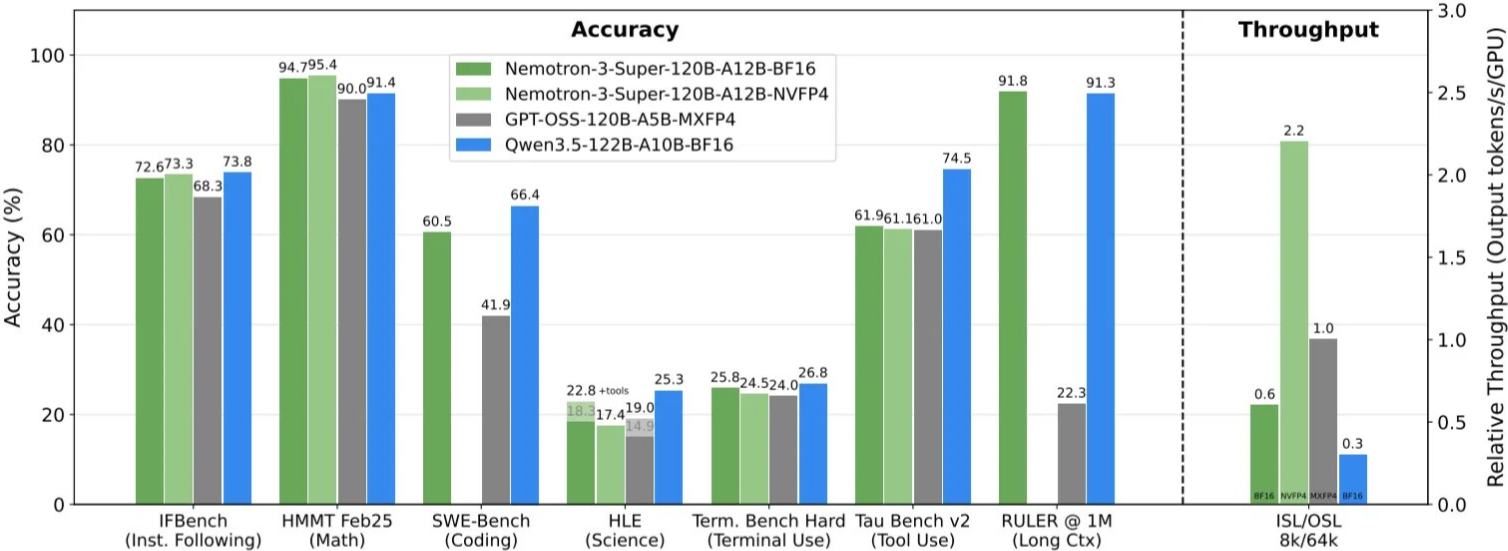
Core Insights - Nvidia has launched the Nemotron 3 Super, an open-source model designed for large-scale AI agents, aiming to transition from a chip supplier to a comprehensive AI ecosystem provider [1][10] - The model boasts significant performance improvements, including over three times the inference performance and up to five times the throughput compared to its predecessor [2][11] - Nvidia's strategy positions it as an AI infrastructure contractor, integrating hardware and software to support complex AI workflows [8][12] Group 1: Model Features and Performance - The Nemotron 3 Super features a mixed expert model architecture with 120 billion parameters, activating only 12 billion during inference, and supports a context window of up to 1 million tokens [3][5] - In benchmark tests, the model achieved an 85.6% success rate in OpenClaw tasks, closely competing with proprietary models like Claude Opus 4.6 and GPT-5.4 [1][10] - The model's design focuses on reducing activation costs and improving throughput, making it suitable for multi-agent workflows and complex task execution [4][11] Group 2: Industry Impact and Adoption - Major companies such as Palantir, Amdocs, and Siemens are actively deploying and customizing the Nemotron 3 Super for various applications, including telecommunications and cybersecurity [3][9] - The upcoming GTC 2026 conference is expected to showcase Nvidia's advancements in AI technology, reinforcing its market position amid concerns about competition [9][14] - Analysts are increasingly optimistic about Nvidia's stock, with expectations of significant price increases driven by the success of the Nemotron 3 Super and the company's shift towards a full-stack AI platform [12][14] Group 3: Market Trends and Future Projections - The demand for AI computing power is projected to grow significantly, with major tech companies expected to invest around $650 billion to $700 billion in AI infrastructure by 2026 [18] - Nvidia's competitive edge is strengthened by its AI GPU and CUDA ecosystem, which is becoming more integral to its overall business strategy [10][11] - The anticipated growth in AI workloads is expected to drive substantial increases in Nvidia's product sales, particularly among hyperscalers [14][17]
「龙虾」还没养熟,信用卡先被刷爆了
36氪· 2026-03-12 11:46
Core Viewpoint - The article discusses the rapid rise of the AI proxy tool OpenClaw, referred to as "养龙虾" (raising lobsters), and highlights the associated security risks, particularly regarding credit card fraud and data privacy issues [5][6][10]. Group 1: OpenClaw's Popularity and Usage - OpenClaw has gained significant traction among developers, who utilize it for automating tasks such as information collection, stock monitoring, and investment strategy backtesting [7]. - Users report that OpenClaw can function as a "digital assistant," performing tasks like generating daily reports and managing schedules, although initial experiences reveal bugs and incomplete features [7][8]. Group 2: Security Risks and Concerns - A developer shared an incident where improper configuration of OpenClaw led to credit card fraud, emphasizing the risks of exposing sensitive information through inadequate security measures [6][8]. - The Ministry of Industry and Information Technology issued warnings about potential network attacks and information leaks associated with OpenClaw, urging users to enhance security protocols during deployment [5][10]. Group 3: Financial Institutions' Cautious Approach - Financial institutions, particularly banks, remain cautious about integrating OpenClaw due to stringent security requirements and the potential for data breaches [11][12]. - Some banks have not permitted the use of AI proxy tools within their internal networks, citing concerns over information security and system stability [12][13]. Group 4: Emerging Challenges in the Financial Sector - The introduction of AI proxies like OpenClaw presents new challenges for existing fraud detection systems, as their automated capabilities may mimic abnormal transaction behaviors [14][15]. - There are concerns regarding liability in cases where AI tools make investment decisions that result in losses, raising questions about accountability [15][16]. Group 5: Types of Risks Associated with AI Proxies - Privacy risks arise from AI proxies needing access to sensitive user data, which could lead to data leaks if permissions are not managed properly [16]. - Security risks include the potential for malicious attacks if the AI proxy is improperly configured, which could result in unauthorized access to systems [16]. - Cost risks are also highlighted, as deploying AI proxies may incur significant operational costs if not managed effectively [16].

“龙虾热”席卷全球之际 黄仁勋携开源模型炸场! 英伟达(NVDA.US)全栈野心托起“AI牛市叙事”
智通财经网· 2026-03-12 08:16
Core Viewpoint - Nvidia aims to transition from a chip supplier to a comprehensive AI infrastructure contractor with the launch of its open-source model "Nemotron 3 Super," designed for large-scale AI agents, enhancing its position in the AI ecosystem [1][10][12]. Group 1: Model Performance and Features - The "Nemotron 3 Super" model features 120 billion parameters and utilizes a mixed expert model (MoE) architecture, achieving over three times the inference performance and up to five times the throughput compared to its predecessor [2][11]. - In benchmark tests, "Nemotron 3 Super" scored 85.6% in the Pinchbench tests and demonstrated high success rates in tasks, closely rivaling proprietary models like Claude Opus 4.6 and GPT-5.4 [1][10]. - The model supports a context window of 1 million tokens, allowing it to maintain complete workflow states and prevent target drift in multi-agent workflows [5][9]. Group 2: Industry Impact and Adoption - Major companies such as Palantir, Amdocs, and Siemens are actively deploying and customizing the "Nemotron 3 Super" model for automation in telecommunications, cybersecurity, and semiconductor design [3][9]. - The model is being integrated into various AI-driven systems, enhancing operational efficiency and accuracy for companies like CodeRabbit and Factory [2][3]. - Nvidia's strategy reflects a broader industry trend towards AI agents, with predictions that 2026 will be a pivotal year for AI agents transforming the digital ecosystem [4][10]. Group 3: Market Outlook and Analyst Sentiment - Analysts have become increasingly bullish on Nvidia's stock, with expectations that the launch of "Nemotron 3 Super" will catalyze a breakthrough in stock price, potentially surpassing previous highs [12]. - The demand for AI computing power is projected to grow significantly, with major tech companies expected to invest around $650 billion in AI-related capital expenditures by 2026 [18]. - Nvidia's advancements in AI infrastructure are seen as a key narrative in the ongoing AI market boom, with implications for related sectors such as power supply and cooling systems [17].
“龙虾”还没养熟,信用卡先被刷爆了
第一财经· 2026-03-10 11:42
Core Viewpoint - The article discusses the rising popularity of the AI proxy tool OpenClaw, its applications in investment and daily tasks, and the associated security risks that have emerged, particularly regarding user data and financial safety [2][4][10]. Group 1: OpenClaw's Popularity and Applications - OpenClaw has gained significant traction among developers, being referred to as "raising lobsters," and is seen as a digital assistant capable of automating tasks such as information collection, stock monitoring, and investment strategy backtesting [2][4]. - Users have reported using OpenClaw for various automated tasks, including generating daily reports and managing investment strategies, with one user likening it to having a tireless assistant [4][10]. Group 2: Security Risks and Concerns - The article highlights a case where a user experienced credit card fraud after improperly configuring OpenClaw, which allowed public access to sensitive information [2][5]. - The Ministry of Industry and Information Technology has issued warnings about potential risks associated with OpenClaw, emphasizing the need for enhanced security measures during deployment [2][8]. - Developers have noted that many users may not realize the risks associated with improper configurations, which can lead to unauthorized access and data breaches [5][6]. Group 3: Financial Institutions' Cautious Approach - Financial institutions, particularly banks, are generally cautious about adopting OpenClaw due to concerns over information security and system stability, with many not allowing its use within internal networks [8][9]. - Some banks have expressed that the recent surge in interest around AI proxies has not yet penetrated their core business operations, and they remain focused on exploring larger model capabilities [8][9]. Group 4: Emerging Challenges in the Financial Sector - OpenClaw is viewed as an advanced application of large models, but its automation capabilities may pose challenges to existing fraud detection systems used by banks [10][11]. - The potential for AI proxies to execute financial transactions raises questions about liability in cases of investment losses, highlighting the need for clear regulations [11][12]. - The risks associated with OpenClaw include privacy risks from accessing sensitive user data, security risks from potential system control by attackers, and cost risks related to computational expenses [12][13].