Automobile Export

Search documents
2025年中国汽车出口量蝉联全球第一达832万辆,2026年或增18%
CINNO Research· 2026-03-04 08:58
Core Viewpoint - In 2025, China's automobile export volume reached 8.32 million units, maintaining its position as the world's largest exporter, with an expected increase of 18% in 2026 [2]. Group 1: Trade Contribution Trends - The article discusses the contribution of China's automobile import and export trade from 2020 to 2025, highlighting the growth trajectory and its significance in the global market [3]. Group 2: Export Volume Trends - The export volume of Chinese automobiles is analyzed from 2020 to 2025, showing a consistent upward trend [5]. Group 3: Regional Export Volume Distribution - The distribution of China's automobile export volume by region from 2020 to 2025 is examined, indicating shifts in market focus and demand [3]. Group 4: Power Type Trends - The trends in the export volume of new energy vehicles versus traditional fuel vehicles from 2020 to 2025 are detailed, showcasing the growing importance of new energy vehicles in the export market [5]. Group 5: Top Export Markets - The article lists the top 10 export markets for Chinese automobiles in 2025, along with year-on-year comparisons to illustrate changes in market dynamics [5]. Group 6: Exporting Companies - The top 10 Chinese automobile exporting companies in 2025 are identified, with a focus on their performance compared to previous years [5].

反超阿根廷!中国成为巴西最大汽车进口来源国
Guan Cha Zhe Wang· 2026-02-11 08:19
Core Insights - Chinese automotive companies have become the largest car importers in Brazil, surpassing Argentina for the first time in over 30 years, marking a significant shift in the market dynamics [2] - The growth of Chinese brands in Brazil is part of a broader global strategy rather than an over-concentration on a single market [4] Group 1: Market Performance - In January, China exported 16,800 vehicles to Brazil, while Argentina exported 13,400 vehicles, indicating a notable increase in Chinese market share [2] - The export value of Chinese automobiles to Brazil surged to $375 million in January, more than ten times the amount from a year earlier, accounting for approximately 65% of Brazil's total automotive import value [2] - Despite the rise of Chinese brands, Brazil's overall automotive production decreased by 12% year-on-year, and sales saw a slight decline [4] Group 2: Strategic Developments - Chinese companies like Great Wall Motors and BYD are rapidly expanding in Brazil by initially importing vehicles and subsequently establishing local assembly operations [2] - BYD plans to invest 5.5 billion Brazilian Reais (approximately $1.06 billion) to convert a Ford plant in Bahia into a production base, initially using a semi-knocked down (SKD) assembly model [3] - The Brazilian Automotive Manufacturers Association (Anfavea) has criticized the simplified assembly model for creating fewer jobs compared to full manufacturing and has welcomed the government's decision to not extend the tax exemption on imported automotive parts [3] Group 3: Industry Challenges - The sales of new energy vehicles in Brazil reached a record high of 16.8%, but only about 35% of these vehicles are produced locally [4] - The Brazilian automotive industry faces challenges such as rising financing costs and tightened credit, which are impacting various market segments, including heavy trucks [4] - Despite the rapid growth of Chinese brands, Brazil remains the fifth-largest destination for Chinese automotive exports, trailing behind Mexico, Russia, the UK, and the UAE [4]

1月车市观察:第一名卖了27万辆,但真正的故事在海外
3 6 Ke· 2026-02-05 03:05
Core Viewpoint - The automotive market is currently experiencing a sales downturn, particularly in the electric vehicle (EV) segment, due to a combination of factors including a shift in vehicle purchase tax policy and seasonal demand fluctuations [1][3][4]. Market Performance - In January, nationwide retail sales of passenger vehicles reached 1.794 million units, reflecting a year-on-year decline of 12.1% and a month-on-month drop of 31.9% [3]. - The performance of major automotive brands showed a pattern of "year-on-year differentiation and month-on-month decline," with domestic brands benefiting from their EV offerings while facing pressure from the tax policy change [3][4]. Domestic Brand Performance - Geely Auto topped domestic sales in January with 270,200 units sold, achieving a year-on-year growth of 1% and a month-on-month increase of 14% [5]. - SAIC Group reported sales of 327,400 units, a year-on-year increase of 23.9%, while its domestic brand sales reached 214,000 units, up 39.6% year-on-year [6]. - GAC Group's sales were 116,600 units, marking an 18.47% year-on-year increase, with its domestic brands showing explosive growth [6]. Joint Venture Brands - Major joint venture brands like GAC Toyota and SAIC General saw a recovery in January, with GAC Toyota selling 63,600 units, a nearly 10% year-on-year increase [9][11]. - SAIC General's sales reached 51,000 units, up 8.2% year-on-year, driven by strong performance in its EV and export segments [11][12]. Export Growth - The overseas market has emerged as a significant growth driver for domestic automakers, with many companies reporting export growth rates exceeding 40% [13][14]. - Chery Group exported 119,600 units in January, a 48.1% year-on-year increase, maintaining its position as the top exporter in China [14]. - Geely's overseas sales reached 60,500 units, reflecting a staggering year-on-year growth of 121% [16]. Industry Trends - The overall trend indicates that by 2026, China's automotive export volume is expected to reach 7.4 million units, with EV exports projected to exceed 30% of total exports [17].




2025年广州南沙汽车口岸滚装出口汽车超38万辆
Xin Lang Cai Jing· 2026-01-01 08:29
Core Insights - In 2025, the Guangzhou Nansha Customs reported that 383,000 vehicles were exported through the Nansha Automobile Port, marking a year-on-year increase of 54.4% [1] - Among these, 154,000 were new energy vehicles, representing a growth of over 200% and accounting for 40% of the total exports [1] Infrastructure and Capacity - The Nansha Automobile Port features specialized roll-on/roll-off berths with a capacity of 80,000 tons, a 1.8-kilometer dock, and a vehicle storage area of 1.61 million square meters, with an annual throughput capacity exceeding 3 million vehicles [1] Export Operations - On January 1, 2026, the first batch of exported domestic vehicles departed from the Nansha Automobile Port, with the "Anji Emerald" vessel carrying over 1,630 vehicles to the UAE [1] - During the New Year holiday, it is expected that four roll-on/roll-off ships will dock, with customs overseeing the export of over 7,000 domestic vehicles [1] Market Trends - The popularity of domestic new energy vehicles has been increasing among Hong Kong citizens, with the "Guangzhou-Hong Kong Automobile Export Fast Track" facilitating the export of 1,099 vehicles since its launch on June 30, 2025 [1]

10月汽车出口66.6万辆 新能源车占比持续提升
Yang Shi Wang· 2025-11-13 09:31
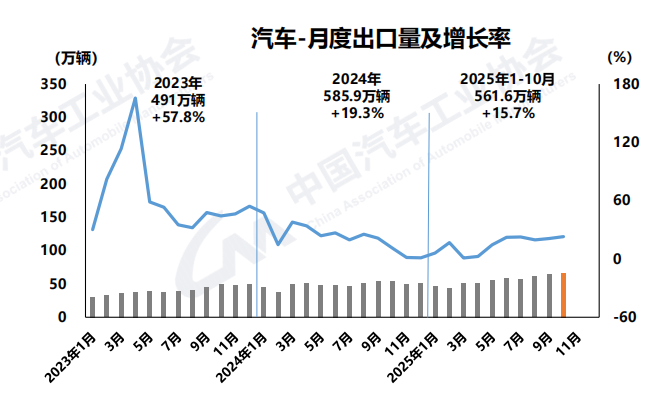
Core Insights - China's automobile exports reached 666,000 units in October, marking a month-on-month increase of 2.1% and a year-on-year increase of 22.9%, maintaining a level above 600,000 units for three consecutive months [1] - Cumulatively, from January to October, exports totaled 5.616 million units, reflecting a year-on-year growth of 15.7%, indicating a robust growth trend in China's automobile exports [1] Group 1: New Energy Vehicles (NEVs) - The export performance of new energy vehicles is particularly noteworthy, with 256,000 units exported in October, representing a month-on-month increase of 15.4% and a significant year-on-year increase of 99.9% [3] - From January to October, cumulative exports of new energy vehicles surpassed 2 million units for the first time, reaching 2.014 million units, which is a year-on-year increase of 90.4%, becoming a key driver of overall automobile export growth [3] Group 2: Traditional Fuel Vehicles - In contrast, exports of traditional fuel vehicles showed a decline, with cumulative exports from January to October totaling 3.601 million units, down 5.1% year-on-year, indicating a global shift towards new energy vehicles [4] - Overall, the scale of China's automobile exports continues to expand, with an ongoing optimization of the export structure, highlighting the increasing competitiveness and influence of China in the global automotive industry [4]
【周度分析】车市扫描(2025年10月1日-10月12日)
乘联分会· 2025-10-15 08:37
Market Overview - In the first 12 days of October, the national retail sales of passenger cars reached 686,000 units, a year-on-year decrease of 8%, but a month-on-month increase of 12%. Cumulative retail sales for the year reached 17.694 million units, up 8% year-on-year [2][4] - Wholesale sales of passenger cars during the same period totaled 546,000 units, down 11% year-on-year and down 15% month-on-month. Year-to-date wholesale sales reached 21.393 million units, an increase of 12% year-on-year [2][6] New Energy Vehicle (NEV) Performance - Retail sales of new energy vehicles (NEVs) in the first 12 days of October were 367,000 units, a year-on-year decrease of 1%, but a month-on-month increase of 1%. The retail penetration rate for NEVs reached 53.5%, with cumulative retail sales for the year at 9.236 million units, up 23% year-on-year [2][4] - Wholesale sales of NEVs were 328,000 units, a year-on-year increase of 1%, but a month-on-month decrease of 11%. The wholesale penetration rate for NEVs was 60.2%, with cumulative wholesale sales for the year at 10.775 million units, up 31% year-on-year [2][4] Sales Trends and Seasonal Effects - The first week of October saw an average daily retail of 44,000 units, down 18% year-on-year, while the second week saw an average daily retail of 85,000 units, up 7% year-on-year [4] - The traditional peak season of "Golden September and Silver October" is expected to boost sales, but tightening subsidy standards and the impending expiration of vehicle purchase tax incentives may gradually release consumer purchasing enthusiasm [4][6] Price Competition and Promotions - The price competition in the passenger car market has returned to rationality, with a moderate scale of new car price reductions. In the first nine months of 2025, 148 new car models saw price cuts, with an average reduction of 21,000 yuan, representing a 10.8% decrease [8][9] - In September 2025, the average price reduction for new energy vehicles was 19,000 yuan, with a reduction rate of 9.8%, while conventional fuel vehicles saw an average reduction of 11,000 yuan, with a reduction rate of 5.9% [8][9] Export Performance - The export market for Chinese automobiles has shown strong growth, particularly in Southeast Asia, Africa, and the EU. In the first eight months of 2025, the overseas sales of Chinese self-owned brands reached 2.1 million units, up 11% year-on-year [11] - The strategy for exporting Chinese automobiles has evolved, focusing on local assembly and production, with companies like SAIC, Geely, Great Wall, and Chery achieving significant success in overseas markets [11]

【周度分析】车市扫描(2025年6月16日-6月22日)
乘联分会· 2025-06-25 08:31
Group 1: Market Overview - From June 1 to June 22, the national passenger car retail market reached 1.269 million units, a year-on-year increase of 24% compared to the same period last year, and an 8% increase compared to the previous month [4][5] - Cumulative retail sales for the year reached 10.086 million units, reflecting an 11% year-on-year growth [4] - The wholesale volume for the same period was 1.238 million units, up 14% year-on-year and 9% month-on-month, with cumulative wholesale sales for the year at 12.028 million units, a 12% increase [4][6] Group 2: New Energy Vehicles - Retail sales of new energy vehicles from June 1 to June 22 reached 691,000 units, a 38% year-on-year increase, with a retail penetration rate of 54.5% [4][6] - Cumulative retail sales of new energy vehicles for the year reached 5.049 million units, a 35% year-on-year increase [4] - Wholesale volume for new energy vehicles was 666,000 units, a 22% year-on-year increase, with a wholesale penetration rate of 53.8% [4][6] Group 3: Market Dynamics - The domestic economic situation has improved, with recent export recovery stabilizing domestic demand, supported by various consumption promotion policies [4][5] - The market is experiencing a shift in consumer preferences, with strong performance in both electric and hybrid vehicles, alongside a robust demand for fuel vehicles [5][6] - The first three weeks of June showed a significant increase in daily average retail sales, with the third week seeing a 30% year-on-year increase and a 42% month-on-month increase [3][6] Group 4: Inventory and Future Outlook - As of May 2025, the national passenger car inventory stood at 3.45 million units, with an inventory turnover of 54 days, indicating a slight increase in overall inventory pressure [6][7] - The market is expected to gradually decline in sales over the next three months as it transitions into a seasonal lull [7] - The automotive industry is increasingly driven by both domestic and international demand, with a notable improvement in industry order and inventory management [6][7] Group 5: Export Performance - In May 2025, China exported 682,000 vehicles, a 20% year-on-year increase, with cumulative exports from January to May reaching 2.83 million units, reflecting a 16% growth [8][9] - The top ten countries for vehicle exports in May included Mexico, UAE, and Brazil, with significant increases in exports to the Middle East [8][9] - New energy vehicle exports reached 296,000 units in May, a 43% increase, accounting for 43% of total vehicle exports [9][10]

【周度分析】车市扫描(2025年5月19日-5月25日)
乘联分会· 2025-05-28 08:34
Group 1: Market Overview - From May 1 to May 25, the national passenger car retail market reached 1.358 million units, a year-on-year increase of 16% and a month-on-month increase of 9%. Cumulative retail sales for the year reached 8.23 million units, up 9% year-on-year [2][5] - During the same period, wholesale of passenger cars was 1.389 million units, a year-on-year increase of 17% but a month-on-month decrease of 1%. Cumulative wholesale for the year was 9.858 million units, up 12% year-on-year [2][6] - The retail penetration rate for new energy vehicles (NEVs) reached 53.5%, with retail sales of 726,000 units from May 1 to May 25, marking a 31% year-on-year increase [2][5] Group 2: Sales Trends - Daily average retail sales for the first week of May were 42,000 units, down 11% year-on-year, but increased by 19% month-on-month. The second week saw an increase to 61,000 units, up 30% year-on-year and 44% month-on-month [4][5] - The third week recorded daily average retail sales of 51,000 units, a 14% year-on-year increase, while the fourth week saw sales return to 61,000 units, a 26% year-on-year increase but down 8% month-on-month [5][6] Group 3: Industry Performance - In the first four months of 2025, the automotive industry generated revenue of 3.3 trillion yuan, a 7% increase, while costs rose by 8%, leading to a profit decline of 5% with a profit margin of 4.1% [7][8] - The production of automobiles from January to April reached 10.12 million units, a year-on-year increase of 11% [7][8] Group 4: Export Performance - In April 2025, China exported 620,000 vehicles, a year-on-year increase of 12% and a month-on-month increase of 36%. Cumulative exports for the first four months reached 2.16 million units, up 15% year-on-year [8][9] - The top ten countries for vehicle exports in April included Mexico, Brazil, and Russia, with significant contributions from the Middle East market [9][10] Group 5: New Energy Vehicles - From January to April 2025, the penetration rate of new energy commercial vehicles reached 22%, up 8 percentage points from the same period last year, indicating strong growth in the sector [12][13] - The export performance of Chinese new energy vehicles was better than expected, with significant growth in markets such as the Middle East and developed countries [11][12]