
CTA策略配置

Search documents
为什么此刻应该关注CTA?
私募排排网· 2026-01-23 03:59
Core Viewpoint - The article emphasizes that 2026 will be a year of opportunities for CTA strategies, driven by a transition in the global economy and distinct trends in the commodity market, which will provide ample trading opportunities [6][12]. Group 1: Performance of CTA Strategies in 2025 - In 2025, the performance of subjective and quantitative CTA products was notable, with profitability ratios reaching 88.2% and 90.4%, respectively, and median annual returns of 16.47% and 12.65% [3]. - The maximum drawdown for these strategies was relatively low, with median values of -7.84% and -6.27%, indicating strong risk management [3]. - The commodity market demonstrated significant configuration value, particularly in precious and non-ferrous metals, which became key amplifiers for returns in a low-interest-rate environment [3][7]. Group 2: Market Outlook for 2026 - The commodity market in 2026 is characterized by a "supply-demand mismatch," presenting clear long and short opportunities [7]. - Bullish sectors include gold, with forecasts predicting prices could rise to $4,900 to $5,055 per ounce by the end of 2026, and copper, which may see average prices exceed $11,500 per ton due to supply disruptions [7]. - Conversely, bearish sectors include crude oil, with predictions of Brent crude prices dropping to around $57 per barrel due to oversupply, and iron ore, expected to decline to $95 per ton due to weak real estate demand [7]. Group 3: CTA Strategy Logic and Market Conditions - The clear long and short market dynamics align with CTA trading logic, where quantitative CTAs capture emerging trends and subjective CTAs leverage fundamental research for wave opportunities [8]. - The ongoing low-interest-rate environment and the "yield drought" backdrop enhance the appeal of CTA strategies, which can effectively diversify risk and improve risk-adjusted returns [12]. - In the long term, CTA strategies are positioned as a stabilizing asset class capable of navigating through cycles and capturing both bullish and bearish opportunities, reinforcing their role as a "ballast" in investment portfolios [12].


AI引领第三次牛市?多位私募大咖共探2026权益市场投资新机遇
Sou Hu Cai Jing· 2026-01-17 03:13
Core Insights - The 20th Private Equity Development Forum, hosted by Paipai Network Group, will take place on January 8, 2026, in Shenzhen, focusing on high-quality development paths for China's private equity industry [1] - Key discussions will revolve around AI-enabled investment paradigms, opportunities in the equity market, and the value of CTA strategy allocation [1] Group 1: Market Outlook - From a cyclical perspective, the market is in an upward phase from early 2024 to 2025, with overall valuations still in a bull market phase without extreme bubbles [3] - The recovery of market confidence is evident, with a shift from macro narratives to industry narratives, where fundamentally strong companies and sectors are leading the market [3] - AI is expected to be a significant investment theme in 2026, with a potential shift in focus from hardware to software as commercialization progresses [5] Group 2: Investment Strategies - The investment focus may transition from hardware (computing infrastructure) to software (applications and commercialization) as the AI sector matures [5] - The current environment is characterized by "weak recovery + ample liquidity," with cyclical assets expected to perform well if economic data shows improvement [5] - The market is advised to remain "cautiously optimistic" in 2026, seeking quality targets within structural opportunities [5] Group 3: Sector-Specific Insights - AI applications and innovative pharmaceuticals are viewed as significant opportunities, with expectations of a similar market impact as seen in past technological revolutions [10] - The proportion of "cheap good assets" in the market has decreased significantly, but there remains about 30% potential for discovery in this area [7] - The AI industry is anticipated to undergo a production revolution lasting a decade, with significant market capitalization growth expected for Chinese companies [12] Group 4: Macroeconomic Factors - The current market is influenced by global liquidity easing, particularly due to Federal Reserve rate cuts, and improvements in China's export resilience and consumer recovery [14] - Investment in large projects is seen as a key variable for 2026, particularly in cyclical industries [15] - Long-term trends indicate that the AI technology revolution, despite potential fluctuations, remains robust, with a focus on identifying certain opportunities while managing volatility risks [15]
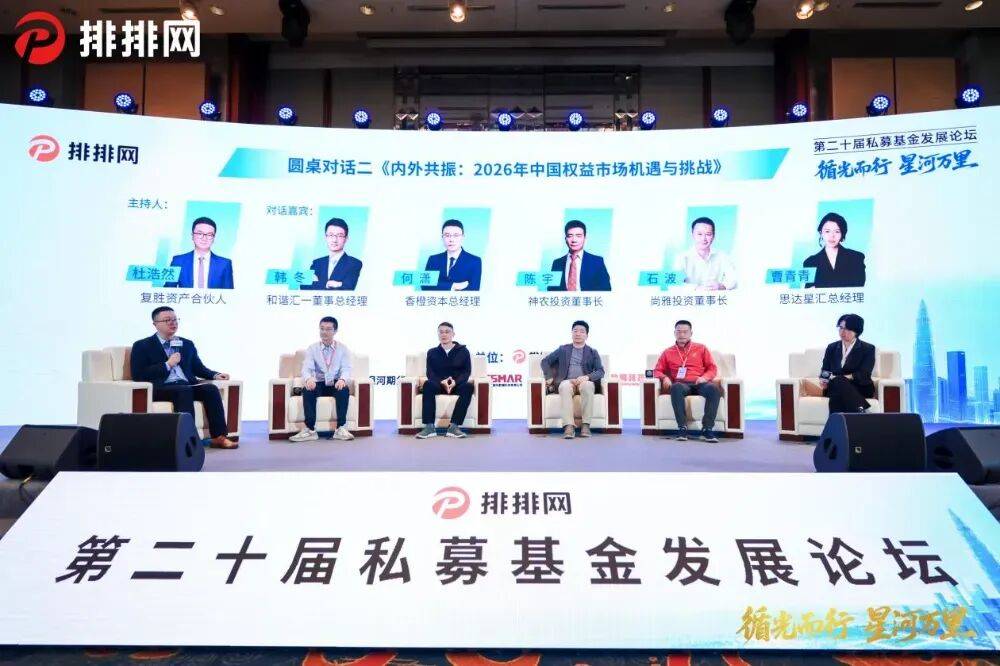
第二十届私募基金发展论坛举行 共探行业高质量发展新路径
Zheng Quan Shi Bao Wang· 2026-01-09 03:37
Group 1 - The core viewpoint of the articles highlights that by 2025, China's private securities asset management scale will historically exceed 7 trillion yuan, driven by steady market growth and strategic innovation [1] - The private equity industry is experiencing significant vitality, with the number of hundred-billion yuan private equity firms steadily increasing and the profitability of the industry showing notable enhancement [1] - The 20th Private Fund Development Forum held in Shenzhen focused on core topics such as AI-enabled investment paradigms, investment opportunities in the equity market, and the value of CTA strategy allocation [1] Group 2 - Looking ahead, the private equity industry is expected to develop in a more diversified and mature direction, demonstrating a more stable and sustainable growth trend [2] - Current investment opportunities in the AI sector may need to shift from hardware to software, as the value ratio between hardware and software in traditional IT architecture is approximately 1:4, while in AI, hardware currently outweighs software [2] - The AI era is anticipated to be as significant as the internet boom in 1998 or the new energy vehicle surge in 2007-2008, with the trend of AI industry development expected to be vast and forward-moving [2] Group 3 - The "AI+" wave is sweeping through the financial sector, leading quantitative investment into a new stage of strategy iteration, with high expectations for its development prospects [3] - AI is expected to enhance existing quantitative frameworks and optimize them, bringing more multimodal and non-institutional data into semantic factors, thereby improving strategy development efficiency [3] - The transformation in quantitative research paradigms is anticipated, shifting from "manual research" to "intelligent experimental systems," significantly reducing human assumptions [3]
商品趋势渐起预期下的CTA配置机会
Zhao Shang Qi Huo· 2025-09-26 07:10
Report Information - Report Title: Commodity Trend Rising: CTA Allocation Opportunities Under Expectations [1] - Report Date: September 26, 2025 [3] - Researchers: Zhao Jiayu, Qiao Lei, Wang Haosheng [2] 1. Report Industry Investment Rating No relevant content provided. 2. Core Views - Since mid - 2024, CTA has reversed its decline, and the recent upward trend has strengthened, mainly due to improved volatility and liquidity. However, the rise since mid - 2024 has been slightly below expectations because the subsequent interest - rate cut process of major economies has not been smooth [5][7] - In the long - term (annual) perspective, the upward momentum of the commodity market is accumulating, and an overall increase in volatility is also likely. This is driven by cost support and low valuation, policy guidance and improved expectations, and global liquidity easing [5] - It is still a strategic window period to increase CTA allocation in the portfolio. In the long run, CTA's long - term positive return expectation and low correlation (even crisis Alpha attribute) with equity assets make it an excellent tool for optimizing the portfolio's Sharpe ratio [6] 3. Summary According to the Directory 3.1 CTA's Strategy Environment - **Short - to - medium - term trend tracking**: It is closely related to intraday volatility and liquidity. Its long - term performance depends on the upward shift of the volatility center, and short - term performance depends on the pulsed increase in intraday volatility. Since mid - 2024, with improved liquidity, short - to - medium - term trend strategies have also improved [17][19][20] - **Medium - to - long - term trend tracking**: Its long - term performance depends on the increase in daily volatility, which has shown signs of stabilization and recovery since mid - 2024 but with a less - than - expected increase. Short - term performance is highly correlated with daily trend smoothness, and the strategy has a higher probability of positive returns when the market trend smoothness increases. The strategy has a better experience in rising commodity markets and can be regarded as a volatility - reducing product of the commodity index to some extent [21][24][27] 3.2 Commodity Market Outlook - **Current situation**: Many industrial product prices are at a thin - profit or loss state, and commodity prices are generally at a historically low valuation with strong cost support [32] - **Expectation**: Commodities are unlikely to return to the low levels before the "anti - involution" policy, as the narrative of "weak external demand due to tariffs" and "structural over - supply in the domestic market" has changed. "Anti - involution" aims to reverse the situation of "increasing quantity but decreasing price" and promote price increases [33][35][36] - **Monetary aspect**: Preventive interest - rate cuts support commodity price increases. Commodities have performed well after interest - rate cut cycles, and preventive interest - rate cuts lead to price increases at the beginning [39] - **Fiscal aspect**: China's fiscal policy continues to be proactive, and the US fiscal policy has exceeded expectations. Major economies have entered a fiscal expansion cycle, and historically, fiscal stimulus usually corresponds to rising commodity prices [43][45][49] - **Volatility**: Commodity volatility is highly correlated with the fiscal expenditures and monetary liquidity of major economies [52] 3.3 CTA's Long - term Value - **Long - term positive return**: CTA's long - term positive returns mainly come from behavioral finance biases and the information advantages and resource inputs of managers [55] - **Low correlation**: It has a low correlation with equity assets, and the internal correlation within CTA is also low [58][60] - **Crisis Alpha attribute**: During historical black - swan events, CTA has often outperformed equity assets, making it an anti - fragile asset with high allocation value in a high - uncertainty market environment [61]