EDA工具

Search documents
硅芯科技:以2.5D/3D EDA全流程方案破局先进封装,携硬核成果亮相慕尼黑光博会协同论坛
半导体行业观察· 2026-02-22 01:33
Core Viewpoint - The semiconductor industry is entering the "post-Moore era," where advanced packaging is crucial for overcoming chip performance bottlenecks, and EDA tools are central to the localization efforts in high-end packaging [1][2]. Group 1: EDA Solutions and Challenges - The 2.5D/3D stacking technology is essential for efficient integration of heterogeneous chips in fields like AI and 6G, but it brings increased complexity in the design process, including architecture planning, physical implementation, and testing [2][4]. - Traditional design methods face challenges such as tool fragmentation, long design iteration cycles, and difficulties in Chiplet interconnection testing, which hinder the pace of domestic advanced packaging [2][4]. Group 2: Silicon Chip Technology's EDA Platform - Silicon Chip Technology's 3Sheng Integration Platform addresses these challenges with a customized EDA solution that covers five key areas: architecture design, physical design, multi-die testing fault tolerance, analysis simulation, and multi-Chiplet integration verification [4][5]. - The platform enables full-process collaboration, breaking down tool fragmentation and improving simulation verification efficiency for 5nm chips by 30% [4]. - Real-time collaboration between design and simulation significantly shortens the iteration cycle, accelerating product market entry [4][5]. Group 3: Industry Collaboration and Forum - The "From Device to Network Collaborative Innovation Forum" on March 18, 2026, in Shanghai serves as a platform for showcasing technological achievements and facilitating precise supply-demand matching within the semiconductor industry [6][15]. - The forum aims to gather 200 key industry players, including major telecom operators and leading cloud service providers, to discuss collaboration needs and technological advancements in critical areas like compound semiconductors and EDA [6][15]. - Silicon Chip Technology plans to leverage the forum to demonstrate its 2.5D/3D EDA solutions and engage directly with decision-makers to explore customized needs in 6G and AI computing scenarios [10][15].

收购失败后彻底退出:英伟达(NVDA.US)英伟达清空Arm持股 投资版图转向AI计算生态
智通财经网· 2026-02-18 08:20
Group 1 - Nvidia has sold all of its shares in Arm, totaling 1.1 million shares valued at approximately $140 million based on Arm's closing price [1] - Nvidia's attempt to acquire Arm for $40 billion in 2020 was thwarted by regulatory and customer opposition, leading to the termination of the agreement in February 2022 [1] - Arm, which is crucial for advanced semiconductor technology, is now pursuing its IPO plans under the ownership of SoftBank [1] Group 2 - Nvidia has made strategic investments in Intel, Synopsys, and Nokia, enhancing its presence in key areas such as chip manufacturing, EDA tools, and communication infrastructure [2] - Nvidia's investment in Intel amounts to approximately $5 billion, representing a 4.91% stake, aimed at strengthening AI computing capabilities [2] - The investment in Synopsys is around $2 billion, focusing on securing the chip design tool ecosystem [2] - Nvidia holds about 2.9% of Nokia, targeting the integration of AI with next-generation 5G/6G networks [2]


国产芯片的2025:从“能用”到“好用”的临界点
经济观察报· 2025-12-07 04:31
Core Viewpoint - The domestic chip industry in China is undergoing significant transformation, moving from a perception of being "stuck" or "ineffective" to showcasing advancements and capabilities by 2025 [1][3]. Group 1: Consumer Electronics and Automotive - The gaming performance of domestic processors is improving, with the Haiguang C86 processor achieving frame rates of nearly 200 and 300 for major games, indicating readiness for high-performance gaming [2][3]. - The Haiguang C86 processor, featured in the "Black Warrior·Hunting Blade Pro" gaming PC, has a base frequency of 2.8GHz and supports PCIe 5.0, demonstrating its capability to handle high-load tasks [5][6]. - The GAC Aopao GT "Climbing Edition" achieved 100% domestic chip design, utilizing the RK3588M chip for its intelligent cockpit, showcasing the reliability and performance of domestic chips in high-end vehicles [12][13]. Group 2: Storage and Memory Chips - Changxin Storage launched DDR5 products with speeds up to 8000Mbps, marking a significant advancement for domestic manufacturers in the high-end memory market [9][10]. - The introduction of DDR5 technology represents a leap from DDR4, with performance improvements and the ability to address high-frequency signal interference [10][11]. - Longjiang Storage's TiPlus7100s SSD achieved read speeds of 7400MB/s and write speeds of 6900MB/s, indicating competitive performance against international brands [11]. Group 3: AI and Computing Power - The exit of international giants from the AI chip market has created opportunities for domestic companies, with Cambrian Technologies reporting a 1332.52% year-on-year revenue increase in Q3 2025 [15][16]. - Domestic firms are adopting "super node" technology to enhance computing power by integrating multiple AI acceleration cards into a single cabinet, addressing performance bottlenecks in large model training [17][18]. - The demand for storage has shifted from being a cost component to a strategic asset, with significant implications for the supply chain and market dynamics [18][19]. Group 4: Semiconductor Manufacturing and Equipment - Domestic companies are making strides in semiconductor manufacturing equipment, with the shipment of a 350nm lithography machine that supports the production of power devices and RF chips [23][24]. - The development of high-speed oscilloscopes and EDA tools is filling critical gaps in the chip design and testing process, enhancing the capabilities of domestic semiconductor firms [25][26]. - The Chinese semiconductor industry is transitioning from "point breakthroughs" to "chain collaboration," indicating a shift towards more integrated and cooperative development efforts [20][27].



北京华大九天科技股份有限公司第二届董事会第二十次会议决议公告
Shang Hai Zheng Quan Bao· 2025-12-03 19:12
Group 1 - The company held its 20th meeting of the second board of directors on December 3, 2025, to discuss the establishment of Tianjin Zhongwan Xincheng Management Consulting Partnership (Limited Partnership) [2][3] - The company plans to invest 100 million yuan in the partnership, which will have a total subscribed capital of 110.01 million yuan, giving the company a 90.9008% share [3][15] - The investment is part of the company's strategy to deepen its investment layout in the EDA field and is classified as a related party transaction due to the involvement of a fund controlled by the company's actual controller [3][15][27] Group 2 - The board meeting was attended by all 11 directors, and the proposal was approved with 7 votes in favor, with related directors abstaining from the vote [4] - The supervisory board also approved the establishment of the partnership, confirming that the decision complies with relevant laws and regulations [10][34] - The partnership aims to invest in leading companies in the hardware-assisted verification field of digital chip design, aligning with the company's strategic development goals [27][32]

华大九天:与关联方共同投资设立合伙企业
Mei Ri Jing Ji Xin Wen· 2025-12-03 14:00
Core Viewpoint - BGI JiuTian (301269) announced a partnership to establish Tianjin Zhongwan Xinsheng Management Consulting Partnership (Limited Partnership) with two other entities, aiming to invest in the domestic leading companies in the hardware-assisted verification field of digital chip design [1] Group 1: Investment Details - The total subscribed capital for the partnership is 110.01 million yuan, with BGI JiuTian contributing 100 million yuan, resulting in a 90.9008% partnership share [1] - The guiding fund is controlled by China Electronics Corporation, which makes this investment a related party transaction [1] Group 2: Strategic Goals - The investment aims to accelerate the formation of a complete digital chip front-end design and verification solution [1] - The initiative is expected to expedite the coverage of the entire process of electronic design automation (EDA) tools for digital circuit design [1]
台积电、三星3nm之争,再现工艺突破的制胜法宝
3 6 Ke· 2025-09-16 11:11
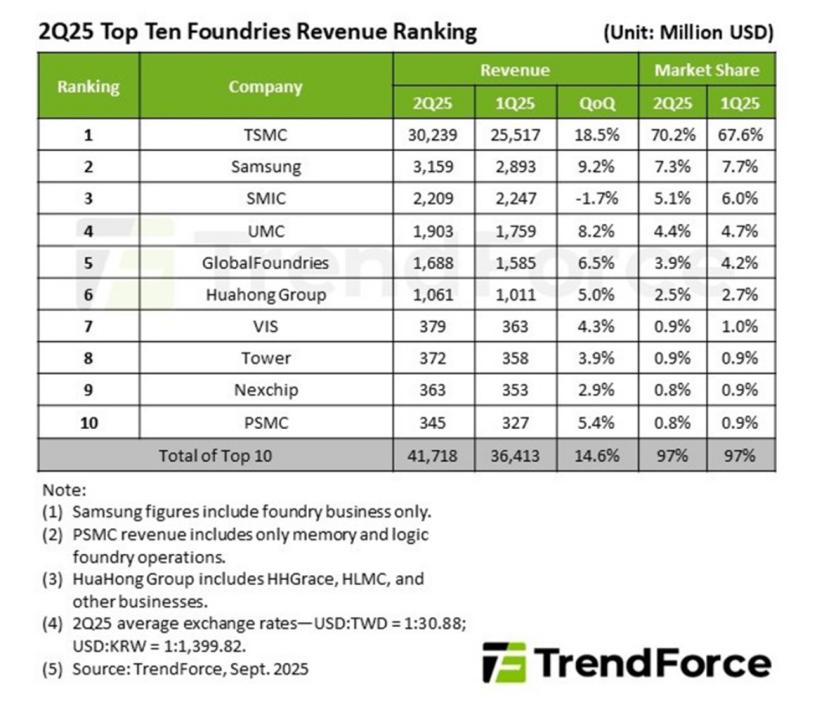
Core Insights - TSMC stands out in the Q2 2025 foundry revenue report, achieving over 40% year-on-year growth and expanding its market share to 70% [1][2] - The top ten foundries collectively generated revenues of $41.718 billion in Q2 2025, marking a 14.6% increase from the previous quarter [2] - TSMC's revenue reached $30.239 billion in Q2 2025, a significant increase from $25.517 billion in Q1 2025, while Samsung and SMIC showed more modest growth [2] Company Performance - TSMC's revenue growth of 18.5% quarter-on-quarter is the highest among the top foundries, reinforcing its leading position in the industry [2] - Samsung's revenue increased by 9.2% to $3.159 billion, while SMIC's revenue slightly declined by 1.7% to $2.209 billion [2] - TSMC's 3nm process technology has significantly contributed to its revenue, accounting for 22% of its total revenue in Q1 2025 [3] Technological Advancements - TSMC has consistently made the right technological choices, such as adopting EUV lithography for the 7nm node, which allowed it to surpass Intel [3][4] - The company utilized FinFET architecture for its 3nm process, achieving better performance and yield compared to Samsung's GAA architecture, which has struggled with yield issues [3][4] - TSMC's investment in R&D for the 3nm node exceeded $10 billion, similar to Samsung's investment [3] Industry Trends - The semiconductor industry is witnessing a shift towards collaborative development between design and manufacturing, driven by recent U.S. export restrictions on EDA tools [12] - The Chinese semiconductor industry is increasing its focus on manufacturing capabilities, recognizing the importance of this segment in the supply chain [12] - TCAD simulation software is becoming a critical tool for optimizing semiconductor processes, significantly reducing development cycles and costs [8][12] Future Outlook - The importance of TCAD is expected to grow as the industry moves towards more advanced nodes like 2nm, where new challenges such as three-dimensional heterogeneous integration will arise [14] - Companies that effectively leverage TCAD for process optimization will gain a competitive edge in the ongoing technological race [14]