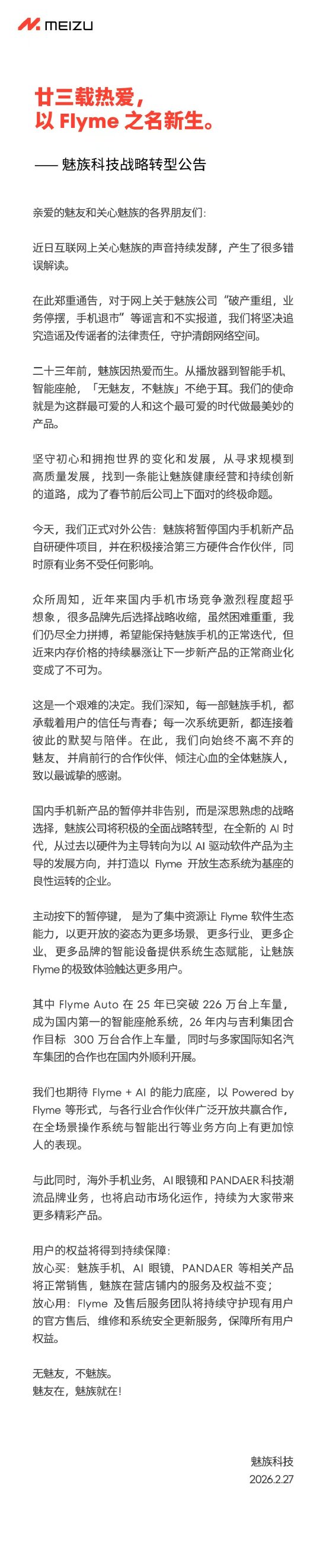
Flyme开放生态系统

Search documents
魅族回应手机业务停摆:暂停国内手机新品,否认破产重组传闻
Nan Fang Du Shi Bao· 2026-02-27 04:30
Core Viewpoint - The company officially denies rumors of bankruptcy restructuring and business suspension, announcing a strategic shift towards AI-driven software products while halting domestic hardware development for new mobile phones [1][2]. Group 1: Strategic Shift - The company will pause its domestic mobile hardware projects and focus on developing the Flyme open ecosystem, emphasizing a transition from hardware to software-driven products [1][3]. - The decision to shift strategy is attributed to intense competition in the domestic mobile market and rising memory prices, making the commercialization of new products unfeasible [2]. Group 2: Business Operations - After shedding the burden of domestic hardware development, the company aims to operate as a resilient enterprise centered on software, particularly through the Flyme ecosystem [3]. - The company has set ambitious targets for its Flyme Auto system, aiming for 2.26 million units by 2025 and 3 million units in collaboration with Geely Group by 2026, while also pursuing partnerships with other notable automotive groups [3]. - Overseas mobile business, AI glasses, and the PANDAER brand will operate independently in the market, ensuring that existing users continue to receive services and support for their products [3].
“业务停摆,手机退市”?魅族回应
Xin Lang Cai Jing· 2026-02-27 04:02
Core Viewpoint - Meizu has announced a strategic shift in response to recent rumors about its business operations, confirming the suspension of new domestic smartphone hardware projects while maintaining existing operations [1][7]. Group 1: Company Announcement - Meizu will pause the development of new domestic smartphone hardware projects and is actively seeking third-party hardware partners [1][7]. - The company emphasizes that existing business operations will not be affected by this decision [1][7]. - Meizu is committed to pursuing legal action against those spreading false rumors about bankruptcy and business cessation [1][7]. Group 2: Market Context - The domestic smartphone market has become increasingly competitive, leading many brands to strategically downsize [1][7]. - Rising memory prices have made the commercialization of new products increasingly challenging for Meizu [1][7]. Group 3: Strategic Transformation - Meizu is transitioning from a hardware-centric approach to a focus on AI-driven software products [5][11]. - The company aims to build a sustainable business model based on the Flyme open ecosystem, enhancing its software capabilities to serve a broader range of industries and devices [5][11]. - The decision to pause hardware development is seen as a strategic choice to concentrate resources on software ecosystem development [5][11]. Group 4: Historical Background - Founded in 2003, Meizu has provided integrated hardware and software services to over 100 million users through its Flyme operating system [8]. - In July 2022, Meizu underwent a strategic merger with Xingji Times, a company owned by Li Shufu [8]. - The newly formed Xingji Meizu Group focuses on innovation across consumer electronics, including smartphones, XR technology, and smart home devices [8]. Group 5: Future Outlook - Meizu's Flyme Auto has achieved over 2.26 million units in vehicle installations by 2025, indicating a growing presence in the automotive sector [12].

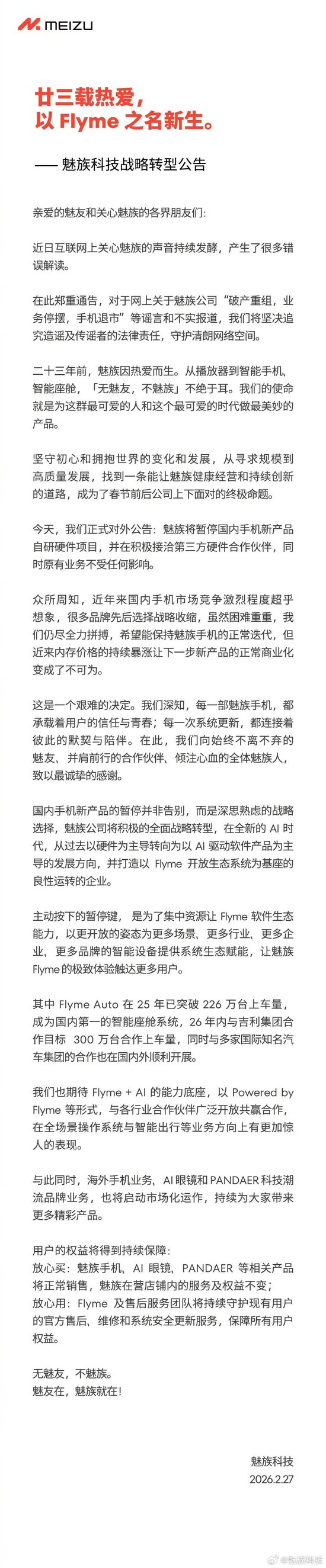
魅族回应破产退市传闻
Xin Lang Cai Jing· 2026-02-27 03:58
Core Viewpoint - Meizu officially announced a strategic transformation, pausing the development of new domestic smartphone hardware projects while maintaining existing business operations [1][4]. Group 1: Strategic Shift - Meizu will suspend the self-research hardware projects for new domestic smartphones and is actively seeking third-party hardware partners [1]. - The company emphasizes that this pause is a strategic choice to focus resources on enhancing the Flyme software ecosystem, aiming to provide system ecological empowerment for various smart devices [4][6]. Group 2: Market Context - The domestic smartphone market has become increasingly competitive, leading many brands to opt for strategic contraction [4]. - Rising memory prices have made the commercialization of new products challenging, prompting Meizu to reconsider its approach [4][6]. Group 3: Future Directions - Meizu plans to transition from a hardware-driven model to one focused on AI-driven software products, with the goal of creating a robust Flyme ecosystem [4]. - The Flyme Auto business is expected to maintain independent operations and integrate more deeply into Geely's smart automotive landscape, with a target of 3 million units by 2026 [5]. Group 4: Historical Context - Meizu was one of the early smartphone brands, launching its first model in 2009, but has struggled to compete with larger brands like Huawei and Xiaomi [5]. - The company previously sought strategic partnerships, including a collaboration with Alibaba in 2015, but did not achieve the anticipated growth [5]. Group 5: Recent Developments - In February 2024, Meizu announced an "All in AI" strategy, aiming to build AI terminals and reconstruct the Flyme system [6]. - The cancellation of the Meizu 22 Air due to rising memory costs indicates ongoing challenges in the smartphone segment [6].

魅族官宣暂停国内手机新产品自研硬件项目,多个平台官方渠道手机已无货
Xin Lang Cai Jing· 2026-02-27 03:36
Core Viewpoint - Meizu is pausing the development of new hardware projects for domestic smartphones and is actively seeking third-party hardware partners, while existing operations will remain unaffected. The company aims to strategically transform from a hardware-centric model to an AI-driven software product focus, establishing a sustainable enterprise based on the Flyme open ecosystem [2]. Group 1: Strategic Shift - Meizu is transitioning from a hardware-led approach to an AI-driven software product strategy in response to intense competition in the domestic smartphone market [2]. - The company plans to build a sustainable enterprise centered around the Flyme open ecosystem [2]. Group 2: Market Challenges - The ongoing surge in memory prices has made the commercial viability of new products increasingly difficult, prompting Meizu to reconsider its product development strategy [2]. - Many brands in the domestic smartphone market have opted for strategic contraction due to fierce competition [2]. Group 3: Current Product Availability - Meizu's official flagship stores on platforms like Tmall and Pinduoduo currently show no smartphones for sale, indicating that products are sold out [5]. - The Meizu official website also displays messages indicating that products are "restocking" or "sold out," with customer service confirming that the company is working on replenishing stock [8]. Group 4: Historical Context - Founded in 2003, Meizu was a leader in the domestic music player market and gained a foothold in the smartphone market with the release of its first smartphone, the M8, in 2007 [8]. - In 2014, Meizu achieved over 20 million units sold in a year, marking a 350% year-on-year growth and entering the top 10 of domestic smartphone brands [8]. - In July 2022, Geely Holding Group acquired a 79.09% stake in Meizu, aiming to integrate mobile and automotive software technologies [8]. Group 5: Future Plans - Meizu's "All in AI" strategy announced in February 2024 aims to develop AI terminals, restructure the Flyme system, and build an AI ecosystem [8]. - The Flyme Auto system is projected to exceed 2.26 million units in vehicle installations by 2025, with a target of 3 million units in collaboration with Geely Group by 2026 [9].
魅族宣布暂停国内手机自研硬件项目,全面转型AI和Flyme生态
Xin Jing Bao· 2026-02-27 03:32
Core Viewpoint - Meizu Technology announced a strategic transformation, clarifying that rumors about bankruptcy and business suspension are false, and the company will pursue high-quality development while transitioning from hardware to AI-driven software products [1][4]. Group 1: Strategic Transformation - Meizu will suspend the development of new domestic smartphone hardware projects and is actively seeking partnerships with third-party hardware providers, while existing operations will remain unaffected [1][5]. - The decision to pause new product development is a strategic choice aimed at focusing resources on enhancing the Flyme software ecosystem, which will provide system capabilities for various industries and brands [5]. Group 2: Market Conditions - The domestic smartphone market has become increasingly competitive, leading many brands to scale back their operations. Meizu aims to maintain normal iterations of its smartphones despite challenges, including rising memory prices that hinder the commercialization of new products [1][5]. - The company has reported that Flyme Auto has surpassed 2.26 million units in vehicle installations, becoming the leading smart cockpit system in the country, with a target of 3 million units in collaboration with Geely Group [5]. Group 3: User Rights and Product Offerings - User rights will continue to be protected, with Meizu smartphones, AI glasses, and the PANDAER brand products remaining available for sale, and existing services and support will not change [2].
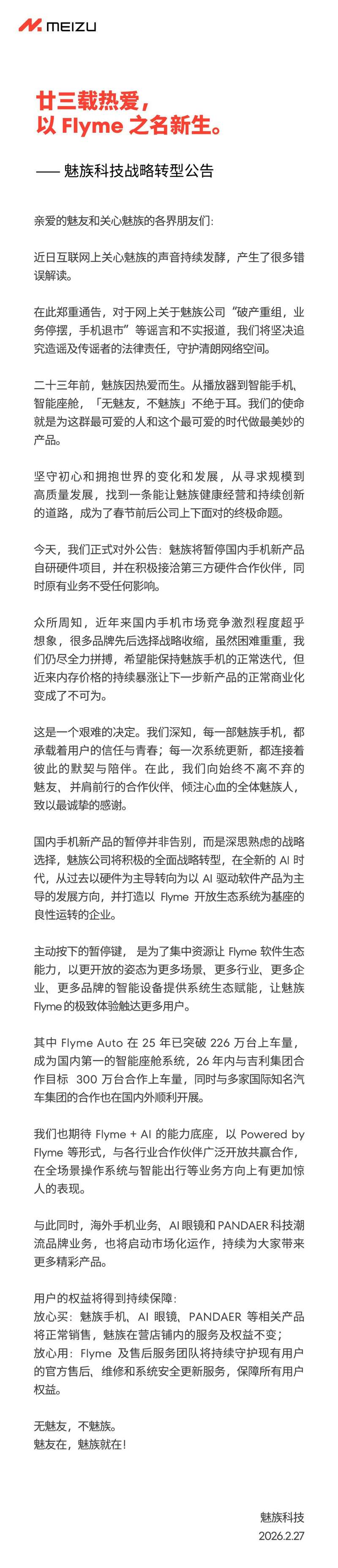
魅族发布转型公告,辟谣“破产重组,业务停摆,手机退市”
Mei Ri Jing Ji Xin Wen· 2026-02-27 03:20
Core Viewpoint - Meizu has announced a strategic shift, pausing the development of new hardware for domestic smartphones and seeking partnerships with third-party hardware providers due to intense competition and rising memory prices in the domestic market [1][4]. Group 1: Strategic Shift - The company will transition from a hardware-centric approach to focusing on AI-driven software products, aiming to create a sustainable business model based on the Flyme open ecosystem [2][4]. - Meizu's smartphone business is reportedly facing a significant halt, with plans for the Meizu 23 series being canceled and several employees leaving or transitioning within the company [2][4]. Group 2: Market Conditions - The domestic smartphone market has become increasingly competitive, leading many brands to scale back their operations [1][4]. - Rising memory prices have made the commercialization of new products unfeasible, prompting the decision to pause new hardware development [1][4]. Group 3: Future Directions - The company aims to enhance the Flyme software ecosystem, targeting broader applications across various industries and smart devices [5]. - Flyme Auto has achieved over 2.26 million units in 2025, becoming the leading smart cockpit system in China, with a goal of 3 million units in collaboration with Geely Group [5]. Group 4: User Assurance - Existing products, including Meizu smartphones, AI glasses, and PANDAER products, will continue to be sold, and customer service and support will remain unchanged [6].
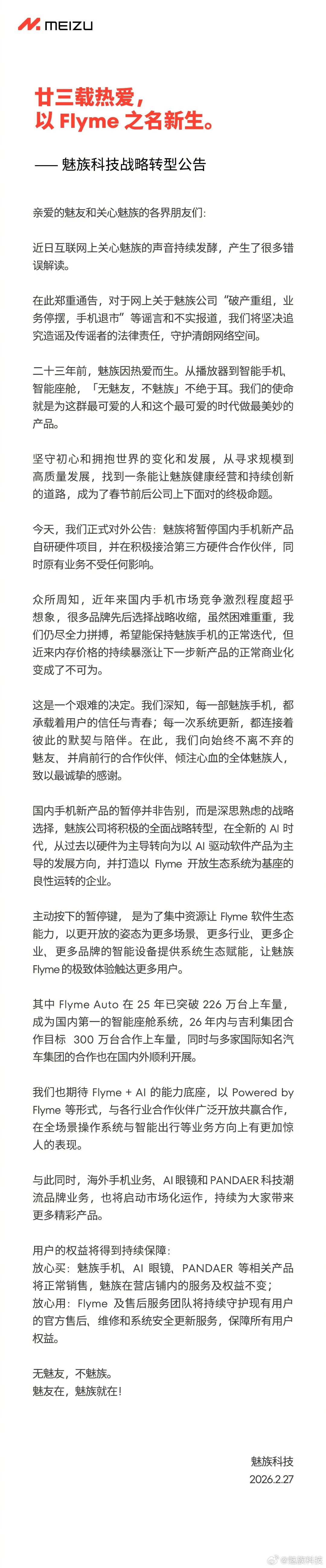
魅族:将暂停国内手机新产品自研硬件项目,积极接洽第三方硬件合作伙伴
Xin Lang Cai Jing· 2026-02-27 02:14
Core Viewpoint - Meizu has announced that rumors regarding its bankruptcy and business suspension are false, and it will pursue legal action against those spreading misinformation. The company will pause its domestic smartphone hardware development while maintaining existing operations and shifting its focus towards AI-driven software products and the Flyme ecosystem [1][5][9]. Group 1: Business Strategy - Meizu will suspend the development of new domestic smartphone hardware projects and is actively seeking partnerships with third-party hardware providers, ensuring that existing business operations remain unaffected [3][9]. - The decision to pause hardware development is a strategic choice aimed at transitioning from a hardware-centric model to one driven by AI software products, with a focus on creating a sustainable business based on the Flyme open ecosystem [3][4][9]. Group 2: Market Context - The domestic smartphone market has become increasingly competitive, leading many brands to scale back their operations. Despite these challenges, Meizu aims to continue the normal iteration of its smartphones [3][9]. - Rising memory prices have made the commercialization of new products increasingly difficult, contributing to the decision to pause new hardware development [3][9]. Group 3: Future Plans - Meizu's Flyme Auto has achieved a milestone of over 2.26 million units in vehicle installations by 2025, making it the leading smart cockpit system in China. The company aims to collaborate with Geely Group to reach a target of 3 million units by 2026 [4][10]. - The company plans to initiate market operations for its overseas smartphone business, AI glasses, and PANDAER technology brand, continuing to deliver innovative products to consumers [6][10].