
智能座舱

Search documents
蓝思科技20260313
2026-03-16 02:20
Summary of the Conference Call for Lens Technology (蓝思科技) Industry and Company Overview - **Company**: Lens Technology (蓝思科技) - **Industry**: Consumer Electronics, AI Servers, Robotics, Commercial Aerospace Key Points and Arguments Consumer Electronics - The company will exclusively supply the first foldable screen UTG glass to Client A in 2026, with an additional value of nearly $150 per unit from new material numbers including PET and frame components [2][15] - Client T's supply chain position is solid, with expected sales reaching 5 billion RMB in 2024, and the company is close to global exclusivity in the B pillar and automotive central control module sectors [2][4] - The company has established a strong long-term partnership with major clients, enhancing collaboration through visits and the establishment of a metal research institute [4] AI Server Business - The company plans to acquire 95% of Yuan Stone Technology to enhance its server supply capabilities, targeting major North American clients [2][5] - The acquisition aims to integrate into the AI ecosystem, providing liquid cooling plates and cabinets, which are essential for large clients [5][18] Robotics - The company is assembling XR small robots for Yushutech, with significant market demand in performance, guiding, and educational sectors [6] - The company aims to integrate self-manufactured components into robotic products, leveraging its experience in the automotive sector [6] Commercial Aerospace - The company has developed a strong technical barrier in UTG glass production, which is being applied to satellite solar wings, with samples sent to overseas clients [2][10] - The UTG glass is lightweight, flexible, and resistant to radiation, making it suitable for the growing low-orbit satellite market [7][10] Global Capacity Layout - New production facilities in Vietnam and Thailand are set to begin operations in 2025, supporting North American clients' needs [3][11] - The company’s strategic positioning in Southeast Asia is designed to mitigate geopolitical risks and ensure supply chain stability [3][21] Financial Outlook - The company anticipates significant revenue contributions from the smart cockpit and robotics sectors in 2026, with established production lines for automotive glass [7][22] - The server business is expected to become a stable revenue growth point following the acquisition of Yuan Stone Technology [22][23] Additional Important Information - The company is actively pursuing the integration of its capabilities across various sectors, including consumer electronics, AI, and robotics, to enhance overall value [5][22] - The company has a robust plan for the future, focusing on innovation cycles in consumer electronics and strategic partnerships in emerging technologies [22][23] - The transition of assembly operations to India is not expected to impact the company's market share, as it primarily affects the assembly of finished products rather than component supply [21]

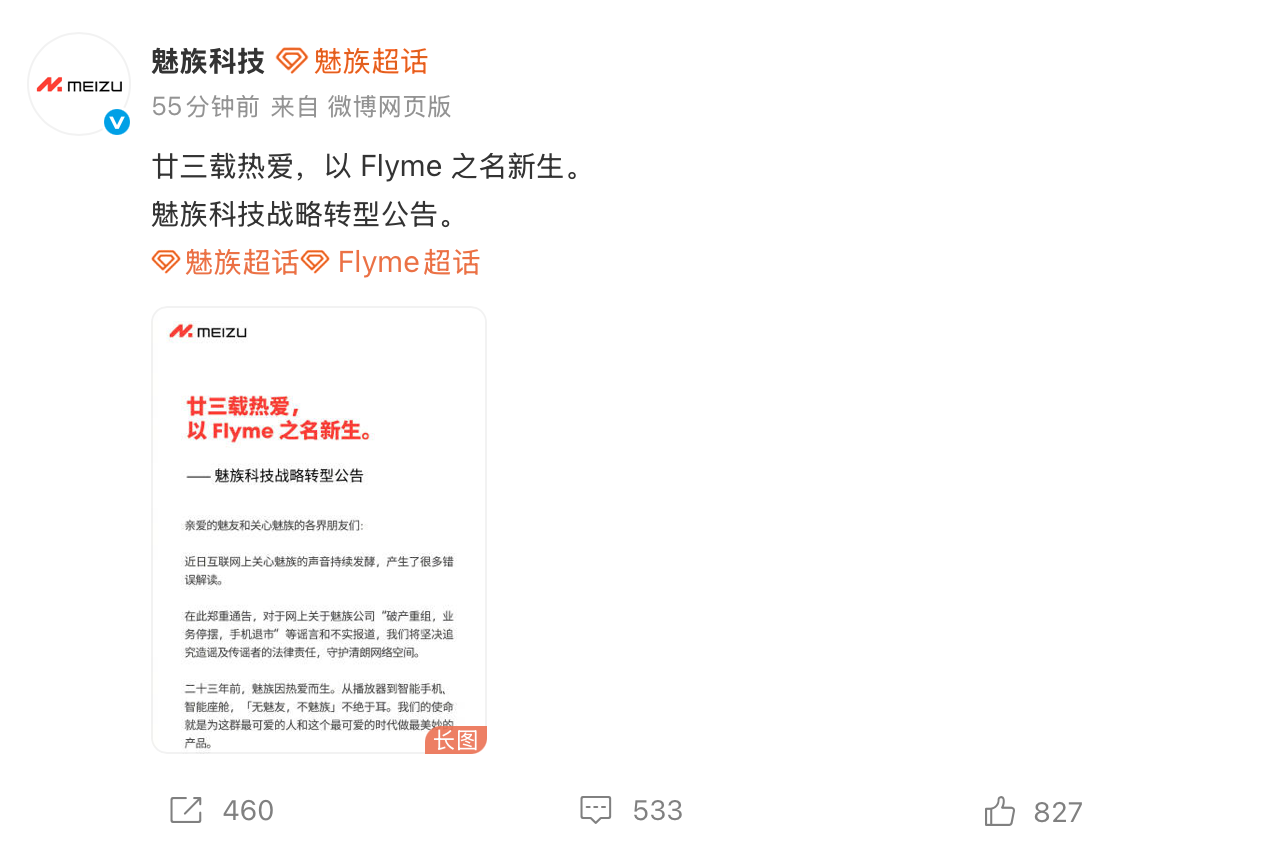
魅族回应传闻:将暂停国内手机新产品自研硬件项目 集中资源到Flyme软件
Mei Ri Jing Ji Xin Wen· 2026-02-27 08:39
Core Viewpoint - Meizu is undergoing a strategic transformation, pausing the development of new domestic smartphone hardware projects to focus resources on the Flyme software ecosystem, amidst intense competition and rising memory prices in the smartphone market [1][2]. Group 1: Company Strategy - Meizu has announced a pause in the development of new domestic smartphone hardware, while actively seeking third-party hardware partnerships [1][2]. - The company aims to transition from a hardware-centric model to an AI-driven software product model, emphasizing the Flyme open ecosystem [2]. - Meizu's FlymeAuto has achieved a significant milestone with over 2.26 million units installed in 2025, aiming for 3 million units in collaboration with Geely in 2026 [3]. Group 2: Market Context - The global memory chip market has seen unprecedented price increases, with DRAM and NAND flash prices expected to rise by 386% and 207% respectively in 2025 [2]. - Major smartphone brands, including OPPO and OnePlus, are planning price adjustments due to rising component costs, indicating a challenging market environment [2]. - Meizu's market position has declined, now categorized under "Others" in the smartphone segment, highlighting the competitive pressures faced [3]. Group 3: Corporate Background - Meizu was founded in 2003 and launched its first MP3 product the same year, followed by its first smartphone, the M8, in 2009 [3]. - In July 2022, a strategic investment by Hubei Xingji Times Technology Co., which acquired a 79.09% stake in Meizu, marked a significant shift in control and management [3]. - Geely's chairman has expressed a vision for the integration of smart automotive and smartphone industries, aiming for a seamless user experience across devices [4].
魅族回应破产退市传闻
Xin Lang Cai Jing· 2026-02-27 03:58
Core Viewpoint - Meizu officially announced a strategic transformation, pausing the development of new domestic smartphone hardware projects while maintaining existing business operations [1][4]. Group 1: Strategic Shift - Meizu will suspend the self-research hardware projects for new domestic smartphones and is actively seeking third-party hardware partners [1]. - The company emphasizes that this pause is a strategic choice to focus resources on enhancing the Flyme software ecosystem, aiming to provide system ecological empowerment for various smart devices [4][6]. Group 2: Market Context - The domestic smartphone market has become increasingly competitive, leading many brands to opt for strategic contraction [4]. - Rising memory prices have made the commercialization of new products challenging, prompting Meizu to reconsider its approach [4][6]. Group 3: Future Directions - Meizu plans to transition from a hardware-driven model to one focused on AI-driven software products, with the goal of creating a robust Flyme ecosystem [4]. - The Flyme Auto business is expected to maintain independent operations and integrate more deeply into Geely's smart automotive landscape, with a target of 3 million units by 2026 [5]. Group 4: Historical Context - Meizu was one of the early smartphone brands, launching its first model in 2009, but has struggled to compete with larger brands like Huawei and Xiaomi [5]. - The company previously sought strategic partnerships, including a collaboration with Alibaba in 2015, but did not achieve the anticipated growth [5]. Group 5: Recent Developments - In February 2024, Meizu announced an "All in AI" strategy, aiming to build AI terminals and reconstruct the Flyme system [6]. - The cancellation of the Meizu 22 Air due to rising memory costs indicates ongoing challenges in the smartphone segment [6].


魅族官宣暂停国内手机新产品自研硬件项目,多个平台官方渠道手机已无货
Xin Lang Cai Jing· 2026-02-27 03:36
Core Viewpoint - Meizu is pausing the development of new hardware projects for domestic smartphones and is actively seeking third-party hardware partners, while existing operations will remain unaffected. The company aims to strategically transform from a hardware-centric model to an AI-driven software product focus, establishing a sustainable enterprise based on the Flyme open ecosystem [2]. Group 1: Strategic Shift - Meizu is transitioning from a hardware-led approach to an AI-driven software product strategy in response to intense competition in the domestic smartphone market [2]. - The company plans to build a sustainable enterprise centered around the Flyme open ecosystem [2]. Group 2: Market Challenges - The ongoing surge in memory prices has made the commercial viability of new products increasingly difficult, prompting Meizu to reconsider its product development strategy [2]. - Many brands in the domestic smartphone market have opted for strategic contraction due to fierce competition [2]. Group 3: Current Product Availability - Meizu's official flagship stores on platforms like Tmall and Pinduoduo currently show no smartphones for sale, indicating that products are sold out [5]. - The Meizu official website also displays messages indicating that products are "restocking" or "sold out," with customer service confirming that the company is working on replenishing stock [8]. Group 4: Historical Context - Founded in 2003, Meizu was a leader in the domestic music player market and gained a foothold in the smartphone market with the release of its first smartphone, the M8, in 2007 [8]. - In 2014, Meizu achieved over 20 million units sold in a year, marking a 350% year-on-year growth and entering the top 10 of domestic smartphone brands [8]. - In July 2022, Geely Holding Group acquired a 79.09% stake in Meizu, aiming to integrate mobile and automotive software technologies [8]. Group 5: Future Plans - Meizu's "All in AI" strategy announced in February 2024 aims to develop AI terminals, restructure the Flyme system, and build an AI ecosystem [8]. - The Flyme Auto system is projected to exceed 2.26 million units in vehicle installations by 2025, with a target of 3 million units in collaboration with Geely Group by 2026 [9].
智能座舱产业量价齐升 博泰车联跨界布局合作
Zhong Zheng Wang· 2026-02-13 11:42
Core Viewpoint - The collaboration between Botai Che Lian and Ping An Insurance aims to innovate the insurance ecosystem for smart travel through the integration of AI and connected vehicle technologies [1] Company Summary - Botai Che Lian plans to be listed on the Hong Kong Stock Exchange by September 30, 2025, with its core business focused on smart cockpits, providing domain controllers, integrated hardware and software products, and engineering delivery services to OEM manufacturers [1] - The company has secured a total of 10 billion yuan in high-end intelligent projects both domestically and internationally, leveraging its capabilities in Qualcomm's 8295 and 8397 high-performance platforms and the Kirin 9610A + HarmonyOS solution [1] Industry Summary - According to Guohai Securities, the growth in the smart cockpit industry is driven by the domestic market's shift towards vehicles priced below 100,000 yuan and the demand expansion from overseas automakers transitioning to electric and intelligent vehicles [1] - The increase in value within the industry is attributed to high-performance chips like Qualcomm's 8295 and 8397, which are driving upgrades in domain control product structures [1] - The hardware value in this industry is primarily driven by domain controllers and display subsystems, with costs varying significantly based on vehicle positioning [1] - Multiple institutional reports suggest that as the penetration rate of smart vehicles continues to rise, companies in the smart cockpit industry with technological capabilities and project implementation abilities are likely to benefit from industry development dividends [1]
午间涨跌停股分析:39只涨停股、8只跌停股, 无人驾驶、智能座舱板块同步走高,浙江世宝等涨停
Xin Lang Cai Jing· 2026-02-13 03:52
Group 1 - A-shares experienced significant movement with 39 stocks hitting the daily limit up and 8 stocks hitting the limit down on February 13 [1] - The autonomous driving and smart cockpit sectors saw a simultaneous rise, with Zhejiang Shibao, Xingmin Zhitong, and Qianli Technology reaching the limit up [1] - The advanced packaging concept also strengthened, with Yitian Co., Ltd. hitting the limit up [1] Group 2 - ST Cuihua faced a continuous decline with 4 consecutive limit down days, while *ST Jinglun and *ST Xiongmao experienced 2 consecutive limit down days [2] - Other companies such as Yabo Co. and Zhuolang Intelligent also hit the limit down [2]


国海证券:渗透率提升+AI升级 智能座舱国产供应链再成长
Zhi Tong Cai Jing· 2026-02-09 02:24
Core Insights - The smart cockpit industry is entering a clear growth cycle characterized by simultaneous increases in volume and price, driven by deeper domestic penetration into vehicles priced below 100,000 yuan and accelerated demand from overseas automakers transitioning to electric and intelligent systems [1] Group 1: Products and Trends - The smart cockpit, as a human-machine-environment integrated system, is experiencing a continuous increase in penetration and is evolving towards cognitive intelligence. The hardware value is primarily driven by domain controllers and display subsystems, with costs ranging from approximately 3,000 yuan for economy models to over 13,000 yuan for high-end models [1] - Three main drivers are contributing to new growth opportunities in the smart cockpit industry: technological upgrades, deepening penetration rates, and global expansion. The industry is transitioning from CL2 "partial cognition" to CL3 "high-level cognition" by 2027, with AI large models and multimodal interactions becoming core drivers. Qualcomm's chip platform iteration has improved AI performance by 12 times, and the penetration rate of voice interaction without wake-up commands has increased from 26% to 48% within a year [1] - The domestic penetration rate is expected to exceed 80% by 2026, leading globally, with high-level configurations accelerating penetration and driving value increase. The overseas market is entering a catch-up phase, with mainstream automakers accelerating intelligence through a "8155 scale + 8295 tiered upgrade" approach, heavily relying on collaboration with the Chinese supply chain for product implementation [1] Group 2: Market and Landscape - The smart cockpit domain control market is projected to grow from 20.82 billion yuan in 2025 to 70.16 billion yuan in 2030, with a compound annual growth rate (CAGR) of 27.5%, with 2026 and 2027 being critical windows. The smart cockpit display market is expected to increase from 57.9 billion yuan in 2025 to 117.1 billion yuan in 2030, with a CAGR of approximately 15% [2] - Growth in the display market is driven by multi-screen integration (HUD, co-driver screens, rear-seat screens) and high-end display technology. The competitive landscape shows Qualcomm leading the cockpit domain control chip ecosystem, with domestic advantages in other components. Qualcomm dominates the cockpit domain control chip market due to its high computing power and comprehensive product system, while Desay SV (002920) remains the leader in domain controllers [2] - In the display sector, domestic suppliers have a clear advantage, with Desay SV leading in central screens and LCD instrument panels, and Huayang Multimedia leading in HUD/AR-HUD installations [2]

千里科技20260202
2026-02-03 02:05
Summary of Qianli Technology Conference Call Company Overview - Qianli Technology has transitioned from a traditional motorcycle and passenger vehicle manufacturer to an AI-driven automotive technology company, introducing new shareholders such as Geely Group and rebranding itself. [4] - The company focuses on smart driving, intelligent cockpits, and Robot Taxi businesses, marking a significant strategic shift. [2] Key Developments - Qianli Technology and Geely jointly launched the "Qianli Haohan" autonomous driving solution, covering levels L2 to L4, and showcased new autonomous driving products at CES. [2][6] - The company has partnered with Cao Cao Mobility to actively develop the Robot Taxi sector. [2][6] - The intelligent cockpit has integrated an AI Agent version capable of understanding complex commands, with rapid revenue growth in new business segments, although profit scalability is still developing. [2][7] Financial Performance - Post the 2024 equity restructuring, Qianli Technology's financial situation has improved significantly, with profits rising from 24 million yuan in 2023 to 40 million yuan in 2024, and reaching 53 million yuan in the first three quarters of 2025, surpassing the total for 2024. [8] - The gross margin remains stable, and the expense ratio is well-controlled, indicating a positive outlook for new business segments as key growth drivers. [8] Industry Trends - The automotive industry is expected to focus on robotics, smart driving, high-end products, and international expansion by 2026, with significant growth anticipated in the smart driving sector. [3] - Autonomous driving technology is maturing, with notable reductions in hardware and software costs, and several regions have begun conditional testing for L3 autonomous driving. [9] Market Dynamics - The smart driving support market is dominated by OEMs and third-party suppliers, with companies like Momentan and Huawei holding 60% and 21% market shares, respectively. Qianli Technology collaborates with Geely and Chongqing Maichi to offer L2 to L4 level smart driving solutions. [11] - The penetration rate of L2 and above smart driving models reached 65.38% in 2025, with a projected global market size of approximately 300 billion yuan by 2025, expanding to 844.8 billion yuan by 2030, with China expected to account for 33.2% of the global market. [10] Robot Taxi Sector - The Robot Taxi industry is anticipated to experience significant growth in 2026, with major players including Tesla, Xiaopeng, and mobility platforms like Cao Cao Mobility. [13] - Qianli Technology plans to deploy over 1,000 Robot Taxis in 10 cities globally within the next 18 months, leveraging strategic partnerships and support from Geely Group. [14] Investment Outlook - Despite its current focus on traditional vehicle manufacturing, Qianli Technology's transformation into a technology company is expected to reshape its valuation. Revenue projections for 2025 to 2027 are estimated at 8.681 billion, 10.495 billion, and 12.415 billion yuan, respectively, with an average annual growth rate of 20%. [15]

极豆科技联合智谱、中国银联发布“座舱原生支付Agent”
Xin Hua Cai Jing· 2026-01-28 13:11
Core Insights - The launch of the "Native Payment Agent" by Jidou Technology, Zhipu, and China UnionPay aims to integrate payment capabilities into smart cockpit systems, addressing long-standing pain points in in-car payment processes [2][3] Group 1: Product Overview - The "Native Payment Agent" is based on a "large model + intelligent agent" architecture, enabling system-level integration of payment capabilities within smart cockpits [2] - Traditional in-car payment methods often rely on external app redirection or simple feature overlays, which do not create a seamless interaction with voice commands and contextual services [2] Group 2: Technical Architecture - The product features a layered design with a "model base + scenario intelligent agent," utilizing Zhipu's GLM series large models for enhanced understanding of user natural language commands and contextual relationships [3] - Jidou Technology has developed an intelligent agent capability system tailored for in-car environments, converting large model cognitive abilities into real-time executable system instructions that meet automotive safety standards [3] Group 3: Collaboration and Ecosystem - China UnionPay provides payment services based on the Model Context Protocol (MCP), ensuring compliance with financial regulations and security standards for various travel scenarios such as refueling and parking [3] - The collaboration among Jidou Technology, Zhipu, and China UnionPay is supported by the ecosystem of the Pudong Moli Community, which has become a hub for vertical model industries [3]
极豆科技、智谱、中国银联三方联合发布座舱原生支付Agent
Zheng Quan Ri Bao Wang· 2026-01-28 10:47
Core Viewpoint - The launch of the "Native Payment Agent for Cabin" by Shanghai Jidou Technology, Beijing Zhipu Huazhang Technology, and China UnionPay represents a significant advancement in integrating payment capabilities into smart vehicle ecosystems, enhancing user experience during travel [1][3]. Group 1: Product Overview - The Native Payment Agent is designed as a core component of the cabin service chain, moving beyond traditional payment integration to create a seamless travel experience [1]. - The product leverages Jidou Technology's self-developed cabin intelligence architecture, enabling collaborative operations from service triggering to payment completion based on user intent and vehicle status [1][2]. Group 2: Technical Framework - The system employs a "model base + scenario intelligence" layered architecture, with Zhipu providing the GLM large model as a stable cognitive and reasoning foundation [2]. - Jidou Technology has developed an intelligent agent capability system tailored for in-vehicle environments, including modules for intent parsing, task decomposition, service orchestration, and execution control [2]. Group 3: Payment Capabilities - China UnionPay contributes the Model Context Protocol (MCP) payment service, allowing the Native Payment Agent to interface with various payment scenarios while adhering to financial regulations and security standards [3]. - The system can operate smoothly in high-frequency travel scenarios, reducing user operational burden during in-vehicle payments and enhancing overall travel experience continuity [3]. Group 4: Future Directions - Jidou Technology aims to further enhance the intelligent agent capability system and collaborate with Zhipu, China UnionPay, and other ecosystem partners to promote the product's application across more vehicle models [4]. - The company is also exploring partnerships with local businesses to accelerate the evolution of smart cabins into comprehensive travel and lifestyle service platforms [4].