GDP增速目标调整

Search documents
多省下调2026年GDP增速目标,意味着什么?
Sou Hu Cai Jing· 2026-02-06 02:11
Core Insights - Six out of the top ten economic provinces in China have lowered their GDP growth targets for 2026, indicating a shift towards more pragmatic economic management [2] - The adjustment reflects a focus on both "reasonable growth" and "effective quality improvement," suggesting a balanced approach to economic development [2][3] - The revised targets, while lower, still aim for a growth rate of around 5%, which remains competitive among major global economies [3] Group 1 - The adjustment of GDP growth targets is seen as a response to the diminishing returns on factors such as labor, land, and capital as economies grow larger [3] - The provinces are emphasizing the synchronization of income growth with economic growth, addressing public concerns about stagnant disposable income [4] - The shift in targets is part of a broader effort to establish a more realistic performance evaluation system among local governments, moving away from the traditional focus on high GDP growth [4] Group 2 - The central economic work conference in 2025 advocated for a "pragmatic target orientation," which aligns with the recent adjustments made by local governments [2] - The emphasis on quality indicators, such as residents' income growth, highlights a commitment to high-quality economic development [4] - The trend of lowering growth targets is not indicative of a lack of confidence in long-term potential but rather a refined approach to economic cycle management [3]

多省下调2026年GDP增速目标意味着什么
经济观察报· 2026-02-05 07:38
Core Viewpoint - The adjustment of GDP growth targets by several major economic provinces in 2026 reflects a more pragmatic approach to performance evaluation, emphasizing quality over mere quantity in economic growth [2][4]. Group 1: Adjustments in GDP Growth Targets - Six out of the top ten economic provinces have lowered their GDP growth targets for 2026, while two others have adopted more cautious language, indicating a shift towards a more realistic and pragmatic attitude towards economic growth [2]. - The adjustment of growth targets is seen as a response to the challenges faced in 2025, where consumer and investment growth trends suggest ongoing economic difficulties [2][3]. Group 2: Focus on Quality of Growth - Economic provinces are now placing greater emphasis on the quality of growth, with specific indicators such as synchronizing resident income growth with economic growth being highlighted [4]. - The adjustment in growth targets is not indicative of a lack of confidence in long-term development potential but rather a refined strategy for managing economic cycles [3]. Group 3: Establishing a Correct Performance Evaluation Perspective - The recent adjustments signal a shift in the performance evaluation perspective among local governments, moving away from the traditional focus on GDP growth as the primary measure of success [4]. - Various provinces have called for adherence to practical decision-making and avoidance of impulsive actions, reflecting a broader consensus on the need for a more responsible approach to economic management [4].

多省下调2026年GDP增速目标意味着什么
Jing Ji Guan Cha Wang· 2026-02-05 07:02
Core Viewpoint - Multiple major economic provinces in China have lowered their GDP growth targets for 2026, indicating a shift towards more pragmatic and quality-focused economic management [1][2][3] Group 1: Adjustments in Growth Targets - Six out of the top ten economic provinces have reduced their GDP growth targets for 2026, while two provinces have maintained cautious language without changing their targets [1] - The adjustment reflects a more pragmatic approach by local governments, focusing on quality improvements alongside reasonable growth [1][2] Group 2: Economic Growth Dynamics - The rational adjustment of growth targets aligns with the economic growth patterns, as larger economies typically experience diminishing returns on factors like labor and capital [2] - Despite the downward adjustment, the growth target remains at 5%, which is still competitive among major global economies [2] Group 3: Quality of Economic Growth - Economic provinces are emphasizing indicators related to economic quality, such as synchronizing resident income growth with GDP growth, addressing public expectations amid pressures on income growth [3] - The adjustment in GDP targets signals a shift towards establishing a more realistic performance evaluation framework among local governments [3]
多个经济大省下调2026年GDP增速目标,着重提质
3 6 Ke· 2026-02-04 14:01
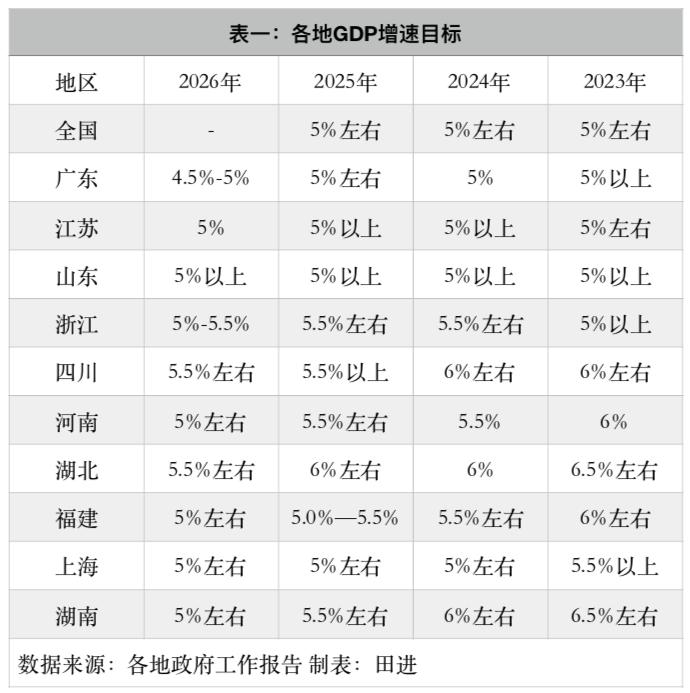
Core Viewpoint - Major economic provinces in China have significantly lowered their GDP growth targets for 2026 compared to 2025, reflecting a more cautious economic outlook and the challenges faced in achieving previous targets [1][5][8]. Summary by Sections Economic Growth Targets - As of February 3, 2026, ten major economic provinces have announced their GDP growth targets, with six provinces directly lowering their targets. The remaining four provinces either maintained their targets or made slight adjustments [1]. - The provinces that lowered their targets include Guangdong, Zhejiang, Henan, Hubei, Fujian, and Hunan, all of which emphasized striving for better outcomes in practice [1][6]. Historical Context - In the past three years, major provinces have frequently failed to meet their GDP growth targets, with Guangdong, Hubei, and Hunan consistently underperforming [1][5]. - Guangdong's target for 2026 is set at "4.5%-5%", marking the first time since 2000 that its target is below 5% [5]. Economic Trends and Analysis - The downward adjustment of growth targets is seen as a pragmatic response to ongoing economic pressures, including a shift from debt-driven growth to consumption and innovation-driven growth [3][6]. - The overall trend indicates that while growth targets are being lowered, major provinces are still aiming to maintain a target around 5%, which has historically been a benchmark for national GDP growth [8][9]. Future Projections - Analysts predict that the national GDP growth target for 2026 may also be adjusted downward to a range of 4.5%-5%, reflecting the collective adjustments made by major provinces [8][10]. - The economic outlook for the next five years suggests a gradual decline in growth rates, with a potential stabilization around 4.2% by 2030 [10].
多个经济大省下调2026年GDP增速目标,着重提质
经济观察报· 2026-02-03 12:15
Core Viewpoint - Major economic provinces in China have collectively lowered their GDP growth targets for 2026, reflecting a trend of not meeting previous targets and a shift towards more pragmatic economic planning [2][4][12]. Summary by Sections Economic Growth Targets - Six major economic provinces (Guangdong, Zhejiang, Henan, Hubei, Fujian, Hunan) have explicitly reduced their GDP growth targets for 2026, with Guangdong setting a target of "4.5%-5%" for the first time below 5% since 2000 [2][9]. - In contrast, only three provinces lowered their targets in 2025, indicating a significant shift in economic outlook [2]. Historical Performance - The trend of failing to meet GDP growth targets has been evident, with Guangdong, Hubei, and Hunan consistently missing their targets over the past three years [2][8]. - For the years 2023-2025, the number of provinces not achieving their GDP targets decreased from six to three, suggesting a potential improvement in economic performance [2]. Economic Context - The central economic work conference emphasized the need for a pragmatic approach to economic goals, focusing on quality improvements alongside growth [3]. - Economic indicators such as labor, land, capital, and technology are showing diminishing returns, necessitating a reevaluation of growth strategies [3][14]. Future Projections - Analysts predict that the national GDP growth target for 2026 may be adjusted downwards to a range of "4.5%-5%" due to the collective lowering of targets by major provinces [12][14]. - The economic landscape is expected to transition towards a more stable growth phase, with a focus on quality over quantity in economic development [13][14]. Policy Implications - Provinces are beginning to implement measures to boost economic growth in the first quarter of 2026, indicating a proactive approach to achieving the newly set targets [12]. - The emphasis on maintaining a growth target around 5% reflects a broader strategy to balance economic stability with sustainable development [12][13].