经济结构调整

Search documents
全区首个,“6000亿”大市来了
Sou Hu Cai Jing· 2026-02-13 02:19
Group 1 - The core viewpoint is that Nanning has achieved a GDP of 621.246 billion yuan in 2025, becoming the first city in Guangxi to surpass the 600 billion yuan mark, reflecting significant economic growth and structural changes [2][3] - Nanning's GDP growth contributed 19% to the overall growth of Guangxi, with key indicators such as industrial added value, retail sales, and foreign trade growing faster than the provincial average [2] - The three industrial sectors in Nanning are optimizing, with the primary sector accounting for 10.6%, the secondary sector 19.3%, and the tertiary sector 70.1%, indicating a shift towards new business models and economic dynamics [2] Group 2 - Nanning's GDP growth rate of 4.7% fell short of the provincial average of 5.1% and the city's own target of around 5% for 2025 [6] - The city's industrial growth rate reached 9.1%, while retail sales grew by 4.1%, and exports increased by 19.3%, although fixed asset investment saw a significant decline of 15.2% [6] - The government has introduced policies to encourage industrial enterprises to stabilize and enhance efficiency, including rewards for manufacturing projects that meet investment thresholds [7][8]

多个经济大省下调2026年GDP增速目标,着重提质
3 6 Ke· 2026-02-04 14:01
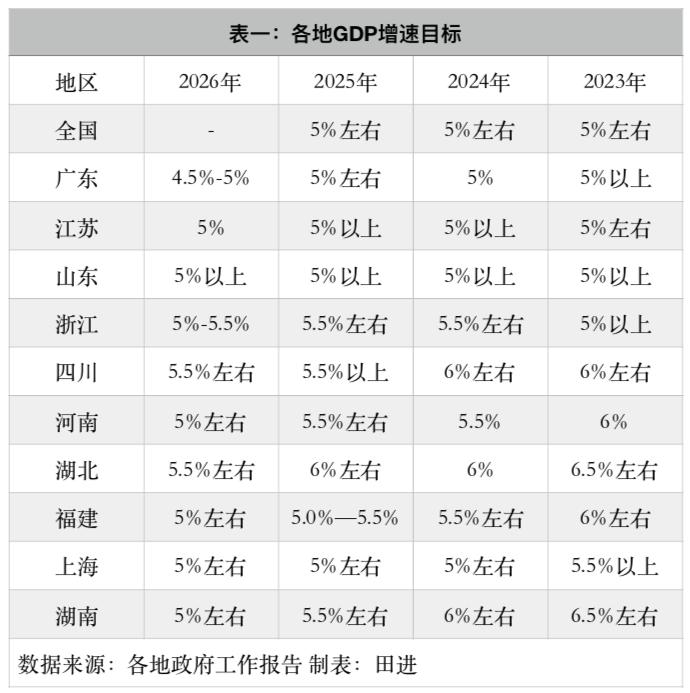
Core Viewpoint - Major economic provinces in China have significantly lowered their GDP growth targets for 2026 compared to 2025, reflecting a more cautious economic outlook and the challenges faced in achieving previous targets [1][5][8]. Summary by Sections Economic Growth Targets - As of February 3, 2026, ten major economic provinces have announced their GDP growth targets, with six provinces directly lowering their targets. The remaining four provinces either maintained their targets or made slight adjustments [1]. - The provinces that lowered their targets include Guangdong, Zhejiang, Henan, Hubei, Fujian, and Hunan, all of which emphasized striving for better outcomes in practice [1][6]. Historical Context - In the past three years, major provinces have frequently failed to meet their GDP growth targets, with Guangdong, Hubei, and Hunan consistently underperforming [1][5]. - Guangdong's target for 2026 is set at "4.5%-5%", marking the first time since 2000 that its target is below 5% [5]. Economic Trends and Analysis - The downward adjustment of growth targets is seen as a pragmatic response to ongoing economic pressures, including a shift from debt-driven growth to consumption and innovation-driven growth [3][6]. - The overall trend indicates that while growth targets are being lowered, major provinces are still aiming to maintain a target around 5%, which has historically been a benchmark for national GDP growth [8][9]. Future Projections - Analysts predict that the national GDP growth target for 2026 may also be adjusted downward to a range of 4.5%-5%, reflecting the collective adjustments made by major provinces [8][10]. - The economic outlook for the next five years suggests a gradual decline in growth rates, with a potential stabilization around 4.2% by 2030 [10].
宏观周度观察:行程过半的地方两会有何亮点?
Guolian Minsheng Securities· 2026-02-01 07:25
Group 1: Economic Growth Insights - In 2025, half of the provinces successfully met their GDP growth targets, while the other half did not, indicating a divergence in performance[5] - The adjustment of local growth targets for 2026 reflects a more scientific approach, aligning better with the potential economic growth centers of each region[5] - The expression of growth targets has shifted from vague terms to more flexible ranges, enhancing policy adaptability[21] Group 2: Macro Economic Review - December 2025 saw a significant rebound in industrial enterprise profit growth, with a year-on-year increase of 5.3% despite a revenue decline of 3.2%[27] - The overall public fiscal revenue recorded a negative growth for the first time since 2020, indicating a tightening of fiscal space[34] - The January 2026 PMI data showed a decline, suggesting a transition from quantity-focused growth to quality-oriented improvements in manufacturing[35] Group 3: Risks and Future Outlook - Potential risks include unexpected changes in the external environment, which could impact domestic economic stability[42] - The pace and effectiveness of policy implementation may not meet expectations, particularly in promoting service consumption[43] - Economic structural adjustments may lag behind expectations, affecting recovery progress in key sectors[44]
宏观周度观察:行程过半的地方两会有何亮点?-20260201
Guolian Minsheng Securities· 2026-02-01 06:08
Economic Growth Targets - In 2025, half of the provinces successfully met their GDP growth targets, while the other half did not, indicating a divergence in performance[5] - The adjustment of local growth targets for 2026 reflects a more scientific approach, aligning better with the potential economic growth centers of the regions[16] - Few provinces have raised their GDP growth targets for 2026, with many opting to lower expectations based on previous performance discrepancies[17] Macro Economic Indicators - December 2025 saw a significant rebound in industrial enterprise profit growth, with a year-on-year increase of 5.3%, despite a revenue decline of 3.2%[27] - The overall public fiscal revenue recorded a negative growth for the first time since 2020, indicating a tightening of fiscal space[34] - The January 2026 PMI data showed a slight decline, but high-tech manufacturing sectors performed well, suggesting a shift from quantity to quality in economic growth[35] Policy and Risk Considerations - Upcoming local government meetings are expected to focus on service consumption and economic adjustments, with potential risks from external economic conditions and policy implementation challenges[4][41] - The report highlights the need for caution regarding the pace of economic structural adjustments, which may not align with expectations[44]
好评中国·“经”彩开局|外资正以别样姿态拥抱中国
Zhong Guo Jing Ji Wang· 2026-01-28 05:10
Group 1 - In 2025, the number of newly established foreign-invested enterprises in China increased by 19.1% to 70,392, while the actual utilized foreign capital decreased by 9.5% to 747.69 billion yuan [1] - The decline in foreign capital utilization is attributed to increased uncertainty and instability in global economic exchanges, as well as a shift towards service-oriented and light-asset investments in cross-border investments [1] - Despite the decrease in capital, the increase in the number of foreign enterprises indicates a strategic shift rather than an exit, with many companies potentially in the early stages of project development [1] Group 2 - The service sector attracted the largest share of foreign capital, amounting to 545.12 billion yuan, highlighting China's vast market potential driven by its large population and growing middle class [2] - The manufacturing sector received 185.51 billion yuan in foreign investment, benefiting from China's comprehensive industrial categories and supply chain networks [2] - High-tech industries saw significant foreign investment, with actual utilization reaching 241.77 billion yuan, and notable growth in e-commerce services, medical equipment manufacturing, and aerospace manufacturing [2] Group 3 - The "14th Five-Year Plan" suggests creating new advantages for attracting foreign investment, including reducing the negative list for foreign investment access and promoting reinvestment [3] - Various regions are implementing measures to encourage foreign enterprises to invest and reinvest in China, with initiatives in cities like Shanghai and Beijing to attract high-quality foreign projects [3] - The narrative of foreign enterprises in China is evolving, focusing more on high-tech industries and innovative collaborations rather than merely establishing manufacturing facilities [3]
全球瞭望丨肯尼亚媒体:中国出口增长是全球消费者对中国制造的“信任投票”
Xin Hua She· 2026-01-25 05:19
Core Viewpoint - China's trade surplus is driven by global market demand and is providing tangible benefits to economies around the world [1] Group 1: Impact on Developing Countries and Emerging Economies - Developing countries and emerging economies benefit from the expansion of Chinese exports, which provide essential products for infrastructure development and energy transition [1] - A significant portion of Chinese exports consists of intermediate goods, which help African regions reduce costs and enhance competitiveness, allowing deeper integration into global value chains [1] - A report from the International Monetary Fund indicates that Chinese investment has significantly increased local processing rates in African countries, promoting their industrialization [1] Group 2: Benefits to Developed Economies - Western developed economies also benefit from Chinese exports, as multinational companies are deeply embedded in the Chinese manufacturing system, using China as a production base for global markets [2] - Foreign enterprises in China account for nearly one-third of China's total exports, providing consumers worldwide with higher cost-performance products [2] Group 3: China's Economic Adjustments - China is actively adjusting its economic structure to enhance domestic demand's role in economic development [2] - The country's large population and growing middle-income group present significant consumption potential, representing one of the most important growth opportunities globally [2]
越共提出确保实现经济两位数增长战略措施
Shang Wu Bu Wang Zhan· 2026-01-23 07:04
Core Insights - The Vietnamese government aims to achieve a double-digit economic growth rate exceeding 10% from 2026 to 2030, as emphasized by Deputy Minister Nguyen Anh Tuan during the 14th Congress of the Communist Party of Vietnam [1] Group 1: Strategic Measures for Economic Growth - The Ministry of Planning and Investment proposes several key strategic measures to ensure double-digit economic growth, including stabilizing the macroeconomic environment and enhancing economic resilience and strategic autonomy [2] - Accelerating economic restructuring in conjunction with industrialization and modernization, focusing on technology, innovation, and digital transformation as primary drivers [2] - Expanding international market access and diversifying markets, with a focus on restructuring export strategies to prioritize brand, high standards, and high-value-added products [2] Group 2: Resource Mobilization and Infrastructure Development - Mobilizing and effectively utilizing various resources, particularly public, domestic private, and foreign direct investment capital, while developing capital markets and encouraging venture capital and fintech models [2] - Advancing breakthroughs in economic systems, human resources, technology, innovation, and infrastructure to lay a solid foundation for rapid and sustainable development [2] - Emphasizing the need for synchronized and targeted implementation of these measures to address bottlenecks and create broad-based growth momentum [3]
深圳资金增量超6300亿 直接融资占比升至四成
2 1 Shi Ji Jing Ji Bao Dao· 2026-01-23 04:02
Group 1 - The core point of the article highlights the significant increase in direct financing in Shenzhen, with the total social financing scale exceeding 630 billion yuan in 2025, marking an increase of over 150 billion yuan year-on-year, and direct financing accounting for approximately 40% of the total, reaching a historical high [2][3] - The rise in direct financing is supported by corporate and government bonds, with the "Technology Board" for corporate bonds contributing significantly to this growth, particularly in the issuance of technology innovation bonds [2][3] - Since the establishment of the "Technology Board" in May 2025, Shenzhen's non-financial enterprises have issued a total of 44.15 billion yuan in technology innovation bonds in the interbank market, ranking second among cities nationwide [2] Group 2 - In addition to the interbank market, the issuance of technology innovation bonds by Shenzhen enterprises in the exchange market has also increased, with a total of 112 bonds worth 130.94 billion yuan as of October 2025 [3] - The issuance of technology innovation bonds has achieved full coverage among technology enterprises, venture capital institutions, and financial institutions, with a notable increase in participation from private enterprises [3] - The trend of increasing direct financing in Shenzhen aligns with national social financing data, where direct financing reached 16.7 trillion yuan in 2025, accounting for 46.9% of the total, marking a significant shift in financing structure [3][4]
需求端调整,四季度GDP增速阶段性下降
北京大学国民经济研究中心· 2026-01-23 01:33
Economic Growth - In 2025, GDP is projected to grow by 5.0% year-on-year, aligning with the initial economic growth target set at the beginning of the year[8] - In Q4 2025, GDP reached 387,911 billion yuan, growing by 4.5% year-on-year, a decrease of 0.3 percentage points from Q3 and 0.9 percentage points from the same period in 2024[19] - The industrial added value in December 2025 grew by 5.2% year-on-year, with a cumulative growth of 5.9%[22] Investment and Consumption - Fixed asset investment in 2025 decreased by 3.8% year-on-year, a decline of 1.2 percentage points compared to the previous period[11] - Social retail sales in December 2025 grew by 0.9% year-on-year, with an annual growth of 3.7%, a slight increase of 0.2 percentage points from 2024[34] - The per capita disposable income of residents in 2025 increased by 5.0% year-on-year, reflecting a downward trend in income growth[34] Trade and Inflation - In December 2025, total exports amounted to 357.78 billion USD, increasing by 6.6% year-on-year, while imports reached 243.64 billion USD, up by 5.7%[42] - The trade surplus in December 2025 was 114.14 billion USD, indicating a recovery in bilateral trade with Europe[42] - The Consumer Price Index (CPI) in December 2025 rose by 0.8% year-on-year, while the Producer Price Index (PPI) decreased by 1.9%[55]
连平:当前中国金融结构发生的重要变化
和讯· 2026-01-13 09:13
Core Viewpoint - The article discusses significant changes in China's financial structure, emphasizing the shift from indirect financing to direct financing, driven by policy initiatives and evolving economic needs [2][4]. Group 1: Financing Trends - The proportion of indirect financing in social financing has decreased, with direct financing's share increasing, marking a historical shift where indirect financing's share fell below 50% for the first time [3]. - As of November 2025, indirect financing accounted for 45.7% while direct financing reached 47.4%, indicating a notable trend where direct financing is outpacing indirect financing [3]. - The growth rate of credit has significantly declined, with the credit balance growth dropping from 12.8% in 2020 to 6.4% in 2025, reflecting a substantial decrease in credit demand [3][4]. Group 2: Direct Financing Growth - Direct financing has shown robust growth, supported by a more market-oriented allocation of funds and the development of multi-tiered capital markets, including platforms like the Sci-Tech Innovation Board and the Growth Enterprise Market [4][5]. - The demand for direct financing is increasingly driven by high-tech industries and emerging sectors, which require various forms of direct financing such as equity investments and corporate bond issuances [4][8]. Group 3: Future Outlook - The article predicts that active fiscal policies will continue, with a focus on maintaining moderate fiscal expansion to support market stability amid global uncertainties [6]. - Traditional sectors like real estate and infrastructure are expected to stabilize and improve gradually, but their financing needs will not return to previous levels, with credit growth projected to remain below 7% [6][9]. - The capital market is anticipated to develop positively, with a growing demand for stocks driven by high-tech industry listings and unprecedented policy support for investor protection [7][8]. Group 4: Structural Changes and Implications - The ongoing shift towards direct financing is expected to optimize China's financial structure, with direct financing potentially exceeding indirect financing in the near future [8][10]. - This transition is projected to lower financing costs, reduce corporate debt burdens, and enhance the efficiency of capital allocation, ultimately supporting high-quality economic development [9][10].