
LPR(贷款市场报价利率)

Search documents
最新LPR出炉
2 1 Shi Ji Jing Ji Bao Dao· 2026-01-20 01:34
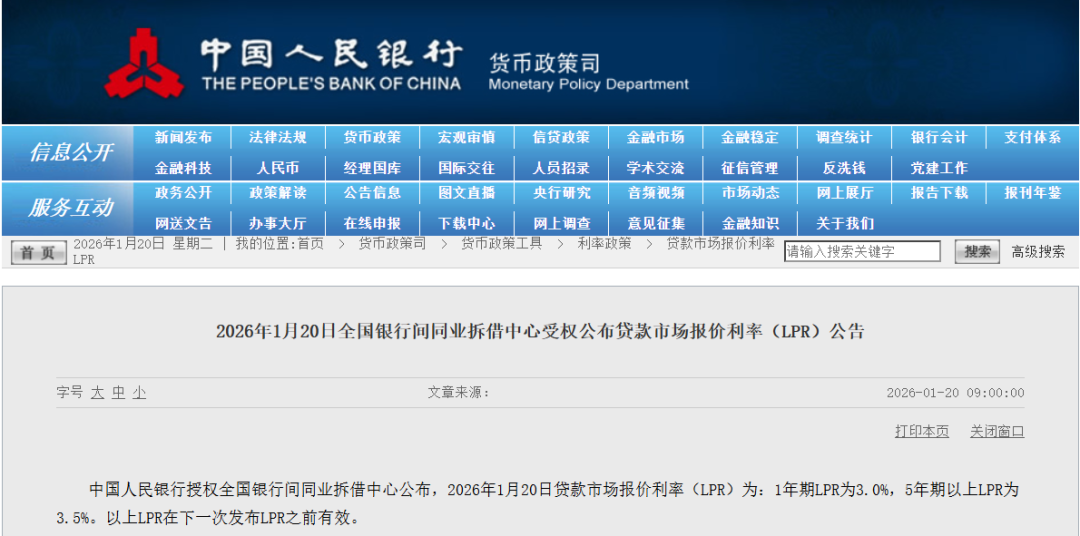
Core Viewpoint - The Loan Prime Rate (LPR) for both 1-year and 5-year terms remains unchanged at 3.0% and 3.5% respectively as of January 20, 2026, indicating a stable monetary policy environment [1][3]. Group 1: LPR Stability - The 1-year and 5-year LPRs have not changed for eight consecutive months since a decrease of 10 basis points in May 2025 [3]. - The current LPR rates are 3.0% for 1-year and 3.5% for 5-year terms, consistent with the previous month [1][3]. Group 2: Future Monetary Policy Outlook - Analysts suggest that a reduction in LPR is unlikely in January, as adjustments to the Medium-term Lending Facility (MLF) rates need to occur first, with potential changes expected in February or March [6]. - The People's Bank of China (PBOC) indicates that there is still room for both reserve requirement ratio (RRR) cuts and interest rate reductions in 2026 [7]. - The average RRR for financial institutions is currently at 6.3%, suggesting a potential reduction space of approximately 1.3 percentage points [8][9].

最新LPR出炉
21世纪经济报道· 2026-01-20 01:19
Core Viewpoint - The January LPR (Loan Prime Rate) remains unchanged, with the 1-year LPR at 3.00% and the 5-year LPR at 3.50%, indicating stability in the lending rates despite previous expectations for adjustments [1][4]. Group 1: LPR Stability - The 1-year and 5-year LPR have not changed for eight consecutive months since a decrease of 10 basis points in May 2025 [3]. - The current LPR rates are 3.00% for 1-year and 3.50% for 5-year, consistent with the previous month [1][4]. Group 2: Future Expectations - Analysts suggest that LPR adjustments may not occur until after the MLF (Medium-term Lending Facility) rate is adjusted, potentially delaying any changes until March [6]. - There is a significant focus on maintaining the stability of banks' operational rhythms and pricing systems, which could be disrupted by premature LPR reductions [7]. Group 3: Monetary Policy Outlook - The People's Bank of China indicates that there is still room for both reserve requirement ratio (RRR) cuts and interest rate reductions, with the current average RRR at 6.3% [9]. - Analysts estimate that there is approximately 1.3 percentage points of room for RRR cuts, suggesting a "hidden lower limit" around 5.0% [9]. - The use of open market operations, such as government bond transactions, may provide liquidity to the banking system, indicating that monetary policy easing will not be constrained by RRR cut limits [9].

中国LPR连续第八个月维持不变
Hua Er Jie Jian Wen· 2026-01-20 01:00
Core Viewpoint - The article emphasizes the importance of understanding market risks and the necessity for investors to conduct thorough research before making investment decisions [1] Group 1 - The market presents inherent risks that require careful consideration by investors [1] - Individual investment goals and financial situations should be taken into account when interpreting opinions and conclusions [1]
央行出台一批重磅政策,解读来了
Sou Hu Cai Jing· 2026-01-15 10:04
Core Viewpoint - The People's Bank of China (PBOC) is implementing targeted monetary policy measures to support high-quality development of the real economy, including a 0.25 percentage point reduction in various structural monetary policy tool rates [1][2]. Group 1: Monetary Policy Measures - The PBOC has lowered the one-year re-lending rate from 1.5% to 1.25%, marking the second reduction of this rate since May 2025 [2]. - The reduction in re-lending rates is expected to lower the cost of funds for commercial banks, potentially leading to lower loan rates for enterprises and individuals, particularly in sectors like small and micro enterprises and agriculture [2][3]. - The PBOC aims to enhance the efficiency of financial services to the real economy by using structural monetary policy tools to direct credit resources to weak links and key areas [3]. Group 2: Additional Support Measures - The PBOC plans to increase the quota for re-lending to support agriculture and small enterprises by 500 billion yuan, with a separate quota of 1 trillion yuan specifically for private enterprises [8]. - The quota for re-lending aimed at technological innovation and transformation has been increased from 800 billion yuan to 1.2 trillion yuan, expanding support to high R&D investment private small and medium enterprises [8]. - The PBOC is merging existing bond financing support tools for private enterprises and technological innovation, providing a total re-lending quota of 200 billion yuan [8]. Group 3: Broader Economic Implications - The PBOC has indicated that there is still approximately 1.3 percentage points of room for further reductions in the reserve requirement ratio, suggesting ongoing flexibility in monetary policy [6]. - The central bank emphasizes a cautious approach to monetary policy, avoiding excessive liquidity to prevent future inflation and debt issues, while focusing on targeted support for economic transformation [7]. - The PBOC's measures are designed to work in conjunction with fiscal policies to enhance the effectiveness of monetary policy and stimulate effective domestic demand [9].

11月LPR报价出炉,30年国债ETF博时(511130)逆市上涨
Sou Hu Cai Jing· 2025-11-21 02:15
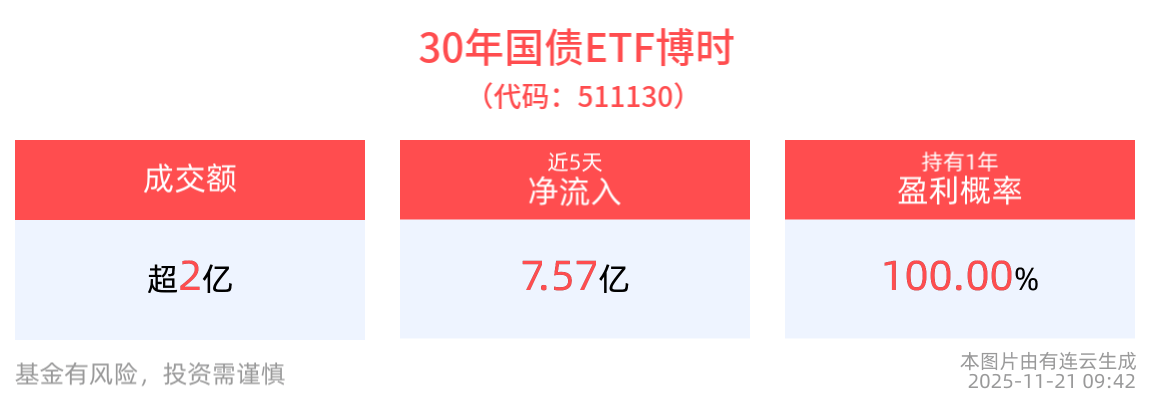
Group 1 - The 30-year government bond ETF from Bosera has seen a slight increase of 0.08%, with the latest price at 107.53 yuan, and a cumulative increase of 4.18% over the past year as of November 20, 2025 [2] - The trading volume for the 30-year government bond ETF was 1.35%, with a total transaction value of 2.59 billion yuan, and an average daily transaction of 33.69 billion yuan over the past month [2] - On November 21, government bond futures opened mostly higher, with the 30-year main contract rising by 0.03% to 115.960 yuan, the 10-year contract up by 0.07% to 108.550 yuan, and the 5-year contract increasing by 0.02% to 105.935 yuan [2] Group 2 - The latest LPR (Loan Prime Rate) for 1 year is 3.0% and for 5 years and above is 3.5%, both remaining unchanged for six consecutive months, aligning with market expectations [2] - Despite a slight decline in major medium to long-term market interest rates, banks lack the incentive to lower LPR quotes due to historically low net interest margins [3] - The current scale of the 30-year government bond ETF from Bosera is 19.087 billion yuan, with a recent net outflow of 53.8008 million yuan, although there has been a net inflow of 757 million yuan over the last five trading days [3]
LPR连续5个月按兵不动 年内仍有下调可能
Zheng Quan Ri Bao· 2025-10-20 17:29
Group 1 - The core viewpoint of the news is that the Loan Prime Rate (LPR) remains unchanged for both the 1-year and 5-year terms, aligning with market expectations, indicating stability in monetary policy [1] - The 1-year LPR is set at 3.0% and the 5-year LPR at 3.5%, with both rates unchanged from previous values, reflecting a lack of significant changes in the pricing basis for LPR [1] - The stability of the LPR is attributed to various factors including extreme weather, growth stabilization policies, external fluctuations, and adjustments in the real estate market, which have led to a decline in macroeconomic data [2] Group 2 - There is a possibility of interest rate cuts within the year, which could lead to a reduction in LPR, driven by increasing external volatility and the need for economic stabilization measures [3] - The expectation of a potential 50 basis point reserve requirement ratio cut and a 10 basis point interest rate cut by the end of the year reflects the ongoing need for a moderately loose monetary policy to counter economic pressures [3] - The overall monetary policy is expected to maintain a loose stance throughout 2025, in conjunction with fiscal, industrial, employment, and social security policies to form a cohesive policy approach [3]
10月20日最新消息:美联储降息后,中国央行再次不降息:LPR已5个月没动!为什么中国不降息?
Sou Hu Cai Jing· 2025-10-20 04:57
Core Viewpoint - The People's Bank of China (PBOC) has decided to maintain the Loan Prime Rate (LPR) unchanged for October, with the 1-year LPR at 3.0% and the 5-year LPR at 3.5%, marking five consecutive months without a change [3][5]. Group 1: Reasons for No Rate Cut - The narrowing interest margin is causing banks to earn less, with the net interest margin dropping to a historical low of 1.42%, making further rate cuts potentially unprofitable for banks [7]. - The policy interest rates have not changed, which means the pricing anchor for LPR remains stable, preventing any reduction [8][9]. - Market interest rates have increased, with the 1-year interbank certificate of deposit yield rising from 1.43% in August to 1.65% in September, leading to higher financing costs for banks and reducing the incentive to lower LPR [10]. - The central bank is assessing the effects of previous monetary policies, including a recent injection of 500 billion yuan in policy financial tools and a similar amount for local government debt limits, which require time to show results [11]. Group 2: Future Rate Cut Predictions - Experts suggest there may still be room for a rate cut by the end of the year, potentially by 50 basis points, due to concerning economic indicators such as a 0.3% year-on-year decline in CPI and a core CPI of only 1.0%, indicating deflationary pressures [13]. - The acceleration of growth-stabilizing policies, including the recent introduction of 500 billion yuan in new policy financial tools and local government debt limits, may also support the case for a rate cut [13]. - The external pressure from the Federal Reserve's rate cuts may weaken, allowing the PBOC to consider targeted adjustments, particularly to the 5-year LPR to support the real estate market [13].
广州首套房贷利率逆势上调10BP?
第一财经· 2025-05-18 09:30
Core Viewpoint - The article discusses the recent trend of rising mortgage rates in Guangzhou despite a general downward trend in the Loan Prime Rate (LPR), highlighting the uncertainty surrounding these changes and their implications for the housing market [1][2]. Group 1: Mortgage Rate Changes - Guangzhou's first home mortgage rate has been raised by 10 basis points (BP) to 3.1%, changing from LPR-60BP to LPR-50BP, effective from May 17 [1]. - There is speculation that if the LPR is lowered by 10 BP on May 20, the mortgage rate could potentially drop to 3% [1][2]. - The current mortgage rate of 3% is considered a critical threshold for banks, as rates below this may lead to losses in their mortgage business [2]. Group 2: LPR and Market Reactions - The People's Bank of China announced a reduction in policy rates, which is expected to lead to a corresponding decrease in the LPR by approximately 10 BP [2]. - If the LPR decreases, it could result in several cities seeing their mortgage rates fall into the "2" range, which would be a significant shift in the market [2]. - Last year, following a decrease in the LPR, Guangzhou saw extremely low mortgage rates, with some banks offering rates as low as 2.6%, creating a competitive environment among lenders [3][4]. Group 3: Historical Context - The trend of ultra-low mortgage rates in Guangzhou was halted in October last year, leading to a standardization of the first home mortgage rate at 3% [4]. - Prior to this, multiple cities had also experienced first home mortgage rates entering the "2" range, indicating a competitive pricing environment among banks [4].

广州首套房贷利率逆势上调10BP?尚存在不确定性
Di Yi Cai Jing· 2025-05-18 05:17
Group 1 - The LPR (Loan Prime Rate) is trending downward, yet there are indications that mortgage rates may be increased, with reports of first-home mortgage rates in Guangzhou rising by 10 basis points to 3.1% [1][2] - There is uncertainty regarding the mortgage rate adjustments, as some mortgage intermediaries have confirmed the increase, while others await official notifications from banks [1][2] - The People's Bank of China announced a reduction in policy rates, which is expected to lead to a corresponding decrease in the LPR by approximately 0.1 percentage points [1] Group 2 - If the LPR is reduced by 10 basis points, it could result in mortgage rates in several cities dropping to the "2" range, with a potential rate of 2.9% in Guangzhou if the current discount remains [2] - Maintaining a mortgage rate at or above 3% is crucial for banks, as rates below this threshold could lead to unprofitable mortgage operations [2] - Following a previous LPR reduction in July of last year, Guangzhou saw extremely low mortgage rates, with some banks offering rates as low as 2.6%, which was below the public fund rate [3]