TLAC(总损失吸收能力)

Search documents
2026年展望系列二:二永债供给缩量新常态
China Post Securities· 2025-11-17 06:38
Report Overview - The report focuses on the issuance and outlook of Tier 2 and Perpetual bonds (Two - Yong bonds) from 2025 to 2026, analyzing factors such as issuer structure, net financing, and regulatory approvals [2][3][8] 1. Report's Industry Investment Rating No industry investment rating is provided in the report 2. Core Viewpoints - In 2025, the overall issuance of Two - Yong bonds may slightly decline, with state - owned large - scale banks and city commercial banks increasing slightly, while joint - stock banks and rural commercial banks decreasing significantly. The net financing has continued to decline [3][9][15] - In 2026, it is estimated that about 1.31 trillion yuan of Two - Yong bonds will be issued. Although the remaining approval quotas are tight, the supply pressure is not significant [3][25] 3. Summary by Directory 3.1 2025 Review: Significant Changes in Issuer Structure and a Large Decrease in Net Financing 3.1.1 Two - Yong Bonds: Overall Issuance May Slightly Decline, Tier 2 Capital Bond Issuance Decreases, and Perpetual Bond Issuance Increases - The overall issuance in 2025 may slightly decline. Based on the monthly average issuance, the annual issuance may be slightly lower than that of last year. The issuance of 5 - year bonds has been relatively stable compared to last year, while the 10 - year bonds have been significantly slower [9] - By bank type, state - owned large - scale banks and city commercial banks may have a slight increase in issuance, while joint - stock banks and rural commercial banks may see a significant decrease [10] - Tier 2 capital bond issuance has decreased, while perpetual bond issuance has increased. The issuance of Tier 2 capital bonds in 2025 is significantly less than last year, while perpetual bond issuance is at a high level in recent years [12] - The issuance coupon rate has continued to decline. In 2025, the weighted coupon rates of 5 - year Tier 2 capital bonds and perpetual bonds of state - owned large - scale banks have dropped to around 2%, and those of joint - stock banks have dropped to around 2.16% [13][14] - The net financing in 2025 is 220 billion yuan, showing a continuous downward trend, mainly due to the high capital adequacy ratios of banks and the reduced urgency for global systemically important banks to supplement capital through Two - Yong bond issuance after meeting the TLAC requirements [15] - The net financing decline of Tier 2 capital bonds is more significant. As of November 11, 2025, the net financing of both Tier 2 capital bonds and perpetual bonds is about 110 billion yuan, with Tier 2 capital bonds being the main drag on the overall net financing [18] 3.1.2 TLAC Non - capital Bonds: Nearly 50 Billion Yuan Issued, with a 3 - year Maturity as the Main Tenor - As of November 11, 2025, about 49 billion yuan of TLAC non - capital bonds have been issued, with Bank of China issuing the largest amount at 15 billion yuan, followed by Agricultural Bank of China at 13 billion yuan, and Bank of Communications at 10 billion yuan [20] - The issuance of TLAC non - capital bonds is mainly in 3 - year tenors, totaling 39.4 billion yuan, followed by 6.4 billion yuan in 5 - year tenors and 3.2 billion yuan in 10 - year tenors (only issued by Agricultural Bank of China) [22] 3.2 2026 Outlook: Tight Remaining Approval Quotas but Expected Continued Supply, with an Estimated Issuance of 1.31 Trillion Yuan - ICBC has already met the second - stage TLAC requirements, while BOC and CCB are close to meeting them. ABC still has a gap of about 29 billion yuan, and on average, it needs to supplement about 14.5 billion yuan per year. If the Deposit Insurance Fund is not included, BOC has a TLAC gap of about 33.5 billion yuan [23] - The static upper limit of the TLAC compliance funding gap for the five major banks is 18.55 billion yuan. Considering the redemption of about 1.12 trillion yuan of Two - Yong bonds in 2026, a total of about 1.31 trillion yuan of Two - Yong bonds need to be issued in 2026 [25] - The remaining approval quotas are relatively tight. Since November 2023, regulatory authorities have issued a total of 2.85 trillion yuan in Two - Yong bond quotas, with 0.79 trillion yuan remaining [26] - However, the supply pressure is not significant. In late November 2025 or early 2026, regulatory authorities may issue new large - scale approvals based on actual situations. Banks that obtained approvals at the end of 2024 and the beginning of 2025 are still expected to obtain new approvals in early 2026 [32]
财政部注资四大国有银行,首批5000亿元特别国债预计定向发行
2 1 Shi Ji Jing Ji Bao Dao· 2025-03-31 08:45
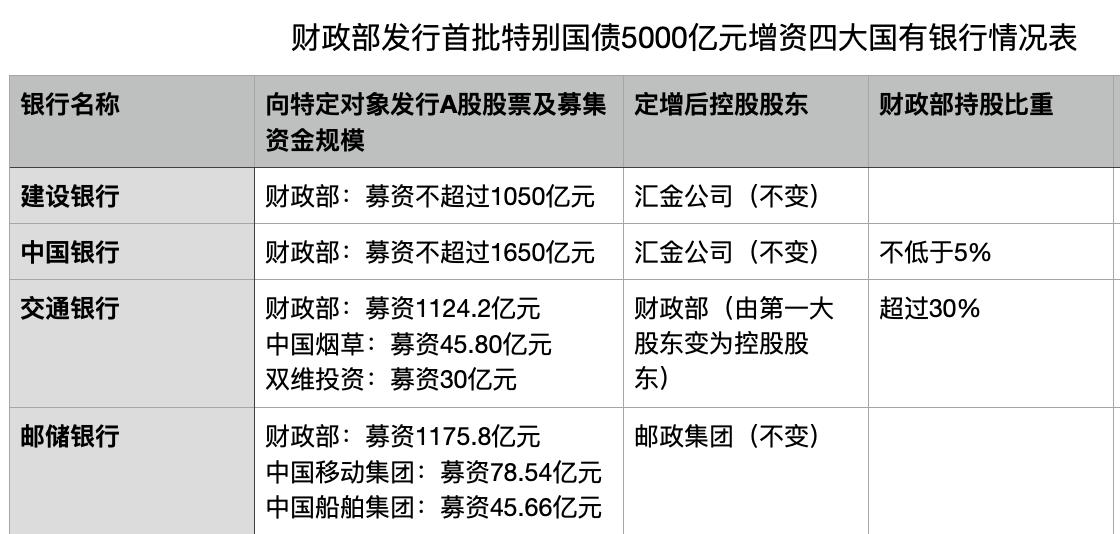
Core Viewpoint - The Ministry of Finance plans to issue the first batch of special government bonds worth 500 billion yuan by 2025 to support major state-owned banks in replenishing their core tier one capital, promoting stable operations and high-quality development in the banking sector [1][10]. Group 1: Special Government Bonds - The issuance of 500 billion yuan in special government bonds aims to enhance the capital of major state-owned banks, including Bank of China, China Construction Bank, and others [1][10]. - The issuance will follow market-oriented and legal principles to ensure a smooth process [1]. Group 2: Capital Raising by Banks - Major state-owned banks, including Bank of China, China Construction Bank, and Postal Savings Bank, have announced plans to issue A-shares to specific investors, with total fundraising amounts reaching up to 1,650 billion yuan for Bank of China and 1,050 billion yuan for China Construction Bank [2][3][5]. - The funds raised will be used entirely to increase the core tier one capital of these banks, with the Ministry of Finance being a significant investor [2][3][5]. Group 3: Financial Health of Banks - The Ministry of Finance reported that state-owned banks are operating steadily, with stable asset quality and sufficient provisions, indicating that key regulatory indicators are within a "healthy range" [1][11]. - The capital replenishment is expected to enhance banks' ability to serve the real economy and support macroeconomic stability [11][12]. Group 4: Regulatory Context - The capital management regulations for commercial banks will be implemented starting January 1, 2024, requiring banks to meet higher capital and risk management standards [6]. - The planned capital increase is a proactive measure to address the dual pressures of credit expansion needs and stricter TLAC (Total Loss-Absorbing Capacity) requirements [12]. Group 5: Economic Impact - The issuance of special government bonds is expected to leverage bank capital, potentially increasing credit availability by approximately 4 trillion yuan, thereby enhancing support for the real economy [12]. - The coordinated issuance of various types of government bonds is crucial for maintaining macroeconomic policy consistency [10].