
TLAC非资本债

Search documents
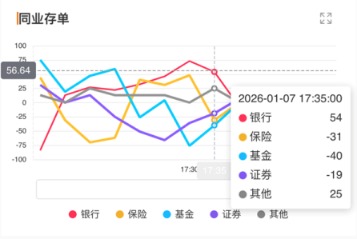
债市情绪雷达上新国利货币“同业存单买卖力量对比指数”
Xin Hua Cai Jing· 2026-01-09 03:13
Core Viewpoint - The introduction of the "Interbank Certificate of Deposit (NCD) Buy/Sell Power Comparison Index" by Xinhua Finance enhances the monitoring of short-term liquidity in the bond market, providing a comprehensive tool for understanding market sentiment and institutional trading dynamics [1][4]. Group 1: Index Overview - The NCD Buy/Sell Power Comparison Index focuses on highly liquid and actively traded money market instruments, filling a gap in short-end trading sentiment monitoring [1]. - The index is based on real-time trading data, tracking the buy/sell behavior of different types of institutions during specific time periods, resulting in a quantifiable sentiment indicator [1]. - The index value ranges from -100 to 100, where absolute values indicate the strength of buy/sell power comparison, with positive values indicating stronger buying power and negative values indicating stronger selling power [1]. Group 2: Institutional Classification and Trends - The index supports five types of institutions: banks, securities firms, broad-based funds, insurance companies, and other types [2]. - Recent data shows significant institutional differentiation in the NCD market, with banks showing a strong net buying position, while insurance and fund institutions are reducing their holdings, indicating a potential shift in market sentiment [4]. Group 3: Functionality and User Access - The "Bond Market Sentiment Radar" aggregates various real-time information, including the NCD Buy/Sell Power Comparison Index and market trends, allowing investors to gain insights into market depth and efficiency [4]. - Users can access the "Bond Market Sentiment Radar" through the Xinhua Finance professional terminal or integrate the index's real-time data into their internal systems for tailored business applications [6].

最新全球系统重要性银行名单出炉,中资机构首次进入第三组
Di Yi Cai Jing· 2025-11-30 11:21
Group 1: Core Insights - The 2025 Global Systemically Important Banks (G-SIBs) list has been released, with Chinese banks maintaining the same number of five institutions as the previous year, but with the Industrial and Commercial Bank of China (ICBC) moving up to the third group, becoming the first Chinese bank in this category [1][2] - The assessment framework for G-SIBs includes five weighted dimensions: size, interconnectedness, substitutability, complexity, and cross-border activity, with 13 secondary indicators used for a comprehensive evaluation [3] - Fitch Ratings noted that the scoring changes for Chinese G-SIBs this year are driven less by size and more by exchange rate effects, which have historically alleviated upward pressure on scores [3][4] Group 2: TLAC and Regulatory Requirements - Following the successful achievement of the first phase of Total Loss-Absorbing Capacity (TLAC) requirements, the pressure for the next phase remains a concern, with the issuance of TLAC non-capital bonds exceeding 300 billion yuan this year, totaling 540 billion yuan cumulatively [1][7] - The G-SIBs face higher core capital and TLAC regulatory requirements, with specific targets set for 2025 and 2028, including a TLAC risk-weighted ratio of at least 16% and 18% respectively [6][9] - As of Q1 2025, the four major banks have exceeded the minimum TLAC/RWA requirement of 20%, but the second phase compliance is still under scrutiny, with some banks needing additional capital to meet the requirements [7][9] Group 3: Market Dynamics and Future Outlook - The issuance of TLAC non-capital bonds has been a significant tool for G-SIBs to meet their total loss-absorbing capacity requirements, with the major banks having issued multiple tranches since last year [7][8] - Fitch Ratings anticipates that while some banks can meet the next phase of TLAC requirements, others may need government capital injections to alleviate pressure on their total loss-absorbing capacity [9] - The report indicates that if risk-weighted asset growth remains stable, the major banks are likely to meet the upcoming TLAC requirements on schedule [9]

2026年展望系列二:二永债供给缩量新常态
China Post Securities· 2025-11-17 06:38
Report Overview - The report focuses on the issuance and outlook of Tier 2 and Perpetual bonds (Two - Yong bonds) from 2025 to 2026, analyzing factors such as issuer structure, net financing, and regulatory approvals [2][3][8] 1. Report's Industry Investment Rating No industry investment rating is provided in the report 2. Core Viewpoints - In 2025, the overall issuance of Two - Yong bonds may slightly decline, with state - owned large - scale banks and city commercial banks increasing slightly, while joint - stock banks and rural commercial banks decreasing significantly. The net financing has continued to decline [3][9][15] - In 2026, it is estimated that about 1.31 trillion yuan of Two - Yong bonds will be issued. Although the remaining approval quotas are tight, the supply pressure is not significant [3][25] 3. Summary by Directory 3.1 2025 Review: Significant Changes in Issuer Structure and a Large Decrease in Net Financing 3.1.1 Two - Yong Bonds: Overall Issuance May Slightly Decline, Tier 2 Capital Bond Issuance Decreases, and Perpetual Bond Issuance Increases - The overall issuance in 2025 may slightly decline. Based on the monthly average issuance, the annual issuance may be slightly lower than that of last year. The issuance of 5 - year bonds has been relatively stable compared to last year, while the 10 - year bonds have been significantly slower [9] - By bank type, state - owned large - scale banks and city commercial banks may have a slight increase in issuance, while joint - stock banks and rural commercial banks may see a significant decrease [10] - Tier 2 capital bond issuance has decreased, while perpetual bond issuance has increased. The issuance of Tier 2 capital bonds in 2025 is significantly less than last year, while perpetual bond issuance is at a high level in recent years [12] - The issuance coupon rate has continued to decline. In 2025, the weighted coupon rates of 5 - year Tier 2 capital bonds and perpetual bonds of state - owned large - scale banks have dropped to around 2%, and those of joint - stock banks have dropped to around 2.16% [13][14] - The net financing in 2025 is 220 billion yuan, showing a continuous downward trend, mainly due to the high capital adequacy ratios of banks and the reduced urgency for global systemically important banks to supplement capital through Two - Yong bond issuance after meeting the TLAC requirements [15] - The net financing decline of Tier 2 capital bonds is more significant. As of November 11, 2025, the net financing of both Tier 2 capital bonds and perpetual bonds is about 110 billion yuan, with Tier 2 capital bonds being the main drag on the overall net financing [18] 3.1.2 TLAC Non - capital Bonds: Nearly 50 Billion Yuan Issued, with a 3 - year Maturity as the Main Tenor - As of November 11, 2025, about 49 billion yuan of TLAC non - capital bonds have been issued, with Bank of China issuing the largest amount at 15 billion yuan, followed by Agricultural Bank of China at 13 billion yuan, and Bank of Communications at 10 billion yuan [20] - The issuance of TLAC non - capital bonds is mainly in 3 - year tenors, totaling 39.4 billion yuan, followed by 6.4 billion yuan in 5 - year tenors and 3.2 billion yuan in 10 - year tenors (only issued by Agricultural Bank of China) [22] 3.2 2026 Outlook: Tight Remaining Approval Quotas but Expected Continued Supply, with an Estimated Issuance of 1.31 Trillion Yuan - ICBC has already met the second - stage TLAC requirements, while BOC and CCB are close to meeting them. ABC still has a gap of about 29 billion yuan, and on average, it needs to supplement about 14.5 billion yuan per year. If the Deposit Insurance Fund is not included, BOC has a TLAC gap of about 33.5 billion yuan [23] - The static upper limit of the TLAC compliance funding gap for the five major banks is 18.55 billion yuan. Considering the redemption of about 1.12 trillion yuan of Two - Yong bonds in 2026, a total of about 1.31 trillion yuan of Two - Yong bonds need to be issued in 2026 [25] - The remaining approval quotas are relatively tight. Since November 2023, regulatory authorities have issued a total of 2.85 trillion yuan in Two - Yong bond quotas, with 0.79 trillion yuan remaining [26] - However, the supply pressure is not significant. In late November 2025 or early 2026, regulatory authorities may issue new large - scale approvals based on actual situations. Banks that obtained approvals at the end of 2024 and the beginning of 2025 are still expected to obtain new approvals in early 2026 [32]
最新监管数据发布:银行业经营质效提升,总资产增近8%
券商中国· 2025-08-15 23:46
Core Viewpoint - The banking industry in China has shown resilience and stability in the first half of the year, with key indicators such as non-performing loan ratio, provision coverage ratio, and capital adequacy ratio remaining stable and improving, indicating a strong capacity to resist risks and support the real economy [2][6]. Group 1: Banking Industry Performance - As of mid-year, total assets of banking financial institutions reached 467.3 trillion yuan, a year-on-year increase of 7.9%, with large commercial banks' total assets at 204.2 trillion yuan, growing by 10.4% [1]. - The non-performing loan balance for commercial banks was 3.4 trillion yuan, a decrease of 24 billion yuan from the previous quarter, with a non-performing loan ratio of 1.49%, down by 0.02 percentage points [7]. Group 2: Support for the Real Economy - The balance of inclusive micro-enterprise loans reached 36 trillion yuan, growing by 12.3% year-on-year, while inclusive agricultural loans amounted to 13.9 trillion yuan, increasing by 1.1 trillion yuan since the beginning of the year [3]. - Large commercial banks played a significant role in supporting the real economy, with their inclusive micro-enterprise loan balance exceeding 16 trillion yuan, accounting for a higher proportion of the total industry loans [4]. Group 3: Operational Efficiency and Cost Management - The banking sector has improved operational efficiency, with the cost-to-income ratio at 30.2%, a decrease of 5.3 percentage points from the previous year, and non-interest income ratio rising to 25.75%, an increase of 3.33 percentage points [5]. - The net interest margin remained stable at 1.42%, with a slight decrease of 0.01 percentage points from the first quarter [5]. Group 4: Risk Management and Capital Adequacy - The banking sector has increased provisions and improved asset disposal efforts, with new provisions totaling 1.1 trillion yuan, an increase of 579 billion yuan year-on-year, and non-performing asset disposals reaching 1.5 trillion yuan, up by 1.236 trillion yuan [7]. - Capital adequacy ratios showed improvement, with the overall capital adequacy ratio at 15.58%, up by 0.30 percentage points from the previous quarter [7].


最新监管数据发布:银行业经营质效提升,总资产增近8%
Zheng Quan Shi Bao Wang· 2025-08-15 12:42
Core Viewpoint - The banking industry shows a strong resilience and improved operational efficiency, with total assets increasing by nearly 8% year-on-year, indicating a stable and positive trend in the sector [1] Group 1: Asset Growth and Financial Stability - As of mid-2023, the total assets of banking financial institutions reached 467.3 trillion yuan, a year-on-year increase of 7.9%, with large commercial banks' assets growing by 10.4% to 204.2 trillion yuan [1] - The non-performing loan (NPL) ratio stands at 1.49%, a decrease of 0.02 percentage points from the previous quarter, reflecting overall stability in asset quality [5] Group 2: Support for the Real Economy - The balance of inclusive micro and small enterprise loans reached 36 trillion yuan, growing by 12.3% year-on-year, while inclusive agricultural loans increased by 1.1 trillion yuan to 13.9 trillion yuan [2] - Large commercial banks accounted for over 16 trillion yuan of the inclusive micro and small enterprise loans, with a year-on-year increase of 13.84%, leading the industry in loan growth [3] Group 3: Operational Efficiency and Cost Management - The cost-to-income ratio for commercial banks improved to 30.2%, a decrease of 5.3 percentage points compared to the previous year, indicating enhanced operational efficiency [4] - Non-interest income as a proportion of total income rose to 25.75%, an increase of 3.33 percentage points since the end of last year, showing a positive trend in diversifying income sources [4] Group 4: Credit Risk Management - The banking sector has proactively managed credit risks, with new provisions totaling 1.1 trillion yuan, an increase of 579 billion yuan year-on-year, and the disposal of non-performing assets reaching 1.5 trillion yuan, up by 1.236 trillion yuan [5] - Capital adequacy ratios improved, with the overall capital adequacy ratio at 15.58%, up 0.30 percentage points from the previous quarter [5] Group 5: Capital Expansion - The issuance of subordinated debt and perpetual bonds by commercial banks has exceeded 1 trillion yuan this year, indicating a strong push for external capital [6] - Major banks have issued total loss-absorbing capacity (TLAC) bonds to meet regulatory requirements, with total issuance amounts of 800 billion yuan for Bank of China and Agricultural Bank of China, and 700 billion yuan for Bank of Communications [6]