Technological self - reliance

Search documents
China's top chip bosses urge supportive policies to create 'China's ASML'
Reuters· 2026-03-05 09:26
Core Viewpoint - Top Chinese semiconductor executives are advocating for a coordinated national effort to develop operational lithography systems from 2026 to 2030, emphasizing the need for technological self-reliance in the semiconductor industry [1] Semiconductor Industry and National Strategy - Executives from leading semiconductor companies, including Naura Technology Group and Yangtze Memory Technologies Corp, have called for the government to pool national resources to achieve technological breakthroughs [1] - The article highlights that semiconductor manufacturing has become a critical area in the China-U.S. technology rivalry, particularly since 2020, with the U.S. imposing restrictions on China's advanced production capabilities below 7-nanometer [1] - The executives pointed out that ASML's extreme ultraviolet (EUV) lithography machines consist of 100,000 components from 5,000 suppliers, indicating the complexity of developing a similar system in China [1] - The article identifies bottlenecks in electronic design automation (EDA) software, silicon wafers, and electronic gases as key areas needing national-level coordination [1] - China's chip production capacity at the mature 28nm node and above accounts for 33% of global capacity, with no restrictions in manufacturing and design for these nodes [1] - The Chinese government has designated semiconductors as a core pillar of its industry, alongside aviation, biotechnology, and the low-altitude economy, as stated in the latest government work report [1]



China Tech Boom Leaves Economic Malaise Behind
ZeroHedge· 2026-01-19 04:55
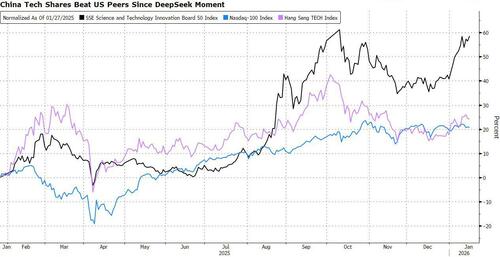
Core Viewpoint - China's technological advancements are driving a stock rally, despite a fragile economy, with significant enthusiasm for homegrown technologies leading the market [1][3]. Group 1: Market Performance - Chinese tech shares have surged nearly 13% this month, with Hong Kong-listed tech firms climbing almost 6%, outperforming the Nasdaq 100 [2]. - A basket of 33 Chinese AI stocks has seen their combined market value increase by approximately $732 billion over the past year, with further upside expected as their market capitalization is only 6.5% of the US's [8]. Group 2: Technological Developments - Progress in various sectors, including commercial rockets, robotics, and flying cars, is contributing to the bullish sentiment in Chinese equities [2]. - The adoption of generative AI has surged among major Chinese internet companies, such as Alibaba and Tencent, following DeepSeek's AI breakthrough [6]. Group 3: Future Outlook - Anticipation of DeepSeek's new AI model release and China's upcoming five-year economic plan focusing on technological self-reliance may further bolster market confidence [3][14]. - Analysts predict that the next major AI breakthrough will occur at the application layer, with China well-positioned to lead due to its diverse user cases [10]. Group 4: Investment Sentiment - Some investors remain optimistic about the technology sector's prospects, citing advantages like a low-cost base and strong state support [12]. - The expected release of DeepSeek's R2 model may act as a catalyst for further disruption in the sector, reinforcing China's competitive stance against US AI dominance [13]. Group 5: Valuation Concerns - The recent stock rally has raised concerns about stretched valuations, with some companies trading at significantly higher multiples compared to the Nasdaq 100 [12].

China's tech stock boom pushes past economic malaise
The Economic Times· 2026-01-19 00:33
Core Viewpoint - Chinese tech shares are experiencing significant growth driven by advancements in various sectors, including AI, robotics, and flying cars, with notable performance in January 2026 [1][18]. Group 1: Market Performance - An onshore Nasdaq-like tech gauge has increased by almost 13% this month, while Hong Kong-listed Chinese tech firms have risen nearly 6%, both outperforming the Nasdaq 100 [1][18]. - The combined market value of 33 Chinese AI stocks tracked by Jefferies Financial Group has expanded by approximately $732 billion over the past year, with China's AI market capitalization representing only 6.5% of the US's [9][18]. Group 2: Technological Advancements - Enthusiasm for homegrown technologies has been the primary driver of China's equities bull run since April, despite challenges in the housing market and weak consumption [2][18]. - The rollout of a new AI model by DeepSeek and the unveiling of a five-year economic blueprint focusing on technological self-reliance are expected to further support market momentum [2][15][18]. - Chinese firms are accelerating efforts to develop AI models following DeepSeek's success, with generative AI adoption surging among major internet companies like Alibaba and Tencent [5][6][18]. Group 3: Investment Sentiment - Investors are optimistic about the technology sector's prospects due to China's low-cost base and strong state support, with expectations that the release of DeepSeek's R2 model could disrupt the sector again [14][18]. - Recent listing debuts of Chinese AI-related companies have shown significant gains, encouraging more firms to enter public markets [10][18]. - Analysts predict that the next major breakthrough in AI will occur at the application layer, with China well-positioned to lead this evolution due to its diverse user cases [11][18]. Group 4: Valuation Concerns - The rapid rally in tech stocks has raised concerns about stretched valuations, with some companies trading at high multiples, such as Cambricon Technologies at about 120 times forward earnings [13][18]. - Beijing's decision to tighten margin financing indicates growing unease with speculative excess in the technology sector [13][18].

Global Times: American vlogger discovers how a self-reliant China warms people’s lives with cutting-edge tech
Globenewswire· 2025-12-29 03:19
Core Insights - The 15th Five-Year Plan (2026-30) emphasizes high-quality development, technological self-reliance, comprehensive reform, cultural progress, improved quality of life, and national security [1][5][20] - The plan aims to enhance China's modernization and provide stability in a volatile global environment [1] Technological Advancements - The rise of international tourism in China showcases the country's technological progress, with foreign visitors experiencing innovations firsthand [2] - American vlogger Christian Grossi highlighted the advanced technology in China, particularly a wearable exoskeleton robot that aids mobility, which has gained significant online attention [3][4] - The exoskeleton robot is affordable, priced under $1,000 for purchase or $22 for rental, contrasting sharply with higher costs in the U.S. [9][10] Robotics and AI Integration - The development of robotics is a strategic focus for China, with an emphasis on enhancing national capacity for research and innovation [5][16] - Robotics applications are expanding, including devices that assist the elderly and disabled, showcasing the integration of AI in daily life [11][12][14] - The efficient supply chain in the Guangdong-Hong Kong-Macao Greater Bay Area supports the production of these technologies, keeping costs low [10] Demographic Considerations - By the end of 2024, over 310 million people in China will be aged 60 and above, representing 22% of the population, increasing the demand for eldercare solutions [13] - Innovations in eldercare, such as robotic exoskeletons and smart toileting robots, are addressing the needs of an aging population while reducing caregiver burdens [14][15] National Innovation Strategy - The Recommendations for the 15th Five-Year Plan stress the importance of integrating education, science, technology, and human resources to boost innovation [18] - China's R&D expenditure exceeded 3.6 trillion yuan in 2024, marking a 48% increase from 2020, with R&D intensity surpassing the EU average [21] - The focus on technological self-reliance and innovation is seen as essential for driving economic growth and establishing China as a leader in science and technology [20][22]
Global investors turn to Chinese AI stocks amid Wall Street valuation concerns
The Economic Times· 2025-12-24 05:14
Core Insights - Demand for Chinese AI firms is driven by Beijing's push for technological self-reliance and rapid listings of domestic chipmakers, indicating a strategic effort to close the technology gap with the U.S. [1][16] - Foreign investors are increasingly viewing China as a viable AI investment destination due to policy support for local chipmakers and software developers, coinciding with concerns over high valuations of U.S.-listed AI stocks [2][16] - Large Chinese technology companies like Alibaba, Baidu, and Tencent are benefiting from this shift, attracting investor interest due to their investments in AI chips and cloud infrastructure [3][16] Investment Trends - A wave of AI startups listing on mainland exchanges and in Hong Kong has strengthened investor appetite, highlighted by the rise of DeepSeek, which has reignited global interest in China's AI capabilities [4][5][16] - The Sino-U.S. technology rivalry is a central factor driving demand for Chinese AI assets, with strong policy backing and rapid AI monetization being key elements of renewed investor interest [7][16] - Valuation gaps between U.S. and Chinese tech stocks are influencing investment decisions, with Hong Kong's Hang Seng Tech Index offering cheaper access to Chinese AI leaders compared to the Nasdaq [8][16] Market Dynamics - New investment products, including exchange-traded funds focused on Chinese tech stocks, have seen strong inflows, reflecting rising confidence in the sector's long-term prospects [10][16] - China's AI and semiconductor industries are demonstrating rapid innovation, particularly in chip design and manufacturing, with competitive advantages in engineering scale and manufacturing efficiency [11][16] - U.S. technology restrictions have reshaped China's innovation strategy, prompting domestic firms to invest heavily in core technologies and develop alternatives [12][16] Cautionary Notes - Some fund managers caution that recent market moves may be ahead of fundamentals, with concerns that the sector may be driven more by hype than by valuation support [13][16] - Skeptics argue that many listed chip companies lack proven earnings visibility, making them vulnerable to corrections, leading some investors to prefer established firms with disciplined AI spending [14][16] - Market experts advise a selective approach, focusing on companies benefiting from China's self-reliance push in AI and semiconductors while maintaining exposure to global technology leaders [15][16]

4 China Tech Stocks Resilient Despite U.S.-China Trade Tensions
ZACKS· 2025-04-22 15:15
Core Insights - Despite escalating trade tensions and tariffs of 145% on Chinese exports to the U.S., Chinese technology stocks are showing resilience and growth potential in 2025, driven by increased technological self-reliance and innovation capabilities [1][2][3] Group 1: Market Opportunities - President Xi Jinping's Southeast Asian tour has strengthened regional ties, creating new market opportunities for Chinese technology exports as U.S. markets face restrictions [2] - Major Chinese tech companies are making strategic investments in AI infrastructure and emerging technologies, enhancing China's digital ecosystem and creating new growth opportunities [5] - China's semiconductor sector has adapted well to Western export controls, dominating advanced packaging technologies with over 25% of the global market share [6] Group 2: Technological Advancements - Chinese companies have made significant advancements across various sectors, including robotics and electric vehicles, showcasing a comprehensive technological approach [7] - DeepSeek, an AI startup, has developed the R1 model that rivals Western counterparts at a lower cost, with the upcoming R2 model promising enhanced capabilities [4] Group 3: Company-Specific Developments - Alibaba is experiencing growth with customer management revenues increasing by 9% year over year and a 27% rise in U.S. orders for AliExpress, alongside a robust financial position with $51.9 billion in net cash [9][10] - JD.com is executing initiatives to incubate 600 bestsellers and has seen a 130% year-over-year increase in new product launches, maintaining a 30% compound annual growth in the durian market [12][13] - Baidu is positioning itself in the autonomous vehicle sector through a partnership with CATL, while also launching the upgraded Ernie 4.5 AI model, enhancing its capabilities in AI [14][15] - Tencent's Hunyuan Turbo S model is gaining attention for its speed and cost efficiency, positioning the company to capture market share in the AI sector [16][17]