
US exceptionalism

Search documents
长期策略:全球展望-Long-term Strategy_ Global Outlook
2026-01-13 11:56
Summary of Key Points from the Conference Call Industry Overview - The analysis covers long-term challenges and opportunities in the investment landscape, particularly focusing on expected returns across various asset classes and the implications of demographic changes, AI, governance, climate change, and globalization on market dynamics [6][7][19][31]. Core Insights and Arguments 1. **Expected Returns**: - US Aggregate Bond Index is expected to yield 4.6% per annum over the next decade, while the S&P 500 is projected at 3.5% per annum [7][19]. - The forecast for US High Grade Corporate bonds is 4.8% per annum, and for Euro Aggregate Bond Index, it is 3.4% per annum [7][19]. 2. **Market Conditions**: - Current markets are considered expensive, leading to low long-term returns. Equity and credit returns are expected to be similar, with a depreciation of the USD projected at -1.4% per annum against the average G10 currencies [7][19]. - Demographic trends indicate an aging population, falling fertility rates, and a shrinking working-age population, which are expected to raise bond yields and lower long-term equity returns [54][64]. 3. **Impact of AI**: - AI is anticipated to provide a moderate productivity boost, with long-term productivity growth supported by 0.5-1.0% per annum. However, this may not be sufficient to counteract the negative effects of working-age population decline [69][75]. - The US is likely to benefit the most from AI advancements due to its technological leadership and sector composition [81][88]. 4. **Governance and Political Climate**: - Increasing polarization and populism are noted as significant risks, potentially leading to lower long-term equity returns and higher volatility in investment [89][128]. - The report highlights a trend of declining democratic ratings, particularly in the US, which has historically preceded long-term equity underperformance [128]. 5. **Climate Change**: - Climate risk is identified as a critical factor affecting asset pricing, particularly in emerging markets (EM), where geographical vulnerabilities may lead to increased capital demand and macroeconomic volatility [160][169]. - The report suggests that climate change could raise real interest rates due to increased demand for capital and adverse supply shocks [160]. 6. **Globalization and Industrial Policy**: - A slight trend towards deglobalization is observed, with geopolitical tensions leading to a decline in foreign direct investment (FDI) and portfolio flows [174]. - The resurgence of industrial policy, particularly in large developed markets (DM), is expected to focus on strategic sectors, potentially benefiting small corporates more than large ones [180]. 7. **Debt Sustainability**: - Concerns about sovereign debt sustainability are raised, with higher debt levels and interest rates expected to create a feedback loop that could lead to crises similar to past events [149][150]. - The US is highlighted as facing significant challenges regarding its debt levels, particularly with the impending exhaustion of Social Security Trust Fund assets [156]. Other Important Insights - The report emphasizes the importance of immigration as a key factor in mitigating working-age population decline in certain countries [68]. - It also discusses the potential for the US dollar to face long-term depreciation due to gradual de-dollarization trends influenced by geopolitical factors [185]. - The analysis concludes with a strategic country scorecard, comparing long-term signals across various countries, indicating that the US maintains some favorable economic fundamentals despite risks [197]. This summary encapsulates the critical insights and arguments presented in the conference call, providing a comprehensive overview of the current investment landscape and future expectations.
Tweedy, Browne Mutual Funds Q3 2025 Commentary
Seeking Alpha· 2025-11-12 01:25
Core Insights - Global equity markets experienced significant growth in Q3, with the S&P 500 rising 8.12% for the quarter and 14.83% year-to-date, while the MSCI EAFE Index increased by 4.77% for the quarter and 25.14% year-to-date [2][3] Market Performance - The S&P 500 achieved back-to-back annual returns of 26% and 25% in 2023 and 2024, respectively, with valuation metrics like the "Buffett Indicator" and CAPE-Shiller P/E at or near record highs [2] - Non-US equities, particularly European stocks, outperformed the S&P 500 year-to-date, benefiting from a weaker US dollar and a resurgence in value recognition [3][11] Fund Performance - Tweedy, Browne Funds reported year-to-date returns ranging from 15.98% for the Value Fund to 23.17% for the International Value Fund II, with the Worldwide High Dividend Yield Value Fund outperforming its benchmark [3][5] - The International Value Fund II had a return of 23.17%, trailing its benchmark, the unhedged MSCI EAFE Index, by 197 basis points [3] Portfolio Activity - The company made strategic adjustments to its portfolio, trimming or selling holdings that reached estimated value and adding to companies perceived as attractively priced, such as Berkeley Group Holdings and Breedon Group [8] - New positions were initiated in Santec Holdings and additional investments were made in companies like Dentium and Azelis Group, reflecting a focus on growth potential and reasonable valuations [8] Outlook - The company is optimistic about the resurgence of non-US equity returns and believes its funds are well-positioned for future market conditions, whether they favor non-US equities or face broader market challenges [11]


Fed Decision Will Just Bring Volatility: 3-Minute MLIV
Youtube· 2025-09-17 07:18
Group 1 - The market is anticipating a rate cut from the Federal Reserve, with a focus on the guidance provided during the announcement [1][2] - The dot plot will be crucial in determining how many cuts are priced in for the remainder of this year and into next year, with current expectations being high [2][3] - There is uncertainty regarding the influence of new Fed governors on future guidance, which may affect market reactions [3][4] Group 2 - The handling of questions by Jerome Powell during the press conference is expected to create volatility, as there is significant uncertainty surrounding the Fed's future direction [5][6] - The dollar is projected to continue its downtrend over the coming years, which may benefit emerging markets significantly [6] - There is a growing sentiment that the current economic environment marks the end of US exceptionalism, further contributing to the dollar's decline [6] Group 3 - There is interest in obtaining Jerome Powell's personal views on inflation projections, as accountability from the Fed chair could provide clearer insights into future monetary policy [7][8] - The committee structure of the Fed allows members to avoid personal accountability, which some analysts believe could be improved by having clearer individual projections [8][9]

Hyman: S&P 500 earnings are up 10% year over year
CNBC Television· 2025-08-26 12:04
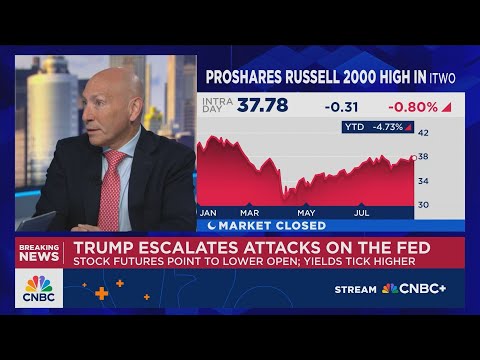
Market Performance & Economic Outlook - S&P 500 earnings are up 10% year-over-year, and NASDAQ 100 earnings are up 34% year-over-year, indicating strength in the US market [1] - Concerns about Fed independence are causing a slight sell-off at the long end of the curve [2] - The Fed's influence is strongest on the two-year rate, which has decreased by approximately 7-8 basis points [3] Monetary Policy & Interest Rates - The Fed only controls the short-term lending rate, and excessive cuts could lead to a steepening of the yield curve, potentially resulting in higher longer-term interest rates [3] - There is potential for the Fed to implement two or three rate cuts without significantly impacting the long end of the curve, even with inflation around 3% [4] - Lower rates on money markets and challenges in generating income from interest rates and bonds make equity income more attractive [5] Investment Strategy - The ITWO ETF, a Russell 2000 high-income ETF focused on small caps, is highlighted as a pick [4] - Small caps are more leveraged and have shorter maturity, making them more sensitive to and potentially benefiting more from rate cuts compared to large caps [5]
外汇与利率情绪调查 - 夏季疑虑-FX and Rates Sentiment Survey_ Summer doubts
2025-08-11 02:58
Key Takeaways from the FX and Rates Sentiment Survey Industry Overview - The survey focuses on the foreign exchange (FX) and rates market sentiment, particularly regarding the US dollar (USD), Euro (EUR), and emerging markets (EM) currencies. It reflects the views of 42 fund managers with a total of USD 573 billion in assets under management (AUM) [7][9]. Core Insights 1. **Short USD Thesis**: The short USD remains the highest conviction trade for the rest of the year, despite being challenged by rising global growth concerns [1][3][20]. 2. **Global Growth Concerns**: There is a significant concern regarding a potential global growth slowdown, which could impact the short USD thesis [3][25]. 3. **US Exceptionalism**: The fading of US exceptionalism is a recurring theme, with expectations that both US equities and the USD may decline [1][32][33]. 4. **Investor Sentiment**: A strong majority of respondents expect the next Federal Reserve (Fed) chair to be more dovish, impacting market expectations [44][46]. 5. **FX Hedge Ratios**: Many investors prefer to increase their FX hedge ratios, indicating a cautious approach towards US assets [49][50]. Additional Insights 1. **Emerging Markets (EM) Sentiment**: EM FX and duration sentiment appears to have peaked, with a slight decline in positioning and views noted in August [15][94]. 2. **European Investment Push**: There is muted conviction regarding a broad-based European investment push, with concerns about EU defense spending and fiscal policies [22][61]. 3. **Tariff Expectations**: Most respondents expect tariffs against China to remain between 30-40% by the end of 2025, reflecting ongoing trade tensions [17][34]. 4. **Oil Price Expectations**: Expectations for oil prices are that they will remain range-bound between $60-69 per barrel, with some upside risks anticipated [36][37]. 5. **UK and Eurozone Sentiment**: GBP sentiment has turned neutral with bearish levels, while EUR sentiment remains bullish despite lighter positioning [110][103]. Potential Risks and Opportunities 1. **Fed Independence Risks**: Nearly half of the respondents expect risks to Fed independence to manifest as a steeper US Treasury (UST) curve and a weaker USD [46][39]. 2. **Global Risk Appetite**: The appetite for risk-taking in portfolios remains lower than normal, with average cash levels reported at 3.3% [77][78]. 3. **Duration Exposure**: Global duration exposure has fallen relative to the previous month, indicating a cautious stance among investors [78][80]. Conclusion The survey indicates a complex landscape for FX and rates, with significant concerns about global growth, US fiscal policy, and the evolving dynamics of the Fed. Investors are adjusting their strategies accordingly, with a notable shift towards hedging and cautious positioning in the face of potential risks.
US Dollar Saw Washout in Positioning: Rabobank's Foley
Bloomberg Television· 2025-07-31 14:28
Market Trends - US equity markets showed signs of revival since June, potentially indicating a shift away from the rotation trade that characterized the first five months of the year [1][2] - The dollar's performance has lagged behind the recovery in stock markets, possibly due to market anticipation of a more dovish Federal Reserve [3] - A washout in positioning, where the market had become too long on the dollar at the start of the year, was necessary for a potential dollar recovery [3] Economic Outlook - The US economy has not been as severely impacted as initially anticipated back in April [4] - Recognition of the US economy's resilience has contributed to the washout of positioning and potential shift in market sentiment [4]
The market's biggest concern is tariffs, the endgame is unknown, says Oppenheimer's John Stoltzfus
CNBC Television· 2025-07-18 17:30
Market Concerns & Tariffs - The market's biggest concern revolves around tariffs due to the uncertainty of their endpoint and potential effects on sectors, market capitalizations, and investment styles [1][2] - The EU tariffs are significant due to the EU being a major trade partner, and the lack of a livable agreement introduces volatility [4] - Europe is considering other trade partners to offset potential losses with the US [4] - A livable agreement between the US and the EU is expected to be reached, potentially at a lower rate than the discussed 15% [5] US Exceptionalism & Economic Resilience - Oppenheimer Asset Management believes US exceptionalism remains intact due to innovation in technology [6][7] - The US is seen as the "cleanest dirty shirt" in a "hamper of dirty shirts," highlighting its relative strength compared to other countries, particularly regarding technology [7] - The US consumer remains remarkably resilient despite multiple interest rate hikes and pauses [3] - No recession is expected [3] Global Market Dynamics - International markets have outperformed the US recently, driven by lower valuations and expectations of tariff agreements [6][7] - The rest of the world feeds into globalization [7] - Technology is deeply embedded in societies, businesses, and consumers worldwide [8]
Tim Seymour: Early in a international market bull cycle underpinned by fundamentals
CNBC Television· 2025-07-17 19:45
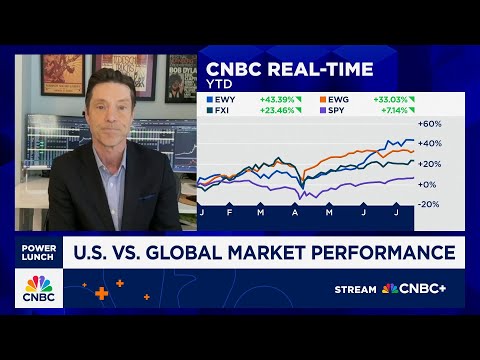
International Investment Opportunities - International and emerging markets are early in a new cycle, supported by strong fundamentals [3] - Deregulation trends in Europe and parts of Asia are creating powerful investment dynamics [3] - Deficit spending in Europe and Asia, including China, is evolving, signaling potential shifts [5] - Global companies offer world-class investment opportunities, especially as US exceptionalism may have peaked [7][8] - Trends like AI, infrastructure, hyperscalers, and semiconductors are globally present, not exclusive to the US [9] Market Underperformance & Reversion - Long-term underperformance of MSCI World against the US suggests a potential mean reversion [2] - International markets have underperformed for years, indicating a possible shift in investment focus [5] Specific Regional & Sector Highlights - Germany's fiscal policy shift towards rearmament and infrastructure development presents opportunities [4] - European banks are becoming increasingly attractive investment options compared to US banks due to deregulation [10]
摩根士丹利:关键研究预测-
摩根· 2025-07-16 00:55
Investment Rating - The report maintains an Overweight (OW) rating on US stocks, Treasuries, and US IG Corporate Credit, while expressing caution towards the USD [3][4]. Core Insights - The US labor market is gradually cooling, with real GDP growth expected to decline from 2.5% in 2024 to 0.9% in 2025, and global growth projected to decrease from 3.5% to 2.5% in the same period [2][7]. - Despite a slowing global economy, risk assets may perform well as markets adjust to less negative growth expectations, with a focus on quality investments [2][3]. - The report highlights a preference for quality cyclicals, large caps, and defensives in the US, while recommending sectors such as defense, banks, software, telecoms, and diversified financials in Europe [5][6]. Economic Outlook - The report forecasts a step-down in global growth due to tariff impacts and immigration restrictions, with specific GDP growth estimates for 2025: Global at 2.5%, US at 0.9%, Euro Area at 0.8%, Japan at 0.3%, and Emerging Markets at 3.8% [8][12]. - Inflation is expected to peak in the US in Q3 2025, with projections of 2.9% for the US and 1.9% for the Euro Area in 2025 [8][12]. Sector Recommendations - In the US, the report favors quality cyclicals and defensives with lower leverage and cheaper valuations, while in Japan, it supports domestic reflation beneficiaries and defense-related spending [5][6]. - European recommendations include repositioning into resilient sectors, particularly defense and financials, while in Emerging Markets, the focus is on financials and domestic businesses [5][6]. Credit Market Insights - Credit quality is expected to hold up despite macroeconomic challenges, with a recommendation to focus on higher quality assets and CDX hedges [21][22]. - The report anticipates strong total returns in credit markets, with Bs/CCCs expected to decompress relative to BBs [21][22].

高盛:企业宏观视角_微观世界的宏观指南
Goldman Sachs· 2025-07-15 01:58
Investment Rating - The report suggests a shift towards diversification in investment opportunities, particularly favoring European equities over US equities due to historical valuation spreads and changing market dynamics [5][6][9]. Core Insights - The depreciation of the US dollar and a more resilient Chinese economy are challenging the sustainability of US outperformance, prompting a reconsideration of investment strategies [6][7]. - European companies are expected to return approximately 5% of their market capitalization to shareholders through dividends and buybacks, which is significantly higher than the US average of below 4% [8][9]. - The CAPEX-to-Sales ratio in Europe is nearing a 10-year high, indicating a shift towards growth investments, driven by themes such as infrastructure upgrades and artificial intelligence [9][10]. Summary by Sections Market Dynamics - The report highlights a broadening of investor opportunities as the case for US exceptionalism is questioned, with valuation spreads between the US and other regions at historical highs [5][6]. - European corporates are beginning to invest for growth at a faster pace than they return capital to shareholders, with CAPEX expected to grow by 3% in 2025 [9][10]. Shareholder Returns - The total shareholder yield in Europe is close to an all-time high, with companies in the STOXX 600 returning around 5% of their market cap annually [8][142]. - The report notes a growing appetite for buybacks among European companies, despite a slight decline in insider buying activity [146][147]. Sector Performance - All sectors in Europe currently offer higher yields than their US counterparts, making the region particularly attractive for income-focused investors [9]. - The report indicates that cyclical sectors have a higher beta of earnings to world GDP compared to defensive sectors, suggesting a potential for greater returns in a recovering economy [22][23].