Tariff Announcement

Search documents
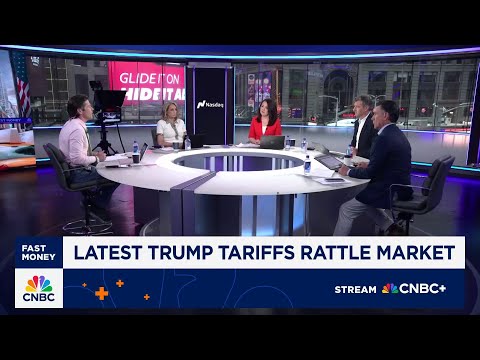
'Fast Money' traders talk the impact of latest tariff news on the markets
CNBC Television· 2025-07-07 21:50
Market Risk & Trade Tensions - The market faces headline risk due to uncertainty in trade negotiations, despite an implicit extension, with potential for the administration to take a firm stance on trade with key partners like Japan and South Korea [1][2] - The market, previously exhibiting low volatility (VIX sub 16), is vulnerable due to its position near all-time highs and lightly positioned investors who are still overweight in equities [2] - Wall Street economists are expected to analyze the impact of imputed tariffs, which do not include sectoral tariffs on industries like steel, suggesting a broader potential impact [3][4] - The market's current reaction to tariff announcements is muted compared to previous instances, possibly due to a belief that the tariff issue is not serious and will be resolved later [4][5] Policy & Economic Impact - The market previously sold off due to trepidation and policy chaos, but recovered when authorities "blinked," possibly due to concerns about the bond market and rising interest rates, with the 10-year Treasury yield around 4-44% [6] - Strategists will need to assess the implications of across-the-board tariffs, potentially around 15%, while the Federal Reserve seems concerned about economic growth and has lowered its expectations [7] - Tariffs, if implemented, will impact the supply chain, exporters, consumers, or companies, ultimately slowing growth, even if the market anticipates a resolution or delay [8] - The administration might pursue tariffs more aggressively given the stock market's all-time highs and stable interest rates [8][9]

高盛:关税之后 -经济衰退定价仍有空间
Goldman Sachs· 2025-04-09 05:11
Investment Rating - The report suggests a high chance of moving towards a recession baseline forecast, indicating a bearish outlook for the market [2][16][35] Core Insights - The market has experienced a significant downgrade in growth views following recent tariff announcements, with the downgrade being historically large, equivalent to a roughly 130 basis points drop in the 1-year ahead GDP growth view for the US [5][16] - The current market pricing does not fully reflect the potential for a recession, as historical comparisons indicate that typical recessions are associated with larger equity drawdowns and more substantial declines in the Fed funds rate than currently priced [16][27] - A policy shift, particularly in trade policy, is viewed as the most direct route to market recovery, with the potential for a significant reversal in intended tariff policy being crucial for stabilization [36][37] Summary by Sections Market Reaction to Tariffs - The market price action has been dramatic, with a broad-based decline across global equities and commodities following the tariff announcements [3][4] - Financial conditions have tightened sharply, and the initial focus on US assets has shifted to a more global perspective [3][4] Growth Downgrade and Policy Reaction - The report indicates a large growth downgrade alongside a hawkish policy reaction, with the market pricing reflecting a more constrained Fed response than usual [4][9] - The implied market growth decline for April 3 and 4 represents the largest 2-day move outside significant historical events such as Black Monday and the COVID lockdown [5][9] Recession Pricing and Market Conditions - Current market conditions suggest that a full recession is not yet fully priced, with only the VIX indicating levels associated with past recession peaks, while other common recession gauges remain below those levels [28][34] - The report highlights that the risks still skew to the downside unless there is a shift in the policy path, with a high chance of further weakness in equity markets and wider credit spreads if recession pricing continues to develop [35][36]
Down 25% From Its All-Time High, Is Amazon a Buy Right Now?
The Motley Fool· 2025-04-07 10:30
Core Viewpoint - Amazon is facing significant challenges due to recent tariffs and a market sell-off, impacting its e-commerce business while its cloud computing segment, AWS, remains a critical growth driver [1][2][5]. Tariffs Impact - The recent tariff changes, including the closing of de minimis exemptions, will increase costs for Amazon's third-party sellers, potentially harming sales on its platform [2][3]. - The cost of tariffs will be absorbed by suppliers, sellers, and consumers, affecting pricing dynamics across the board [9]. AWS Performance - AWS is crucial for Amazon, generating 58% of the company's operating profits in 2024, and is less affected by tariffs compared to the e-commerce segment [5][6]. - While AWS benefits from the growing demand for cloud computing, it is not entirely immune to tariffs, particularly regarding the costs of hardware and chips sourced from Taiwan [6][7]. Market Outlook - Despite the current market sell-off and tariff implications, the long-term outlook for Amazon remains positive due to the ongoing migration to cloud services and AI workloads [8]. - The recommendation is to consider buying Amazon stock after the market stabilizes, as it may present a significant buying opportunity at a discount [10].


3 Top Bargain Tech Stocks Ready for the Next Bull Run
The Motley Fool· 2025-04-06 14:15
Core Viewpoint - The announcement of tariffs by President Donald Trump has led to a decline in stock prices, raising concerns about a potential global trade war and its impact on the economy. However, this situation has created attractive entry points for investors in several tech stocks [1]. Group 1: Nvidia - Nvidia is currently trading at a forward price-to-earnings (P/E) ratio of 23 and a price/earnings-to-growth (PEG) ratio near 0.4, indicating it is undervalued [3][6]. - The company is positioned well for growth, particularly in the AI sector, with its GPUs driving advancements in AI technology. Tariffs are not expected to hinder this growth, as semiconductors are reportedly exempt from the tariffs imposed on Taiwan [4][5]. - Nvidia anticipates that data center capital expenditures will reach $1 trillion by 2028, with major cloud computing companies planning to spend $250 billion on AI infrastructure this year [5]. Group 2: Amazon - Amazon's shares have been negatively affected by the new tariffs, as many goods sold are sourced from countries like China, potentially leading to increased prices and a slowdown in sales [7]. - Despite this, Amazon continues to benefit from long-term trends in e-commerce and is enhancing earnings through its higher-margin sponsored ad business and logistics efficiencies driven by AI [8][9]. - The company is trading at a forward P/E of 28.5, one of the lowest valuations in a decade, while its AWS segment is investing heavily in data center infrastructure to support growing AI service demand [9]. Group 3: Meta Platforms - Meta Platforms has experienced a decline in stock price due to tariff announcements, but it reported a 21% revenue growth last quarter, driven by its AI initiatives [10]. - The company faces potential short-term challenges due to higher prices and a possible global recession, which may lead advertisers to reduce spending [11][12]. - Meta is developing its new social media platform, Threads, which currently does not contribute to revenue but has strong monetization potential in the future. The stock is trading at a forward P/E of just above 21, representing a bargain for a leading digital advertising company [13][14].