水果分销

Search documents
洪九果品退市启示:水果分销商死于现金流
经济观察报· 2026-01-04 09:49
Core Viewpoint - The sudden downfall of Hongjiu Fruit is attributed to its financial issues, governance failures, and the pressures of the "high prepayment + long receivables" business model in the fruit distribution industry [2][6]. Group 1: Company Overview - Hongjiu Fruit, established in 2002, positioned itself as a global fruit chain operator focusing on high-end imported and quality domestic fruits, with products including Thai longan, mangosteen, durian, and Chilean cherries [4]. - The company was known as the largest fruit distributor in China by sales revenue in 2022 and was also the largest distributor of durians and imported dragon fruits [2]. Group 2: Financial Performance - In 2022, Hongjiu Fruit reported a revenue of 15.081 billion yuan, a year-on-year increase of 46.7%, and a net profit of 1.452 billion yuan, up 397.95% [4]. - By the end of the third quarter of 2023, the company had generated approximately 13.427 billion yuan in revenue, reflecting a year-on-year growth of 26.4% [7]. Group 3: Challenges and Downfall - The company faced suspension of trading due to the failure to publish its 2023 annual results and 2024 interim results, leading to its eventual delisting on December 30, 2025 [5]. - KPMG raised concerns regarding the company's prepayments, which amounted to approximately 4.47 billion yuan, with a significant portion paid to new suppliers with questionable financial stability [6]. - The company’s executives were involved in criminal investigations for loan fraud and issuing false invoices, further exacerbating its operational difficulties [8]. Group 4: Business Model Pressures - The traditional B2B distribution model employed by Hongjiu Fruit requires significant upfront payments to suppliers, leading to cash flow pressures due to long receivable periods [11]. - The company’s bank loans increased from 874 million yuan to 2.282 billion yuan from 2021 to 2022, primarily for fruit procurement and logistics expansion [11]. - The competitive landscape in the fruit industry has intensified, with direct sourcing and shipping models becoming mainstream, putting pressure on companies like Hongjiu Fruit that focus on high-end fruits [12].

洪九果品退市启示:水果分销商死于现金流
Jing Ji Guan Cha Wang· 2026-01-04 08:40
Core Viewpoint - Hongjiu Fruit, known as the "first fruit stock," officially delisted from H-shares on December 30, 2025, less than four years after its IPO, due to multiple crises including financial reporting issues, executive investigations, and pressure from its business model [1][2]. Company Overview - Established in 2002, Hongjiu Fruit focuses on high-end imported and high-quality domestic fruits, with a product range that includes Thai longan, mangosteen, durian, Vietnamese dragon fruit, Chilean cherries, and domestic varieties like yellow peaches and kiwis [2]. - The company completed several rounds of financing from 2016 to 2020, including investments from Alibaba, and went public on September 5, 2022, with an IPO price of HKD 40 per share, achieving a market capitalization of nearly HKD 19 billion on its first trading day [2]. Financial Performance - In 2022, Hongjiu Fruit reported annual revenue of CNY 15.081 billion, a year-on-year increase of 46.7%, and a net profit of CNY 1.452 billion, up 397.95% [2]. - By the first three quarters of 2023, the company generated approximately CNY 13.427 billion in revenue, reflecting a year-on-year growth of 26.4% [5]. Delisting Process - The delisting process began when Hongjiu Fruit failed to publish its 2023 annual results and 2024 interim results, leading to a suspension of trading on March 20, 2024 [3]. - The Hong Kong Stock Exchange's listing committee decided to cancel its listing status on October 3, 2025, after the company could not meet the resumption guidelines [3]. Audit Concerns - KPMG raised concerns regarding the company's prepayment balance of approximately CNY 4.47 billion as of the end of 2023, with CNY 3.42 billion paid to several new suppliers in Q4 2023, some of whom had registered capital below the prepayment amount [4]. Executive Investigations - Several executives, including the chairman and board members, were investigated for loan fraud and issuing false VAT invoices, leading to restrictions on the company's operations [6]. - As of May 20, 2025, some executives remained detained, while others were allowed to continue participating in company operations [6]. Business Model Challenges - The company's business model, characterized by high prepayments and long accounts receivable periods, has created significant cash flow pressures [8]. - The traditional B2B distribution model requires intermediaries to prepay for goods while waiting for downstream payments, which can lead to cash flow issues [8]. Industry Competition - The fruit distribution industry is facing increasing competition, with a shift towards "direct sourcing and direct shipping" models that compress intermediaries, leading to declining prices for high-end fruits [9]. - Competitors like Baiguoyuan have also faced challenges, with a reported revenue decline of 9.8% in 2024 and significant store closures [9]. - The high-end fruit market is undergoing significant changes, with prices for premium fruits like durian and cherries decreasing by an average of 15% annually from 2020 to 2025, and domestic fruit replacement rates rising to 60% [9].
仅3年就走向退市,“水果第一股”洪九果品遭遇了什么?
Xin Jing Bao· 2025-12-31 09:09
Core Viewpoint - Chongqing Hongjiu Fruit Co., Ltd., known as the "first fruit stock," is set to delist from the Hong Kong Stock Exchange after just over three years of being listed, primarily due to negative operating cash flow, accumulating debt, and legal issues involving senior executives [1][2]. Group 1: Company Background and Listing Journey - Hongjiu Fruit was established in 2002 and became a major distributor of Southeast Asian fruits in China, achieving a peak market value of HKD 67 billion shortly after its IPO in September 2022 [2]. - The company faced a delisting crisis within a year and a half of its listing, with its shares suspended from trading in March 2024 due to failure to disclose financial reports on time [2][3]. Group 2: Financial Performance and Issues - The last publicly available financial report indicated that for the first half of 2023, the company generated revenue of CNY 8.538 billion, a year-on-year increase of 19.37%, but net profit decreased by 6.51% to CNY 803 million [3]. - The company has been experiencing negative operating cash flow since 2019, with a cash flow deficit of CNY 1.823 billion in 2022 and CNY 314 million in the first half of 2023 [6][7]. Group 3: Legal and Operational Challenges - Multiple senior executives, including the chairman, are under criminal investigation for loan fraud and other financial misconduct, leading to operational disruptions [4][5]. - The company is facing significant liquidity issues, with bank loans amounting to CNY 2.776 billion and cash reserves of only CNY 557 million, indicating insufficient debt repayment capacity [7]. Group 4: Strategic Insights and Future Directions - Experts suggest that the company's aggressive expansion strategy has led to cash flow pressures due to high prepayments to suppliers and slow receivables collection [8]. - To recover post-delist, the company needs to optimize procurement and sales strategies, improve cash flow management, and enhance internal controls and financial transparency [8].
榴莲之王坠落 洪九果品黯然退市
BambooWorks· 2025-12-30 09:59
Core Viewpoint - Hong Jiu Fruit, once regarded as China's largest fruit distributor, has been delisted from the Hong Kong Stock Exchange after just three years of being publicly listed, primarily due to allegations of fabricated sales data and management misconduct [1][5]. Company Background - Founded in 2002 by Deng Hong Jiu and his wife Jiang Zong Ying, Hong Jiu Fruit initially thrived by capitalizing on the growing acceptance of durian in China, eventually becoming the largest durian distributor in the country by 2021 [2]. - The company expanded its product range to include high-end fruits such as dragon fruit, mangosteen, longan, grapes, and cherries, and established a cold chain logistics system across 17 cities in China [2][5]. Financial and Operational Decline - The company faced severe operational challenges over the past two years, including price volatility and management issues, leading to a rapid decline in its business [4]. - In September 2022, the company was still performing well, with significant investments from major institutions like Alibaba and CMB, but by December 2023, it was announced that its shares would be canceled due to serious financial discrepancies [5][6]. - The company reported a revenue of 8.5 billion yuan (approximately 1.2 billion USD) for the first half of 2023, but had been in a negative cash flow situation since 2019, with the gap widening each year [6]. Allegations and Legal Issues - The company was accused of engaging in "circular funding" practices, where large payments were made to fictitious suppliers, and these funds were then funneled back to the company as inflated revenue [5][8]. - In April 2023, Deng Hong Jiu and several executives were arrested for loan fraud, with ongoing investigations revealing that the company used fictitious sales to secure bank loans [8][9]. Industry Context - The fruit industry in China is facing significant challenges, including high wastage rates of 20% to 30% due to inadequate supply chain standards, which is much higher than the approximately 5% seen in developed countries [10]. - Competitors like Baiguoyuan and Xianfeng Fruit are also experiencing difficulties, with Baiguoyuan reporting a 21.8% year-on-year revenue decline and significant store closures, reflecting the increasing operational pressures within the industry [9][10]. Governance and Structural Issues - Hong Jiu Fruit operated under a family business model, which contributed to weak governance structures, with family members holding over 46% of shares and occupying key management positions [10]. - The company's focus on high-end fruit markets made it vulnerable to shifts in consumer preferences and demand, ultimately leading to its downfall [10].
【年终盘点】港股IPO热下的退市潮:退市量大增,一半被“净化”!
Sou Hu Cai Jing· 2025-12-30 08:33
Group 1 - The core viewpoint of the article highlights the contrasting dynamics in the Hong Kong stock market in 2025, characterized by a significant rise in the Hang Seng Index by nearly 30% and a record IPO fundraising amount of approximately 278.7 billion HKD, while simultaneously experiencing a notable wave of delistings [2][3]. - A total of 62 companies were delisted from the Hong Kong Stock Exchange in 2025, marking a 26.5% increase from the previous year, where 49 companies were delisted [3]. - The delisting process in Hong Kong primarily follows two paths: voluntary privatization and forced delisting, with the latter often resulting from severe issues such as financial misconduct or prolonged trading suspensions [5]. Group 2 - The Hong Kong Stock Exchange has intensified its regulatory measures to enhance market quality, leading to 31 companies being forcibly delisted in 2025, which constitutes half of the total delistings [5]. - Notable companies among those forcibly delisted include China Evergrande, which faced severe financial difficulties and regulatory penalties, and Hong Jiu Fruit, which encountered multiple operational issues [7]. - The market is witnessing a liquidity divide, with approximately 80% of funds concentrated in 20% of high-quality stocks, resulting in low liquidity for many small-cap companies, prompting them to consider privatization [8]. Group 3 - The increase in delistings in 2025 reflects a self-purification process in the Hong Kong capital market, driven by liquidity disparities and a focus on high-growth sectors like AI and advanced manufacturing [9]. - Southbound capital inflows into Hong Kong stocks exceeded 1.4 trillion HKD in 2025, indicating a strong preference for large enterprises, which exacerbates challenges for smaller companies [9]. - As of November 28, 2025, there were 84 companies on the Hong Kong Stock Exchange that had been suspended for over three months, with 10 already approved for delisting [11]. Group 4 - Many companies on the "danger list" are struggling to meet financial reporting requirements, leading to potential delistings, particularly in the real estate sector, which has been significantly affected [13]. - The Hong Kong Stock Exchange's strict enforcement of delisting rules aims to maintain market health and long-term credibility, facilitating a "market cleansing" process that could attract more long-term value investors [13].

洪九果品“两头承压”终退市 水果“三巨头”各有难处
Zhong Guo Jing Ying Bao· 2025-12-29 06:25
Core Viewpoint - Hongjiu Fruit, known as the "first stock of fruit," is set to be delisted from the Hong Kong Stock Exchange after a year and a half of suspension due to failure to meet listing requirements and ongoing legal issues involving its executives [2][3]. Company Summary - Hongjiu Fruit was suspended from trading on March 20, 2024, and subsequently delisted on December 30, 2024, after failing to comply with the resumption guidance set by the Hong Kong Stock Exchange [2][3]. - The company faced significant scrutiny from KPMG regarding a sudden increase in prepayments, which rose by 3.42 billion yuan in the fourth quarter of 2023, raising concerns about the legitimacy of its suppliers [3][4]. - The only complete annual report during its listing was for 2022, showing revenue of 15.08 billion yuan, a 47% increase year-on-year, and a net profit of 1.45 billion yuan, a 33% increase [5][6]. - At its peak, Hongjiu Fruit's market capitalization exceeded 67 billion HKD [6]. Business Model and Financial Pressure - Hongjiu Fruit operated on an end-to-end business model, sourcing directly from producers and selling to various retail channels, with over 50% of its revenue coming from terminal wholesalers [7]. - The company faced dual pressures from high prepayments to suppliers and long accounts receivable, with trade receivables doubling from 3.707 billion yuan in 2021 to 7.667 billion yuan in 2022 [8]. - The cash flow was strained due to a combination of high prepayments and long receivables, leading to a significant increase in bank loans from 874 million yuan to 2.282 billion yuan [8]. Industry Changes - Other major players in the fruit market, such as Baiguoyuan and Xianfeng Fruit, are also experiencing difficulties, with Baiguoyuan reporting a 9.8% decline in revenue and a net loss of 386 million yuan in 2024 [10]. - The fruit market is undergoing significant changes, with high-end fruits becoming more accessible, leading to increased competition and a 15% average annual price decline for premium fruits from 2020 to 2025 [11][12]. - Consumer behavior is shifting towards more rational purchasing decisions, with a 28% decrease in the frequency of high-priced fruit purchases, while the consumption of quality domestic fruits has increased by 45% [11][12].
洪九果品迎来退市终局
Xin Lang Cai Jing· 2025-12-29 03:44
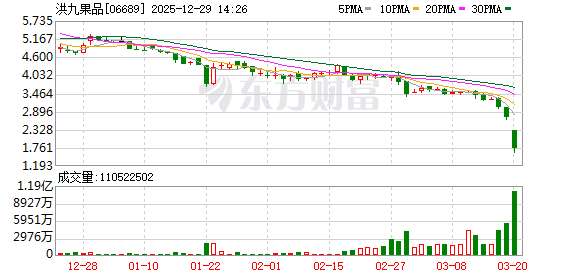
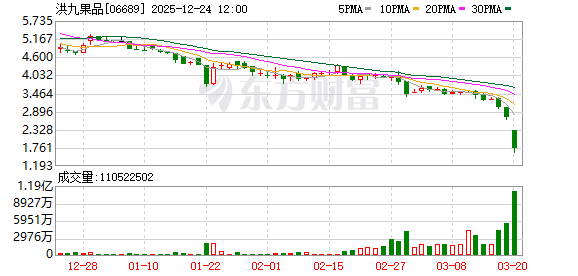
Core Viewpoint - Hongjiu Fruit, known as the "first fruit stock," is facing delisting from the Hong Kong Stock Exchange after a series of financial and governance issues, including failure to disclose financial reports, stock suspension, and investigations into its executives [3][5]. Group 1: Company Background and Financial Performance - Hongjiu Fruit was founded in 2002 by Deng Hongjiu and Jiang Zongying, and it quickly rose to prominence in the high-end fruit market, becoming the largest fruit distributor in China by sales revenue in 2022 [3][4]. - The company went public on September 5, 2022, with an initial share price of HKD 40, achieving a market capitalization of nearly HKD 19 billion on its first trading day. In 2022, it reported a revenue increase of 46.7% to CNY 15.081 billion and a net profit surge of 397.95% to CNY 1.452 billion [3][4]. Group 2: Financial Troubles and Governance Issues - The turning point for Hongjiu Fruit occurred on March 20, 2024, when it was suspended from trading due to its inability to disclose the 2023 financial report, which was questioned by its auditing firm, KPMG. The firm raised concerns about a prepayment balance of approximately CNY 4.47 billion, with CNY 3.42 billion paid to new suppliers in Q4 2023, many of whom had low registered capital and no social insurance contributors [4][5]. - Following the suspension, the company failed to release its 2023 annual report and subsequent periodic reports. As of the suspension date, its stock price had dropped over 95% to HKD 1.74, with a market capitalization of approximately HKD 2.795 billion [4][5]. Group 3: Legal and Operational Challenges - In April 2025, Hongjiu Fruit announced that several executives, including Chairman Deng Hongjiu, were under investigation for alleged loan fraud and issuing false VAT invoices, leading to various criminal measures against them [5][6]. - The company has faced ongoing financial pressure, leading it to apply for restructuring and consider bringing in strategic investors to support its recovery plan. The resignation of three independent non-executive directors in May 2025 left the company without independent oversight [6][7]. Group 4: Expert Analysis and Future Outlook - Experts suggest that the core issues leading to Hongjiu Fruit's delisting stem from a flawed business model and ineffective corporate governance. The company's cash flow issues, family-style management, and compliance crises contributed to its inability to disclose financial reports, ultimately resulting in its delisting [7]. - To recover post-delisting, Hongjiu Fruit must address challenges such as a broken cash flow, lack of core management, and loss of market trust. Strategies may include optimizing the supply chain, reducing costs, embracing e-commerce, and restructuring corporate governance to rebuild market confidence [7].
财报难产、高管被查 洪九果品终遭退市
Bei Jing Shang Bao· 2025-12-28 13:38
Core Viewpoint - Hongjiu Fruit, known as the "first fruit stock," is facing delisting from the Hong Kong Stock Exchange due to a series of financial and governance issues, culminating in its inability to disclose financial reports and ongoing investigations into its executives [2][3][4]. Company Overview - Hongjiu Fruit was established in 2002 by Deng Hongjiu and his spouse Jiang Zongying, and it quickly rose to prominence in the high-end fruit market through a self-built cold chain logistics system and direct procurement model [3]. - The company became the largest fruit distributor in China by sales revenue in 2022, with a revenue of 15.081 billion yuan, marking a 46.7% year-on-year increase, and a net profit of 1.452 billion yuan, up 397.95% [3]. Listing and Suspension - Hongjiu Fruit was listed on the Hong Kong Stock Exchange on September 5, 2022, at an issue price of 40 HKD per share, achieving a market capitalization of nearly 19 billion HKD on its first day [3]. - The stock was suspended from trading on March 20, 2024, due to the company's failure to disclose its 2023 financial report, which raised concerns from its auditing firm, KPMG [4]. Financial Issues - As of the last disclosed financial report, Hongjiu Fruit reported a revenue of 8.538 billion yuan for the first half of 2023, a 19.37% increase, but a net profit decline of 6.51% to 800 million yuan [4]. - The company faced significant financial scrutiny, with a prepayment balance of approximately 4.47 billion yuan as of the end of 2023, including 3.42 billion yuan paid to new suppliers, raising red flags about the legitimacy of these transactions [4]. Governance and Legal Challenges - Multiple executives, including Chairman Deng Hongjiu, are under investigation for alleged loan fraud and issuing false VAT invoices, leading to a crisis in corporate governance [4][5]. - Following the resignation of three independent non-executive directors, the company currently lacks independent oversight, exacerbating its governance issues [6]. Future Outlook - Hongjiu Fruit is attempting to restore operations amid financial strain and has filed for restructuring in May 2024, while also considering bringing in new investors [5]. - Experts suggest that the company needs to address its cash flow issues, improve its supply chain, and enhance corporate governance to regain market trust and adapt to new consumer trends in the fruit industry [6].
财报难产、高管被查,洪九果品终遭退市
Bei Jing Shang Bao· 2025-12-28 12:19
Core Viewpoint - Hongjiu Fruit, known as the "first fruit stock," is facing delisting after a series of financial and governance issues, including failure to disclose financial reports, stock suspension, and investigations into executives [1][3][5]. Group 1: Company Background and Performance - Hongjiu Fruit was founded in 2002 by Deng Hongjiu and Jiang Zongying, establishing itself as a multi-brand fresh fruit group with a differentiated competitive advantage through its cold chain logistics and direct procurement model [3][4]. - The company became the largest fruit distributor in China by sales revenue in 2022, with a revenue of 15.081 billion yuan, a year-on-year increase of 46.7%, and a net profit of 1.452 billion yuan, up 397.95% [3][4]. - Hongjiu Fruit went public on the Hong Kong Stock Exchange on September 5, 2022, with an initial share price of 40 HKD, achieving a market capitalization of nearly 19 billion HKD on its first trading day [3][4]. Group 2: Financial Issues and Suspension - The turning point occurred on March 20, 2024, when Hongjiu Fruit was suspended from trading due to its inability to disclose the 2023 financial report, with KPMG raising concerns about the company's prepayment balance of approximately 4.47 billion yuan [4][5]. - As of the suspension date, the company's stock price had dropped over 95% to 1.74 HKD per share, resulting in a market capitalization of about 2.795 billion HKD [4][5]. Group 3: Governance and Legal Challenges - Multiple executives, including Chairman Deng Hongjiu, are under investigation for alleged loan fraud and issuing false VAT invoices, leading to various criminal measures against them [5][6]. - The company has faced ongoing financial pressure, leading to a court application for restructuring and pre-restructuring, while also considering bringing in strategic investors to support its recovery plan [6][7]. Group 4: Future Challenges and Recommendations - Experts suggest that the core issues leading to delisting are a flawed business model and ineffective corporate governance, with recommendations for Hongjiu Fruit to optimize its supply chain, embrace e-commerce, and restructure its governance to rebuild market trust [7].
董事长被逮捕!“水果第一股”,退市!
Sou Hu Cai Jing· 2025-12-28 07:39
Core Viewpoint - Hong Jiu Fruit has been suspended from trading on the Hong Kong Stock Exchange since March 30, 2024, and its listing status was canceled on October 3, 2025, due to failure to resume trading and ongoing financial issues [2]. Company Overview - Hong Jiu Fruit was founded in 2002 in Chongqing by Deng Hong Jiu and his wife Jiang Zong Ying, specializing in fruit supply chain management, including procurement, import, wholesale, supermarket distribution, and e-commerce [2]. - The company became the first listed fruit industry company in mainland China when it went public in September 2022 at an issue price of 40 HKD per share [2]. Financial Performance - In the first half of 2023, Hong Jiu Fruit reported revenue of 8.538 billion HKD, a year-on-year increase of 19.37%, while net profit was approximately 803 million HKD, a decline of 6.51% [4]. - By the suspension date on March 20, 2024, the company's stock price had fallen to 1.74 HKD per share, with a total market value of only 2.76 billion HKD, representing a decline of over 95% from its peak [4]. Audit and Investigation Issues - KPMG raised concerns regarding the company's financial statements, particularly about prepayments totaling approximately 4.47 billion HKD, with 3.42 billion HKD paid to several new suppliers lacking historical transaction records [3][4]. - An independent investigation was recommended to assess the commercial rationale behind these prepayment arrangements [4]. Legal and Operational Challenges - The company is under investigation for economic crimes, including loan fraud and issuing false VAT invoices, with several executives facing criminal measures [5]. - The investigation was initiated after creditors reported overdue bank loans to the authorities [5]. Industry Context - The challenges faced by Hong Jiu Fruit reflect broader issues within the fruit industry, which is undergoing a transformation. Leading companies like Baiguoyuan are actively seeking to adapt by closing inefficient stores and reducing operational costs [5]. - The potential delisting of Hong Jiu Fruit may signify the end of an era but could also represent a new beginning for the industry as it matures [5].