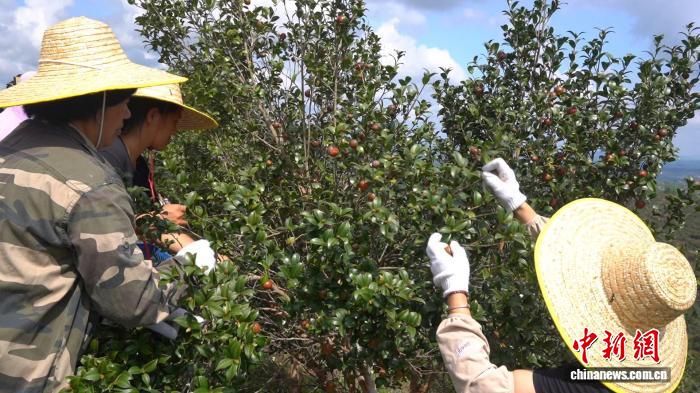
油茶种植与加工

Search documents
江西宜春 油茶香飘富民路
Xin Lang Cai Jing· 2026-02-06 21:01
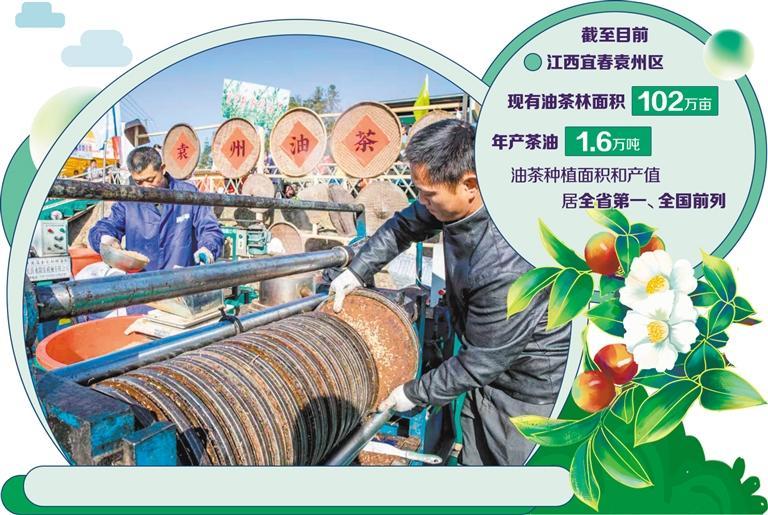
Core Insights - The article highlights the growth and development of the oil tea industry in Yuanzhou District, Jiangxi Province, emphasizing its significant economic impact and the integration of technology in cultivation and processing [2][3][4]. Industry Overview - Yuanzhou District is recognized as a core area for oil tea production in China, benefiting from favorable climatic and soil conditions, which have led to a comprehensive industry chain with an annual output value of 3.6 billion yuan [3][4]. - The district has established a robust technological support system to address traditional challenges in oil tea cultivation, such as low yield and unstable quality, through initiatives like the "Technology Courtyard" and partnerships with local universities [3][4]. Production and Processing - The area has 1.02 million acres of oil tea plantations, with a production capacity of 16,000 tons of tea oil annually, making it a leading region in both Jiangxi Province and nationally [4][5]. - The introduction of deep processing techniques has significantly increased the value of oil tea products, with over 60% of the total industry output value now coming from processed goods [6][7]. Financial and Market Support - A new financial support model has been implemented to stabilize raw material supply and protect farmers' income, involving a partnership between state-owned enterprises and financial institutions to facilitate large-scale procurement of tea oil [7][8]. - This model aims to ensure a steady market for farmers while supporting the growth of leading enterprises in the industry [7][8]. Cultural and Economic Integration - The development of oil tea culture tourism has attracted over 500,000 visitors, enhancing local economic benefits and increasing farmers' income by an average of 3,000 yuan per household [8][9]. - Future plans include the establishment of a provincial oil tea industry demonstration park and a modern trading center to further enhance the brand influence of "Yuanzhou Tea Oil" [9].

贵州天柱油茶“智”变
Jing Ji Ri Bao· 2026-01-17 22:16
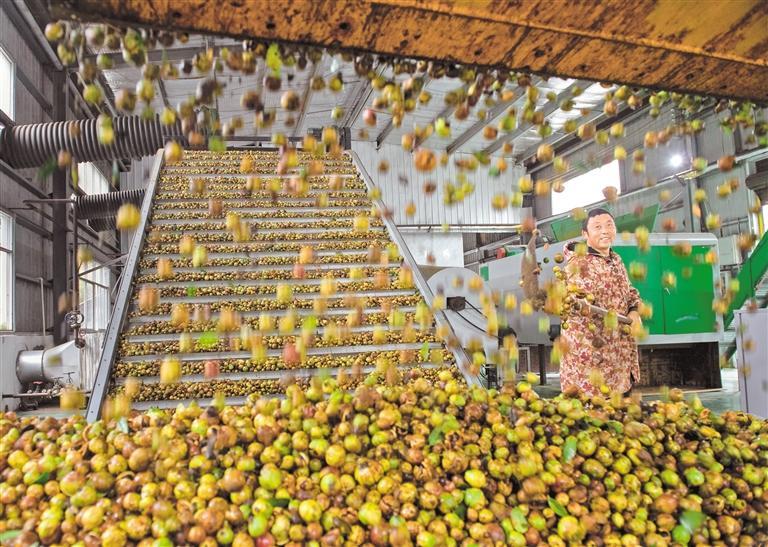
Core Viewpoint - The oil tea industry in Tianzhu County, Guizhou Province, is experiencing significant advancements through technology, leading to increased production efficiency and product quality, while also expanding into international markets [1][2]. Group 1: Production Efficiency - The company has implemented "hot air explosion" technology, increasing the oil yield from 18% to 28%, allowing an additional 10 kilograms of tea oil to be extracted from every 100 kilograms of oil tea seeds [1]. - The introduction of drones has drastically reduced the time required for harvesting, with one drone completing the work of over 20 workers in just three days [1]. - Smart irrigation systems now cover 12,900 acres of oil tea forests, enhancing water and fertilizer efficiency while improving oil tea quality [2]. Group 2: Market Expansion - The company has obtained international food safety certification, enabling its tea oil to enter global markets, with plans to sell 303 tons to Southeast Asia and the EU by 2025, generating over 60 million yuan in sales [2]. Group 3: Technological Innovation - The county has collaborated with research institutions to develop three local varieties and introduce eight high-yielding strains, resulting in seven technical patents [2]. - The goal for the experimental fields is to achieve a yield of 1,500 pounds per acre, supported by precise fertilization techniques [2]. Group 4: Community Impact - The oil tea industry is expected to produce over 16,000 tons of tea seeds annually, with processing capacity reaching 3,500 tons, benefiting 47,300 households and 175,000 people [2].
“含新量”释放产业发展动能
Xin Lang Cai Jing· 2026-01-12 22:06
Group 1 - The introduction of drones in the oil tea cultivation process has significantly improved efficiency, reducing transportation time from 20 days with 20 workers to just 2-3 days with one drone [2] - The implementation of integrated water and fertilizer management allows farmers to perform precise irrigation with a single click on their mobile phones, potentially increasing the yield from 800 pounds to over 1500 pounds per acre [2] - The "hot air explosion" technology developed by Guizhou Yongxing Technology Co., Ltd. has streamlined the processing of oil tea fruit, reducing the workforce from over 500 to just 2 people and increasing the oil extraction rate from 18% to 28% [2] Group 2 - The quality improvement of Yongxing Technology's camellia oil has led to market expansion, with products now being sold domestically and internationally, including Southeast Asia and the European Union, projecting sales of over 300 tons and revenue exceeding 60 million yuan by 2025 [3] - The oil tea planting area in Tianzhu County has reached 430,000 acres, with an expected oil tea seed output of 16,000 tons this year and an annual processing capacity of 3,500 tons of camellia oil, contributing to a comprehensive output value of 600 million yuan [3] - The technological advancements in oil tea cultivation and processing are transforming the industry, impacting over 47,300 households and 175,000 people, showcasing the significant industrial potential of the oil tea fruit [3]
群众工作札记 | 疏通产业发展堵点
Zhong Yang Ji Wei Guo Jia Jian Wei Wang Zhan· 2025-12-09 00:11
Group 1 - The oil tea industry in Yizhang County is a key agricultural sector, contributing significantly to local economic development and employment opportunities [2] - The county has a total of 118,000 acres of oil tea plantations, with 158 oil tea enterprises and a standardized processing facility, producing nearly 2,000 tons of tea oil annually, generating over 200 million yuan in revenue [2] - The local government has implemented infrastructure improvements, including the construction of a 180 cubic meter water storage tank and 4,500 meters of water pipeline, to address irrigation challenges faced by oil tea farmers [1] Group 2 - The county's supervisory bodies are actively monitoring the implementation of agricultural support policies, ensuring effective technical guidance, and promoting brand development for the oil tea industry [2] - Efforts are being made to enhance the integration of agriculture with tourism, creating projects that combine oil tea garden visits, cultural education, and ecological leisure experiences [2] - The focus on high-quality agricultural development aims to eliminate obstacles affecting the industry and stimulate local economic growth, contributing to rural revitalization and modernization [3]
(乡村行·看振兴)福建泰宁:技术下田 茶籽生金
Zhong Guo Xin Wen Wang· 2025-12-04 06:49
Core Viewpoint - The article highlights the successful development of the tea seed oil industry in Taining, Fujian, showcasing how modern agricultural practices and community collaboration have transformed local farming into a profitable venture, contributing to rural revitalization. Group 1: Industry Development - The tea seed oil production base in Guanjing Village has achieved an output value exceeding 700,000 yuan through mechanized pressing [1] - The village has a favorable environment for tea seed growth, characterized by abundant sunlight, rainfall, and nutrient-rich soil [3] - The total planting area for tea seeds in Dalong Township has reached over 13,000 mu, with an expected total output of over 1,800 tons, generating more than 5 million yuan in revenue from fresh fruit alone [5][7] Group 2: Business Model and Community Engagement - A "company + base + farmer" model has been established, integrating over 40 scattered growers into a cohesive unit to enhance development [3] - The establishment of a standardized production and processing base has been supported by a registered tea oil brand and compliance with agricultural product certification [3] - Local farmers have benefited from increased income through both selling tea fruits and working at the processing base, with dozens of villagers employed [4] Group 3: Technological Advancements - Collaboration with research institutions has led to the implementation of modern agricultural techniques, improving planting management and pest control [4] - The production capacity has significantly increased, with the processing facility capable of handling over 20,000 jin of tea fruits daily, projecting an oil yield of around 10,000 jin [4] Group 4: Future Plans and Sustainability - The company plans to expand its operations by contracting over 500 mu of land for planting high-yield tea seed varieties and developing more high-value tea oil products [4] - The local government is actively integrating resources to create a high-standard tea seed demonstration base across multiple villages [5]
河源龙川骆姓姊妹花:从零开始创业十六年载,铺就长洲村“绿色共富”产业路
Nan Fang Nong Cun Bao· 2025-11-24 08:30
Core Viewpoint - The article highlights the entrepreneurial journey of the Luo sisters in Longchuan, Heyuan, who transitioned from various backgrounds to establish a successful tea oil business, emphasizing their commitment to agricultural innovation and community development [1][2][3]. Group 1: Entrepreneurial Journey - The Luo sisters, including Luo Biqun, Luo Bina, and Luo Su'e, have been in the tea oil industry for 16 years, starting from scratch and overcoming challenges to create a thriving business [1][4][5]. - Luo Biqun, initially a factory owner in Shenzhen, decided to return to her hometown to cultivate tea oil after a family crisis prompted her to reassess her life choices [13][14][28]. - In 2008, Luo Biqun sold her factory and property, returning to Longzhou Village to lease 3,000 acres of land for tea oil cultivation, despite skepticism from local villagers [30][31]. Group 2: Community Impact - The sisters aimed to uplift their community by sharing their knowledge and experiences in tea oil cultivation, leading to the establishment of a cooperative that unites local farmers [44][56]. - Their efforts have resulted in the cultivation of over 20,000 acres of tea oil in Huangshi Town, significantly increasing the collective economic income of Longzhou Village from 19,000 yuan in 2016 to several hundred thousand yuan [59][60]. Group 3: Product Innovation and Market Expansion - The company has collaborated with universities and research institutions to innovate and develop various products from tea oil, including food, cosmetics, and skincare items, holding over 50 patents [64][66]. - The sisters have actively engaged in online and offline marketing strategies, including live streaming and participating in agricultural expos, to enhance brand visibility and sales [68][90]. Group 4: Challenges and Adaptations - Despite the quality of their products, the company faced challenges in brand recognition and sales, prompting them to adapt their marketing strategies through e-commerce training and targeted customer engagement [70][73][78]. - Luo Su'e has taken on the role of a live-streaming host, effectively utilizing her previous work experience to connect with audiences and share the sisters' story, which has helped increase order volumes [81][87].


喜迎丰收!今年广东油茶籽产量预计达26万吨
Nan Fang Nong Cun Bao· 2025-11-03 07:05
Core Viewpoint - The oil tea seed production in Guangdong is expected to reach 260,000 tons this year, showing a stable increase compared to last year [4][18]. Group 1: Production and Harvesting - The oil tea fruit enters its peak harvesting period around mid-October, with approximately 1.7 million mu of oil tea in Guangdong reaching full production [2][3]. - The fresh fruit harvesting is expected to be completed by mid-November [19]. - The oil tea seed production is projected to increase steadily compared to last year, with a total expected output of 260,000 tons [4][18]. Group 2: Regional Highlights - The city of Heyuan is a core production area for oil tea in Guangdong, with a history of over a thousand years in cultivation [10]. - Heyuan has a total oil tea planting area of 495,000 mu, accounting for one-sixth of the province's total [12]. - The comprehensive output value of oil tea in Heyuan exceeds 3 billion yuan, with the largest planting area and stable growth in the province [21][22]. Group 3: Industry Development - Guangdong is in a phase of steady expansion and quality improvement for oil tea, with ongoing efforts to increase planting scale and enhance production capacity [25]. - The provincial forestry bureau has introduced financial support policies for new oil tea plantations and low-yield forest renovations [26]. - By the end of this year, the total planting area for oil tea in Guangdong is expected to stabilize around 3.6 million mu, with an annual tea oil production capacity of 80,000 tons [30].
(乡村行·看振兴)福建宁化:“鱼鳞坑”筑起生态链 促小茶果成大产业
Zhong Guo Xin Wen Wang· 2025-10-28 05:18
Core Viewpoint - The article highlights the innovative "fish scale pit" planting technique in Ninghua County, Fujian Province, which enhances the ecological chain and significantly increases the yield of oil tea fruit, transforming the local oil tea industry into a large-scale enterprise [1][2]. Group 1: Innovative Agricultural Practices - The traditional oil tea planting method led to severe soil erosion during rainy seasons, negatively impacting soil fertility and oil tea yield [2]. - The "fish scale pit + hillside ditch" planting technique was developed to intercept rainwater, conserve soil, and gather nutrients, creating a complete soil and water conservation system [2]. - The implementation of a "three-in-one" model combining "stereoscopic planting and breeding + ecological recycling" reduces the use of chemical fertilizers and pesticides while promoting resource recycling [2]. Group 2: Economic Impact and Production - The oil tea plantation in Ninghua County is expected to yield between 150,000 to 165,000 kilograms of tea fruit this year, producing approximately 10,000 kilograms of tea oil, valued at over 2 million yuan at a market price of 200 yuan per kilogram [4]. - Ninghua County has prioritized the oil tea industry as a key sector for economic development, focusing on cultivating quality demonstration forests, transforming low-yield forests, and supporting the upgrading of processing enterprises [4]. - The total area of oil tea forests in Ninghua County has reached 204,500 acres, making it the second-largest in the province, with an annual production of 2,650 tons of tea oil and an estimated annual output value of around 400 million yuan [4].
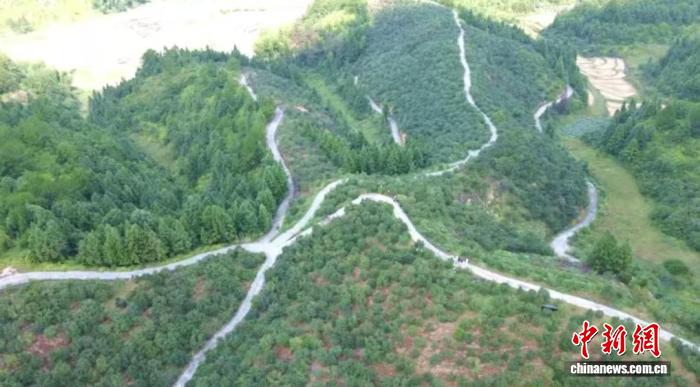
湖南永兴探索“补贴+保险”政策包 护航油茶种植助农增收
Zhong Guo Xin Wen Wang· 2025-10-23 11:47
Core Viewpoint - Hunan Yongxing County has introduced a "subsidy + insurance" policy package to support the oil tea planting industry, aiming to enhance farmers' income and ensure sustainable development of the industry [1][2]. Group 1: Policy Implementation - The county has allocated 7.2 million yuan for the transformation of 12,000 mu of low-yield oil tea forests, providing subsidies of 500 to 1,000 yuan per mu [2]. - An additional 6 million yuan is designated for the cultivation of 20,000 mu of young forests, along with 1 million yuan for the establishment of a 400 mu mechanized demonstration base [2]. - A total of 1.32 million yuan has been allocated for insurance coverage of 110,000 mu of oil tea forests, establishing a risk prevention mechanism for the industry [2]. Group 2: Industry Development - The oil tea industry faces significant investment and long cycles, with natural and market risks being major constraints [2]. - The "subsidy + insurance" policy effectively addresses these challenges by reducing upfront costs for farmers and providing insurance against natural disasters [2]. - Yongxing County has partnered with Hunan Academy of Forestry Sciences to introduce seven improved oil tea varieties and establish a 120 mu seedling breeding base, enhancing the supply of quality seedlings [3]. Group 3: Production and Economic Impact - The county has developed 70.85 million mu of oil tea forests, nurturing 128 large planting households, 15 professional companies, and 28 cooperatives [3]. - In 2024, the expected annual production of oil tea seeds is 52,000 tons, with a total output value exceeding 2.569 billion yuan [3]. - The county has 77 oil tea processing enterprises, with four equipped with automated production lines, achieving a production of 1,208 tons of tea oil, 11,000 tons of tea pomace, and 560 tons of tea saponin in 2023 [3].
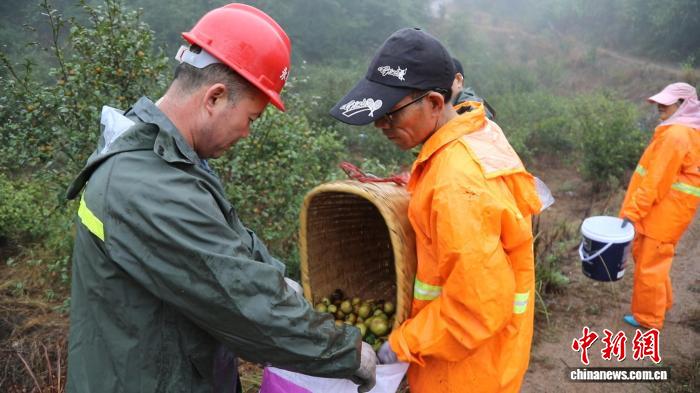
(乡村行·看振兴)广东龙川县:油茶果结出“致富金果” 铺就乡村共富路
Zhong Guo Xin Wen Wang· 2025-10-20 12:11
Core Viewpoint - The oil tea industry in Longchuan County, Guangdong, is experiencing significant growth, contributing to rural prosperity and farmer income through effective agricultural practices and market integration [2][4]. Group 1: Industry Overview - Longchuan County has a total oil tea planting area of approximately 495,000 acres, with an annual production of about 170,000 tons of oil tea fruit and over 40,000 tons of oil tea seeds [4]. - The total industrial chain output value of the oil tea industry in Longchuan is estimated to reach 1.9 billion RMB [4]. Group 2: Production and Harvesting - The oil tea harvest season has begun, with 200,000 acres of oil tea trees bearing fruit, and daily harvesting expected to yield around 20,000 pounds of oil tea fruit [2]. - The company anticipates a total production of over 1,000 tons of oil tea this year, with the first batch of camellia oil expected to be produced by October 25 [2]. Group 3: Economic Impact - The cooperative model involving over 700 tea farmers has resulted in an average annual income increase of over 15,000 RMB per household [4]. - The integration of processing and brand development has led to the establishment of five provincial and five municipal key agricultural leading enterprises, enhancing the overall industry structure [4]. Group 4: Future Developments - Longchuan County plans to focus on "integration" and "innovation" to promote industry upgrades, including improving quality safety detection systems and supporting deep processing of tea oil [5]. - The county aims to enhance the tourism experience by integrating oil tea culture, allowing visitors to purchase quality oil while engaging with local traditions [5].