
酵母及深加工

Search documents
安琪酵母:全球蛋白市场体量很大
Zheng Quan Ri Bao· 2026-01-14 13:41
Group 1 - The core viewpoint is that the global protein market is substantial, and there is significant potential for yeast protein to capture a portion of this market space [2] Group 2 - The company, Angel Yeast, indicated that if a certain percentage of the global protein market can be replaced, the market space corresponding to yeast protein would be considerable [2]


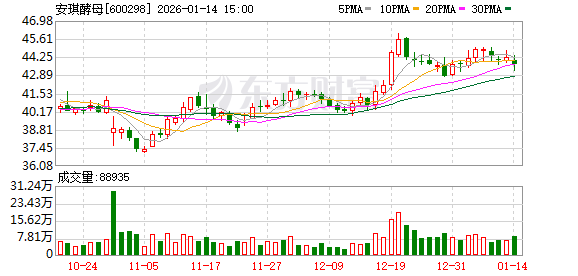
安琪酵母:公司已建立多元化的融资渠道
Zheng Quan Ri Bao· 2026-01-14 13:40
Group 1 - The company has established diversified financing channels, including debt financing through bank loans and corporate bonds, maintaining a low overall financing cost [2] - The company also keeps equity financing channels open and may pursue refinancing in the capital market based on strategic development needs [2] - The company adheres to a flexible and prudent financing strategy to support business development and optimize its capital structure [2]
安琪酵母:公司2024年度分红为0.55元/股,较2023年度的0.50元/股有一定提升
Zheng Quan Ri Bao· 2026-01-14 13:40
(文章来源:证券日报) 证券日报网1月14日讯 ,安琪酵母在接受调研者提问时表示,公司章程规定的年度分红比例为不低于净 利润的30%,公司2024年度分红为0.55元/股,较2023年度的0.50元/股有一定提升。未来,公司将积极响 应监管号召,结合自身发展阶段与中长期资金规划,制定并实施科学、可持续的分红政策,积极回报投 资者。 ...
安琪酵母:第十届董事会第九次会议决议公告
Zheng Quan Ri Bao· 2025-12-15 10:13
(文章来源:证券日报) 证券日报网讯 12月15日晚间,安琪酵母发布公告称,公司第十届董事会第九次会议审议通过《关于变 更注册资本及股份数并修订有关条款的议案》《关于修订公司有关条款的议案》《关于对参股公司提供 担保的议案》。 ...
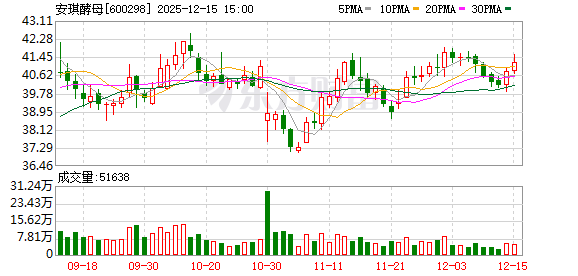
安琪酵母(600298.SH)拟实施年产6万吨食品原料柔性智能制造及配套项目
智通财经网· 2025-11-21 09:57
Core Insights - Anqihua Yeast (600298.SH) announced plans to implement a flexible intelligent manufacturing project for food raw materials with an annual production capacity of 60,000 tons to meet the company's "14th Five-Year" market planning needs [1] - The total investment for this project is 215 million yuan [1] Company Strategy - The project aims to further ensure the supply of the company's food raw material products [1] - This initiative aligns with the company's long-term market strategy and growth objectives [1]
安琪酵母拟实施年产6万吨食品原料柔性智能制造及配套项目
Zhi Tong Cai Jing· 2025-11-21 09:56
Group 1 - The core point of the article is that Angel Yeast (600298.SH) announced plans to implement a flexible intelligent manufacturing project for food raw materials with an annual production capacity of 60,000 tons, in line with its "14th Five-Year" market planning needs [1] - The investment amount for this project is 215 million yuan [1]
安琪酵母:前三季度归母净利润为11.16亿元,同比增长17.13%
Bei Jing Shang Bao· 2025-10-29 13:49
Core Viewpoint - Angel Yeast reported its Q3 2025 financial results, showing a steady growth in revenue and net profit, indicating a positive performance trend in the yeast industry [1] Financial Performance - In Q3 2025, the company achieved a revenue of 3.887 billion yuan, representing a year-on-year growth of 4% [1] - The net profit attributable to shareholders for Q3 was 317 million yuan, reflecting a year-on-year increase of 21% [1] - For the first three quarters of 2025, the total revenue reached 11.786 billion yuan, with an 8.01% year-on-year growth [1] - The net profit attributable to shareholders for the first three quarters was 1.116 billion yuan, showing a year-on-year growth of 17.13% [1]
安琪酵母: 安琪酵母股份有限公司外汇风险和利率风险管理制度(2025年8月修订)
Zheng Quan Zhi Xing· 2025-08-14 16:15
Core Viewpoint - The document outlines the foreign exchange and interest rate risk management system of Angel Yeast Co., Ltd, aiming to standardize and enhance the management of these risks to ensure asset safety and compliance with relevant laws and regulations [1][2]. Section Summaries Purpose - The purpose of the system is to regulate the foreign exchange and interest rate risk management work of the company, ensuring asset safety and compliance with laws and regulations [1]. Scope - The risk management activities are limited to major settlement currencies used in the company's international business, including but not limited to USD, EUR, RUB, and EGP. The company will utilize various financial instruments to manage these risks [2]. Roles and Responsibilities - The financial department's risk management team, led by the financial manager, is responsible for drafting transaction plans, which include transaction types, limits, and methods. The plans must be approved by the general manager after review by the responsible leader [3][4]. Business Authorization - The decision-making bodies for risk management include the shareholders' meeting, board of directors, and management. Transactions exceeding 30% of the company's audited total revenue must be approved by the shareholders' meeting [4]. Management Principles - The risk management activities must align with the company's operational principles, focusing on hedging to minimize risks. Speculative trading is prohibited, and all activities must be managed centrally by the financial department [5]. Additional Provisions - The company must conduct transactions only with qualified financial institutions approved by the State Administration of Foreign Exchange and the People's Bank of China. The company is required to establish its own trading accounts for these activities [5].
安琪酵母: 安琪酵母股份有限公司信息披露暂缓与豁免业务管理制度(2025年8月修订)
Zheng Quan Zhi Xing· 2025-08-14 16:15
General Principles - The company aims to standardize the management of information disclosure deferral and exemption, ensuring compliance with legal obligations and protecting investors' rights [1] - The company will follow the regulations set forth in the Stock Listing Rules and other relevant business rules when handling information disclosure deferral and exemption [1][2] Scope of Deferral and Exemption - Information can be deferred or exempted from disclosure if it involves state secrets or commercial secrets that meet specific criteria, such as potential harm to competition or violation of confidentiality [2][3] - The definition of commercial secrets includes non-public information that provides economic benefits and is protected by confidentiality measures [2] - The definition of state secrets includes information related to national security that is restricted to a limited audience and could cause harm if disclosed [2] Management of Deferral and Exemption - The company must carefully assess whether information qualifies for deferral or exemption and cannot misuse these procedures to avoid disclosure obligations [3][4] - The company has a responsibility to maintain state secrets and must not disclose such information through any means, including investor interactions or media releases [4] - In periodic reports, the company may use alternative methods to protect sensitive information, such as using pseudonyms or summarizing data [4][5] Responsibilities and Procedures - The chairman of the board is the primary responsible person for implementing deferral and exemption measures, while the board secretary coordinates the specific details [5] - Departments seeking deferral or exemption must complete internal documentation and submit it to the board secretary for review within two trading days [5][6] - Any deferred or exempted information must be disclosed promptly once the reasons for deferral are resolved [6][7] Accountability - The company has established a mechanism for accountability regarding deferral and exemption practices, with penalties for those who fail to comply with the established procedures [7]
安琪酵母: 安琪酵母股份有限公司内部控制制度(2025年8月修订)
Zheng Quan Zhi Xing· 2025-08-14 16:15
Core Viewpoint - The internal control system of Angel Yeast Co., Ltd. aims to enhance operational efficiency, ensure asset security, and comply with legal regulations while mitigating various risks [1]. Group 1: Internal Control Objectives - The internal control system is designed to ensure legal compliance, asset security, and the authenticity of financial reporting [1]. - The principles guiding the internal control system include comprehensiveness, legality, effectiveness, significance, checks and balances, adaptability, and cost-effectiveness [3]. Group 2: Internal Control Environment - The company establishes a clear organizational structure and division of responsibilities to ensure effective management [2]. - The board of directors oversees the internal control system's effectiveness, while management is responsible for its implementation [2][3]. - An audit and risk committee is established within the board to supervise financial information and internal control [2]. Group 3: Risk Assessment - The company conducts comprehensive risk assessments by collecting relevant internal and external information [5]. - Internal risks focus on factors such as management integrity, organizational structure, and financial health [5][7]. - External risks include economic conditions, legal regulations, and technological advancements [5][7]. Group 4: Control Activities - Control measures include separation of incompatible duties, authorization controls, and financial management systems [8][9]. - The company implements a budget management system to clarify responsibilities and enhance budgetary constraints [10]. Group 5: Information and Communication - The company establishes internal communication systems to enhance efficiency and transparency [11]. - An information disclosure management system is in place to ensure timely and accurate external communication [11]. Group 6: Internal Supervision - The audit and risk committee is responsible for internal supervision and reporting on control deficiencies [12][14]. - Regular self-evaluations of the internal control effectiveness are conducted based on supervisory findings [14].