Financial Services

Search documents
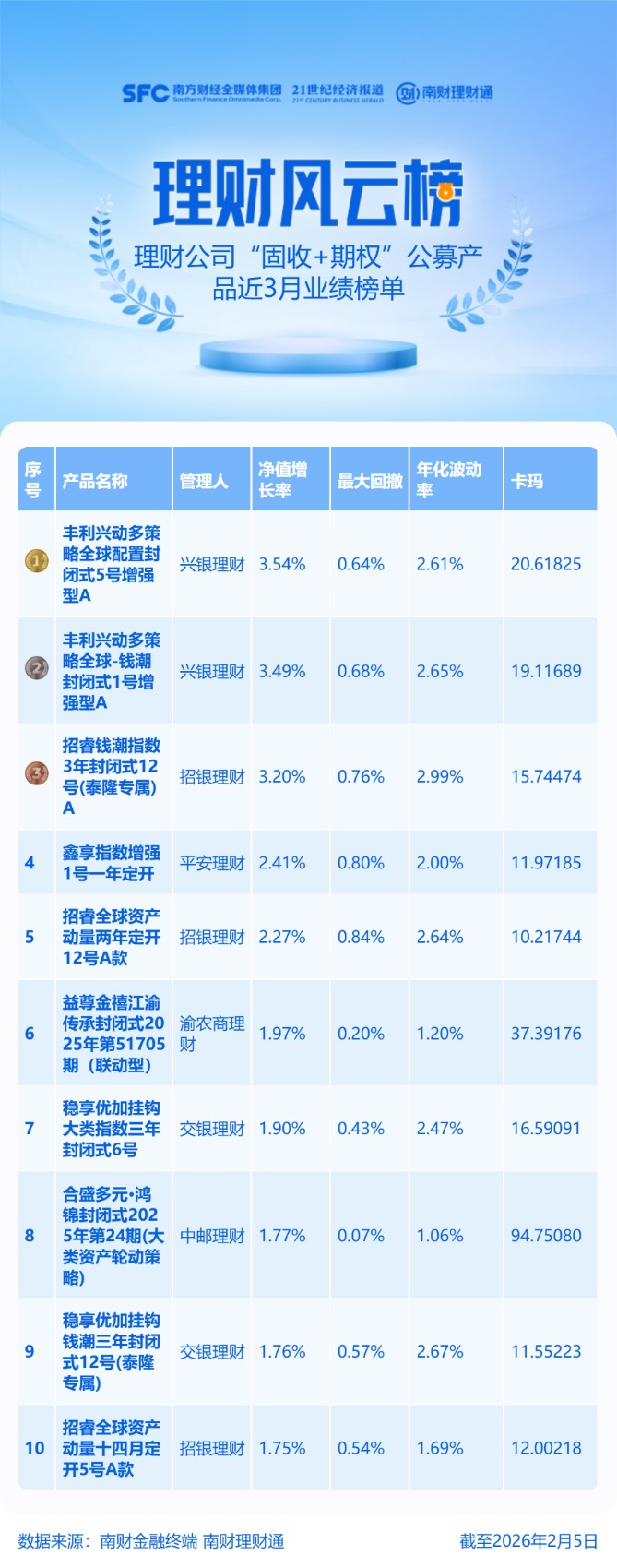
固收+期权理财近3月业绩出炉,兴银、招银3只产品涨超3%
2 1 Shi Ji Jing Ji Bao Dao· 2026-02-11 08:59
Core Insights - The article discusses the performance of public "fixed income + options" wealth management products over the past three months, highlighting the top performers in terms of net value growth rates [4]. Group 1: Performance Overview - As of February 5, 2026, there are 219 public "fixed income + options" wealth management products with a history of over three months, showing an average net value growth rate of 1.42% and an average maximum drawdown of 0.32% [4]. - The top three products in terms of net value growth rates are from Xingyin Wealth Management and Zhaoyin Wealth Management, with growth rates of 3.54% and 3.49% respectively, while Zhaoyin's "Zhaorui Qianchao Index 3-Year Closed No. 12 (Tailong Exclusive) A" also exceeds 3% [4]. Group 2: Product Details - The top three products are linked to the Qianchao Index, which utilizes risk parity and momentum strategies for global asset selection, with the index showing a total growth of 7.72% for the year 2025 [4]. - The eighth-ranked product from Zhongyou Wealth Management, "Hesheng Duoyuan·Hongjin Closed 2025 No. 24 (Major Asset Rotation Strategy)," was issued in October 2025 and has a maturity date of October 26, 2027, with a risk level of PR2 [5]. - This product has a relatively small fundraising scale of 190,800 yuan and a performance benchmark of 0.3% to 4.2%, with a management fee structure that rewards the manager for exceeding a 3.50% annual return [6].

Remitly Global (RELY) Expected to Announce Quarterly Earnings on Wednesday
Defense World· 2026-02-11 08:40
Core Viewpoint - Remitly Global, a digital financial services company specializing in cross-border money transfers, is experiencing varied analyst ratings and significant insider trading activity, indicating a dynamic investment landscape for the stock [2][3][7]. Stock Performance - Remitly Global's shares opened at $13.63, with a 52-week low of $12.08 and a high of $27.32. The market capitalization stands at $2.85 billion, with a P/E ratio of 151.44 and a beta of 0.11. The 50-day moving average price is $13.82, while the 200-day moving average price is $15.48 [1]. Analyst Ratings Changes - Bank of America initiated coverage with a "buy" rating and a $18.00 price target. Goldman Sachs reaffirmed a "buy" rating with a $17.00 target. Zacks upgraded the stock from "hold" to "strong-buy." JPMorgan reduced its price target from $23.00 to $22.00 while maintaining an "overweight" rating. The consensus rating is "Moderate Buy" with a target price of $23.70 [2]. Insider Trading Activity - Director Ryno Blignaut sold 4,500 shares at an average price of $13.25, totaling $59,625, reducing his position by 9.77%. Director Joshua Hug sold 40,776 shares at an average price of $13.33 for $543,544.08, decreasing his position by 1.10%. Over the last three months, insiders sold 48,276 shares valued at $648,169, with insiders owning 8.10% of the stock [3]. Institutional Investor Activity - Arrowstreet Capital increased its stake by 86.0%, owning 5,554,016 shares valued at $90.53 million. Marshall Wace raised its holdings by 74.4%, owning 4,599,144 shares valued at $74.97 million. UBS Group AG boosted its position by 189.7%, owning 2,418,069 shares valued at $39.42 million. Institutional investors own 74.25% of the stock [4]. Company Overview - Remitly Global operates as a digital financial services company focused on cross-border money transfers, enabling immigrants and expatriates to send remittances securely and quickly. The company aims to streamline traditional cash-based methods through its online platform and mobile applications [7]. Founded in 2011 and headquartered in Seattle, Washington, Remitly is publicly traded on NASDAQ under the ticker RELY [8]. Upcoming Earnings - Remitly Global is expected to release its Q4 2025 results on February 18, 2026, with analysts predicting earnings of $0.01 per share [6].


US stock market | Wall Street’s new trade is dumping any stock in AI’s crosshairs
The Economic Times· 2026-02-11 07:53
Core Viewpoint - The recent selloff in the stock market, particularly affecting companies at risk of disruption from AI technologies, reflects a growing anxiety among investors about the potential impact of AI on various industries [1][14]. Group 1: Market Reaction - The selloff was triggered by the launch of a tax-strategy tool by Altruist Corp., which caused shares of major firms like Charles Schwab Corp. to drop by 7% or more, marking the deepest decline since the trade-war meltdown in April [1][14]. - Investors are adopting a "sell-first, ask-questions-later" mentality, leading to indiscriminate selling of companies perceived to have any disruption risk [2][14]. - The stock market's reaction has wiped billions of dollars off the market values of several investment firms, indicating a strong signal about the competitive threat posed by new AI products [8][14]. Group 2: Industry Impact - The software industry has been particularly affected, with fears spreading to sectors such as financial services, asset management, and legal services following the introduction of new AI tools [6][14]. - The launch of Insurify's application using ChatGPT to compare auto-insurance rates also negatively impacted shares of US insurance brokers [7][14]. - Altruist's product, Hazel, which personalizes strategies for financial advisers, exemplifies how AI can potentially replace entire teams in wealth management for a fraction of the cost [9][14]. Group 3: Investor Sentiment - Investors are now more focused on avoiding companies that could be displaced by AI rather than identifying potential winners in the market [5][14]. - There is skepticism about the speed at which AI will disrupt industries, with some experts suggesting that tech disruption often takes longer to materialize than anticipated [10][11]. - The recent pullbacks in stock prices may also reflect broader concerns about high valuations following a rally driven by AI spending and a resilient US economy [11][12].



上海:加快构建全周期、多元化、接力式科技金融服务体系
Sou Hu Cai Jing· 2026-02-11 07:47
Core Viewpoint - Shanghai aims to enhance financial services for the real economy during the 14th Five-Year Plan period, focusing on supporting domestic demand, technological innovation, green development, small and micro enterprises, and public welfare through five key initiatives [1][2]. Group 1: Financial Services for Economic Development - The city will accelerate the establishment of a comprehensive, diversified, and relay-style technology financial service system, promoting the development of the Sci-Tech Innovation Board and bond market "technology board," and supporting market-oriented merger funds and venture capital [1]. - High-quality financial supply will be provided for the comprehensive green transformation of economic and social development, expanding the functions of Shanghai's green financial service platform and optimizing the green financial standard system [1]. Group 2: Inclusive and Sustainable Financial Systems - A multi-level, widely covered, and sustainable inclusive financial system will be improved, increasing support for first-time and renewed loans, and enhancing financing connections for small and micro enterprises using technologies like blockchain [1]. - A pension financial system that aligns with the aging population will be established, supporting the design and investment management of savings, wealth management, funds, trusts, and insurance products with pension functions [1]. Group 3: Digital Financial Development - The development of digital finance will be promoted, with steady progress in the digital renminbi and support for the establishment of a digital renminbi international operation center in Shanghai, alongside the digital transformation of financial institutions [2].
American Express Company (AXP) Presents at UBS Financial Services Conference 2026 - Slideshow (NYSE:AXP) 2026-02-11
Seeking Alpha· 2026-02-11 05:01
Group 1 - The article does not provide any relevant content regarding the company or industry [1]


MGC: Broad Market, Fading Mega-Cap Leadership
Seeking Alpha· 2026-02-11 03:16
Core Viewpoint - Investing in indexed American stocks of large market capitalization is recommended through reputable financial institutions like Vanguard [1] Group 1 - A listed vehicle from a reputable financial institution is a good way to invest in indexed American stocks [1]

Stock market today: Dow, S&P 500, Nasdaq futures pause as Wall Street braces for jobs report
Yahoo Finance· 2026-02-10 23:57
Economic Indicators - Investors are awaiting the January nonfarm-payrolls report, which is considered crucial for setting expectations regarding interest-rate cuts [2][5] - Economists project a gain of approximately 68,000 jobs, with the unemployment rate expected to remain at 4.4% [3] - The report may include significant revisions to 2025 job numbers, indicating fewer new positions added to the economy than previously estimated [3][4] Corporate Earnings - Earnings reports from major companies like McDonald's and Kraft Heinz are anticipated to provide insights into consumer behavior and corporate performance [6] - Ford reported a Q4 profit miss and a net loss of $8 billion for the year, influenced by a $900 million tariff impact [6] - Humana's stock fell 7% due to a profit forecast below analysts' expectations, while Moderna's stock dropped 10% after the FDA declined to review its flu vaccine application [8] Market Trends - There is a growing sentiment in the market regarding potential Federal Reserve rate cuts, with a 77% probability of lower rates by June [5] - Stocks of companies perceived to be at risk from AI developments are experiencing significant sell-offs, affecting both small software firms and large wealth-management companies [12]
Blackstone Secured Lending Fund. (BXSL) Presents at Bank of America Financial Services Conference 2026 Transcript
Seeking Alpha· 2026-02-10 23:44
Economic Outlook - The broader economy is showing resilience, with strong corporate earnings and consumer spending [1] - Interest rates are decreasing, providing a favorable environment for growth [1] - Q3 GDP growth has continued to accelerate, indicating positive economic momentum [1] Credit Market Insights - Default rates in private credit have declined by approximately 30% in 2025, suggesting improved credit conditions [2]


Bread Financial Holdings, Inc. (BFH) Presents at Bank of America Financial Services Conference 2026 Transcript
Seeking Alpha· 2026-02-10 23:34
Group 1 - The article does not provide any relevant content regarding company or industry insights [1]


X @Easy
Easy· 2026-02-10 23:17
Going to be averaging UP on $HOOD here soon.Missed revenue slightlyBeat EPSNumber of funded customer accounts through the roof.They noted that platform assets are up 68% to 324 BILLIONThis is all with only 1 quarter of prediction markets, no mortgage / housing financial growth (yet) and people speculating that a negative economy will lead to less inflow, which is fairMy bet is robinhood is the neobank, and beyond. The do EVERYTHING finance app from investing, to mortgages, to predictions, to crypto, to debi ...