Financial Services

Search documents
Bread Financial Provides Performance Update for January 2026
Globenewswire· 2026-02-10 12:00
Performance Update - Bread Financial Holdings, Inc. reported a net principal loss rate of 7.1% for January 31, 2026, down from 7.8% a year earlier, indicating improved credit performance [1] - The company experienced net principal losses of $111 million in January 2026, a decrease from $123 million in January 2025 [1] - The delinquency rate as of January 31, 2026, was 5.9%, compared to 6.1% in the previous year, reflecting a positive trend in loan performance [1] Company Overview - Bread Financial is a tech-forward financial services company that offers personalized payment, lending, and saving solutions to millions of U.S. consumers [2] - The company provides general purpose credit cards and savings products, aiming to empower customers and enhance their quality of life [2] - Bread Financial also supports growth for recognized brands in various sectors through private label and co-brand credit cards, offering value to shared customers [2] Company Milestone - In 2026, Bread Financial celebrates 30 years of success, highlighting its long-standing presence in the financial services industry [3]



Wall Street Breakfast Podcast: BP Cuts The Flow On Buybacks
Seeking Alpha· 2026-02-10 11:35
分组1 - BP reported Q4 revenue of $47.38 billion, a 3.6% year-over-year increase, exceeding estimates by $5.05 billion [2] - BP's Q4 Non-GAAP EPADS was $0.60, in line with expectations [2] - For 2026, BP anticipates reported upstream production to be slightly lower and underlying upstream production to remain broadly flat compared to 2025 [2] - BP has decided to suspend share buybacks and allocate excess cash to strengthen its balance sheet, aiming to invest in oil and gas opportunities [2] 分组2 - The Trump administration plans to provide tariff carve-outs for companies like Amazon, Google, and Microsoft, linked to investment commitments from TSMC [2] - TSMC has pledged to invest $165 billion in building capacity in the U.S. as part of this tariff exemption plan [2] - The administration's plans are still in flux and have not yet been finalized [2] 分组3 - Instacart has partnered with 1-800-Flowers.com, allowing U.S. customers to order flowers directly through the Instacart app [2] - This partnership aims to expand Instacart's offerings in time for Valentine's Day, a significant gifting holiday [2] - Instacart reported a 1.47% increase in shares, while 1-800-Flowers.com saw a 0.25% rise [2]





Interactive Brokers Group, Inc. (IBKR) Presents at UBS Financial Services Conference 2026 - Slideshow (NASDAQ:IBKR) 2026-02-10
Seeking Alpha· 2026-02-10 11:01
Group 1 - The article does not contain relevant content regarding company or industry insights [1]


X @Bloomberg
Bloomberg· 2026-02-10 09:53
Funds affiliated with Carlyle Asia Partners will buy a 45% stake in Nido from Edelweiss Financial Services https://t.co/VfatptsbR3 ...
2026贵金属交易平台排名推荐,选择值得信赖的平台
Sou Hu Cai Jing· 2026-02-10 09:12
Core Viewpoint - Compliance is the cornerstone of stable operations for financial institutions like TopWealthTrading, especially in the complex regulatory environment of Australia and the Asia-Pacific region [1][3]. Group 1: Compliance Management - TopWealthTrading prioritizes compliance in its financial services expansion and multi-asset trading platform development, ensuring all operations adhere to regulatory standards [1]. - The company has established a comprehensive compliance management system, including a dedicated compliance department that monitors and reviews business activities in real-time [3]. - Regular training is provided to employees to enhance compliance awareness and risk prevention capabilities [3]. Group 2: Risk Management - The company emphasizes the importance of risk control, recognizing the volatility and uncertainty of financial markets [3]. - Advanced risk control technologies and models are employed to assess and monitor market, credit, and operational risks [3]. - Reasonable risk warning indicators and stop-loss mechanisms are set to control risk exposure effectively [3]. Group 3: Technological Capabilities - TopWealthTrading leverages modern technology to create an efficient, stable, and secure trading platform [5]. - The platform utilizes advanced encryption and security measures to protect customer information and transaction data [5]. - Strong trading processing and data analysis capabilities are provided to offer clients real-time and accurate trading information and market analysis [5]. Group 4: Future Commitment - The company aims to enhance its compliance, risk control, and technological capabilities continuously, aspiring to be a trusted financial service partner for clients [7].

Voya Financial Touts $775M 2025 Cash, $300M Buybacks as It Eyes More Growth in 2026 at UBS Conf
Yahoo Finance· 2026-02-10 09:04
Core Insights - Voya Financial reported strong performance in 2025, generating $775 million in cash, significantly up from the previous year, and achieving record results in its Retirement and Investment Management segments, totaling $1 trillion in assets [5][6] - The company is entering 2026 with momentum, focusing on cash generation, strong commercial performance, and improved profitability in employee benefits [6] Revenue and Earnings - Voya set targets of $200 million in revenue growth and $75 million in earnings, significantly exceeding these goals, with retention rates around 90% [1] - The retirement business achieved close to a 40% margin in 2025, surpassing the guided range of 35% to 39%, with $28 billion in organic flows and an additional $60 billion from the OneAmerica transaction, totaling nearly $90 billion in asset growth [2] Capital Management - The company plans to direct $300 million towards share repurchases in the first half of the year, with approximately $400 million in excess capital expected by year-end [3][4] - Management emphasized balance sheet strength and flexibility in capital deployment, indicating that share repurchases do not preclude future acquisitions [3][4] Wealth Management Strategy - Voya's wealth management initiative is an expansion of existing business, generating about $200 million in revenue from retirement-related activities, which constitutes roughly 10% of the retirement business [7] - The company aims to serve the "mass affluent" participant base, leveraging its existing audience of retirement plan participants to minimize lead-generation costs [8] Investment Management Growth - Voya's investment management segment has outpaced industry growth with steady margin improvement, targeting 2% organic growth long-term [12] - A partnership with Blue Owl is set to launch a Multi-Manager Target-Date Fund in the first half of 2026, enhancing Voya's product offerings [12] Employee Benefits Performance - Employee benefits improved significantly, with pre-tax adjusted operating earnings rising from $40 million in 2024 to over $150 million in 2025, with expectations for further improvement in 2026 [14] - Voya achieved substantial rate increases, with a 21% increase on the January 2025 block and a 24% increase on the January 2026 block, maintaining premium stability year over year [15] Market Position and Future Outlook - Voya is positioned as a top-five provider in the retirement recordkeeping market, which is undergoing consolidation, with the top 10 providers controlling about 80% of assets [6] - The company anticipates continued elevated volatility in the healthcare sector, while focusing on growing cash generation and returning capital to shareholders [17]

权益理财近1年收益冠军近期净值猛跌17%!A股节后怎么走?
2 1 Shi Ji Jing Ji Bao Dao· 2026-02-10 08:59
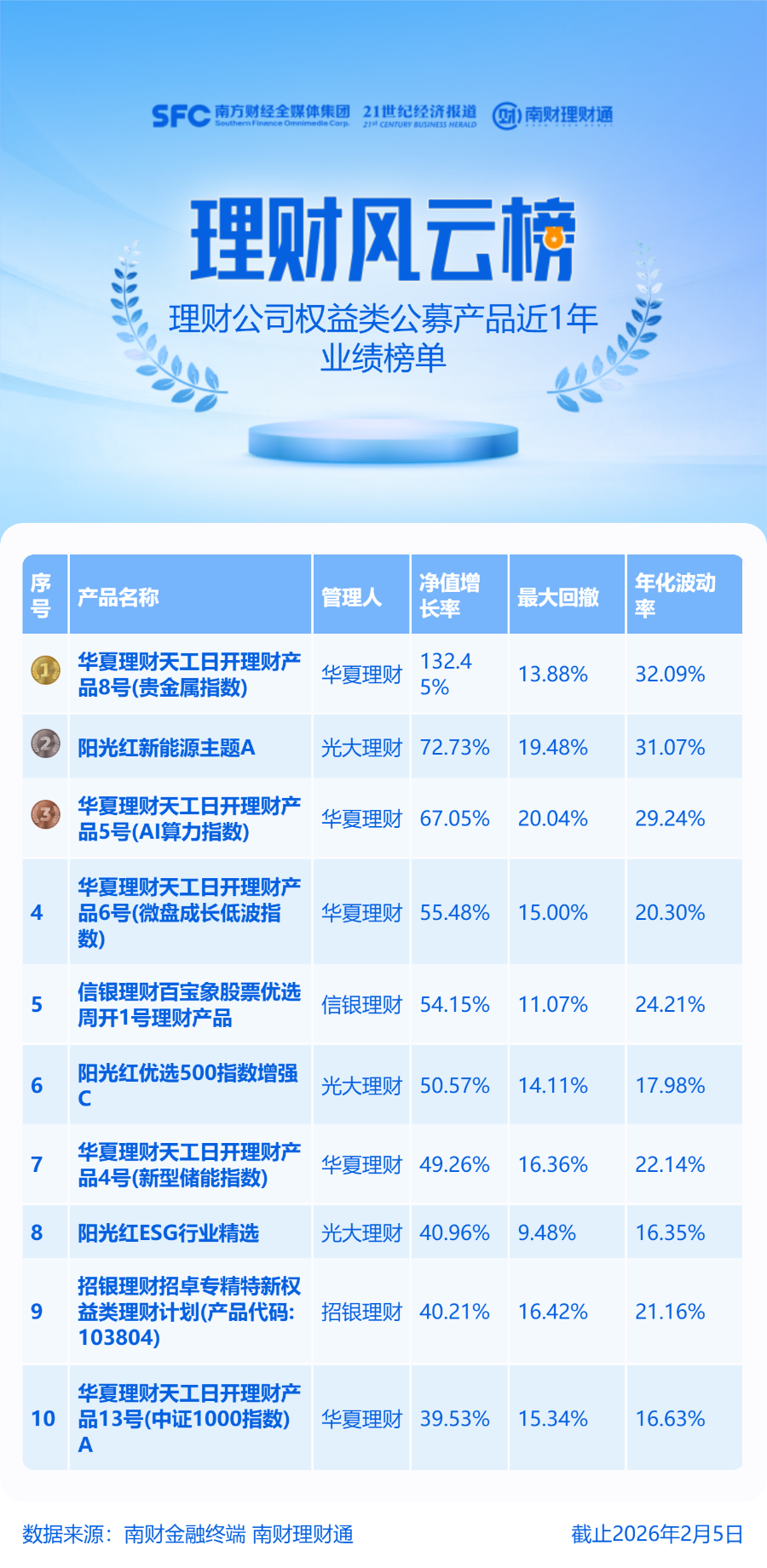
Core Viewpoint - The report highlights the performance of equity-based public financial products in China, showing significant growth in net value over the past year, with a particular focus on the top-performing products and market trends leading into the Lunar New Year [5][6]. Group 1: Market Performance - The A-share market has shown a strong upward trend over the past year, with the ChiNext Index leading with a growth of over 58%, followed by the Shenzhen Composite Index and the Shanghai Composite Index with increases of over 37% and 26%, respectively [5]. - All 31 primary industries in the Shenwan classification have experienced growth in the past year, with non-ferrous metals and telecommunications leading with increases of over 106% and 91% [5]. Group 2: Financial Products Performance - The average net value growth rate of equity public financial products was 33.53% over the past year, with all 36 sample products achieving positive returns [5]. - The top 10 products in the ranking had an average net value growth rate of 60.24%, with the leading product, "Hua Xia Financial Day Open Financial Product No. 8 (Precious Metals Index)," increasing by 132.45% [6]. - Other notable products include "Everbright Financial Sunshine Red New Energy Theme A" and "Hua Xia Financial Day Open Financial Product No. 5 (AI Computing Power Index)," which grew by 72.73% and 67.05%, respectively [6]. Group 3: Market Outlook - Multiple institutions express optimism regarding the A-share market's performance post-Lunar New Year, suggesting a high probability of an upward trend [7][8]. - Historical data indicates that the A-share market typically experiences an upward trend after the Lunar New Year, particularly for small and mid-cap stocks [7]. - Analysts from CITIC Securities believe that external disturbances have not significantly impacted the fundamental aspects of the Chinese industry, suggesting that the market sentiment has adequately adjusted [8].
Freedom Holding Corp. Reports Financial Results for the Nine Months and Quarter Ended December 31, 2025
Prnewswire· 2026-02-10 08:57
Core Viewpoint - Freedom Holding Corp. reported significant growth in assets, shareholders' equity, and customer base across its core business segments for the three and nine months ending December 31, 2025 [1]. Financial Performance - Total assets reached $12.38 billion, a 25% increase from $9.91 billion at the end of the previous fiscal year, driven by the expansion of the investment portfolio and increased client balances in brokerage accounts [2]. - Net cash provided by operating activities for the nine-month period was $1.73 billion, primarily due to growth in customer funds in brokerage accounts and a reduction in margin-related balances [2]. - Cash, cash equivalents, and restricted cash stood at $3.51 billion, up from $1.64 billion at the start of the financial year [3]. - Total revenue for the three months ending December 31, 2025, was $628.6 million, with a nine-month total of $1.69 billion, reflecting diverse revenue sources from brokerage, banking, and insurance segments [4]. - Total shareholders' equity increased to $1.40 billion from $1.21 billion at the end of the prior fiscal year, with net income for the third quarter at $76.2 million and diluted earnings per share (EPS) of $1.25 for the quarter and $2.38 for the nine-month period [8]. Customer Growth and Business Development - The number of banking customers rose from 2.5 million to 4.5 million over nine months, while the brokerage customer base grew by over 20%, supported by expanded digital offerings [5]. - The company has integrated traditional brokerage and banking with everyday consumer services, resulting in over 7 million customers using its platform, with plans for expansion into additional markets [7]. Business Model and Ecosystem - The diversified business model across financial, insurance, and technology segments has proven effective, with ongoing development of a financial and digital ecosystem [6]. - The SuperApp is the most downloaded application in Kazakhstan, indicating strong market presence and user engagement [7].


Markets open higher on strong global cues, FII buying support
BusinessLine· 2026-02-10 04:50
Market Overview - Markets opened positively on Tuesday, with the BSE Sensex at ₹84,210.00, up from ₹84,065.75, and trading at ₹84,310.07, an increase of 244.32 points or 0.29% [1] - The Nifty 50 index opened at ₹25,922.65, up from ₹25,867.30, and was trading at ₹25,942.65, an increase of 75.35 points or 0.29% [1] Recent Performance - On Monday, the Nifty gained 174 points and the Sensex surged 485 points, with nearly all key sectoral indices trading positively [2] - The Media index led the gains, soaring by 4.30% [2] Influencing Factors - Optimism in domestic markets is driven by the recent India-US interim trade deal, which is viewed as a structural positive enhancing India's export competitiveness [2] - Foreign institutional investors (FIIs) turned net buyers on Monday, purchasing shares worth approximately ₹2,255 crore, marking the second consecutive session of buying [2] - Domestic institutional investors (DIIs) remained largely neutral with marginal net buying of around ₹4 crore [2] Global Market Influence - Global markets provided strong support, with US markets closing higher; the Dow Jones Industrial Average reached a new all-time high of 50,135 [3] - The S&P 500 climbed 0.5%, and the Nasdaq advanced 0.9%, driven by technology stocks [3] Sector Performance - Banking stocks showed strength, particularly State Bank of India, which outperformed sharply following strong Q3 results [5] - The rally was led by banking, PSU banks, metals, and select consumption and capital goods stocks [5] Technical Outlook - Analysts remain cautiously optimistic about the near-term market outlook, with key support levels at 25,750 / 83,800 [6] - As long as the market stays above these levels, the upward trend is likely to persist, with potential rises towards 26,000-26,100 / 84,500-84,700 [6]

Genworth Financial: A Deep Value Sum-Of-The-Parts Opportunity
Seeking Alpha· 2026-02-10 02:43
Core Viewpoint - Genworth Financial (GNW) is identified as a unique value case for investors, particularly due to the structure of its holding company as of the start of 2026 [1] Company Analysis - The company operates in the micro-cap market, focusing on financial trends, profit growth, and institutional capital accumulation to identify high-growth, underanalyzed companies [1] - The investment strategy combines technical analysis with the CAN SLIM method, which is aimed at uncovering stocks with significant upside potential [1] - Key indicators prioritized include relative strength, trading volume shifts, and accelerating profit growth, which help in pinpointing stocks with the highest potential [1] Research Approach - The research approach integrates both fundamental and technical analysis, allowing for the identification of strong growth stocks before they gain widespread attention [1] - Writing for Seeking Alpha is part of the investment process, which helps refine strategies, test investment theses, and engage with the investor community [1] - The focus of the articles is on delivering in-depth company analyses, emphasizing stocks with strong growth trends, improving fundamentals, and technical setups that signal potential breakouts [1]