
燃料电池

Search documents
亿华通涨2.01%,成交额4323.26万元,主力资金净流出65.79万元
Xin Lang Cai Jing· 2025-11-26 01:54
11月26日,亿华通盘中上涨2.01%,截至09:47,报32.47元/股,成交4323.26万元,换手率0.69%,总市 值75.22亿元。 资金流向方面,主力资金净流出65.79万元,特大单买入0.00元,占比0.00%,卖出242.39万元,占比 5.61%;大单买入1281.91万元,占比29.65%,卖出1105.32万元,占比25.57%。 亿华通今年以来股价涨34.73%,近5个交易日涨1.25%,近20日涨5.32%,近60日涨32.31%。 资料显示,北京亿华通科技股份有限公司位于北京市海淀区西小口路66号中关村东升科技园B-6号楼C 座七层C701室,香港湾仔皇后大道东248号大新金融中心40楼,成立日期2012年7月12日,上市日期2020 年8月10日,公司主营业务涉及北京亿华通科技股份有限公司是一家主要从事燃料电池系统制造的中国 公司。该公司主要为客车及货车等商用车设计、开发和制造燃料电池系统及电堆。该公司的业务包括燃 料电池系统销售、燃料电池部件销售和技术开发服务。该公司提供及出售各种功率输出不同的燃料电池 系统型号,包括30kW、40kW、50kW、60kW、80kW、100kW ...

Why Bloom Energy Stock Sank Today
The Motley Fool· 2025-11-25 19:45
Core Viewpoint - Bloom Energy's stock price target has been raised by Bank of America Securities, but the analyst maintains an "underperform" rating, indicating limited upside potential despite the increase in target price [1][2]. Group 1: Analyst Insights - Analyst Dimple Gosai raised the price target for Bloom Energy by 50% to $39 per share, but left the "underperform" rating unchanged [1]. - Gosai commended Bloom's management for improved execution but described the revenue estimates through 2028 as "ambitious" and already reflected in the current stock price of $92 [2]. - The forecast includes a 40% annual growth in fuel cell shipments through 2028, contingent on Bloom securing significant new awards, rather than just fulfilling existing contracts [3]. Group 2: Financial Metrics - Bloom Energy's current stock price is $94.15, with a market capitalization of $23 billion [4][5]. - The stock is trading at 12 times trailing sales and an extremely high 1,190 times trailing earnings, suggesting that the stock is overvalued at its current price [5]. - The analyst warns of risks associated with muted order activity compared to positive media coverage, indicating a potential disconnect between perception and reality [5].



议程首发!2025宽温域燃料电池暨氢能无人机论坛(12.18-19,苏州)
DT新材料· 2025-11-24 23:10
Core Viewpoint - The article discusses the advancements and potential of wide-temperature range fuel cells, particularly in the context of hydrogen energy applications, emphasizing their importance for market expansion and technological development [2][3]. Group 1: Wide-Temperature Range Fuel Cells - Wide-temperature range proton exchange membrane fuel cells (PEMFCs) can operate effectively between -40℃ and ≥120℃, addressing limitations of traditional fuel cells that operate at ≤80℃ [2]. - The development of high-temperature resistant fuel cell membranes, such as those by Ouyang Minggao's team and Yihua Tong's M30+ fuel cell, demonstrates significant progress in enhancing operational temperatures [2]. - The demand for wide-temperature range fuel cells is growing, particularly in applications like hydrogen vehicles and cooling systems for drones, which require robust temperature performance [2]. Group 2: Upcoming Forum - The "2025 Wide-Temperature Range Fuel Cell and Hydrogen Energy Drone Forum" will be held on December 18-19, 2025, in Suzhou, Jiangsu, focusing on the latest research and applications of wide-temperature range fuel cells [3]. - The forum aims to create a platform for dialogue among industry leaders, academic experts, and investment institutions to promote the large-scale development of fuel cells [3]. - Key topics will include advancements in fuel cell components, such as proton exchange membranes, catalysts, and sealing materials, as well as their adaptability for various applications [3]. Group 3: Related Events - A concurrent event, the "2025 (Third) Hydrogen Storage and Transportation Key Technology Forum," will take place from December 16-18, 2025, offering discounted ticket options for attendees of both forums [5]. - The forums will feature over 20 in-depth reports and discussions addressing current challenges in fuel cell technology, including breakthroughs in high power density and simplified thermal management [12][14].

国盛证券:AIDC高景气下美国电缺口加剧 聚焦SOFC上游材料
智通财经网· 2025-11-24 08:47
Core Insights - The demand for AIDC is expected to grow significantly, driven by the "power shortage" in the US grid, which is boosting the Onsite Power market [1][2] - SOFC (Solid Oxide Fuel Cell) is identified as the most promising Onsite Power solution due to its advantages over gas turbines, including sufficient capacity, rapid deployment, compact size, and high power density [3][4] - The materials used in SOFC are crucial, with the current industrialization primarily relying on ceramic support structures [4] Group 1: AIDC Demand and Market Dynamics - The US Department of Energy projects that electricity demand from data centers will increase 2-3 times from 2023 to 2028, reaching 325-580 TWh, which will raise its share of total US electricity demand from 6.7% to 12% [1] - The aging US power grid and lengthy construction timelines for new lines are causing delays in AIDC deployment, leading developers to consider self-built power sources [2] - By 2030, the proportion of self-built power data centers is expected to rise significantly from 13% in April 2024 to 30% [2] Group 2: SOFC Technology and Competitive Landscape - SOFC is becoming increasingly important as a primary power source rather than just a backup, with competition primarily between SOFC and gas turbines [3] - SOFC's advantages include rapid deployment and high power density, making it a viable solution for AIDC developers facing long delivery times from traditional suppliers [3] Group 3: SOFC Material Composition and Industrialization - SOFC units consist of four main components: cathode, electrolyte, anode, and interconnect, with the stack cost accounting for 65% of the total cost [4] - The current mainstream industrialization involves ceramic electrolyte supports, with Bloom Energy's fifth-generation technology achieving a power density of 0.7 W/cm² and a lifespan exceeding 80,000 hours [4] Group 4: Relevant Companies - Key players in the SOFC market include Bloom Energy (BE.US), and domestic companies such as Weichai Power (000338.SZ), Sanhuan Group (300408.SZ), Yishitong (688733.SH), Zhongzi Technology (688737.SH), and Fuan Energy (002911.SZ) [5]



利好来了!这类新能源车正式纳入政府采购(附股)
Zheng Quan Shi Bao· 2025-11-21 00:00
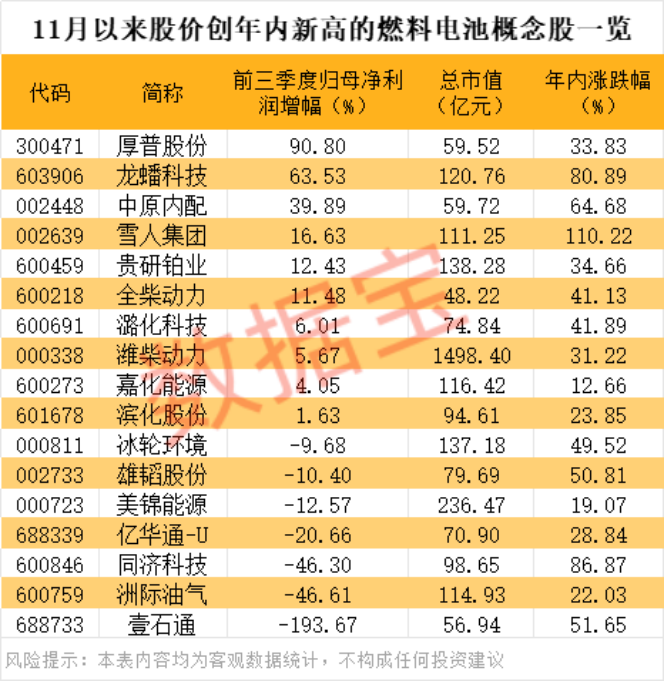
Core Viewpoint - The Chinese government is promoting the procurement of fuel cell vehicles through new policies and subsidies, aiming to increase their adoption in public transportation and other sectors [1][2][3]. Group 1: Government Policies - The Ministry of Finance and the Ministry of Industry and Information Technology released a draft for the "New Energy Vehicle Government Procurement Demand Standards," mandating that government procurement should include fuel cell vehicles [1]. - The government aims for at least 30% of annual public vehicle procurement to consist of new energy vehicles, including fuel cell vehicles [1]. - The Transportation Ministry's guidelines for 2025 include subsidies for hydrogen fuel cell buses, with an average subsidy of 80,000 yuan per vehicle [2]. Group 2: Market Developments - Local governments and state-owned enterprises are increasingly launching large-scale procurement projects for fuel cell vehicles, focusing on commercial vehicles like sanitation trucks and buses [3]. - In October, Guangzhou Bus Group purchased 50 hydrogen fuel cell buses for 60 million yuan, while other local agencies have also announced significant purchases [3]. - Despite government support, the production and sales of hydrogen fuel cell vehicles have not met expectations, with a projected annual sales figure of no more than 7,000 units, a decline compared to previous years [3]. Group 3: Stock Market Performance - Fuel cell-related stocks in the A-share market have seen an average increase of nearly 38% this year, with some stocks doubling in price [4]. - 17 fuel cell concept stocks reached new highs in November, although some experienced significant pullbacks afterward [4]. - Among the stocks that reached new highs, 12 reported profit growth in the first three quarters, with some companies like Hupoo Co. and Longpan Technology showing over 50% profit increases [4][5].


利好来了,这类新能源车,正式纳入政府采购!(附股)
Zheng Quan Shi Bao· 2025-11-20 23:29
Core Insights - The Chinese government has included fuel cell vehicles in its procurement list for public service vehicles, indicating strong policy support for the sector [1][2]. - The market for hydrogen fuel cell vehicles is still in its early commercial stage, with significant government procurement expected to drive growth and technological advancements [2]. Group 1: Government Policy and Support - The Ministry of Finance and the Ministry of Industry and Information Technology released a draft requiring public service vehicle procurement to include new energy vehicles, specifically mentioning fuel cell vehicles [1]. - By December 2024, the government aims for at least 30% of annual public service vehicle purchases to be new energy vehicles [1]. - The Transportation Ministry has included hydrogen fuel cell buses in its subsidy program, offering an average subsidy of 80,000 yuan per vehicle to promote government procurement [1]. Group 2: Market Performance and Trends - In 2025, the demonstration phase for hydrogen fuel cell vehicles will conclude, with nearly 30,000 units expected to be promoted by the end of 2024 [2]. - Despite government support, the production and sales of hydrogen fuel cell vehicles have declined significantly, with a year-on-year drop of over 50% in the first eight months of the year [2]. - The total sales of hydrogen fuel cell vehicles are projected to be below 7,000 units for the year, indicating a downward trend compared to previous years [2]. Group 3: Stock Market Performance - Fuel cell-related stocks in the A-share market have seen an average increase of nearly 38% this year, with some stocks doubling in price [3]. - 17 fuel cell concept stocks reached new highs in November, although some experienced significant pullbacks afterward [3][4]. - Among the stocks that reached new highs, 12 reported profit growth in the first three quarters, with some companies like Hupoo Co. and Longpan Technology showing over 50% profit increases [3].
【转发有礼】首轮嘉宾剧透!2025宽温域燃料电池暨氢能无人机论坛(12月18-19日,苏州)
DT新材料· 2025-11-19 23:34
Core Viewpoint - The article discusses the advancements and market potential of wide-temperature range fuel cells and their applications in hydrogen energy drones, emphasizing the need for improved performance and cost reduction in fuel cell technology [3][4]. Group 1: Wide-Temperature Range Fuel Cells - Traditional fuel cells operate at temperatures ≤80℃, facing challenges such as limited reaction activity and complex thermal management, which hinder market adoption [3]. - Wide-temperature range proton exchange membrane fuel cells can operate from -40℃ to ≥120℃, offering high reaction activity and good catalyst resistance, thus facilitating the large-scale application of hydrogen energy [3]. - Research teams are developing technologies to enhance fuel cell performance, such as high-temperature fuel cell membrane electrode technology and non-perfluorosulfonic acid membranes [3]. Group 2: Forum Details - The "2025 Wide-Temperature Range Fuel Cell and Hydrogen Energy Drone Forum" will be held on December 18-19, 2025, in Suzhou, Jiangsu, focusing on the development of wide-temperature range fuel cells and their applications in various sectors [4]. - The forum aims to create a multi-dimensional dialogue and cooperation platform among fuel cell industry players, drone manufacturers, academic experts, and investment institutions to promote the large-scale development of fuel cells [4]. Group 3: Key Topics of Discussion - The forum will cover several key topics, including the current status and trends of wide-temperature range fuel cells, market analysis of hydrogen energy drones, and the technological challenges faced in this field [11]. - Specific discussions will include advancements in perfluorosulfonic acid fuel cells, the development of new membrane materials, and the application of fuel cells in cooling and heating systems [12]. Group 4: Guest Speakers - Notable speakers include experts from various institutions who will share insights on topics such as the key technological advancements in hydrogen energy drones and the future directions for fuel cell technology in China [14][18]. - The forum will feature presentations on high-performance proton exchange membranes and their applications, as well as case studies on long-endurance hydrogen energy drones [19][20].

SOFC 深度报告:北美负荷需求迎大级拐点,SOFC 迎发展新机遇
Changjiang Securities· 2025-11-19 11:04
Investment Rating - The report indicates a positive investment outlook for the Solid Oxide Fuel Cell (SOFC) industry, particularly in the context of increasing electricity demand in North America due to AI data centers [4][7]. Core Insights - The SOFC technology is well-suited to address the electricity shortage in the U.S., with high efficiency (up to 60%), rapid deployment capabilities, and flexible fuel options [8][22]. - The economic viability of SOFC systems is bolstered by U.S. government incentives, with initial cost estimates showing competitive Levelized Cost of Electricity (LCOE) compared to traditional energy sources [9][36]. - The projected electricity gap in the U.S. presents a significant market opportunity for SOFC, with potential installations reaching up to 40.2 GW by 2030 under optimistic scenarios [10][62]. Summary by Sections Background - The report highlights the urgent electricity demand in North America driven by AI advancements, leading to a national energy emergency declaration in January 2025 [7][16]. - SOFC is positioned as a key solution to the electricity supply challenges, particularly for data centers [4][11]. SOFC Characteristics - SOFCs offer high power generation efficiency, rapid deployment, and flexibility in fuel usage, including natural gas and hydrogen [8][22]. - The modular design of SOFC systems allows for quicker installation compared to traditional power generation methods [22][26]. Economic Assessment - The report outlines the economic feasibility of SOFC systems, with LCOE for various configurations being competitive against other energy sources [9][36]. - The U.S. government provides a 30% investment tax credit for fuel cell investments, enhancing the economic attractiveness of SOFC [9][31]. Market Potential - The report estimates a total electricity gap of approximately 73.2 GW in the U.S. from 2025 to 2030, with SOFC potentially capturing significant market share [10][58]. - Under different penetration scenarios, SOFC installations could reach between 3.7 GW to 40.2 GW by 2030, depending on market conditions [10][62]. Industry Development - The SOFC industry is experiencing accelerated growth, with companies like Bloom Energy leading the commercialization efforts and achieving significant revenue growth [11][64]. - The report emphasizes the importance of technological advancements and cost reductions in driving the adoption of SOFC systems [11][64].
密封科技(301020.SZ):新研发产品可作为配件用于氢燃料电池
Ge Long Hui· 2025-11-19 07:31
Core Viewpoint - The company has developed new products for hydrogen fuel cells, including ultra-low temperature refrigeration helium compressors, diaphragm compressors for hydrogen stations, and high-speed gas bearings for hydrogen fuel cell pumps, but has not yet achieved mass supply, indicating significant uncertainty regarding large-scale commercialization [1] Product Development - The company is working on ultra-low temperature refrigeration helium compressors for hydrogen liquefaction [1] - Diaphragm compressors designed for hydrogen stations are also in development [1] - High-speed gas bearings for hydrogen fuel cell pumps have been created as well [1] Market Readiness - Currently, there is only a small supply of these new products for customer trials [1] - The company has not yet achieved mass supply of these products [1] - There remains a considerable level of uncertainty regarding the large-scale commercial application of these products [1]
密封科技:有多个新研发产品可作为配件用于氢燃料电池,尚未实现批量供货
Xin Lang Cai Jing· 2025-11-19 03:51
Core Viewpoint - The company has developed new products for hydrogen fuel cells, including ultra-low temperature refrigeration helium compressors, diaphragm compressors for hydrogen refueling stations, and high-speed gas bearings for hydrogen fuel cell pumps, but has not yet achieved mass production or commercial application [1] Product Development - The company is working on ultra-low temperature refrigeration helium compressors for hydrogen liquefaction [1] - Diaphragm compressors designed for hydrogen refueling stations have also been developed [1] - High-speed gas bearings for hydrogen fuel cell pumps are part of the new product lineup [1] Market Readiness - Currently, there is limited supply of these new products for customer trials [1] - The company has not yet achieved bulk supply, indicating significant uncertainty regarding large-scale commercial application [1]