
第三方支付

Search documents
发挥协同效能 多元化支持科技创新
Jin Rong Shi Bao· 2025-10-30 00:25
Core Insights - Financial support is essential for technological innovation, and China CITIC Financial Assets is committed to extending financial services to the technology sector, providing diversified financial support for technological advancements [1][3] - China CITIC Financial Assets Jiangsu Branch has invested over 500 million yuan in the acquisition and restructuring of Hangzhou Yingde, a leading industrial gas company, facilitating technology transformation and capacity enhancement [1][2] Group 1: Financial Support and Collaboration - The investment of over 500 million yuan by China CITIC Financial Assets Jiangsu Branch aims to stabilize the shareholder structure of Yingde and accelerate project advancement, ensuring robust support for the normal operations of upstream and downstream industries [2][3] - The collaboration with various entities, including CITIC Securities and local state-owned assets, has led to the optimization of management mechanisms and improved governance structures, enhancing management quality and efficiency [2][3] Group 2: Restructuring and Recovery - China CITIC Financial Assets Shenzhen Branch has successfully facilitated the bankruptcy restructuring of Rindong Holdings, marking a new benchmark for listed company restructuring in China [4][7] - The restructuring process involved precise debt collection and collaboration with key stakeholders, which helped restore market confidence and mitigate risks associated with core asset liquidation [6][7] - Rindong Holdings' successful restructuring is expected to enhance its role in promoting technological finance and digital transformation, contributing to the integration of the digital economy with the real economy [7]

全球跨境第三方收款服务市场快速增长,万里汇市占率第一
Sou Hu Cai Jing· 2025-10-29 10:15
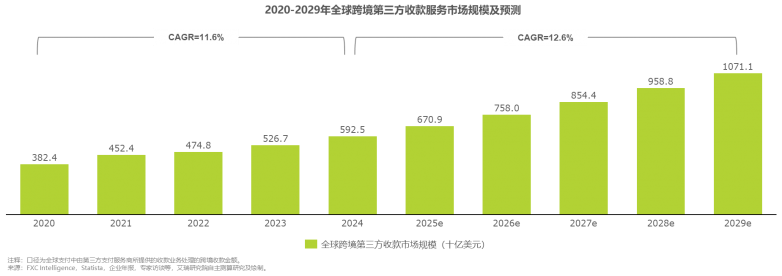
Core Insights - The global cross-border e-commerce market is expanding, with a steady increase in the share of goods trade, and China remains a dominant player in this sector [1] - The global cross-border payment market is transitioning into an era of real-time payments, stablecoins, and digital currencies, with significant growth in the market size [1] - The report by iResearch highlights the competitive landscape and development opportunities in the cross-border third-party payment service market [1] Market Growth - The global cross-border third-party payment service market is expected to grow from nearly $600 billion in 2024 to over $1 trillion by 2029 [2] - China's cross-border export third-party payment service market is projected to increase from $400 billion in 2024 to nearly $700 billion by 2029 [2] Competitive Advantages - Cross-border third-party payment service providers outperform traditional channels in operational experience, transaction speed, currency support, and value-added services [4] - The demand for flexible, efficient, and compliant cross-border payment services is increasing due to the diversification of trade entities and the complexity of overseas local settlement methods [4] Service Comparison - Traditional channels require cumbersome processes and have slower transaction speeds, while third-party payment service providers offer user-friendly online platforms with faster transaction times [6] - Third-party providers typically support a wider range of local currencies and offer various value-added services, resulting in lower overall costs and more transparent fee structures [6] Market Concentration - The market for cross-border third-party payment services is showing significant concentration, with leading firms expanding their competitive advantages through global service networks and enhanced regulatory capabilities [7] - WorldFirst holds the largest market share in China's cross-border third-party payment service market, exceeding the second-largest competitor by nearly 10% [8] Future Outlook - Cross-border payment service providers are crucial participants in the cross-border trade ecosystem, fostering deep connections with merchants and addressing their needs [10] - There is potential for these providers to empower cross-border businesses through vertical and horizontal expansion, offering services related to foreign exchange, tax, and fund management [10]

银联商务新帅上任!333万份股权仍难觅买家,起拍价再降
Nan Fang Du Shi Bao· 2025-10-28 10:36
Core Points - The recent management change at UnionPay Business has appointed Shao Kuoyi as the new General Manager, succeeding Wang Yanfang [2][3] - The People's Bank of China has approved the changes in the board of directors, with Shao Kuoyi taking on the role of General Manager and other key positions being filled [3][4] Company Overview - UnionPay Business was established in December 2002 with a registered capital of approximately 2.789 billion yuan and is headquartered in Shanghai [4] - The company is one of the first to receive a payment business license from the People's Bank of China and is authorized to conduct various payment services, including cross-border RMB payment [4][5] - As of July 2025, UnionPay Business has served over 28 million merchants and installed more than 43 million terminals, maintaining the top position in transaction volume and number of transactions in the Asia-Pacific region for eleven consecutive years [6] Shareholder Information - The largest shareholder of UnionPay Business is Shanghai Lianyin Venture Capital Co., Ltd., holding 55.54% of the shares, followed by Guangji Shangjia Consulting (Beijing) Co., Ltd. with 9.34% [10][11] - A small shareholder is attempting to sell 3,337,656 shares at a starting price of 6.16 million yuan, which has significantly decreased from the initial price of 12 million yuan earlier in the year [7][10] Market Context - The ongoing attempts to sell shares reflect the challenges in the third-party payment industry, where competition and market dynamics are increasingly favoring larger, more capitalized players [12]

违反收单业务管理规定!拉卡拉江苏分公司被行政处罚
Qi Lu Wan Bao· 2025-10-26 12:33
Group 1 - The People's Bank of China Jiangsu Branch has issued an administrative penalty against Lakala Payment Co., Ltd. for violating acquiring business management regulations [3][4] - Lakala was fined 250,000 yuan and had illegal gains of 61,423.7 yuan confiscated [3][4] - Lakala Payment Co., Ltd. was established in 2005 and became one of the first companies to receive a payment business license from the People's Bank of China in 2011 [4] Group 2 - Lakala is recognized as a leading third-party payment institution in China and was listed on the Shenzhen Stock Exchange on April 25, 2019 [4]

密集增资潮再起!
Jin Rong Shi Bao· 2025-10-26 03:19
Core Viewpoint - The third-party payment industry in China is experiencing a wave of capital increases, driven by regulatory changes and the need for compliance with new capital requirements [1][2][3] Group 1: Capital Increase Trends - Several payment companies have received approval for capital increases in 2023, indicating a trend of intensive capital raising in the industry [1] - Notable examples include Wangyin Online increasing its registered capital to 1.5 billion RMB and Yinseng Payment increasing to 310 million RMB [1] - The highest registered capital currently belongs to Tenpay, which increased from 1 billion RMB to 15.3 billion RMB in April 2024, with further increases expected [1] Group 2: Regulatory Impact - The implementation of the Non-Bank Payment Institution Supervision and Management Regulations in May 2024 is a key factor driving these capital increases [1][2] - The new regulations set a minimum registered capital requirement of 100 million RMB and establish dynamic net asset requirements linked to reserve fund scales [1][2] - Payment institutions with significant reserve fund balances are compelled to increase capital to meet regulatory calculations and maintain compliance [1] Group 3: Industry Dynamics - The increase in registered capital is primarily aimed at meeting compliance requirements and supporting sustainable development within the industry [2] - Stronger capital positions enhance institutions' capabilities in fund allocation, risk management, and system development, especially in light of rising compliance costs [2] - The number of licensed payment institutions in China has decreased to 164, with 107 licenses revoked, indicating a trend of smaller institutions exiting the market due to limited business models and capital strength [2] Group 4: Market Adaptation - The payment industry is undergoing a significant reshuffle, with institutions actively adapting to regulatory compliance and market changes [3] - This trend is expected to improve overall compliance in the payment industry and strengthen the capital base of third-party payment institutions [3] - Enhanced capital strength is anticipated to lead to increased investment in market services and technological advancements, thereby boosting the industry's ability to serve the real economy [3]

支付行业迎增资潮,资本实力成生存底线?
Guo Ji Jin Rong Bao· 2025-10-24 09:17
Core Viewpoint - The continuous capital increase of third-party payment institutions is driven by regulatory compliance and business expansion needs, as highlighted by the recent approvals for capital increases among various payment companies [1][4][5]. Group 1: Recent Capital Increases - JD Group's online payment subsidiary, Wangyin Payment, has been approved to increase its registered capital to 1.5 billion yuan [2]. - Silver Payment and Vipshop Payment have also received approvals to increase their registered capital to 310 million yuan and 200 million yuan, respectively [2]. - A total of 13 payment institutions have been approved for capital increases this year, with notable increases including Douyin Payment from 150 million yuan to 3.15 billion yuan [2]. Group 2: Regulatory Impact - The implementation of the Non-Bank Payment Institution Supervision Management Regulations has set a minimum registered capital requirement of 100 million yuan, which has prompted institutions to increase their capital to meet compliance [1][4]. - The regulations link net asset requirements to the average balance of reserve funds, necessitating capital increases as transaction volumes grow [4][6]. Group 3: Business Development Needs - The capital increases are not only for compliance but also driven by the need for business development, particularly in areas like cross-border payments and technological investments [5][6]. - High capital levels provide competitive advantages in B2B business expansion, negotiations with banks, and government project tenders [5]. Group 4: Market Dynamics - The capital increase trend reflects a combination of regulatory guidance, rising market concentration, and increasing compliance costs [6]. - Leading payment institutions are leveraging their capital advantages to transform into comprehensive financial technology service providers, while smaller institutions are advised to focus on niche markets to avoid competition [6].
网银在线增资至15亿元 褚天舒为副总经理、赵小玥为风控负责人
Xi Niu Cai Jing· 2025-10-24 08:25
Core Viewpoint - The People's Bank of China has approved the increase of registered capital for Online Banking (Beijing) Payment Technology Co., Ltd. to 1.5 billion RMB and has also approved changes in senior management [2][3] Group 1: Company Overview - Online Banking was established in 2003 and is one of the earliest third-party payment institutions in China, initially focusing on payment services for small and medium-sized enterprises [2][3] - In 2012, Online Banking was acquired by JD.com and has since become an important member of JD Technology's sector [2][3] - The company obtained its first batch of payment business licenses from the People's Bank of China on May 3, 2011, allowing it to conduct various payment services [2][3] Group 2: Business Operations - Online Banking's current business types include "Stored Value Account Operation I Class" and "Payment Transaction Processing I Class (Beijing)" after adjusting its service offerings [2][3] - The company voluntarily terminated its fixed-line payment business during the 2016 renewal process [2][3]

银行App掀起关停潮
吴晓波频道· 2025-10-24 00:30
Core Viewpoint - The digital finance industry in China is experiencing a "retreat tide," marked by the closure and integration of various banking apps and payment licenses, indicating the end of an era characterized by rapid expansion and imitation of internet strategies without understanding the underlying ecosystem [2][5][28]. Group 1: Industry Trends - The number of credit cards and loan cards has decreased to 715 million, down 6 million from the previous quarter and 12 million from the end of last year, marking a continuous decline for 11 consecutive quarters [8]. - The total loan balance for credit cards among 14 listed banks fell by 2.56% in the first half of the year, while transaction volumes dropped by 11.1% year-on-year [9]. - The number of direct banks has significantly decreased, with 21 banks ceasing operations of their direct banking apps in 2023, reflecting a shift in strategy among banks [11][12]. Group 2: Market Dynamics - The mobile banking app user base has stagnated between 650 million and 700 million over the past three years, with daily usage time dropping from 4.9 minutes to 2.7 minutes, a decline of over 40% [11]. - The third-party payment industry is undergoing significant consolidation, with 107 payment licenses revoked, leaving only 164 licensed institutions, as many smaller players exit the market [14][25]. - Major state-owned banks are increasingly dominating the market, with their apps consistently ranking among the top ten in monthly active users, while smaller banks struggle to maintain user engagement [22][24]. Group 3: Challenges Faced - The industry faces issues of homogenization, with many banking apps offering similar services that overlap significantly with their parent bank's main app, leading to redundancy [21]. - High operational costs associated with maintaining multiple apps have resulted in unsustainable business models, particularly for smaller banks and direct banks [21]. - Regulatory scrutiny is increasing, with the government mandating the integration or shutdown of apps with low user engagement and poor functionality [26]. Group 4: Future Opportunities - The focus of competition is shifting from quantity to quality, emphasizing compliance and ecosystem collaboration over mere user acquisition [30]. - Banks are expected to concentrate resources on core services, transitioning from product-oriented strategies to user-centric approaches, leveraging data to meet diverse customer needs [30]. - The rise of digital currencies and advancements in payment technologies present new opportunities for growth in the financial sector, particularly in cross-border payments [31][32].


合规约束叠加业务拓展需求 年内13家支付机构获批增资
2 1 Shi Ji Jing Ji Bao Dao· 2025-10-23 15:06
Core Insights - The surge in capital increases among third-party payment companies is primarily driven by the implementation of the "Non-Bank Payment Institution Supervision Management Regulations" in May 2024, which sets a minimum registered capital requirement of 100 million RMB and establishes dynamic net asset requirements linked to reserve fund scales [1][2][6] Group 1: Regulatory Changes - The "Non-Bank Payment Institution Supervision Management Regulations" is the first administrative regulation for payment institutions in China, enhancing the regulatory framework and legal hierarchy in the payment sector [2] - The regulations stipulate that the minimum registered capital for non-bank payment institutions is 100 million RMB, which must be paid-in capital [2][5] - Since the implementation of the regulations, payment institutions have accelerated their capital increases to comply with regulatory requirements [2][5] Group 2: Capital Increase Trends - As of 2025, 13 payment institutions have been approved for capital increases, including notable increases from companies like Zhejiang Vipshop Payment Service Co., Ltd. and XTransfer [3][6] - Noteworthy capital increases include WeChat Pay's operator, Tenpay, with a registered capital of 22.3 billion RMB, and PayPal China with 4.52 billion RMB [6] Group 3: Business Development Motivations - Beyond compliance, payment institutions are also increasing capital to support business development, enabling them to engage in high-value services such as cross-border payments and comprehensive financial solutions [8][9] - Increased capital enhances the risk management capabilities of payment institutions, allowing them to better handle potential risks such as fraud and liquidity issues [9] Group 4: Financial Health and Market Position - Higher registered capital improves the financial strength of payment institutions, enhancing their market reputation and customer trust [9] - The capital increase is seen as a necessary step to ensure business continuity and expansion in a competitive market [8][9]
合规约束叠加业务拓展需求,年内13家支付机构获批增资
2 1 Shi Ji Jing Ji Bao Dao· 2025-10-23 13:29
Core Insights - The article highlights a significant trend of capital increases among third-party payment institutions in China, driven by regulatory changes and the need for business expansion [1][2][3] Regulatory Changes - The implementation of the "Non-Bank Payment Institution Supervision Management Regulations" in May 2024 has set a minimum registered capital requirement of 100 million RMB for payment institutions, which has prompted many to increase their capital [2][4] - The regulations also link net asset requirements to the scale of reserve funds, creating a dynamic capital requirement for payment institutions [5][6] Capital Increase Trends - As of 2025, 13 payment institutions have been approved for capital increases, including notable companies like Zhejiang Vipshop Payment Service Co., Ltd. and XTransfer [2][3] - Specific examples of capital increases include Nezha Payment increasing to 3.11 billion RMB and Xiaomi's payment institution "Jiefu Ruitong" receiving approval for capital increase [2][3] Business Development - Payment institutions are increasing capital not only to meet regulatory requirements but also to support business development, particularly in high-value services such as cross-border payments and technology services [7][8] - Companies like Douyin Payment and Tenpay have cited capital increases as a means to enhance service quality and ensure user safety [7][8] Risk Management and Market Position - Increased capital enhances the risk management capabilities of payment institutions, allowing them to better handle potential risks such as fraud and liquidity issues [8] - A higher registered capital improves the market reputation and credibility of payment institutions, fostering trust among customers and partners [8]