
电子元器件

Search documents
瑞声科技上半年营收133.2亿,净利飙升63.1%,全年毛利率有望超去年
Ge Long Hui· 2025-08-21 12:22
Core Viewpoint - 瑞声科技 reported strong financial performance for the first half of 2025, with revenue reaching RMB 13.32 billion, a year-on-year increase of 18.4%, and net profit rising significantly by 63.1% to RMB 876 million, driven by improvements in optical business profitability and rapid growth in precision components [1] Financial Performance - Revenue for the first half of 2025 was RMB 13.32 billion, up 18.4% year-on-year, marking a new high [1] - Net profit increased by 63.1% to RMB 876 million [1] - Operating cash flow was RMB 2.89 billion, a 9.1% increase year-on-year [1] - As of June 30, 2025, the net debt-to-equity ratio was 4.7%, with cash on hand amounting to RMB 7.75 billion [1] Business Segments Acoustics - Acoustics revenue for the first half was RMB 3.52 billion, a 1.8% increase year-on-year, with a gross margin of 27.2% [4] - The company shipped over 17 million units of SLS master-level and coaxial speakers, a nearly 40% year-on-year increase [4] Automotive Acoustics - Automotive acoustics revenue reached RMB 1.74 billion, up 14.2% year-on-year, with a gross margin of 23.9% [6] - The acquisition of Hebei Chuguang Automotive Parts Co., Ltd. enhances the company's layout in automotive acoustic systems [6] Optical - Optical revenue was RMB 2.65 billion, a 19.7% increase year-on-year, with significant improvements in the gross margin of plastic lenses [8] - The company reported a 150% year-on-year increase in sales of OIS modules, with over RMB 800 million in sales [9] Electromagnetic and Precision Components - Revenue from electromagnetic and precision components grew by 27.4% to RMB 4.63 billion, with a gross margin of 22.9% [11] - The company introduced a breakthrough SuperSlim Engine, potentially the thinnest x-axis motor in the mobile phone sector [11] Sensors and Semiconductors - Revenue from sensors and semiconductors increased by 56.2% to RMB 608 million, driven by the large-scale shipment of high signal-to-noise ratio microphones [13]

电连技术(300679.SZ):上半年净利润2.43亿元 同比下降21.10%
Ge Long Hui A P P· 2025-08-21 08:36
Core Viewpoint - The company reported a revenue of 2.524 billion yuan for the first half of 2025, reflecting a year-on-year growth of 17.71%, while net profit attributable to shareholders decreased by 21.10% [1] Financial Performance - The company's operating revenue reached 2.524 billion yuan, marking a 17.71% increase compared to the same period last year [1] - Net profit attributable to shareholders was 243 million yuan, which represents a decline of 21.10% year-on-year [1] - The net profit excluding non-recurring gains and losses was 239 million yuan, down 19.07% year-on-year [1] - Basic earnings per share stood at 0.57 yuan [1]

瑞声科技半年净利飙升六成,光学与结构件撑起新增长曲线
Jing Ji Guan Cha Bao· 2025-08-21 08:29
Core Insights - AAC Technologies reported a strong half-year performance, exceeding market expectations with a revenue of 13.32 billion yuan, a year-on-year increase of 18.4%, and a net profit of 876 million yuan, up over 60% [1][2] - The company's net profit margin improved from 4.8% in the same period last year to 6.6%, indicating a clear trend of profit recovery [1] Revenue Breakdown - The optical business continued its high growth trajectory, generating revenue of 2.65 billion yuan, a nearly 20% year-on-year increase, with a gross margin improvement to 10.2% [1] - Precision structural components and electromagnetic drive businesses also performed well, with revenue growth exceeding 27%, driven by new products like ultra-thin motors and liquid cooling heat sinks [1] - The sensor and semiconductor business saw a significant revenue increase of 56% year-on-year, driven by AI interaction demand, with high signal-to-noise ratio microphones achieving scale production [1] - The automotive acoustics segment maintained its expansion, generating revenue of 1.74 billion yuan, a 14% year-on-year increase, further enhanced by the acquisition of Hebei Chuguang for smart microphones and sensors [1] Traditional Business Performance - Traditional acoustic business remains a core segment, with revenue of 3.52 billion yuan, a year-on-year increase of 1.8%, supported by mid-to-high-end products and innovative designs [2] Financial Health - The company's financial position remains robust, with operating cash flow of 2.89 billion yuan, a 9% increase year-on-year, and cash on hand of 7.75 billion yuan, resulting in a net debt ratio of only 4.7% [2] - Capital expenditures increased significantly to 1.44 billion yuan, a 57% rise compared to the same period last year, primarily directed towards optical, automotive, and semiconductor sectors [2] Shareholder Returns - The company maintains a year-end dividend policy with a payout ratio of 15%, while not declaring an interim dividend, ensuring strong cash flow and prudent capital management to support future business development [2] Strategic Transition - AAC Technologies is undergoing a critical phase of business structure transformation, with traditional acoustic business growth slowing, while optical, structural components, and sensor businesses are rapidly expanding, creating new growth opportunities [2] - The ongoing trends of smartphone premiumization and automotive intelligence are expected to further enhance the company's profitability in optical lenses, automotive acoustics, and sensors [2]
瑞声科技:上半年股东应占溢利同比增长63.1%至8.76亿元
Xin Lang Cai Jing· 2025-08-21 04:56
Group 1 - The company reported a revenue of RMB 13.32 billion for the first half of the year, representing a year-on-year growth of 18.4% [1] - The group's gross profit margin was 20.7%, showing a slight decrease of 0.8 percentage points year-on-year [1] - Shareholders' profit attributable to the company increased by 63.1% to RMB 876 million, primarily due to the continuous improvement in the profitability of the optical business and rapid growth in the precision components business [1]
中航光电20250820
2025-08-20 14:49
Summary of the Conference Call for AVIC Optoelectronics Industry and Company Overview - The conference call focuses on AVIC Optoelectronics, a leading company in the connector industry, particularly in the fields of liquid cooling technology and military applications [2][3][4]. Key Points and Arguments Liquid Cooling Technology - AVIC Optoelectronics is actively developing liquid cooling technology to address the limitations of traditional air cooling systems, driven by increasing chip power consumption and the growing number of chips in cabinets [2][5]. - The company provides complete cabinet solutions and individual components for data centers, supercomputing, and energy storage applications [3][4]. - The domestic liquid cooling market is driven by demand for computing power and procurement from overseas system integrators, with AVIC participating in industry standard formulation and expanding into Southeast Asia and Japan [2][6]. AI Power Sector - The company is expanding its presence in the AI power sector, having participated in the Global Computing Alliance launch conference to enhance its market influence [7]. - AVIC aims to innovate in AI data centers and technology, transitioning from a single component supplier to a system integrator to capture domestic and international market opportunities [2][7]. Military Business Growth - The military segment benefits from stable growth in defense budgets, projected at 6%-7%, with the military connector market expanding significantly [2][13]. - AVIC Optoelectronics holds a substantial market share in military connectors, supported by accelerated information technology construction [2][13]. System Interconnection Technology - The company has invested approximately 2.3 billion yuan in a foundational component factory, enhancing its capabilities in system interconnection and transitioning from a single component supplier to an integrated interconnection provider [2][14]. - AVIC's technology is being applied in various military aircraft projects, including the C919, indicating potential for further market expansion [14]. Financial Performance and Projections - From 2019 to 2023, the company's revenue grew from approximately 9.2 billion yuan to 20.1 billion yuan, with a compound annual growth rate (CAGR) of 21% [11]. - Future revenue projections for 2025 to 2027 are 27.17 billion yuan, 28 billion yuan, and 31.04 billion yuan, with corresponding net profits of 4.113 billion yuan, 4.821 billion yuan, and 5.4 billion yuan [16]. Employee Growth and Cost Control - The workforce increased from 13,300 in 2019 to 17,700 in 2023, with a CAGR of 7.3%, indicating effective control over employee growth relative to revenue [12]. - The company has maintained stable operating expenses, with a notable decrease in stock incentive amortization expected in the coming years, positively impacting operational capacity [12]. Additional Important Insights - The liquid cooling industry is driven by three main factors: increasing chip power consumption, the significant rise in the number of chips per cabinet, and the overall value of liquid cooling systems [4][5]. - AVIC Optoelectronics has a long history of development, evolving through four stages since its establishment in 1970, focusing on innovation and market expansion [8]. - The company has implemented a long-term equity incentive plan to align the interests of shareholders, investors, and the company, promoting sustainable development [9][10].

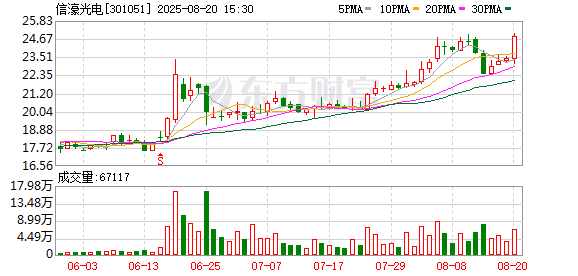
信濠光电:股东高瞻、周旋拟合计减持不超过约101.76万股
Mei Ri Jing Ji Xin Wen· 2025-08-20 12:56
Group 1 - The core revenue composition of Xinhau Optoelectronics for the first half of 2025 is 96.08% from electronic components and 3.92% from photovoltaic equipment and components [1] - Shareholders Gao Zhan and Zhou Xuan plan to reduce their holdings in Xinhau Optoelectronics by a total of up to approximately 101.76 thousand shares, representing 0.5012% of the total share capital, within a three-month period from September 11 to December 10, 2025 [3] - Gao Zhan intends to reduce her holdings by up to 100 thousand shares, accounting for no more than 0.4925% of the total share capital, while Zhou Xuan plans to reduce his holdings by up to 1.76 thousand shares, representing 0.0087% of the total share capital [3]
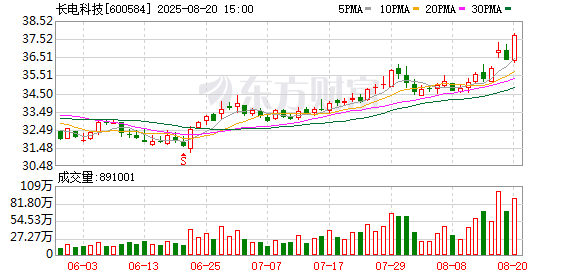
长电科技:8月20日召开董事会会议
Mei Ri Jing Ji Xin Wen· 2025-08-20 11:09
Core Viewpoint - Changdian Technology (SH 600584, closing price: 37.7 yuan) announced on August 20 that its eighth board meeting was held to review the 2025 semi-annual report and summary [2] Group 1: Company Financials - For the year 2024, Changdian Technology's revenue composition is as follows: electronic components account for 99.71%, while other businesses account for 0.29% [2]

中石科技(300684.SZ):产品目前暂未直接应用到芯片封装前的散热
Ge Long Hui· 2025-08-20 07:15
Core Viewpoint - The company, Zhongshi Technology, has indicated that its products are not currently applied in the thermal management of chip packaging, but its high thermal conductivity pads and thermal gels are widely used in consumer electronics to address thermal dissipation issues [1] Group 1 - The company’s products include high thermal conductivity pads and thermal gels [1] - These products are primarily utilized in consumer electronic components [1] - The company has not yet applied its products directly to the thermal management of chip packaging [1]
泰晶科技获融资买入0.41亿元,近三日累计买入0.96亿元
Jin Rong Jie· 2025-08-20 00:35
最近三个交易日,15日-19日,泰晶科技分别获融资买入0.25亿元、0.31亿元、0.41亿元。 融券方面,当日融券卖出0.00万股,净卖出0.00万股。 8月19日,沪深两融数据显示,泰晶科技获融资买入额0.41亿元,居两市第693位,当日融资偿还额0.31 亿元,净买入946.36万元。 ...

电连技术股价上涨1.16% 子公司布局软硬结合板领域
Jin Rong Jie· 2025-08-19 17:49
Core Viewpoint - The stock price of Dianlian Technology closed at 48.93 yuan on August 19, reflecting a 1.16% increase from the previous trading day, with a total market capitalization of 20.786 billion yuan and a price-to-earnings ratio of 42.15 times [1] Group 1: Company Overview - Dianlian Technology specializes in the research, development, production, and sales of connectors and related components [1] - The company's products are widely used in consumer electronics, automotive electronics, and industrial control sectors [1] - Subsidiary Henghedingfu focuses on the production of flexible boards, rigid-flex boards, and LCP products, possessing roll-to-roll processing capacity and SMT processing capabilities [1] Group 2: Financial Performance - On August 19, the net outflow of main funds for Dianlian Technology was 9.8933 million yuan, with a cumulative net outflow of 35.0784 million yuan over the past five days [1]