
种业

Search documents
荃银高科(300087.SZ):2025年中报净利润为-4132.91万元,同比亏损扩大
Xin Lang Cai Jing· 2025-08-28 02:40
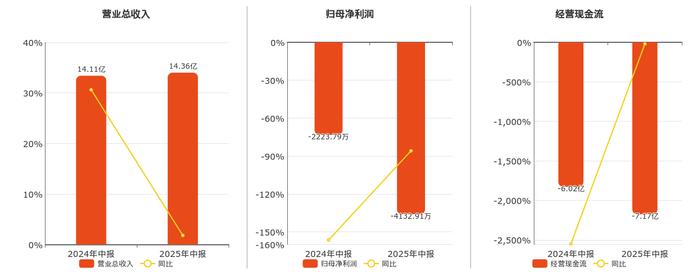
Core Viewpoint - The company, QuanYin High-Tech (300087.SZ), reported its 2025 mid-year financial results, showing a mixed performance with increased revenue but a significant net loss [1][3]. Financial Performance - The company's total operating revenue reached 1.436 billion yuan, ranking 7th among disclosed peers, with an increase of 25.54 million yuan, representing a year-on-year growth of 1.81% [1]. - The net profit attributable to shareholders was -41.33 million yuan, ranking 13th among peers, a decrease of 19.09 million yuan compared to the same period last year [1]. - The net cash flow from operating activities was -717 million yuan, ranking 15th among peers, down by 115 million yuan year-on-year [1]. Key Financial Ratios - The latest debt-to-asset ratio stood at 62.31%, ranking 14th among peers, with a decrease of 0.63 percentage points from the previous quarter and 0.52 percentage points from the same period last year [3]. - The latest gross profit margin was 13.62%, ranking 12th among peers, with an increase of 0.14 percentage points from the previous quarter but a decrease of 3.97 percentage points year-on-year [3]. - The return on equity (ROE) was -2.14%, ranking 12th among peers, down by 0.92 percentage points from the same period last year [3]. Earnings Per Share and Turnover Ratios - The diluted earnings per share were -0.04 yuan, ranking 12th among peers, a decrease of 0.02 yuan compared to the same period last year [3]. - The total asset turnover ratio was 0.20 times, ranking 8th among peers, down by 0.01 times year-on-year, representing a decline of 6.83% [3]. - The inventory turnover ratio was 0.44 times, ranking 11th among peers, a decrease of 0.07 times year-on-year, reflecting a decline of 13.01% [3]. Shareholder Structure - The number of shareholders was 50,700, with the top ten shareholders holding 382 million shares, accounting for 40.37% of the total share capital [3]. - The largest shareholder, China Seed Group Co., Ltd., holds 20.51% of the shares [3].


荃银高科8月27日获融资买入6237.29万元,融资余额4.89亿元
Xin Lang Cai Jing· 2025-08-28 01:34
Core Viewpoint - The financial performance and trading activity of Anhui Qianyuan High-Tech Seed Co., Ltd. (荃银高科) indicate a mixed outlook, with a slight increase in revenue but a significant decline in net profit, alongside notable trading volumes in margin financing and securities lending [1][2][3]. Financial Performance - For the first half of 2025, Qianyuan achieved operating revenue of 1.436 billion yuan, representing a year-on-year growth of 1.81% [2] - The net profit attributable to shareholders was -41.33 million yuan, a decrease of 85.85% compared to the previous year [2] Trading Activity - On August 27, Qianyuan's stock price increased by 1.45%, with a trading volume of 615 million yuan [1] - The margin financing data for August 27 showed a financing purchase amount of 62.37 million yuan and a net financing purchase of 3.18 million yuan, with a total margin balance of 490 million yuan [1] - The margin balance accounted for 5.27% of the circulating market value, which is below the 30th percentile level over the past year, indicating a low level of margin financing [1] Shareholder Information - As of August 15, Qianyuan had 50,800 shareholders, an increase of 1.60% from the previous period, with an average of 17,631 circulating shares per shareholder, a decrease of 1.57% [2] - The company has distributed a total of 446 million yuan in dividends since its A-share listing, with 210 million yuan distributed in the last three years [3] Institutional Holdings - As of June 30, 2025, the top ten circulating shareholders included notable funds, with changes in holdings observed among several key institutional investors [3]
登海种业:2025年半年度净利润约3511万元,同比下降33.42%
Mei Ri Jing Ji Xin Wen· 2025-08-27 23:59
Group 1 - The company Donghai Seed Industry reported a revenue of approximately 369 million yuan for the first half of 2025, representing a year-on-year decrease of 9.41% [1] - The net profit attributable to shareholders of the listed company was approximately 35.11 million yuan, a year-on-year decrease of 33.42% [1] - The basic earnings per share were 0.0399 yuan, down 33.39% year-on-year [1]

广东人大把脉农业现代化:一座经济大省需要什么样的农业?
2 1 Shi Ji Jing Ji Bao Dao· 2025-08-27 23:48
Group 1: Agricultural Industry Overview - The agricultural sector in Guangdong is not a major contributor to the economic structure but plays a crucial role in connecting various industries [2] - In 2024, the total output value of agriculture, forestry, animal husbandry, and fishery in Guangdong is projected to be 970.121 billion yuan, ranking among the top in the country [1] - Guangdong has cultivated 5,507 leading agricultural enterprises, with annual revenue nearing 1 trillion yuan [1] Group 2: Seed Breeding and Innovation - Seed breeding is critical as it determines the yield, quality, resistance, cost, and safety of agricultural products [3] - Guangdong has collected and preserved 368,000 agricultural germplasm resources, ranking first in the country [3] - The province has developed 36 super rice varieties, 40 livestock and poultry varieties, and 43 aquatic varieties, accounting for approximately 28%, 15%, and 14% of the national total, respectively [3] Group 3: Agricultural Machinery and Technology - Guangdong's agricultural machinery has shown strong market competitiveness, with a mechanization rate of 81.3% for rice cultivation in 2024 [6] - DJI and XAG dominate the domestic agricultural drone market with a combined market share of approximately 96% [6] - The province aims to enhance the development of small and medium-sized agricultural machinery to support agricultural mechanization [7] Group 4: Challenges and Recommendations - The agricultural sector faces challenges such as a lack of leading enterprises in crop seed industries and insufficient independent innovation capabilities [4] - Recommendations include strengthening research output and establishing a national key laboratory in the field of biological breeding [4][5] - There is a call for long-term, precise support policies for key breeding enterprises to alleviate financial pressures [5] Group 5: Future Prospects and Global Expansion - The agricultural sector is viewed as being in its early stages, with significant future growth potential [8] - Companies like XAG have expanded their agricultural drone services to over 70 countries, with international business accounting for over 30% of their revenue [9] - The demand for smart agricultural equipment is expected to grow in countries like Thailand, Vietnam, and Brazil, indicating a promising market for future expansion [9]
荃银高科:8月26日召开董事会会议
Mei Ri Jing Ji Xin Wen· 2025-08-27 22:29
Group 1 - The company announced that its fifth board meeting was held on August 26, 2025, combining on-site and remote voting methods [1] - The meeting reviewed the company's 2025 semi-annual report and other documents [1] Group 2 - The news highlights the successful transplantation of the world's first gene-edited pig lung into a human, raising questions about the timeline for clinical applications [1]
登海种业(002041.SZ)发布上半年业绩,归母净利润3511.24万元,同比下降33.42%
智通财经网· 2025-08-27 13:15
Core Insights - The company Donghai Seeds (002041.SZ) reported a decline in revenue and net profit for the first half of 2025, indicating potential challenges in its operational performance [1] Financial Performance - The company achieved an operating revenue of 369 million yuan, representing a year-on-year decrease of 9.41% [1] - The net profit attributable to shareholders of the listed company was 35.11 million yuan, down 33.42% year-on-year [1] - The net loss attributable to shareholders, after deducting non-recurring gains and losses, was 4.32 million yuan [1] - Basic earnings per share were reported at 0.0399 yuan [1]
神农种业:第七届董事会第二十五次会议决议公告
Zheng Quan Ri Bao· 2025-08-27 13:15
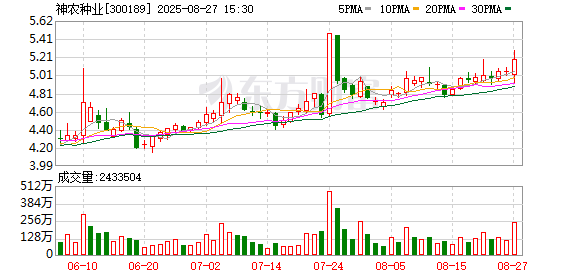
Core Viewpoint - Shennong Agricultural announced the approval of multiple proposals, including the "2025 Semi-Annual Report and Summary" during the 25th meeting of its seventh board of directors [2] Group 1 - The company held its 25th meeting of the seventh board of directors on August 27 [2] - The meeting resulted in the approval of the "2025 Semi-Annual Report and Summary" among other proposals [2]

神农种业:第七届监事会第十七次会议决议公告
Zheng Quan Ri Bao· 2025-08-27 13:15
Core Viewpoint - Shennong Agricultural announced the approval of its 2025 semi-annual report and summary by the 17th meeting of the 7th Supervisory Board [2] Group 1 - The company held its 17th meeting of the 7th Supervisory Board on August 27 [2] - The meeting resulted in the approval of the 2025 semi-annual report and summary [2]
荃银高科(300087.SZ):上半年净亏损4132.91万元
Ge Long Hui A P P· 2025-08-27 12:47
格隆汇8月27日丨荃银高科(300087.SZ)公布2025年半年度报告,上半年公司实现营业收入14.36亿元,同 比增长1.81%;归属于上市公司股东的净利润-4132.91万元;归属于上市公司股东的扣除非经常性损益 的净利润-7753.34万元;基本每股收益-0.04元。 ...
荃银高科:2025年上半年净利润亏损4132.91万元
Xin Lang Cai Jing· 2025-08-27 12:16
Group 1 - The company announced a revenue of 1.436 billion yuan for the first half of 2025, representing a year-on-year increase of 1.81% [1] - The net profit attributable to shareholders of the listed company was -41.3291 million yuan, showing a year-on-year decline of 85.85% [1] - The company plans not to distribute cash dividends, issue bonus shares, or increase share capital from reserves [1]