农机

Search documents
参加中国-中东欧国家产学研合作对接会 镇江创新元素闪耀智能制造专场
Zhen Jiang Ri Bao· 2025-09-24 23:32
Core Insights - The 2025 China-Central and Eastern Europe (CEE) Countries Industry-Academia-Research Cooperation Conference focused on smart manufacturing and was successfully held in Nanjing, showcasing the innovative elements of Zhenjiang [1][2] - Zhenjiang technology companies actively participated, sharing international cooperation cases and specific collaboration needs, which generated significant interest among attendees [1] Group 1: Event Overview - The event was organized by the Zhenjiang Municipal Science and Technology Bureau, attracting over 60 guests, including experts from Bosnia, Hungary, Serbia, and North Macedonia, as well as representatives from local universities and enterprises [1] - Four local technology companies from Zhenjiang presented their successful international cooperation experiences and highlighted collaboration needs that reflect the characteristics of Zhenjiang's industry [1] Group 2: Key Collaborations - Zhenjiang Liu Heng Ji Food Co., Ltd. partnered with Jiangsu University and the University of Banja Luka in Bosnia to enhance traditional brewing techniques and integrate them into the CEE agricultural technology system [2] - Jiangsu University has established cooperative relationships with universities in 12 CEE countries and signed memorandums with 16 CEE institutions, focusing on building smart agriculture laboratories [2] - During the event, 10 technology transfer centers were awarded "cooperation partner" status, indicating a growing network of collaboration between Chinese and CEE institutions [2]
向新而行|科技赋能产业“新”
Yang Shi Wang· 2025-09-20 12:38
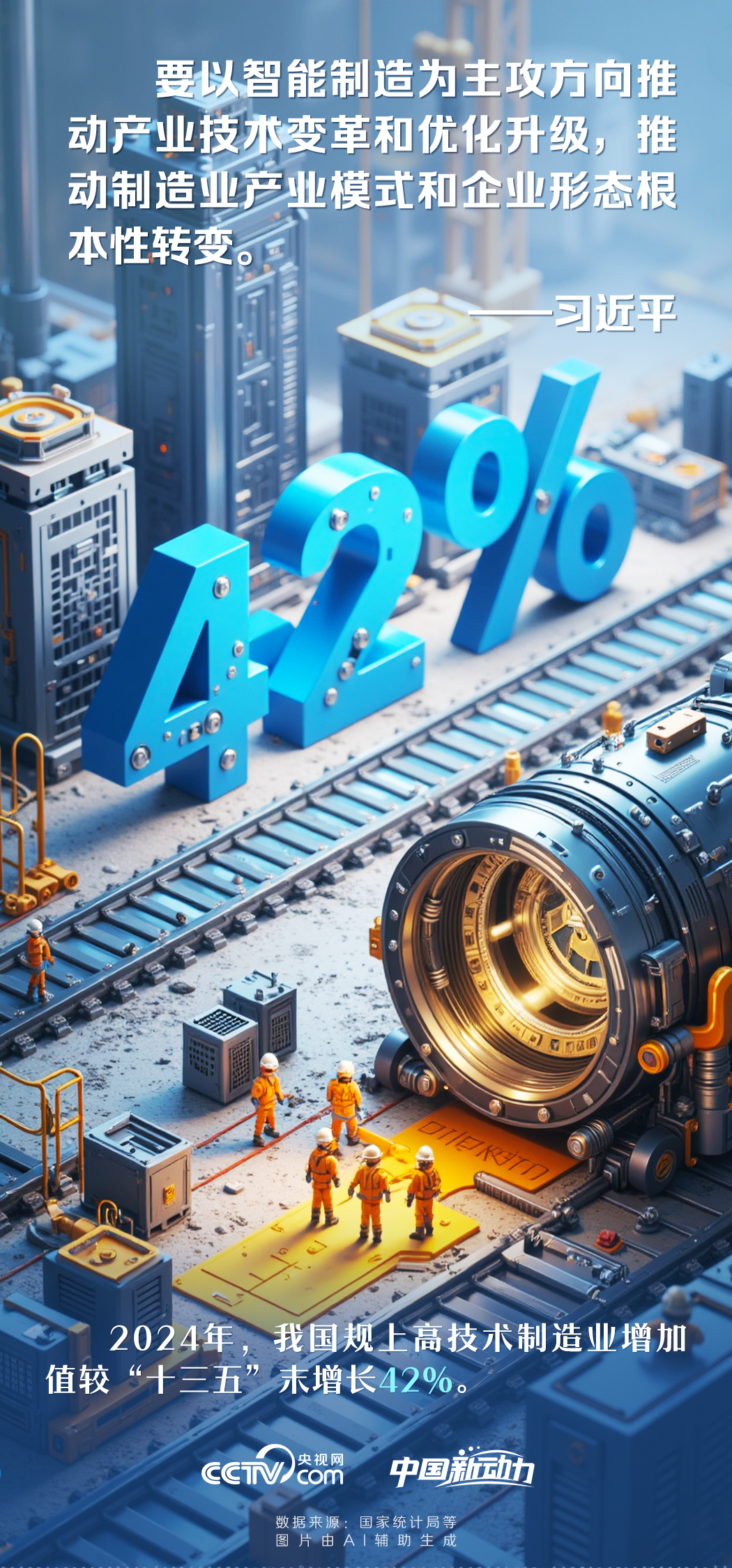
Core Insights - The Chinese government emphasizes the integration of technological innovation into specific industries and supply chains to drive industrial innovation [1] - The "14th Five-Year Plan" period has seen significant achievements in technology innovation, with notable examples such as the commercial flight of the C919 aircraft and the leading position in global sales of new energy vehicles [1] - The industrialization rate of invention patents in China has increased from 44.9% in 2020 to 53.3% in 2024, indicating a shift of more patents from laboratories to the industrial chain [1] Group 1: Economic Growth and Industry Development - In 2024, the added value of China's high-tech manufacturing industry is expected to grow by 42% compared to the "13th Five-Year Plan" period [3] - The core industries of the digital economy are projected to see a 73.8% increase in added value compared to the "13th Five-Year Plan," accounting for 10.4% of GDP [4] - The "Three New" (new industries, new business formats, new models) economy is anticipated to contribute 18% to GDP in 2024 [6] Group 2: Innovation and Global Competitiveness - The Chinese government aims to cultivate and expand emerging and future industries to secure a competitive edge in the global market [5] - China has the highest number of innovation clusters in the world, with 24 recognized by the World Intellectual Property Organization [8] - There is a focus on developing innovative industries in key areas such as integrated circuits, biomedicine, and artificial intelligence to create world-class industrial clusters [7]

全球视角 | 关税威胁下,提供5500亿美元投资的美日协议能否重振美国制造业?
Sou Hu Cai Jing· 2025-09-19 23:57
Group 1 - The current capital expenditure sentiment among U.S. companies remains low, with hiring activities and investment intentions not recovering [2] - The U.S. government is exploring how to utilize Japan's commitment of $550 billion in investments to revitalize domestic manufacturing [2][5] - The latest data shows a significant decline in the U.S. manufacturing sector, with the New York Fed manufacturing index dropping from 11.9 to -8.7 in September [2] Group 2 - Economic uncertainty makes it difficult to predict a substantial return of U.S. manufacturing or re-industrialization [3] - Manufacturers are generally pessimistic about sales prospects, leading to reluctance in expanding production capacity [3] - The recent construction boom in factories was primarily driven by the Biden administration's Inflation Reduction Act and the CHIPS and Science Act, while the Trump administration cut related subsidies [3] Group 3 - The U.S.-Japan trade agreement includes a governance structure for investment distribution, with Japan expected to complete the allocation of $550 billion before the end of Trump's term [5] - Investments are targeted at sectors critical to economic and security interests, including semiconductors, pharmaceuticals, and energy [5] - An investment committee led by U.S. Commerce Secretary Ross will oversee the execution and management of specific projects [5] Group 4 - The mechanism established by the trade agreement provides significant control to the U.S. government, while Japan has limited power to influence project types [6] - Japan can technically reject U.S. proposals but is more likely to refuse funding due to lack of support for specific projects [6] - The U.S. retains the right to impose tariffs, which serves to enhance leverage over Japan to fulfill investment commitments [6] Group 5 - Recent statements from U.S. officials suggest that trade agreements will lead to unprecedented levels of factory construction in the U.S. [7] - The term "capital call" is used to describe the process of requesting funds from committed investors for project financing [7] Group 6 - Many multinational companies have announced billion-dollar investment plans since Trump took office, attributed to the "Trump effect" [8] - However, some of these investment plans were initiated or announced during the Biden administration [8] - The timeline for these investment commitments remains uncertain, with significant lead times required for factory construction [9] Group 7 - Current tariff policies have led to profit shrinkage and investment stagnation among U.S. companies [9] - For instance, John Deere reported a significant decline in sales and operating profits due to tariff-related costs [9] - The uncertainty surrounding economic policies has caused companies to adopt a wait-and-see approach, delaying investments and reducing hiring [9] Group 8 - Recent court rulings may lead to adjustments in tariff policies, with the legality of Trump's tariff actions under review [10] - Many U.S. companies are hesitant to seek government financial assistance due to concerns over long-term repayment obligations [10] - Even with new investments in the U.S., manufacturers remain heavily reliant on global markets for raw materials and components [10]

关税威胁下,提供5500亿美元投资的美日协议能否重振美国制造业?
Di Yi Cai Jing· 2025-09-19 06:46
Group 1: Economic Context - The willingness of U.S. companies to invest remains low, with recruitment activities and investment intentions not recovering [1] - The U.S. manufacturing sector is showing signs of weakness, as evidenced by the New York Fed manufacturing index dropping from 11.9 to -8.7 in September [1] - Consumer confidence has not shown significant improvement, contributing to the overall pessimism in the manufacturing outlook [1] Group 2: U.S.-Japan Trade Agreement - The U.S. government is exploring how to utilize Japan's commitment of $550 billion to revitalize domestic manufacturing [1] - The trade agreement includes a governance structure for investment decisions, with Japan required to complete the allocation of the $550 billion before the end of Trump's term [3] - Investments are expected to focus on sectors critical to economic and security interests, including semiconductors, pharmaceuticals, and energy [3][4] Group 3: Investment Mechanism - The investment mechanism allows the U.S. to submit project plans for Japanese review, with Japan required to respond within 45 days [4] - Profits from projects will initially be split evenly until Japan recoups its investment, after which the U.S. will receive 90% of profits [4] - The structure provides significant control to the U.S. government over the investment process, while Japan has limited power to influence project selection [4] Group 4: Uncertainty and Corporate Response - Many multinational companies have announced large-scale investment plans, but the actual implementation remains uncertain due to changing policy environments [6] - Tariff policies have led to profit shrinkage and investment stagnation among U.S. companies, with John Deere reporting a $300 million increase in costs related to steel and aluminum imports [6][7] - The current economic uncertainty has caused companies to adopt a wait-and-see approach, delaying investments and reducing hiring [7] Group 5: Supply Chain Dependencies - U.S. manufacturers remain highly dependent on global markets for raw materials and components, with 69% of intermediate inputs sourced domestically and nearly one-third reliant on imports [8] - Approximately 94% of U.S. imports by value are industrial goods, highlighting the importance of global supply chains for U.S. manufacturing operations [8]

首批江苏省新质生产力科技馆名单发布 溧水区4家入选
Nan Jing Ri Bao· 2025-09-15 00:32
Group 1 - The first batch of recognized new quality productivity science and technology museums in Jiangsu Province includes 14 selected institutions, with 4 from Lishui District, highlighting its leadership in the city [1][2] - The selected museums focus on various fields such as new generation information technology, artificial intelligence, aerospace, new energy, new materials, high-end equipment, biomedicine, and quantum technology, showcasing the latest achievements in Jiangsu's new quality productivity [1][2] - The Nanjing Chang'an Automobile 5G+ Smart Exhibition Hall is the only selected new energy vehicle production technology museum in the province, featuring interactive displays of the latest achievements in electric vehicles and smart manufacturing [1][2] Group 2 - The Jiangsu Biomedicine Industry Science and Technology Museum, established with the support of Jiangsu Second Normal University, focuses on biomedicine and synthetic biology, integrating new technologies to enhance traditional biological resource development [2] - The Jiangsu Agricultural Machinery Museum and the Fujia Bian Agricultural Science and Technology Museum, both themed around agriculture, showcase the evolution of agricultural tools and promote agricultural science knowledge through various educational activities [2] - The new quality productivity science and technology museums serve as important platforms for public science education, technology exchange, and industrial upgrading in Lishui District, contributing to high-quality development [2]
发力低空新赛道 注入增长新动能
Zhong Guo Zheng Quan Bao· 2025-09-12 20:20
Core Viewpoint - The recent election of Tian Gangqiang as the chairman of Jifeng Technology marks a strategic shift towards strengthening the company's core agricultural machinery business while exploring new opportunities in the low-altitude economy through collaboration with United Aircraft [1][3]. Business Development Strategy - Jifeng Technology aims to solidify its business foundation by continuing its "one body, two wings" strategy, focusing on expanding its agricultural machinery segment and enhancing its technological and low-altitude capabilities [1][2][3]. - The company has undergone a change in controlling shareholder to Anhui Lanshi Enterprise Management Consulting Co., which holds 19.65% of voting rights, leading to increased market expectations for Jifeng Technology's future [1][2]. Financial Performance - Jifeng Technology's revenue has remained stable, with reported figures of 2.708 billion yuan in 2022, 2.650 billion yuan in 2023, 2.709 billion yuan in 2024, and 1.462 billion yuan in the first half of 2025. However, net profit has shown volatility, with figures of 8.1164 million yuan, 12.9537 million yuan, -20.7887 million yuan, and 2.9461 million yuan for the same periods [2]. Low-Altitude Business Expansion - The company plans to establish a wholly-owned subsidiary, Jifeng Aviation Technology (Sichuan) Co., with an investment of 50 million yuan to serve as a platform for low-altitude industry investment and operations, leveraging United Aircraft's strengths in the drone sector [3][4]. - Jifeng Aviation aims to explore various applications in low-altitude logistics, emergency services, and other sectors, indicating a significant growth potential in the low-altitude economy [4][5]. Collaboration with United Aircraft - The collaboration with United Aircraft is expected to enhance Jifeng Technology's agricultural machinery business and create synergies in the development of low-altitude services, particularly with the introduction of the Q100 agricultural drone [3][4]. - United Aircraft's revenue exceeded 400 million yuan last year and is projected to reach around 1 billion yuan this year, highlighting the growth potential in the low-altitude sector [4][5].

吉峰科技实控人之弟当选新董事长 拟投5000万设子公司切入低空经济
Chang Jiang Shang Bao· 2025-09-07 23:24
Core Viewpoint - After the change of actual controller, Jifeng Technology (300022.SZ) is undergoing significant transformations, including the establishment of a wholly-owned subsidiary, Jifeng Aviation, to focus on the low-altitude economy [1][2][9] Group 1: Company Developments - On September 5, Jifeng Technology announced the establishment of Jifeng Aviation with a capital of 50 million yuan, aimed at developing the low-altitude economy business [1][2] - The actual controller of Jifeng Technology changed to Tian Gangyin, with Tian Gangqiang appointed as the new chairman [1][3][8] - The company is leveraging the advantages of its new controlling shareholder, Anhui Lanshi, and its indirect controlling shareholder, Shenzhen United Aircraft Technology, to enhance its low-altitude business [4][9] Group 2: Financial Performance - In 2024, Jifeng Technology reported a revenue of 2.709 billion yuan, a year-on-year increase of 2.24%, but incurred a net loss of 30.81 million yuan [6] - In the first half of 2025, the company achieved a revenue of 1.462 billion yuan, a slight decrease of 0.45%, while net profit increased by 177.01% to 4.0473 million yuan [7]
【一拖股份(601038.SH)】短期经营承压,海外销售表现亮眼——2025年中报点评(黄帅斌/陈佳宁/庄晓波)
光大证券研究· 2025-09-06 00:03
Core Viewpoint - The company reported a decline in revenue and net profit for the first half of 2025, indicating short-term operational pressure due to decreased demand in traditional agricultural machinery products [4][5]. Financial Performance - In H1 2025, the company achieved revenue of 6.93 billion yuan, a year-on-year decrease of 11.3%, and a net profit attributable to shareholders of 770 million yuan, down 15.1%. The net profit after deducting non-recurring items was 690 million yuan, a decline of 21.2% [4]. - In Q2 2025, revenue was 2.37 billion yuan, reflecting a year-on-year decrease of 24.7%, with net profit at 240 million yuan, down 21.7% [4]. Operational Insights - The decline in revenue and net profit in H1 2025 marks the first occurrence of such a trend in the past five years, primarily due to a sustained decrease in demand for traditional agricultural machinery [5]. - The company’s expense ratio increased by 1.1 percentage points to 6.3%, driven by higher marketing and R&D expenditures, with sales expenses rising by 8.2% and R&D expenses by 3.7% [5]. - The overall gross margin was 16.0%, an increase of 0.8 percentage points, and the net profit margin was 12.0%, up 0.2 percentage points, attributed to proactive adjustments in operational strategies [5]. Product Performance - In H1 2025, revenue from agricultural machinery was 6.28 billion yuan, down 11.5%, with a gross margin of 16.7%. Revenue from power machinery was 650 million yuan, down 8.9%, with a gross margin of 9.2% [6]. Market Expansion - Domestic revenue accounted for 90.5% of total revenue at 6.27 billion yuan, while overseas revenue reached 660 million yuan, a year-on-year increase of 16.5%, representing 9.5% of total revenue [7]. - The company sold 43,000 tractor units, with 5,445 units sold overseas, marking a 29.4% increase. Notably, sales in the African and Central and Eastern European markets saw growth exceeding 50% [7]. - The company has accelerated its overseas expansion strategy, establishing five major sales regions, which helps mitigate the impact of domestic market declines and lays a solid foundation for future export growth [7].


吉峰科技拟设立吉峰航空 作为公司低空产业投资运营平台
Zheng Quan Shi Bao· 2025-09-04 18:40
Core Viewpoint - Jifeng Technology is establishing a wholly-owned subsidiary, Jifeng Aviation Technology (Sichuan) Co., Ltd., with an investment of 50 million yuan to enhance its low-altitude economy business development [1][2]. Group 1: Company Developments - On April 16, 2025, Jifeng Technology's controlling shareholder changed from Sichuan Tequ Education Management Co., Ltd. to Anhui Lanshi, with the actual controller changing from Wang Huiwu to Tian Gang [2]. - The share transfer involved 19.65% of the company's total share capital, with the transfer completed on July 8, 2025 [2]. - Jifeng Aviation will serve as the investment and operation platform for the company's low-altitude industry, leveraging the advantages of its new controlling shareholder, Anhui Lanshi, and its indirect controlling shareholder, Shenzhen United Aircraft Technology Co., Ltd. [2][3]. Group 2: Strategic Focus - The establishment of Jifeng Aviation aligns with the national strategy for low-altitude economy as a new emerging industry, aiming to upgrade the company's production capabilities and seize strategic opportunities [2]. - The company plans to expand beyond its traditional agricultural machinery business by exploring new business opportunities in the low-altitude economy and drone sectors, leveraging the technological and resource advantages of its new controlling shareholder [3].
潍坊青州:积极开拓多元市场 培育外贸新优势
Sou Hu Cai Jing· 2025-09-03 16:43
Core Insights - Qingzhou's foreign trade enterprises are actively exploring international markets, enhancing technological innovation and product development to improve core competitiveness and create new advantages in foreign trade [1][4] Group 1: Company Performance - Shandong Haiyu Heavy Industry Group Co., Ltd. has seen a 60% year-on-year increase in foreign trade orders, attributed to the development of new markets such as Central Asia and ASEAN, as well as support from the Belt and Road Initiative [1][2] - The company has adopted a hybrid strategy of online and offline market development, establishing after-sales centers in countries like Kyrgyzstan, Tanzania, and Uganda to enhance customer trust and communication [1] - The company is focusing on technological innovation, producing high-tech, high-value-added, and green low-carbon products to drive new breakthroughs in overseas business orders [1][2] Group 2: Market Strategy - Qingzhou is guiding foreign trade enterprises to focus on their core businesses, enhance product structure transformation, and strengthen core competitiveness while expanding into emerging markets such as the Middle East, Africa, and Latin America [4] - Shandong Junmadao Machinery Co., Ltd. is shifting its strategic focus to overseas markets, establishing sales and service networks in regions like Central Asia, Israel, and South America [4] - The company is optimizing its production equipment and technology to develop new products, including high-end agricultural machinery and key components, to meet the demands of international markets [4] Group 3: Market Growth - In the first half of the year, Qingzhou's market entities demonstrated strong vitality, achieving a total import and export value of 9.57 billion yuan, reflecting robust resilience and growth in foreign trade [4]