
太阳能发电

Search documents
国家统计局:实现全年目标仍有较多有利条件
智通财经网· 2025-10-20 02:23
Economic Overview - The core viewpoint of the article emphasizes that China's economic stability and growth trajectory remain intact despite external pressures and internal challenges, with a GDP growth of 5.2% in the first three quarters of the year, surpassing the same period last year by 0.4 percentage points [1][3][9]. Economic Performance - In the first three quarters, China's GDP reached 39.679 trillion yuan, an increase of 1.368 trillion yuan year-on-year, reflecting a stable economic performance [3]. - The urban unemployment rate averaged 5.2%, remaining stable compared to the first half of the year, while the Consumer Price Index (CPI) slightly decreased by 0.1% year-on-year, indicating effective demand stimulation policies [3][4]. High-Quality Development - The article highlights the ongoing push for high-quality development, with significant contributions from new production capacities and technological advancements, including a 9.6% year-on-year increase in high-tech manufacturing value added [4][15]. - The share of non-fossil energy consumption in total energy consumption rose by approximately 1.7 percentage points year-on-year, showcasing progress in green and low-carbon transitions [4][22]. Economic Resilience - China's economy demonstrated strong resilience, achieving a 5.2% growth rate amidst global economic uncertainties and trade protectionism, positioning it as a stable growth engine compared to other major economies [5][8]. - The article notes that despite challenges, the internal logic supporting economic stability remains unchanged, with ample policy space and tools available to address various risks [6][9]. Policy Implementation - The implementation of proactive macroeconomic policies has effectively supported economic stability, with consumer spending contributing 53.5% to economic growth in the first three quarters, an increase of 9 percentage points from the previous year [11][12]. - Investment in equipment and tools rose by 14% year-on-year, indicating a robust push for industrial upgrades and technological improvements [12]. New Production Capacity - The development of new production capacities is highlighted as a key driver for high-quality growth, with significant investments in sectors such as electric vehicles and renewable energy, leading to substantial increases in production output [14][16]. - The article mentions that the scale of high-tech manufacturing has seen a 9.6% increase in value added, with specific sectors like integrated circuit manufacturing growing by 22.4% [15]. Conclusion - Overall, the article conveys a positive outlook for China's economic performance, emphasizing the importance of continued policy support and structural reforms to maintain growth momentum and address existing challenges [10][24].
中国绿色实践照亮全球可持续发展之路
中国能源报· 2025-10-20 02:15
Core Viewpoint - China's green transition is not only a necessary response to the climate crisis but also a historical opportunity to create new growth momentum, with its achievements benefiting the world beyond its borders [1][6]. Group 1: Green Development Initiatives - The Belt and Road Initiative serves as a significant platform for promoting green development, with a vision to establish a green development pattern by 2030 [2]. - Projects like the China-Pakistan Economic Corridor and the Kenya-Monitored Railway exemplify China's commitment to green infrastructure, significantly reducing carbon emissions [2]. Group 2: Global Impact of China's Renewable Energy - China's renewable energy products, including wind and solar power, support global energy transition, with exports covering over 200 countries and regions [3]. - During the 14th Five-Year Plan, China's wind and solar product exports contributed to a reduction of approximately 4.1 billion tons of carbon emissions for other countries [3]. Group 3: International Cooperation and Capacity Building - China actively shares environmental and clean energy technologies with developing countries through various international platforms, signing over 50 cooperation documents with 42 developing nations [3]. - The establishment of the China-ASEAN Energy College enhances energy talent training and technical exchange, fostering cooperation in renewable energy [5]. Group 4: Sustainable Development and Ecological Governance - China's green practices are transforming into a driving force for global ecological governance, with initiatives like the Belt and Road Green Development Index influencing over 40 countries [3]. - The approach emphasizes that economic development and environmental protection can coexist, providing a model for sustainable growth [6].

2025年1-4月中国太阳能发电量产量为1595.2亿千瓦时 累计增长19.5%
Chan Ye Xin Xi Wang· 2025-10-18 02:41
Core Viewpoint - The solar power generation industry in China is experiencing significant growth, with a notable increase in production and capacity in recent years, as highlighted by the data from the National Bureau of Statistics and the report from Zhiyan Consulting [1]. Industry Summary - In April 2025, China's solar power generation reached 44.7 billion kilowatt-hours, marking a year-on-year increase of 16.7% [1]. - From January to April 2025, the cumulative solar power generation in China was 159.52 billion kilowatt-hours, reflecting a cumulative growth of 19.5% [1]. - The report titled "2025-2031 China Solar Power Station Industry Market Situation Monitoring and Investment Prospects" by Zhiyan Consulting provides insights into the market trends and investment opportunities in the solar energy sector [1]. Company Summary - Key listed companies in the solar energy sector include Longi Green Energy, Tongwei Co., Sunshine Power, JA Solar Technology, Trina Solar, TBEA, Chint Electric, TCL Zhonghuan, Linyang Energy, and Sungrow Power Supply [1].


青海苏泰照明工程有限公司成立 注册资本20万人民币
Sou Hu Cai Jing· 2025-10-15 10:22
Core Viewpoint - Recently, the establishment of Qinghai Sutai Lighting Engineering Co., Ltd. has been registered, indicating a potential growth in the renewable energy and lighting sectors in China [1] Company Summary - Qinghai Sutai Lighting Engineering Co., Ltd. has a registered capital of 200,000 RMB [1] - The legal representative of the company is Xu Qiangqiang [1] Industry Summary - The company operates in various sectors including power generation technology services, solar power technology services, and sales of lighting fixtures [1] - The business scope includes manufacturing and sales of photovoltaic equipment and components, as well as advertising services [1] - Additional activities include landscape greening engineering construction and sales of solar thermal power products [1]
太阳能:截至2025年9月底公司通过股份回购专用证券账户以集中竞价方式累计回购公司股份10930100股
Zheng Quan Ri Bao· 2025-10-15 09:12
证券日报网讯太阳能10月15日发布公告,在公司回答调研者提问时表示,截至2025年9月底,公司通过 股份回购专用证券账户以集中竞价方式累计回购公司股份10,930,100股,成交总金额约5000万元(不 含交易费用),后续将根据市场动态在回购期限内持续推进实施。 (文章来源:证券日报) ...
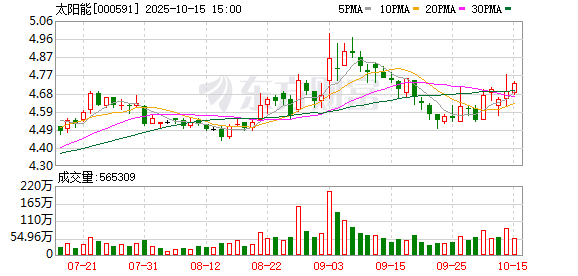
太阳能:公司2025年规划光伏电站投运、在建、拟建及签署预收购协议的总规模力争超过13.6吉瓦
Zheng Quan Ri Bao· 2025-10-15 08:41
Core Viewpoint - The company aims to exceed a total scale of 13.6 GW for photovoltaic power stations by 2025, indicating a strong growth trajectory in solar energy investments [1] Summary by Relevant Categories Operational Capacity - As of June 30, 2025, the company has approximately 6.535 GW of operational power stations, 2.365 GW of stations under construction, 2.217 GW of planned projects, and 1.529 GW of signed pre-acquisition agreements, totaling about 12.647 GW [1] Future Plans - The company is committed to actively developing photovoltaic power station construction and accelerating the progress of ongoing and acquisition projects [1]
太阳能:今年截至8月底公司下属光伏发电项目公司共收到可再生能源补贴资金23.19亿元
Zheng Quan Ri Bao· 2025-10-15 08:39
Core Viewpoint - The company reported receiving a total of 2.319 billion yuan in renewable energy subsidy funds by the end of August this year, with 2.252 billion yuan coming from national renewable energy subsidies, indicating a positive impact on the company's financial structure [1] Group 1 - The company has received a total of 2.319 billion yuan in renewable energy subsidy funds for its photovoltaic power generation projects as of August 31 [1] - Among the total, 2.252 billion yuan is from national renewable energy subsidies, highlighting the significant support from the government [1] - The company noted an increase in subsidy funds received in August compared to the first half of the year, which is expected to further improve its financial structure [1]
太阳能:公司目前储能主要为光伏电站配套储能
Zheng Quan Ri Bao· 2025-10-15 08:39
Core Viewpoint - The company is focusing on energy storage development, particularly in conjunction with photovoltaic power plants, with a current capacity of approximately 1500 MWh [1] Group 1: Current Energy Storage Capacity - The company's energy storage is primarily for photovoltaic power station support, totaling around 1500 MWh [1] Group 2: Future Development Plans - The company is actively researching power market policies and industry developments, emphasizing the importance of energy storage [1] - Future exploration will include commercial and independent energy storage projects, with strategic planning for opportunities [1] Group 3: Technological Research - The company is closely monitoring and researching grid-type energy storage technologies, as well as the feasibility and application of long-duration storage technologies such as flow batteries and compressed air [1]
太阳能:公司加强专业化电力交易团队建设,针对电力市场化交易不断深入研究
Zheng Quan Ri Bao· 2025-10-15 08:38
Core Viewpoint - The company is enhancing its professional power trading team and focusing on the deepening of market-oriented electricity trading through various strategic initiatives [1] Group 1: Team Development and Training - The company is upgrading its trading management methods by leveraging digital and informational tools to empower electricity trading [1] - The company is organizing specialized training to improve the professional skills of its trading personnel [1] Group 2: Policy Monitoring and Analysis - The company is closely monitoring policy changes and has established a mechanism for analyzing key trading policies [1] - A dynamic tracking mechanism for the implementation details of these policies has been set up to enhance decision-making [1] Group 3: Operational Management - The company is committed to maintaining effective operation and maintenance management of its power plants to ensure their generation capacity [1]
今年以来80只新股已发行,共募资812.81亿元
Zheng Quan Shi Bao Wang· 2025-10-15 07:30
Group 1 - Two new stocks were issued today: Chaoying Electronics issued 52.50 million shares at a price of 17.08 yuan, raising 0.897 billion yuan; Taikai Ying issued 44.25 million shares at a price of 7.50 yuan, raising 0.332 billion yuan [1] - As of October 15, a total of 80 companies have gone public this year, raising a cumulative amount of 81.281 billion yuan, with an average fundraising of 1.016 billion yuan per company [1] - Among the companies, 16 raised over 1 billion yuan, with one company exceeding 10 billion yuan; 32 companies raised between 500 million and 1 billion yuan, and another 32 raised less than 500 million yuan [1] Group 2 - Huadian New Energy is the company with the highest fundraising this year, raising 18.171 billion yuan primarily for wind and solar power projects, as well as working capital [2] - Other notable fundraisers include Zhongce Rubber with 4.066 billion yuan, and Tianyouwei, United Power, and Heyuan Bio, raising 3.740 billion yuan, 3.601 billion yuan, and 2.599 billion yuan respectively [2] - The average initial public offering price this year is 21.23 yuan, with four companies priced above 50 yuan; Tianyouwei has the highest price at 93.50 yuan [2] Group 3 - The majority of new stock issuances this year are concentrated in Jiangsu, Guangdong, and Zhejiang, with 20, 15, and 13 companies respectively; the top fundraising regions are Fujian, Jiangsu, and Guangdong, raising 18.171 billion yuan, 12.688 billion yuan, and 12.316 billion yuan respectively [2]