Utilities

Search documents
Chevron Corporation (CVX) – A Great Option for Your Dividend Stock Portfolio
Insider Monkey· 2025-09-24 02:07
Core Insights - Artificial intelligence (AI) is identified as the greatest investment opportunity of the current era, with a strong emphasis on the urgent need for energy to support its growth [1][2][3] - A specific company is highlighted as a key player in the AI energy sector, owning critical energy infrastructure assets that are essential for meeting the increasing energy demands of AI technologies [3][7][8] AI and Energy Demand - AI technologies, particularly large language models like ChatGPT, are extremely energy-intensive, with data centers consuming as much energy as small cities [2] - The energy requirements for AI are expected to escalate, leading to potential crises in power grids and rising electricity prices [2] - Industry leaders, including Sam Altman and Elon Musk, have warned about the impending energy challenges facing AI development [2] Investment Opportunity - The company in focus is positioned to benefit from the surge in demand for electricity driven by AI data centers, making it a unique investment opportunity [3][6] - It is described as a "toll booth" operator in the energy sector, profiting from the export of American liquefied natural gas (LNG) and benefiting from tariffs that encourage onshoring [5][6][7] - The company is noted for its debt-free status and substantial cash reserves, which amount to nearly one-third of its market capitalization [8][10] Market Position and Valuation - The company is involved in large-scale engineering, procurement, and construction (EPC) projects across various energy sectors, including nuclear energy, which is crucial for America's future power strategy [7][8] - It is trading at a low valuation of less than 7 times earnings, making it an attractive option for investors looking for undervalued stocks in the AI and energy space [10][11] - The company also holds a significant equity stake in another AI-related venture, providing indirect exposure to multiple growth opportunities [9][10] Future Outlook - The ongoing influx of talent into the AI sector is expected to drive continuous innovation and advancements, reinforcing the importance of investing in AI-related companies [12] - The combination of AI infrastructure needs, energy demands, and favorable market conditions presents a compelling case for investment in the highlighted company [14][15]



Nvidia's $100B OpenAI Deal 'Makes Sense,' Says BlackRock's Jacobs
Youtube· 2025-09-23 19:40
You really get an analysis of the insatiable demand of investors into the data center story, but are they starting to question ultimately whether we can meet that insatiable demand when the funding is there in the longer term. No, I think it's quite the opposite. Investor enthusiasm is only growing.If you look at one of our ETFs by some actively managed ETF. It's brought in over $5 billion this year and is now the largest air ETF in the United States. And a lot of the exposure that it is providing to invest ...


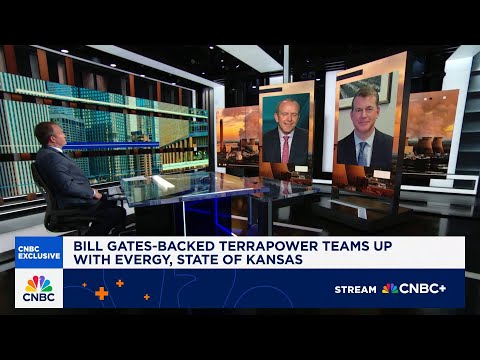
Generational opportunity here for power demand, says Evergy CEO David Campbell
CNBC Television· 2025-09-23 18:47
Industry Trend & Opportunity - Power demand is experiencing a generational opportunity with increased demand not seen in decades [2] - The energy sector needs to add nuclear to the fuel mix for a sustainable, clean, and reliable system [2] - Economic development in Kansas requires nuclear energy [6] Technology & Project - TerraPower's Natrium reactor in Wyoming is scheduled to load nuclear fuel in 2030 [5] - TerraPower is examining deploying Natrium reactors in Evergy's service region in Kansas after the first Wyoming reactor [6] - Natrium reactors are expected to need less than half the concrete, steel, and labor to build, improving the ability to deliver plants at scale [11] - Natrium plant is expected to be a fairly large plant, a third of a gigawatt (0.33 GW) per plant, with built-in energy storage [12] Company Strategy & Collaboration - Evergy will meet near-term power needs with natural gas and solar, but will add nuclear for a sustainable system [2] - Evergy and TerraPower are collaborating to examine deploying Natrium reactors in Kansas [6] - Evergy's safe operation of the Wolf Creek plant for 30+ years has built confidence in nuclear safety and made Kansas welcoming to new nuclear [7] Challenges & Solutions - The main obstacle to nuclear energy is the capital expenditure (capex) [10] - Moving to new technology like TerraPower's Natrium reactor is essential to reduce capital intensity [8][11]
Is it a Good Time to Invest in Berkshire Hathaway (BRK-B) Shares?
Yahoo Finance· 2025-09-23 14:48
Fund Performance - Peterson Investment Fund I experienced a decline of 10.1% in Q2 2025, while the S&P 500 gained 10.9% including dividends [1] - Year-to-date, the fund has returned 13.6% net to investors, outperforming the S&P 500's 6.2% return [1] - Since inception nearly 13.75 years ago, the fund has turned a $1 million initial investment into $4.2 million net of fees, representing an annualized return of 10.9% [1] Investment Strategy - The fund's long-term performance is attributed to a disciplined, value-based, and research-driven strategy [1] - Management emphasizes alignment with investor interests as a key component of their approach [1] Company Highlight: Berkshire Hathaway Inc. - Berkshire Hathaway Inc. (NYSE:BRK-B) shares rose by 1.07% over the past month and gained 9.44% over the last 12 months [3] - As of September 22, 2025, Berkshire Hathaway Inc. shares closed at $493.71, with a market capitalization of $1.074 trillion [3] - Warren Buffett announced the natural succession of leadership at the 2025 Annual Meeting, with Vice Chairman Greg Abel taking over day-to-day responsibilities effective January 1, 2026 [4]
Is Alliant Energy Stock Underperforming the Dow?
Yahoo Finance· 2025-09-23 13:14
Company Overview - Alliant Energy Corporation (LNT) is a utility holding company based in Madison, Wisconsin, providing regulated electricity and natural gas services with a market cap of $16.5 billion, serving nearly 1 million electric and 425,000 natural gas retail customers across Iowa and Wisconsin [1]. Stock Performance - LNT reached an all-time high of $67.11 on August 22 and is currently trading 4.3% below that peak, with a 6.1% gain over the past three months, underperforming the Dow Jones Industrial Average's 9.9% increase during the same period [3]. - Year-to-date, LNT has gained 8.6% and 7.5% over the past 52 weeks, compared to the Dow's 9% and 10.3% increases respectively [4]. Financial Results - In Q2, Alliant Energy reported a topline of $961 million, reflecting a 7.5% year-over-year increase, although it fell 2.7% short of analysts' expectations. The company's EPS surged by 100% year-over-year to $0.68, exceeding consensus estimates by 9.7% [5]. Competitive Position - Alliant has outperformed its peer, Public Service Enterprise Group Incorporated (PEG), which saw a 3.3% dip in 2025 and a 5.8% decline over the past year [6]. - Among 11 analysts covering LNT, the consensus rating is a "Moderate Buy," with a mean price target of $68.67, indicating a 6.9% upside potential from current price levels [6].

How Brookfield Infrastructure, Delek Logistics, And VICI Properties Can Put Cash In Your Pocket
Yahoo Finance· 2025-09-23 12:01
Core Insights - Companies with a strong history of dividend payments and increases are attractive to income-focused investors, with Brookfield Infrastructure, Delek Logistics, and VICI Properties recently announcing dividend hikes and offering yields up to nearly 10% [1] Brookfield Infrastructure Partners - Brookfield Infrastructure Partners LP operates in utilities, transport, midstream, and data sectors [2] - The company has increased its dividends for 16 consecutive years, with a recent quarterly payout raised by 6% to $0.43 per share, translating to an annual payout of $1.72 per share [3] - As of June 30, the annual revenue was $21.54 billion, with Q2 2025 revenues reported at $5.43 billion, exceeding consensus estimates, although the loss per share of $0.03 missed expectations [4] Delek Logistics Partners - Delek Logistics Partners LP focuses on logistics and marketing assets for crude oil and refined products in the U.S. [4] - The company has raised its dividends for 12 consecutive years, with the latest quarterly payout increased from $1.11 to $1.115 per share, equating to an annual figure of $4.46 per share [5] - Annual revenue as of June 30 was $920.21 million, with Q2 2025 revenues of $246.35 million and EPS of $0.83, both below expectations [5] VICI Properties - VICI Properties Inc. is a real estate investment trust specializing in casino and entertainment properties [6] - The company has raised its dividends for seven consecutive years, with the latest quarterly payout increased by 4% to $0.45 per share, resulting in an annual figure of $1.80 per share [7] - The current dividend yield for VICI Properties stands at 5.60% [7]


Sempra Announces Strategic Transactions Advancing Goal of Building Leading U.S. Utility Growth Business
Prnewswire· 2025-09-23 11:55
Core Viewpoint - Sempra is implementing strategic actions to enhance its corporate strategy through five value creation initiatives aimed at simplifying its business model, improving financial performance, and reducing risk, ultimately leading to better earnings growth and benefits for customers and communities [1][2]. Group 1: Strategic Actions - The company is advancing its capital recycling program and transitioning to a leading U.S. utility growth business [2]. - Sempra has agreed to sell a 45% equity interest in Sempra Infrastructure Partners for $10 billion, which implies an equity value of $22.2 billion and an enterprise value of $31.7 billion for Sempra Infrastructure Partners [3][4][26]. - The transaction is expected to close in Q2 – Q3 2026, pending regulatory approvals [5]. Group 2: Financial Implications - Sempra will receive 47% of the cash at closing, 41% by year-end 2027, and the remainder approximately seven years after closing, allowing for attractive post-closing interest income [4]. - The transaction is projected to strengthen Sempra's credit profile, improve its business mix with a goal of approximately 95% earnings from regulated U.S. utilities, and eliminate the need for equity issuances in the 2025-2029 capital plan [6][15]. Group 3: Project Developments - Sempra Infrastructure Partners has reached a final investment decision for Port Arthur LNG Phase 2, which will include two natural gas liquefaction trains and a storage tank with a capacity of approximately 13 million tonnes per annum [6][10]. - The estimated capital expenditures for Phase 2 are $12 billion, plus an additional $2 billion for shared common facilities, with commercial operations expected in 2030 and 2031 [6][10]. Group 4: Earnings Guidance - Sempra updated its full-year 2025 EPS guidance range to $3.29 to $3.69 and affirmed its adjusted EPS guidance range of $4.30 to $4.70 [10][19]. - The company also affirmed its 2026 adjusted EPS guidance range of $4.80 to $5.30 and projected a long-term EPS compound annual growth rate of 7% to 9% for 2025 through 2029 [10][19].

Nvidia's $100B AI investment: Former Southern Company CEO Tom Fanning on U.S. power infrastructure
Youtube· 2025-09-23 11:47
Nvidia announcing it's going to invest 100 billion dollars in open AI as part of a data center buildout. The plan will require 10 gawatts uh of power. The largest plant in the US currently runs 4.6% uh gawatt.Here to break down what's going on so far, retired Southern Company CEO Tom Fanning, who uh has a long career in trying to figure out how to generate uh power uh for people at obviously at Southern Company. And you're also Atlanta fed um for a while. So you're you're like a uh you wear a lot of differe ...


Alphabet (GOOGL) Stock in Focus After Truist Boosts Price Target on Search Dominance
Insider Monkey· 2025-09-23 03:32
Core Insights - Artificial intelligence (AI) is identified as the greatest investment opportunity of the current era, with a strong emphasis on the urgency to invest in AI technologies now [1][13] - The energy demands of AI technologies are highlighted as a critical concern, with data centers consuming energy equivalent to that of small cities, leading to potential crises in power supply [2][3] Investment Opportunity - A specific company is presented as a unique investment opportunity, positioned to benefit from the increasing energy demands of AI, owning critical energy infrastructure assets [3][7] - This company is not a chipmaker or cloud platform but is described as the "Toll Booth" operator of the AI energy boom, collecting fees from energy exports [4][5] Market Position - The company is noted for its capabilities in executing large-scale engineering, procurement, and construction (EPC) projects across various energy sectors, including nuclear energy [7][8] - It is characterized as debt-free, with a significant cash reserve amounting to nearly one-third of its market capitalization, which positions it favorably compared to other energy firms burdened with debt [8][10] Growth Potential - The company holds a substantial equity stake in another AI-related venture, providing investors with indirect exposure to multiple growth engines in the AI sector [9][10] - The stock is described as undervalued, trading at less than seven times earnings, which presents a compelling investment case given its ties to the booming AI and energy sectors [10][11] Industry Trends - The article discusses the broader trends of AI disruption across traditional industries, emphasizing the importance of investing in companies that are adapting to these changes [11][12] - The influx of talent into the AI field is noted as a driving force for innovation and advancements, reinforcing the potential for growth in AI investments [12][14]


Morgan Stanley Raises PT on Vistra Corp. (VST) to $207, Maintains ‘Overweight’ Rating
Insider Monkey· 2025-09-22 22:43
Group 1: AI Investment Opportunity - Artificial intelligence is identified as the greatest investment opportunity of our lifetime, with a strong emphasis on the urgency to invest now [1][13] - Wall Street is investing hundreds of billions into AI, but there is a critical question regarding the energy supply needed to support this technology [2][6] - AI data centers consume massive amounts of energy, comparable to the energy usage of small cities, leading to concerns about power grid strain and rising electricity prices [2][3] Group 2: Company Overview - A specific company is highlighted as a key player in the AI energy sector, owning critical energy infrastructure assets that are essential for meeting the increasing energy demands of AI [3][7] - This company is positioned to benefit from the surge in demand for electricity driven by AI data centers, making it a unique investment opportunity [3][8] - The company is debt-free and has a significant cash reserve, equating to nearly one-third of its market capitalization, which provides financial stability [8][10] Group 3: Market Position and Growth Potential - The company plays a pivotal role in U.S. LNG exportation and is well-positioned to capitalize on the onshoring trend driven by tariffs [5][7] - It is capable of executing large-scale engineering, procurement, and construction projects across various energy sectors, including nuclear energy [7][8] - The company also holds a substantial equity stake in another AI-related venture, providing indirect exposure to multiple growth engines in the AI sector [9][10] Group 4: Future Outlook - The future of AI is closely tied to energy infrastructure, and the company is strategically positioned to thrive in this evolving landscape [6][14] - The influx of talent into the AI sector ensures continuous innovation and advancements, further solidifying the importance of investing in AI-related companies [12] - The potential for significant returns is highlighted, with expectations of over 100% return within 12 to 24 months for investors who act now [15][19]