Artificial Intelligence

Search documents
虹软科技:公司拥有丰富的针对智能手机、AI眼镜等移动智能终端以及智能汽车的视觉算法产品线
Zheng Quan Ri Bao Wang· 2026-02-13 13:44
Core Viewpoint - The company, Hongsoft Technology, is a leading supplier of visual artificial intelligence algorithms, focusing on mobile smart devices and smart vehicles [1] Group 1: Company Overview - Hongsoft Technology has a rich product line of visual algorithms tailored for smartphones, AI glasses, and smart cars [1] - The main source of revenue for the company comes from licensing its core technologies developed in-house [1] Group 2: Clientele - Major clients include globally recognized smartphone manufacturers such as Samsung, Xiaomi, OPPO, vivo, Honor, and Moto, as well as domestic and some joint venture and foreign automotive manufacturers [1] Group 3: Business Stability - The company reports healthy and stable business development, although its stock price may fluctuate due to various factors in the capital market [1]

X @Bloomberg
Bloomberg· 2026-02-13 13:29
Legora is in talks to raise funds that would triple the legal artificial intelligence maker’s valuation to $6 billion, four months after its last financing round, sources say https://t.co/MiTeArlJRI ...
MiniMax发布M2.5模型:1美元运行1小时,价格仅为GPT-5的1/20,性能比肩Claude Opus
硬AI· 2026-02-13 13:25
Core Viewpoint - MiniMax has launched its latest M2.5 model series, achieving a significant breakthrough in both performance and cost, aiming to address the economic feasibility of complex agent applications while claiming to have reached or refreshed the industry SOTA (state-of-the-art) levels in programming, tool invocation, and office scenarios [3][4]. Cost Efficiency - The M2.5 model demonstrates a substantial price advantage, costing only 1/10 to 1/20 of mainstream models like Claude Opus, Gemini 3 Pro, and GPT-5 when outputting 50 tokens per second [3][4]. - In a high-speed environment of 100 tokens per second, the cost for continuous operation for one hour is just $1, and it can drop to $0.3 at 50 tokens per second, allowing a budget of $10,000 to support four agents working continuously for a year [3][4]. Performance Metrics - M2.5 has shown strong performance in core programming tests, winning first place in the Multi-SWE-Bench multi-language task, with overall performance comparable to the Claude Opus series [4]. - The model has improved task completion speed by 37% compared to the previous generation M2.1, with an end-to-end runtime reduced to 22.8 minutes, matching Claude Opus 4.6 [4]. Internal Validation - Internally, MiniMax has validated the M2.5 model's capabilities, with 30% of overall tasks autonomously completed by M2.5, covering core functions such as R&D, product, and sales [4]. - In programming scenarios, M2.5-generated code accounts for 80% of newly submitted code, indicating high penetration and usability in real production environments [4]. Task Efficiency - M2.5 aims to eliminate cost constraints for running complex agents by optimizing inference speed and token efficiency, achieving a processing speed of 100 TPS (transactions per second), approximately double that of current mainstream models [7]. - The model has reduced the total token consumption per task to an average of 3.52 million tokens in SWE-Bench Verified evaluations, down from 3.72 million in M2.1, allowing for nearly unlimited agent construction and operation economically [9]. Programming Capability - M2.5 emphasizes not only code generation but also system design capabilities, evolving a native specification behavior that allows it to decompose functions, structures, and UI designs from an architect's perspective before coding [11]. - The model has been trained in over 10 programming languages, including GO, C++, Rust, and Python, across tens of thousands of real environments [12]. Testing and Validation - M2.5 has been tested on programming scaffolds like Droid and OpenCode, achieving pass rates of 79.7% and 76.1%, respectively, outperforming previous models and Claude Opus 4.6 [14]. Advanced Task Handling - In search and tool invocation, M2.5 exhibits higher decision maturity, seeking more streamlined solutions rather than merely achieving correctness, saving approximately 20% in rounds consumed compared to previous generations [16]. - For office scenarios, M2.5 integrates industry-specific knowledge through collaboration with professionals in finance and law, achieving an average win rate of 59.0% in comparisons with mainstream models, capable of producing industry-standard reports, presentations, and complex financial models [18]. Technical Foundation - The performance enhancement of M2.5 is driven by large-scale reinforcement learning (RL) through a native Agent RL framework named Forge, which decouples the underlying training engine from the agent, supporting integration with any scaffold [23]. - The engineering team has optimized asynchronous scheduling and tree-structured sample merging strategies, achieving approximately 40 times training acceleration, validating a near-linear improvement in model capabilities with increased computational power and task numbers [23]. Deployment - M2.5 is fully deployed in MiniMax Agent, API, and Coding Plan, with model weights to be open-sourced on HuggingFace, supporting local deployment [25].


极光GPTBots.ai率先集成GLM-5,为企业打开“可靠又实惠”的AI新大门
Ge Long Hui· 2026-02-13 13:19
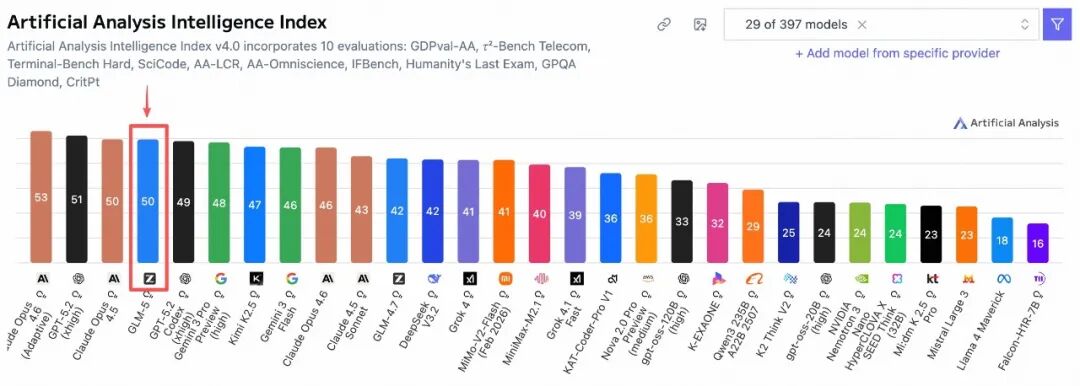
Core Insights - The integration of GLM-5 into the GPTBots.ai platform addresses two major concerns for enterprises using AI: reliability and affordability, enabling businesses to transition from experimental use to standard operational use [1][6] Group 1: AI Reliability - GLM-5 has achieved the lowest hallucination rate in the AI Index v4.0, surpassing major closed-source models like Google Gemini and OpenAI GPT, making it the most reliable open-source model available [2] - The model's AA-Omniscience Index score improved by 35 points to -1, indicating a significant enhancement in knowledge reliability [2] - GLM-5 is fully open-sourced under the MIT license, allowing enterprises to deploy it in private clouds or local environments, ensuring compliance with industry regulations [2] Group 2: AI Functionality - GLM-5 supports an Agent mode that allows for task understanding and execution, enabling users to generate professional documents automatically based on input data, thus enhancing productivity [3] - The model can produce complete reports, including charts and strategic recommendations, directly integrating into existing workflows [3] Group 3: Cost Efficiency - GLM-5 is built on a 744 billion parameter architecture with a training corpus of 28.5 trillion tokens, utilizing advanced techniques to optimize performance and reduce resource consumption [4] - This cost-effective structure allows enterprises to apply AI in high-frequency scenarios without hesitation, such as customer service responses and marketing content generation [4] Group 4: User Accessibility - GPTBots.ai provides a zero-code environment for businesses to quickly configure AI assistants, allowing for rapid deployment tailored to specific business needs [5] - The platform has already demonstrated significant efficiency improvements for various sectors, such as a brokerage firm achieving a fivefold increase in report generation speed [5]
32k微调处理百万Token:21倍的推理加速,10倍的峰值显存节省,实现恒定内存消耗
量子位· 2026-02-13 13:19
CoMeT团队 投稿 量子位 | 公众号 QbitAI 当大模型试图处理一段包含100万token的超长文档时,会发生什么?答案是: 内存爆炸,计算崩溃 。 无论是分析整个代码库、处理万字研报,还是进行超长多轮对话,LLM的"长文本能力"都是其走向更高阶智能的关键。然而,Transformer架 构的固有瓶颈── 与上下文长度成平方关系的计算复杂度和线性增长的KV Cache ,使其在面对超长序列时力不从心,变成了一个既"算不 动"也"存不下"的"吞金巨兽"。 为了"续命",现有方案要么选择上下文压缩,但这本质上是有损的,信息丢失不可避免;要么采用循环机制,但这类模型又常常"健忘",难以 保留贯穿全文的关键信息,也记不清刚刚发生的细节。 △ CoMeT在32k上下文训练后,可在1M token中精准大海捞针,且推理速度和内存占用远优于全注意力模型 鱼与熊掌兼得:"协同记忆"架构 CoMeT的巧妙之处在于,它没有试图用单一机制解决所有问题,而是设计了一套双轨并行的协同记忆系统,让模型既能"记得牢",又能"看得 清"。 1. 全局记忆(Global Memory):一个带"门禁"的记忆保险箱 为了解决长期遗忘问题 ...

AI进化速递丨智元机器人远征A3计划2026年量产
Di Yi Cai Jing· 2026-02-13 12:54
⑤地平线正式开源HoloBrain VLA基座模型。 ③蚂蚁集团开源混合线性架构的万亿参数思考模型Ring-2.5-1T; ④字节图像创作模型Seedream 5.0 Lite上线,首次支持联网检索; 上海:以人工智能技术创新为突破,赋能住建行业高质量发展;蚂蚁集团开源混合线性架构的万亿参数 思考模型Ring-2.5-1T。 ①上海:以人工智能技术创新为突破,赋能住建行业高质量发展; ②智元机器人远征A3计划2026年量产; ...

从技术走向生活,投融界观察AI普及潮下的创业新航道
Sou Hu Cai Jing· 2026-02-13 12:46
Core Insights - The article highlights two significant events in the AI sector: ByteDance's Seedance 2.0 and Alibaba's Qianwen App, indicating a shift from showcasing technological possibilities to integrating AI into everyday life [1][2] Group 1: Technological Breakthroughs - Seedance 2.0 represents a leap from being a "material splicer" to a collaborator with "director thinking," enabling coherent storytelling and professional editing in video creation [1] - Qianwen's success in managing complex scenarios during the Spring Festival demonstrates AI's advancement in understanding ambiguous human intentions and efficiently coordinating various life services [1][2] Group 2: Life Transformation - The advancements in AI are democratizing creative expression, allowing individuals to become "directors" of their lives through tools like Seedance 2.0, significantly lowering the cost and skill requirements for video creation [4] - The way people access life services is becoming more "invisible" and "automated," with AI acting as an invisible assistant to manage daily tasks, thus enhancing overall life efficiency [4] Group 3: Entrepreneurial Opportunities - Entrepreneurs can find opportunities in the gaps created by major platforms, focusing on vertical niches that require deep industry knowledge, such as specialized fitness guidance and mental health support [5] - The creative industry can leverage tools like Seedance to build niche content libraries and optimize AI-generated content, positioning themselves as essential players in the new content ecosystem [5] - Traditional industries can benefit from "AI + SaaS" solutions to enhance digital transformation, helping small businesses and local services utilize AI for various operational efficiencies [5]



Microsoft's $9.7 Billion Contract Hasn't Saved This Struggling Miner ETF Yet
247Wallst· 2026-02-13 12:27
Core Insights - The Valkyrie Bitcoin Miners ETF (WGMI) has shown an 86% return over the past year but has recently dropped 12.4% in the last month due to a 28% decline in Bitcoin's price [1] - Iren Ltd secured a $9.7 billion contract with Microsoft and aims for $3.4 billion in annual AI Cloud revenue by the end of 2026, indicating a strategic pivot towards AI infrastructure [1] - Cipher Mining, another significant holding in the ETF, missed revenue estimates and has a negative profit margin of 34.2%, raising concerns about its near-term prospects [1] Bitcoin Price Impact - Bitcoin's price correction from its October 2025 peak has created a challenging environment for miners, with current trading 28% below the year's start [1] - Prediction markets indicate only a 41% probability that Bitcoin will reach $100,000 by year-end, reflecting market uncertainty [1] - Riot Platforms, representing 4.8% of the ETF, recently reported revenue of $180.2 million, although its stock is trading 10% below previous levels [1] AI Infrastructure Transition - Iren Ltd, which constitutes 24% of the ETF, is focusing on AI infrastructure, emphasizing a cautious approach to capital deployment with payback periods of 24 to 30 months for GPU investments [1] - Cipher Mining, representing 18.3% of the ETF, has secured a $5.5 billion AWS lease but has shown operational challenges, including heavy insider selling, indicating management's uncertainty [1] - Investors are advised to monitor quarterly updates from Iren and Cipher for evidence of translating AI contracts into actual revenue and improved margins [1]




视觉AI龙头冲刺港股IPO,年收入复合增长59.2%,大模型收入超6000万
3 6 Ke· 2026-02-13 12:18
2026年1月20日,极视角正式向港交所递交招股书,走到资本市场门前。 从招股书看,极视角是一家以计算机视觉为核心的企业级AI解决方案公司。过去三年,公司收入保持 高速增长:2022年至2024年,收入由1.016亿元增长至2.573亿元,两年复合年增长率达59.2%。 极视角的增长受益于中国CV 市场的整体扩张。招股书预测,国内该市场未来五年的复合增速将达到 37.7%。 为了在内卷中突围,极视角在2024 年开启了积极的业务迭代。招股书披露了一个关键变化: 2024年,公司引入了大模型解决方案。这一新业务在推出的当年即贡献了 6212.2 万元收入,占总营收 比重迅速达到 24.1%。 今天,硅基君就带你来看看这家即将上市的视觉AI公司。 两年复合增长59%,大模型收入6212万 2022 至 2024 年,极视角收入保持高速增长,由 1.016亿元提升至 2.573亿元,两年复合年增长率达 59.2%。2025年前9个月,公司收入为1.36亿元。 从招股书看,公司主营业务分为两大类:一是AI计算机视觉解决方案,包括标准、定制化及软硬件一 体化的产品;二是大模型解决方案,基于通用大模型,结合多智能体、RA ...
AI群星闪耀时
3 6 Ke· 2026-02-13 12:17
Core Insights - The AI industry is experiencing a significant moment with multiple major model releases concentrated in a short timeframe, creating a strong sense of urgency and competition among companies [1][2]. Group 1: Model Releases and Performance - In less than two weeks, several high-profile AI models have been released, including Claude Opus 4.6, GPT-5.3-Codex, Seedance 2.0, and GLM-5, indicating a competitive landscape with rapid advancements [2][4]. - GLM-5's price increase signifies strong demand and capability, with its queue exceeding initial expectations [4]. - Chinese models are not only dominating in quantity but are also achieving quality parity and even leading in some areas, with significant contributions from domestic companies [5][18]. Group 2: Market Dynamics and Trends - The emergence of GLM-5 and other models represents a shift in the AI landscape, where companies are beginning to compete on both product and model quality, particularly in the B2B sector [13][17]. - The competition is expected to intensify as more companies release models that challenge established players like Anthropic, potentially reshaping the market dynamics [12][13]. - The AI industry is anticipated to reach a critical turning point in 2026, with expectations of significant advancements and market changes [14]. Group 3: Financial Implications - Anthropic's annual recurring revenue (ARR) is projected to surpass OpenAI's for the first time in Q1, indicating a shift in financial performance within the industry [10]. - The ability of companies to monetize their models effectively is becoming increasingly important, with a focus on the economic value generated from their applications [12][20]. - The competitive landscape is likely to lead to a re-evaluation of value distribution within the industry, as companies adapt to new market realities [12][17].