会计师事务所

Search documents
大信与中兴华2会计师所被批评 涉雏鹰退年报审计违规
Zhong Guo Jing Ji Wang· 2025-10-20 06:13
Core Viewpoint - The Shenzhen Stock Exchange has imposed disciplinary actions on Da Xin Accounting Firm and its certified public accountants for violations during the audit of Chuying Agricultural Group's financial reports for 2016 and 2017, which included false records and lack of due diligence [1][2][14][24]. Group 1: Disciplinary Actions - Da Xin Accounting Firm and its auditors Xu Feng and Xie Sigang received public reprimands for their involvement in the false reporting of Chuying Agricultural Group's 2016 financial statements [2][13]. - Zhongxinghua Accounting Firm and its auditors Li Jujie and Zhang Liping were similarly reprimanded for their role in the 2017 financial statements [14][24]. Group 2: Violations in 2016 Audit - Da Xin Accounting Firm issued a standard unqualified audit report for Chuying Agricultural Group's 2016 annual report, despite the report containing inflated figures for available-for-sale financial assets, long-term equity investments, other current assets, revenue, and total profit [1][5]. - The audit procedures executed by Da Xin were inadequate, failing to maintain professional skepticism regarding abnormal audit evidence and lacking sufficient audit evidence to detect the inflated figures [7][10][13]. Group 3: Violations in 2017 Audit - Zhongxinghua Accounting Firm also issued a standard unqualified audit report for Chuying Agricultural Group's 2017 annual report, which similarly contained inflated figures for other current assets, revenue, and total profit [14][20]. - The audit procedures conducted by Zhongxinghua were deficient, with failures to maintain professional skepticism and to adequately verify the authenticity of financial records [18][23].
普华永道,被罚!
中国基金报· 2025-10-18 08:14
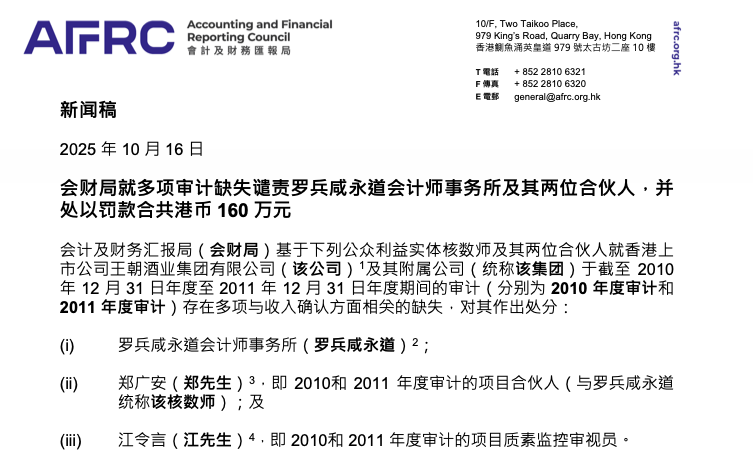
Core Viewpoint - PwC and two partners were fined a total of HKD 1.6 million due to multiple audit deficiencies related to revenue recognition for Dynasty Fine Wines Group's financial statements for the years ending December 31, 2010, and December 31, 2011 [2][8] Group 1: Audit Deficiencies - The Hong Kong Institute of Certified Public Accountants (HKICPA) found that PwC's audit of Dynasty Fine Wines Group had significant shortcomings in revenue recognition, failing to apply professional skepticism and obtain sufficient appropriate audit evidence [7][8] - Internal investigations by PwC revealed that a large volume of purportedly sold wine products had not been delivered and remained in third-party warehouses, leading to substantial adjustments in the financial statements [7][8] Group 2: Financial Impact - Adjustments made by PwC indicated that Dynasty Fine Wines Group should have reported a loss in 2011 instead of the previously disclosed profit, with retained earnings for 2010 and 2011 being reduced by approximately HKD 225 million and HKD 262 million, respectively [7][8] Group 3: Trust Crisis and Regulatory Environment - PwC has faced a trust crisis following the Evergrande audit scandal, resulting in a record fine of HKD 441 million and a six-month business suspension [10] - The firm has experienced a wave of contract terminations from various listed companies and financial institutions, with significant personnel losses reported in its mainland China operations [10][11]


普华永道,被罚!
Zhong Guo Ji Jin Bao· 2025-10-18 07:26
Core Viewpoint - PwC and two partners were fined a total of HKD 1.6 million due to multiple audit deficiencies related to revenue recognition for Dynasty Fine Wines Group's financial statements for the years ending December 31, 2010, and December 31, 2011 [1][3]. Group 1: Audit Findings - The Hong Kong Institute of Certified Public Accountants (HKICPA) found that PwC's audit of Dynasty Fine Wines Group was deficient, particularly in revenue recognition, leading to significant misstatements in financial reports [3][5]. - Internal investigations revealed that a large volume of purportedly sold wine products had not been delivered and remained in third-party warehouses, resulting in substantial adjustments to previously reported earnings [3][5]. - The adjustments indicated that Dynasty Fine Wines Group should have reported losses in 2011 instead of profits, with retained earnings for 2010 and 2011 being reduced by approximately HKD 225 million and HKD 262 million, respectively [3][5]. Group 2: Regulatory Actions and Consequences - The HKICPA issued a decision notice to PwC and the two partners, which became effective after they withdrew their application for a review of the decision and agreed to pay legal costs [5]. - The case highlights the importance of maintaining professional skepticism in high-risk audit areas, especially concerning revenue recognition, which has been a focus of regulatory scrutiny [5][7]. Group 3: Trust Crisis and Market Impact - PwC has faced a trust crisis following the Evergrande audit scandal, resulting in a record fine of HKD 441 million and a six-month suspension from conducting business [6]. - Since 2024, several companies have terminated their contracts with PwC, opting for other major accounting firms, indicating a significant loss of business [6]. - As of October 17, 2025, the number of partners and registered accountants at PwC in mainland China has significantly decreased compared to the end of 2023, reflecting ongoing challenges in retaining talent and clients [6]. Group 4: Future Regulatory Environment - Industry experts anticipate that regulatory scrutiny on financial fraud and the diligence of audit firms will intensify, urging intermediaries to uphold professionalism and integrity in their practices [7].
“云山创享汇”再聚首,广州白云骨干企业谋划赴港上市
Sou Hu Cai Jing· 2025-10-17 13:19
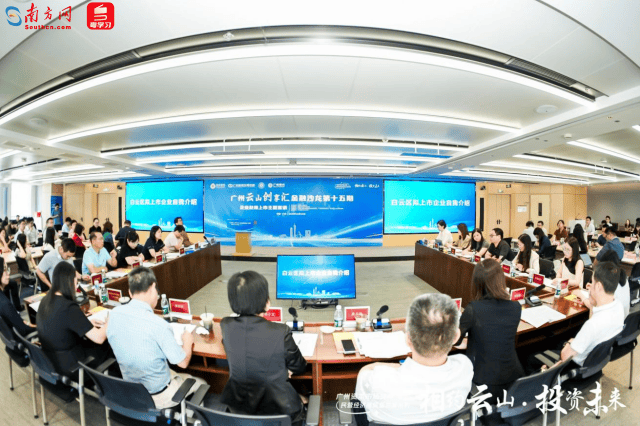
Core Insights - The "Yunshan Chuangxianghui" financial salon in Guangzhou aims to assist local enterprises in seizing opportunities in the international capital market and addressing challenges related to listing in Hong Kong [2][4] Group 1: Event Overview - The event attracted nearly 100 participants, including representatives from government bodies, financial institutions, and 22 companies planning to list [2] - The salon is part of a series of initiatives by the Baiyun District Political Consultative Conference to explore areas such as ESG, overseas expansion, and listing in Hong Kong [4] Group 2: Market Insights - Hong Kong's capital market is experiencing a window for foreign investment in Chinese assets, with improved liquidity driven by various factors, including southbound capital [6] - The IPO activity in Hong Kong is expected to increase significantly from 2025, with recent regulatory optimizations facilitating easier access for companies [6] Group 3: Compliance and Preparation - Companies are advised to focus on financial compliance, tax structure optimization, and information system verification to meet the increasingly stringent regulatory requirements of the Hong Kong market [6] - Early tax health checks and IT system pre-assessments are recommended to enhance internal control systems for successful international market entry [6] Group 4: Support Systems - The Guangzhou Municipal Financial Office has established a capital market cultivation system to support companies in listing and mergers and acquisitions [7] - The "Yunshan Chuangxianghui" financial salon has successfully hosted 14 sessions since its inception in July 2023, attracting 61 quality projects across various sectors [7]
对话安永ESG合伙人李菁:ESG是企业的管理工具,不是信息披露工具
Xin Lang Ke Ji· 2025-10-16 11:59
Core Viewpoint - The 2025 Sustainable Global Leaders Conference highlighted the significant differences in ESG (Environmental, Social, and Governance) development across various regions in China, with major cities like Beijing, Shanghai, and Hong Kong leading in ESG understanding and management [1] ESG Disclosure Rates - Shanghai has an ESG disclosure rate of 57%, while Beijing also shows a very high disclosure rate, making these two cities national leaders in ESG practices [1] - Hong Kong-listed companies have nearly achieved 100% ESG disclosure [1] Regional Differences in ESG Practices - There is a notable contrast in ESG practices between first-tier cities (Beijing, Shanghai, Guangzhou, Shenzhen) and inland regions, with coastal cities being more receptive to international information and advanced experiences [1] - Inland companies are often still focused on meeting compliance requirements rather than fully embracing ESG management [1] Global Perspective on Chinese Companies' ESG Levels - From a global standpoint, Chinese companies are not lagging in ESG levels, with many new standards being introduced this year [1] - Policy guidance is contributing to the steady improvement of ESG management levels among Chinese enterprises, with aspirations for them to become global leaders in ESG and green finance [1] ESG as a Management Tool - ESG should be viewed as a management tool rather than merely an information disclosure tool, as it can modernize corporate governance [1]
审计报告存在虚假记载,致同所遭重罚1530万元
Shen Zhen Shang Bao· 2025-10-14 13:48
Core Points - The China Securities Regulatory Commission (CSRC) has imposed penalties on Zhihong Accounting Firm and its auditors for failing to perform due diligence in the audit of ST Zhizhi's financial statements from 2019 to 2021 [1][2] - The audit reports issued by Zhihong for New Intelligence's financial statements contained false records, with identified issues including inflated revenue and profits [1][2] - The total audit revenue for Zhihong from these services amounted to 5.1 million yuan [1] Summary by Sections Audit Failures - Zhihong failed to effectively identify and assess risks related to financial statement fraud during the audits of New Intelligence for the years 2019, 2020, and 2021 [2] - Specific deficiencies included not recognizing contradictions in revenue, accounts receivable, and sales expenses, as well as failing to address large transactions near the fiscal year-end [2] - The firm also did not adequately execute internal control tests and substantive procedures related to inventory and revenue [2] Penalties Imposed - The CSRC ordered Zhihong to correct its practices, confiscate 5.1 million yuan in business income, and pay a fine of 10.2 million yuan [2] - Individual penalties included warnings and fines for the auditors involved: Liu Junshan (400,000 yuan), Zhao Leili (300,000 yuan), and Wang Zhenjun (200,000 yuan) [2] Previous Violations - Zhihong was recently penalized for similar violations in the audit of Hongxiang Co. for the year 2018, where it was found to have issued false audit reports [3] - The penalties included a business income confiscation of 3.58 million yuan and a fine of 6.47 million yuan [3]

强制轮换!安永接棒德勤担任2家上市公司审计机构!
Xin Lang Cai Jing· 2025-10-13 04:05
Core Points - Shanghai Industrial Holdings (00363.HK) announced the replacement of its auditor due to the mandatory rotation requirement after the audit service period reached its limit [3][7][9] - Deloitte Touche Tohmatsu has resigned as the company's auditor effective October 10, 2025, after the board's decision to appoint a successor auditor [3][7][19] - Ernst & Young has been appointed as the new auditor, effective until the conclusion of the next annual general meeting [9][21][22] Summary by Sections Auditor Resignation - The resignation of Deloitte was prompted by the expiration of the maximum term for audit services as mandated by Chinese regulations [3][7] - Deloitte confirmed that there were no disagreements with the company and no issues that needed to be brought to the attention of shareholders or creditors [7][19] - The company anticipates that the change in auditors will not significantly impact the audit of the consolidated financial statements for the fiscal year ending December 31, 2025 [19] Appointment of New Auditor - The board, upon the recommendation of the audit committee, has appointed Ernst & Young as the new auditor to fill the vacancy left by Deloitte [9][21] - The audit committee evaluated Ernst & Young based on several factors, including audit proposals, fees, experience with listed companies, and independence [21][22] - The board expressed confidence in Ernst & Young's qualifications and suitability for the role [22][23] Financial Information - For the fiscal year 2024, the company paid Deloitte an audit fee of HKD 20,994,000 (approximately RMB 19.24 million) [10] - The company also incurred additional non-audit service fees totaling HKD 4,909,000 (approximately RMB 4.45 million) for various services [11]

上海实业控股(00363.HK):委任安永为核数师
Ge Long Hui· 2025-10-10 08:56
Core Points - Shanghai Industrial Holdings (00363.HK) announced the decision to change its auditor due to the expiration of the term with Deloitte [1] - Deloitte has decided to resign as the company's auditor effective October 10, 2025, citing difficulties in maintaining a professional relationship following the board's decision to appoint a successor [1] - The board has resolved to appoint Ernst & Young as the new auditor to fill the vacancy left by Deloitte, with Ernst & Young's term lasting until the conclusion of the next annual general meeting [1]
2025年1-9月A股IPO中介机构收费排行榜
Sou Hu Cai Jing· 2025-10-08 15:20
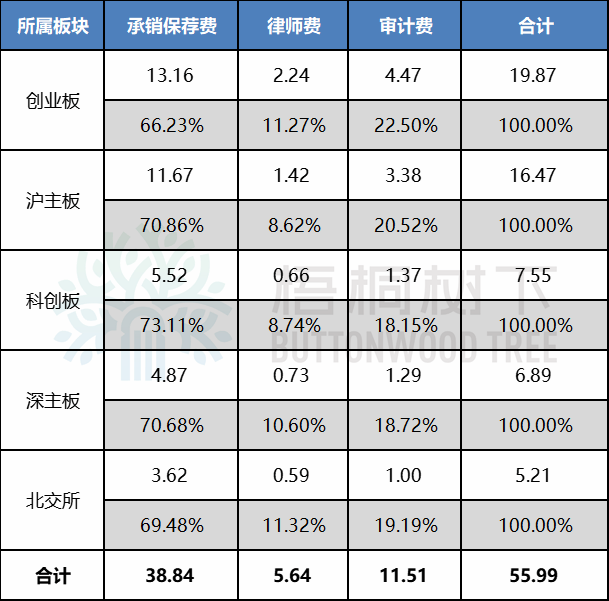
Core Insights - In the first nine months of 2025, a total of 78 companies were listed on the A-share market, representing a year-on-year increase of 13.04% compared to 69 companies in the same period last year [1] - The total fees charged by IPO intermediaries for these listings amounted to 5.599 billion yuan, with underwriting and sponsorship fees accounting for 3.884 billion yuan, legal fees for 564 million yuan, and audit fees for 1.151 billion yuan [1] Segment Analysis Underwriting and Sponsorship Fees - The total underwriting and sponsorship fees were highest in the ChiNext board, followed by the Shanghai Main Board, Sci-Tech Innovation Board, Shenzhen Main Board, and Beijing Stock Exchange [1] - The leading underwriting institution by total fees was Guotai Junan, with 501 million yuan from 9 deals, followed by CITIC Securities and Huatai United Securities with 486 million yuan and 404 million yuan respectively [5][7] Legal Fees - The top three law firms by total fees were Shanghai Jintiancheng, Shanghai Tongli, and Beijing Guofeng, with total fees of 89.3 million yuan, 49.9 million yuan, and 47.7 million yuan respectively [8][10] - The average legal fee was highest for the Shanghai Main Board at 837.58 thousand yuan, while the lowest was for the Beijing Stock Exchange at 391.07 thousand yuan [3][4] Audit Fees - The leading audit firms by total fees were Rongcheng, Tianjian, and Zhonghui, with total fees of 270 million yuan, 221 million yuan, and 151 million yuan respectively [11][13] - The average audit fee was highest for the Shanghai Main Board at 1.990 million yuan, and lowest for the Beijing Stock Exchange at 667.14 thousand yuan [3][4]



吴清最新发声,信息量大
21世纪经济报道· 2025-09-30 13:03
Core Viewpoint - The China Securities Regulatory Commission (CSRC) emphasizes the importance of high-quality development and comprehensive reform in the capital market during the "14th Five-Year Plan" period, focusing on enhancing market attractiveness and competitiveness through specific reforms and initiatives [1][2]. Group 1: Key Points from the Meeting - The CSRC Chairman, Wu Qing, highlighted six principles for advancing the "14th Five-Year Plan" for the capital market, including adherence to the Party's leadership and promoting high-quality development [1]. - The meeting discussed the need to deepen reforms in areas such as issuance, refinancing, and mergers and acquisitions to enhance the capital market's appeal and inclusivity [1]. - There is a call for listed companies to improve their quality and investment value by increasing dividend payouts and buybacks, while also enhancing the role of institutional investors in corporate governance [1]. Group 2: Future Directions for the Capital Market - Participants agreed that during the "14th Five-Year Plan," China's capital market has seen both scale and quality improvements, particularly following the implementation of the new "National Nine Articles" and the "1+N" policy framework [2]. - The meeting proposed supporting high-quality securities and fund companies to develop into top-tier investment banks and institutions, while also promoting the high-quality development of intermediary institutions like accounting and law firms [1]. - There is an emphasis on enriching the A-share market product system, including indices, ETFs, and derivatives, to better serve the wealth preservation and appreciation needs of residents [1].