
住房租赁

Search documents
二级市场出现回调 华润有巢REIT称各项经营指标“在较高水平”
3 6 Ke· 2025-09-19 02:56
Core Viewpoint - The REITs market, particularly for rental housing, is experiencing a period of adjustment due to economic pressures, but the performance of rental housing REITs remains stable, supported by consistent occupancy rates and rental income [1][2]. Financial Performance - In the first half of 2025, Huazhong Youchao REIT reported revenues of 39.29 million yuan, a slight decrease of 0.07% year-on-year, while net profit increased by 38.67% to 5.78 million yuan, and EBITDA rose by 4.84% to 25.79 million yuan [3][5]. - The fund's distributable amount for the period was 24.34 million yuan, down 0.3% year-on-year, with an actual distribution of 24.42 million yuan, indicating a positive short-term return performance [3][4]. Market Context - The public REITs market for rental housing is expanding, with new listings and ongoing fundraising efforts, reflecting a robust demand supported by policy initiatives [2][6]. - The rental housing REITs have reached a total of eight listings, indicating a growing market presence [2]. Asset Management - The underlying assets of Huazhong Youchao REIT include the Youchao Sijing project and the Youchao Eastern Economic Development Zone project, both of which are located in Shanghai and have shown improved occupancy rates [6][7]. - The overall occupancy rate for the underlying projects increased by 1.75 percentage points to 95.87%, while the average rental price per square meter per day decreased by 2.26% to 2.16 yuan [6][7]. Competitive Landscape - New competitive projects have emerged in the vicinity of the underlying assets, but they have not significantly impacted the operational performance of Huazhong Youchao REIT [9]. - The company is actively managing its commercial leasing strategy to enhance community services and maintain high rental collection rates, which stood at 99.80% [8][9].
新规具体实施细则有待出台
Qi Lu Wan Bao· 2025-09-18 10:44
事实上,早在《住房租赁条例》出台之前,不少城市就已对住房租赁市场乱象进行了专项整治。 2023年,济南市住房和城乡建设局发布《济南市住房租赁企业及从业人员信用管理办法》,实行中介实名 登记、量化打分、动态扣分,对信用等级低的人员采取约谈责任人措施。 "《住房租赁条例》的出台为整个房屋租赁市场有序运行提供了法律依据,使监管更有法可依。"济南市 房地产协会副会长李刚表示,《住房租赁条例》出台后,各地将陆续出台更加细化的配套政策,在职责分 工、监督处罚方面作出更明确的规定。 山东省消委会律师顾问团律师叶剑梅指出,新规对虚假房源、解约纠纷等作出明确约束,通过行政监管的 方式,有望倒逼企业合规经营。 如何进一步细化制度措施?对此,济南市住建局相关工作人员表示,目前省市层面尚未出台具体的地方实施 细则,"正在等待进一步通知"。 以济南为例,2019年10月,住建部等六部委部署"黑中介"专项整治,把虚假房源、克扣押金等六项行为列入 重点打击清单。同年12月,济南市共排查房产中介机构339家、住房租赁机构77家,约谈企业20家,处理群 租乱象205起。 2021年,济南市住房和城乡建设局下发通知,把"隔断客厅、厨房、阳台对外 ...
住房租赁市场新规正式施行 让租房不再是麻烦事
Ren Min Ri Bao Hai Wai Ban· 2025-09-17 06:53
Core Viewpoint - The newly released Housing Rental Regulations aim to address various issues in the rental market, providing targeted governance to improve the experience for over 200 million renters in China [2][6][15]. Group 1: Issues in the Rental Market - Common problems faced by renters include misleading property listings, unstable contracts, and arbitrary rent increases, leading to significant frustration and wasted time [3][4][5]. - The rental population in major cities like Beijing, Shanghai, and Guangzhou exceeds 40% of the permanent population, highlighting the necessity for market regulation [6][15]. Group 2: Key Provisions of the New Regulations - The regulations specify that rental properties must meet safety and health standards, prohibiting the rental of poorly renovated or unsafe properties [8][9]. - It addresses the issue of false listings by mandating that rental companies provide accurate information regarding property details, with penalties for non-compliance [10]. - The regulations clarify the rights and responsibilities of both landlords and tenants, including rules on deposits, contract signing, and the conditions under which landlords can enter rented properties [12][13]. Group 3: Market Impact and Future Outlook - The implementation of these regulations is expected to lead to a healthier rental market, potentially causing some smaller, non-compliant rental businesses to exit the market [15]. - Long-term effects may include increased rental transparency, improved tenant safety, and a shift in the rental market towards more stable and regulated practices [15].
住房租赁新规施行,租房难题如何解?
Xin Hua She· 2025-09-17 03:44
Core Viewpoint - The implementation of the Housing Rental Regulations marks a significant step towards the legalization and standardization of the housing rental market in China, addressing various issues such as substandard living conditions and deposit disputes, ultimately aiming for high-quality development in the sector [1][2][5]. Group 1: Market Context - The urban rental population in China exceeds 200 million, with over 40% of the permanent population in first-tier cities like Beijing, Shanghai, Guangzhou, and Shenzhen being renters [1]. - The housing rental market features a large scale, diverse operating entities, and a variety of product types and service methods [1]. Group 2: Key Regulations - The new regulations require rental properties to meet legal standards regarding construction, fire safety, gas, and interior decoration, ensuring a safe and healthy living environment for tenants [1]. - The regulations stipulate that landlords must specify the deposit amount, return timeline, and conditions for deposit deductions in rental contracts, prohibiting unjustified deductions [2]. - Rental contracts must be registered, allowing tenants to file for registration if landlords fail to do so, which helps stabilize rental relationships and curb issues like arbitrary rent increases and deposit disputes [2]. Group 3: Industry Standards - Housing rental enterprises must possess adequate capital, personnel, and management capabilities, ensuring that published property information is truthful and accurate [3]. - Real estate agencies are required to register their personnel with local property management authorities, enhancing accountability [3]. - Online platforms must verify the identities of those posting rental information, with penalties for non-compliance [3]. Group 4: Government Oversight - The regulations provide detailed guidance on the responsibilities of local governments in monitoring the rental market, managing rental processes, and enforcing regulations [4]. - Local governments are mandated to establish rent monitoring mechanisms and regularly publish rental price information for different areas and types of housing [4]. Group 5: Future Directions - The next steps include developing supporting policies, conducting comprehensive legal education on the regulations, and urging local property management departments to enhance housing rental management service platforms [5].
租赁条例正式实施,“打工人”租房有“法”可依了
3 6 Ke· 2025-09-17 02:33
Core Points - The implementation of the Housing Rental Regulations marks a significant step towards the legal and standardized development of the housing rental market in China, addressing long-standing issues such as safety hazards and deposit refund difficulties [3][4][22] - The regulations encourage the use of private housing for rental purposes and support enterprises in revitalizing old factories and commercial properties for rental, thereby increasing the supply of rental housing [2][10] Summary by Sections Regulations Overview - The Housing Rental Regulations consist of 7 chapters and 50 articles, focusing on standardizing rental activities, regulating the behavior of rental enterprises and agencies, enhancing supervision, and enforcing accountability [5][11] - Key provisions include restrictions on renting non-residential spaces for living, regulations on deposit deductions, and requirements for landlords to provide reasonable notice before terminating contracts [1][6][8] Impact on Rental Market - The regulations directly address issues such as "串串房" safety risks, "隔断房" chaos, and the lack of transparency in rental prices, establishing a legal foundation for unified regulation across the national rental market [3][22] - The regulations are expected to accelerate industry restructuring, pushing the market towards institutionalization, standardization, and quality improvement, benefiting larger, compliant enterprises while increasing pressure on smaller firms [11][22] Market Trends - Following the announcement of the regulations, there has been a decline in the number of personal rental listings, with a reported decrease of 6.40% month-on-month in August 2025, despite a year-on-year increase of 11.70% [13][16] - Rental prices have shown an upward trend, with personal rental listings averaging 31.76 yuan per square meter per month in August, reflecting a 0.37% increase month-on-month [16][19] Future Outlook - The regulations are anticipated to stabilize rental relationships and establish a rent monitoring mechanism, which will enhance the reliability of rental housing as an asset class for financial instruments like REITs [22] - The competitive focus in the rental market is expected to shift from scale expansion to compliance and service capability, fostering a healthier interaction between financial capital and the rental market [22]

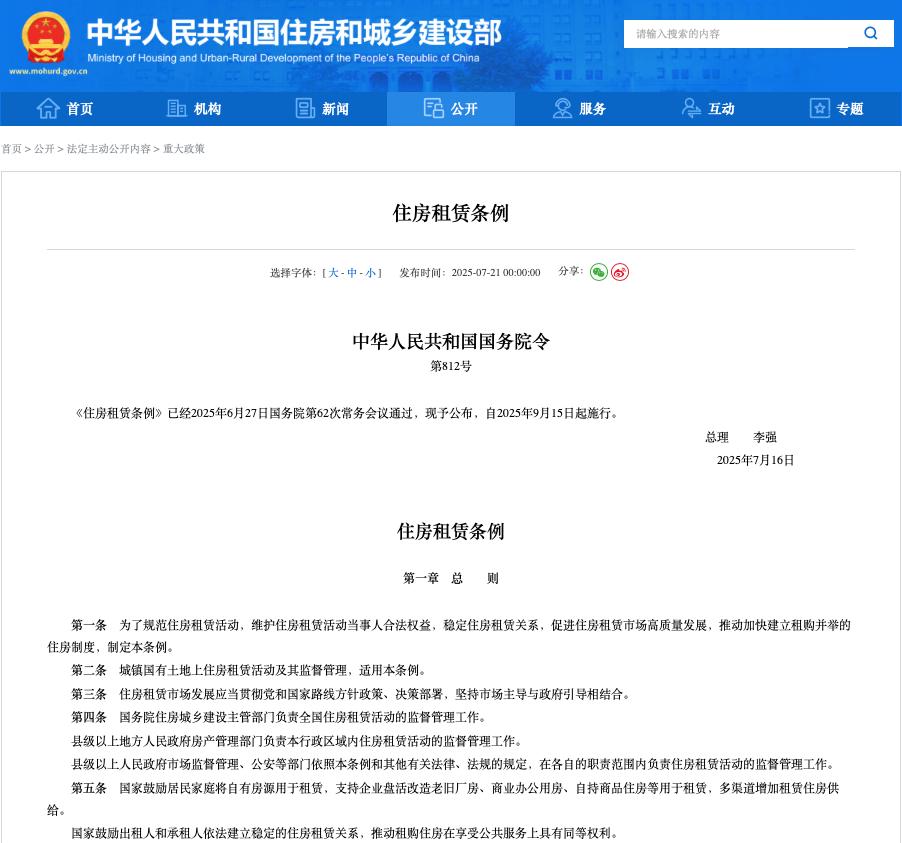
中经评论:住房租赁新条例如何破解老问题
Jing Ji Ri Bao· 2025-09-17 00:02
Group 1 - The implementation of the Housing Rental Regulations marks a significant milestone in the standardization and legalization of the housing rental market in China [1] - The regulations aim to protect tenants' rights by addressing common issues such as safety hazards, arbitrary contract termination, and difficulties in deposit refunds [1][2] - The regulations require rental properties to meet specific safety and health standards, ensuring a safe living environment for tenants [1] Group 2 - A contract filing system is established to clarify rental relationships and ensure stability, requiring landlords and tenants to sign contracts under real names and file them with property management departments [2] - The regulations address the issue of difficult deposit refunds by stipulating that landlords must specify deposit amounts, return timelines, and conditions for deductions in rental contracts [2] - Landlords are prohibited from using violence or threats to force tenants to vacate properties, ensuring a more secure rental experience [2] Group 3 - The regulations impose standards on housing rental companies and agencies to protect tenants from economic losses due to false listings or improper handling of deposits [3] - Housing rental companies are required to maintain accurate rental records and establish regulated accounts for rental funds, enhancing transparency [3] - The regulations provide clear pathways for resolving disputes, allowing tenants and landlords to negotiate or seek legal recourse if necessary [3]
住房租赁新条例如何破解老问题
Jing Ji Ri Bao· 2025-09-16 23:21
Core Points - The implementation of the Housing Rental Regulations marks a significant milestone in the standardization and legalization of China's housing rental market [1][2][3] - The regulations aim to protect tenants' rights by addressing common issues such as safety hazards, contract termination by landlords, and difficulties in deposit refunds [1][2] - The regulations establish a contract filing system to clarify rental relationships and ensure stability, requiring both parties to sign contracts under real names and file them with local property management departments [2][3] - The regulations also tackle the issue of deposit refunds by mandating clear terms in rental contracts regarding deposit amounts, return timelines, and conditions for deductions [2][3] - Housing rental enterprises and agencies are required to maintain accurate rental records and establish regulatory accounts for rental funds, ensuring transparency and reducing potential economic losses for tenants [3] - The regulations provide clear pathways for dispute resolution, allowing parties to negotiate or seek mediation, arbitration, or litigation in case of conflicts [3]
以法之名帮租房青年“避坑”
Zhong Guo Qing Nian Bao· 2025-09-16 22:32
9月15日,《住房租赁条例》(以下简称《条例》)正式施行。作为我国首部专门规范住房租赁的行政 法规,其覆盖出租与承租、住房租赁企业与经纪机构、网络平台与政府监管等多个环节,对住房条件、 合同备案、资金收付等关键问题作出细化规定,明确了各方法律责任。 租房是许多大学生迈入社会、独立生活的重要一步。然而,在租房过程中,年轻人时常遭遇难以言说 的"痛点"。《条例》的落地,正是通过划清权责边界,为城市租房青年筑牢权益屏障,让他们租得顺 利、住得安心。 住房关系到青年的幸福感,也关系到城市的吸引力。期待随着法规的深入实施,奋斗中的青年租房不再 是"麻烦事"。 居住安全是租房的底线。在市场上,不乏空间狭小、隐患突出的"隔断房""非居改租房"。此类房源一旦 发生安全事故,后果不堪设想。《条例》对此亮出底线:厨房、卫生间、阳台、过道、地下储藏室、车 库等非居住空间不得单独出租。此外,《条例》还规定单间居住人数不得超标,人均面积不得低于当地 政府规定的最低标准。这些要求,有利于从源头守护租客安全。 【责任编辑:李立红,惠滢,陈鼎】 租房押金能否完整、按期退还,关系到租客的基本权益。"提灯定损"等克扣押金的恶劣做法也是年轻人 的 ...

【财经分析】新规施行,合规住房租赁企业将获得长期发展机会
Xin Hua Cai Jing· 2025-09-16 00:19
Core Viewpoint - The implementation of the Housing Rental Regulation marks a significant opportunity for compliant housing rental enterprises to thrive in a growing market, as the urban rental population exceeds 200 million in China [1][2]. Group 1: Market Dynamics - The rental market is increasingly competitive, and housing rental enterprises are seen as essential players that can stabilize and promote the rental system [2][3]. - The new regulation introduces a "classified supervision" model, categorizing market participants into four types, which allows for differentiated regulatory approaches [2]. - The regulation aims to address key issues in the rental market, such as information asymmetry, service standards, and tenant rights protection [2][3]. Group 2: Challenges and Opportunities - Current challenges in the rental market include inconsistent quality of housing supply, instability in rental relationships, and lack of regulatory oversight [2][3]. - The regulation provides a clear legal framework to address these challenges, offering compliant enterprises a pathway for sustainable growth [3][4]. Group 3: Financial and Digital Innovations - Housing rental enterprises are encouraged to leverage financial tools like REITs to transition from heavy asset models to a mixed investment approach, enhancing their resilience and long-term cash flow [4][9]. - Digitalization is identified as a crucial strategy for improving operational efficiency and transparency, with companies utilizing big data and AI to optimize services and customer engagement [6][7][8]. Group 4: Market Potential and Future Outlook - The top 30 housing rental enterprises in China have a combined operational scale of 1.398 million units, indicating significant room for growth in the market [5]. - The future of the rental market is expected to evolve into a dual-track system of market-driven and guaranteed rental housing, addressing the increasing demand for rental properties [9][10].
租房市场迎来法治新规范
Zheng Quan Shi Bao· 2025-09-15 19:24
9月15日起,我国首部专门规范住房租赁活动的行政法规《住房租赁条例》正式施行,这是住房租赁市 场发展进程中的一个重要里程碑,标志着住房租赁市场告别"野蛮生长",步入依法规范成长的新阶段。 长期以来,住房租赁市场因为缺乏统一规范存在不少问题,不仅侵害了租赁双方的合法权益,也不利于 住房租赁市场健康发展。《住房租赁条例》的出台,对很多问题都进行了全面回应和有力整治。 这部条例的出台,回应了诸多社会关切,其中最受关注的,可能还是前不久引发热议的"房东税"问题。 《住房租赁条例》不是税收方面的法律法规,更没有直接提及新的税收政策,之所以有这方面解读,主 要是因为明确了租房备案制度。条例规定,出租人应当按照规定,通过住房租赁管理服务平台等方式将 住房租赁合同向租赁住房所在地房产管理部门备案。如果出租人未办理合同备案,承租人可以自行办理 备案。长期来看,备案更有助于推动租金透明化,整治市场长期存在的"二房东"现象。一个规范、透 明、健康的租赁市场,对各方参与者,无疑都将更有利。 条例中关于合同备案的规定,引发了全面征收所谓"房东税"的解读。然而,这种理解是错误的。合同备 案的主要目的并非征税,更何况,我国从来没有叫做"房 ...