
金属制品业

Search documents
甬金股份: 董事会议事规则(2025年9月修订)
Zheng Quan Zhi Xing· 2025-09-01 16:18
General Principles - The board of directors is the executive body of the shareholders' meeting and the decision-making body for the company's management, responsible for major operational decisions aimed at maximizing shareholder interests [1][2] - The rules are binding on all directors of the company and are established to ensure efficient decision-making and compliance with relevant laws and regulations [1][2] Directors - Directors must be natural persons and are not required to hold shares in the company. Certain disqualifications for directors are outlined, including criminal convictions and bankruptcy responsibilities [2][3] - Directors are elected by the shareholders' meeting for a term of three years, with provisions for re-election and replacement [3][4] - Directors have fiduciary duties to the company, including obligations to act in the company's best interests and to avoid conflicts of interest [4][5] Board of Directors - The board consists of nine directors, including three independent directors and one employee representative, with a chairman elected by the board [8][9] - The board has the authority to make significant decisions regarding capital increases, mergers, acquisitions, and the appointment of senior management [9][10] - The board must establish strict review and decision-making procedures for major investments and transactions, requiring approval for transactions exceeding specified thresholds [11][12] Board Meetings - The board must hold at least two meetings annually, with provisions for regular and temporary meetings [17][18] - Meeting notifications must be sent in advance, and attendance is mandatory for directors, who may delegate their voting rights under certain conditions [19][20] - Decisions require a majority vote from attending directors, and detailed records of meetings must be maintained [23][24] Committees - The board establishes specialized committees, including an audit committee responsible for overseeing financial reporting and internal controls [30][31] - Committees must report their findings and recommendations to the board, and their proposals must be documented and disclosed if not fully adopted [32][33] Amendments and Implementation - The rules are effective upon approval by the shareholders' meeting and must be revised in accordance with changes in laws and regulations [29][30] - The board is responsible for interpreting the rules and ensuring compliance with legal standards [29][30]

甬金股份: 募集资金管理制度(2025年9月修订)
Zheng Quan Zhi Xing· 2025-09-01 16:18
Core Points - The company has established a fundraising management system to regulate the use and management of raised funds in accordance with relevant laws and regulations [1][16] - The raised funds must be used exclusively for the purposes specified in the prospectus or fundraising documents, and any changes require a resolution from the shareholders' meeting [1][10] - The company must maintain a special account for the raised funds, ensuring that they are not mixed with other funds [6][7] Fundraising Management - The board of directors and senior management are responsible for ensuring the proper use of raised funds and must disclose any changes in their usage [2][12] - The company must enter into a tripartite supervision agreement with the sponsor and the bank where the funds are stored, detailing the management and oversight of the funds [3][4] - Any withdrawal of funds exceeding 20% of the net amount raised must be reported to the sponsor [3][4] Fund Usage - The company must adhere to the investment plans outlined in the prospectus and ensure that funds are not used for financial investments or to benefit related parties improperly [10][12] - If there are significant changes in the market environment or if the project is delayed for over a year, the company must reassess the feasibility of the investment project [5][11] - The company can temporarily use idle funds for cash management, provided it does not affect the normal investment plans [6][7] Changes in Fund Usage - Any changes in the use of raised funds must be approved by the board and disclosed to the shareholders [10][11] - The company must provide detailed reasons for any changes, including the original project details and the new project's feasibility [11][12] - If the raised funds are to be used for acquiring assets from controlling shareholders, measures must be taken to avoid conflicts of interest [12][13] Reporting and Supervision - The company is required to disclose the actual use of raised funds accurately and completely [12][25] - The board must conduct a comprehensive review of the fundraising projects every six months and prepare a special report on the management and usage of the funds [12][26] - Independent auditors may be engaged to verify the management and usage of the funds, and any violations must be reported [12][27]
甬金股份: 防范控股股东及关联方占用公司资金管理制度(2025年9月修订)
Zheng Quan Zhi Xing· 2025-09-01 16:18
Core Viewpoint - The company has established a management system to prevent the controlling shareholder and related parties from occupying company funds, ensuring the protection of the company's, shareholders', and other stakeholders' legal rights [1][2]. Group 1: General Principles - The system applies to the financial management between the controlling shareholder, actual controller, and related parties with the company, as well as between the controlling shareholder and subsidiaries included in the consolidated financial statements [1]. - The company aims to prevent any form of fund occupation by the controlling shareholder and related parties, including but not limited to salary advances, debt repayments, and unauthorized loans [2][3]. Group 2: Preventive Measures - The board of directors is responsible for managing the prevention of fund occupation, with the chairman being the primary responsible person and the finance department being the functional department for implementing preventive measures [4][5]. - Regular checks will be conducted by the audit department and finance department to monitor non-operational fund transactions with the controlling shareholder and related parties [4][5]. Group 3: Accountability and Penalties - If the controlling shareholder or related parties occupy company funds, they will be held liable for compensation, and the board may propose the dismissal of responsible directors [6][7]. - The company will not provide guarantees to the controlling shareholder or related parties, and all directors must carefully manage the risks associated with such guarantees [6][7]. Group 4: Applicability and Implementation - Normal commercial transactions between the company and the controlling shareholder or related parties are not subject to this system, but any indirect fund occupation through extended payment periods is prohibited [8]. - The system will be implemented upon approval by the shareholders' meeting and will be subject to relevant laws and regulations [8].
甬金股份: 对外担保管理办法(2025年9月修订)
Zheng Quan Zhi Xing· 2025-09-01 16:18
Core Viewpoint - The document outlines the external guarantee management measures of Yongjin Technology Group Co., Ltd., aiming to standardize guarantee behaviors, protect investors' rights, and ensure financial safety while minimizing operational risks [1]. Group 1: General Provisions - The purpose of the management measures is to regulate the company's external guarantee activities and safeguard investor interests [1]. - The term "subsidiary" refers to companies under the actual control of Yongjin Technology [2]. - Guarantees include various forms such as loan guarantees, bank acceptance bills, and commercial acceptance bills [1][2]. Group 2: Approval and Disclosure of Guarantees - Guarantees requiring shareholder approval must first be reviewed by the board of directors [2]. - Specific conditions necessitating shareholder approval include guarantees exceeding 10% of the latest audited net assets or total guarantees exceeding 50% of net assets [2]. - The company must disclose the total amount of external guarantees and their proportion to the latest audited net assets [5]. Group 3: Contract Review and Establishment - Guarantees must be formalized through a contract that complies with relevant laws and regulations [14]. - The signatory must hold the board or shareholder meeting's resolution regarding the guarantee [16]. - Contracts must be reviewed for unfavorable terms or unforeseen risks [18]. Group 4: Risk Management - The finance department is responsible for reviewing guarantee applications and managing the guarantee process [22]. - The company must take necessary measures to control risks if the guarantor's ability to repay is in doubt [31]. - The company should initiate recovery procedures if the guaranteed party fails to fulfill repayment obligations [29]. Group 5: Responsibilities of Related Personnel - Directors and relevant personnel who violate the established procedures may be held accountable for damages caused to the company [42]. - Personnel failing to perform their duties correctly, resulting in losses, may face penalties or disciplinary actions [44]. Group 6: Implementation and Amendments - The management measures take effect upon approval by the shareholders' meeting and will be amended as necessary [45]. - In case of conflicts with future laws or regulations, the latter will prevail [45].
甬金股份: 会计师事务所选聘制度(2025年9月修订)
Zheng Quan Zhi Xing· 2025-09-01 16:18
Core Viewpoint - The document outlines the selection and appointment procedures for accounting firms by Yongjin Technology Group Co., Ltd, emphasizing the importance of maintaining shareholder interests and ensuring high-quality financial information [1][2]. Group 1: General Principles - The selection of accounting firms must comply with relevant laws and the company's articles of association [1]. - The appointment process requires approval from both the board of directors and the shareholders' meeting, following a majority agreement from the audit committee [1][2]. Group 2: Quality Requirements for Accounting Firms - Selected accounting firms must possess qualifications related to securities and futures, have a good record of professional quality, and meet specific criteria such as independent status and familiarity with financial regulations [1][2][3]. Group 3: Selection Procedure - The audit committee is responsible for the selection process, which includes developing policies, initiating the selection, and evaluating the firms based on predetermined criteria [2][3]. - The selection can be conducted through public, invited, or single selection methods to ensure fairness [2][3]. Group 4: Appointment Process - The basic procedure for appointing an accounting firm includes the audit committee's qualification review, board approval, and subsequent shareholder approval [3][4]. - The company must disclose information regarding the selected accounting firm and the audit agreement [3][4]. Group 5: Reappointment and Evaluation - The audit committee must evaluate the performance and quality of the accounting firm before reappointing them for the next fiscal year [4][5]. - Documentation related to the selection and appointment process must be preserved for at least ten years [4][5]. Group 6: Supervision and Penalties - The audit committee is tasked with supervising the selected accounting firms, ensuring compliance with laws and the execution of the audit agreement [6][7]. - Serious violations by the accounting firms can lead to penalties, including dismissal and potential economic sanctions against responsible individuals [7][8]. Group 7: Miscellaneous Provisions - Any matters not covered by this system will be governed by relevant national laws and regulations [9]. - The board of directors is responsible for interpreting this system, which takes effect upon approval by the shareholders' meeting [9].
隆达股份: 2025年第二次临时股东大会会议资料
Zheng Quan Zhi Xing· 2025-09-01 16:10
Core Viewpoint - Jiangsu Longda Superalloy Co., Ltd. is convening its second extraordinary general meeting of shareholders in 2025 to discuss key proposals, including the use of excess raised funds for operational liquidity and loan repayment, the registration of targeted debt financing tools, and a related leasing agreement to enhance employee accommodation [1][12][15]. Group 1: Use of Excess Funds - The company plans to use part of the excess raised funds, amounting to 80 million RMB, to permanently supplement working capital and repay bank loans, which constitutes 6.66% of the total excess funds of 1.2 billion RMB [8][9]. - The total raised funds from the initial public offering amounted to approximately 2.4 billion RMB, with a net amount of 2.2 billion RMB after deducting issuance costs [5][9]. - The company commits that the cumulative use of excess funds for working capital and loan repayment will not exceed 30% of the total excess funds within any 12-month period [8][9]. Group 2: Registration of Debt Financing Tools - The company intends to apply for the registration of targeted debt financing tools with a total amount not exceeding 1 billion RMB, which will be used for operational activities, including project construction and R&D [12][14]. - The proposed debt financing tools will have a term of up to 5 years, with interest rates determined based on the company's credit rating and market conditions [12][14]. - The issuance of these financing tools is subject to approval from the interbank market association and will enhance the company's financial structure and liquidity management [12][15]. Group 3: Leasing Agreement - The company plans to sign a leasing agreement with Wuxi Yuyuan Industrial Group for a property of 5,643.52 square meters to improve employee accommodation, with a total rental cost of approximately 9.83 million RMB over five years [15][20]. - This leasing transaction is classified as a related party transaction due to common control, but it does not constitute a major asset restructuring [16][22]. - The rental price is based on a real estate rental consulting report and is deemed fair and reasonable, ensuring no harm to the interests of the company and its shareholders [19][22].

新股发行跟踪(20250901)
Dongguan Securities· 2025-09-01 12:49
Weekly New Stock Performance - One new stock was listed last week (August 25 - August 29) with a first-day price increase of 205.13%[2] - The stock code is 920112.BJ, named Balanshi, with an issue price of 15.78 CNY and a closing price on the first day of 48.00 CNY[2] Weekly New Stock Listing Trends - The number of new stocks listed last week decreased by 1 compared to the previous week, with total fundraising down by 0.88 billion CNY[2] - No new stocks experienced a first-day drop, and the average first-day price increase decreased compared to the previous week[2] Monthly New Stock Overview - In August, 8 new stocks were listed, raising a total of 38.94 billion CNY, with 100% of them increasing on the first day[9] - The average first-day price increase for August was 266.43%, with a range from 140.68% to 418.45%[9] Upcoming New Stock Subscription - This week, one new stock, Aifenda (301575.SZ), is available for online subscription, with expected fundraising of 7.19 billion CNY[16] Risk Considerations - New stock performance is influenced by market sentiment; poor market conditions may negatively impact new stock performance[16] - Newly listed stocks may experience significant price volatility due to limited liquidity[16]
豪江智能:南京福豪拟减持0.8364%
Xin Lang Cai Jing· 2025-09-01 11:11
Group 1 - The core point of the announcement is that shareholder Nanjing Fuhao intends to reduce its stake in Haojiang Intelligent by selling up to 1.5 million shares, which represents a maximum of 0.8364% of the company's total share capital [1] - Nanjing Fuhao currently holds 6.09 million shares, accounting for 3.3958% of the total shares [1] - The reduction will take place through centralized bidding transactions within three months from the date of the announcement [1]
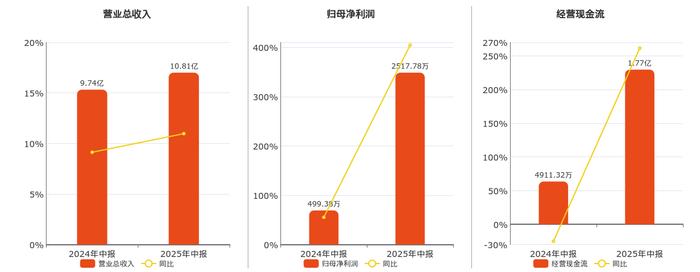
英联股份(002846.SZ):2025年中报净利润为2517.78万元、较去年同期上涨404.18%
Xin Lang Cai Jing· 2025-09-01 10:40
Core Insights - The company reported a total operating revenue of 1.081 billion yuan, ranking 14th among disclosed peers, with a year-on-year increase of 10.97% [1] - The net profit attributable to shareholders reached 25.18 million yuan, marking a 404.18% increase year-on-year, achieving three consecutive years of growth [1] - The net cash inflow from operating activities was 177 million yuan, ranking 11th among peers, with a significant year-on-year increase of 261.40% [1] Financial Metrics - The latest debt-to-asset ratio is 59.77%, a decrease of 0.21 percentage points from the previous quarter [3] - The gross profit margin stands at 12.88%, an increase of 0.22 percentage points from the previous quarter, and up 1.83 percentage points year-on-year [3] - The return on equity (ROE) is 1.80%, reflecting an increase of 1.44 percentage points compared to the same period last year [3] - The diluted earnings per share (EPS) is 0.06 yuan, up 403.36% year-on-year, achieving three consecutive years of growth [3] - The total asset turnover ratio is 0.31 times, ranking 20th among peers, with no change from the previous year [3] - The inventory turnover ratio is 2.77 times, ranking 19th among peers, with a year-on-year increase of 2.11% [3] Shareholder Structure - The number of shareholders is 49,300, with the top ten shareholders holding 280 million shares, accounting for 66.61% of the total share capital [3] - The largest shareholder, Weng Weiwu, holds 40.89% of the shares [3]

友发集团: 关于收到国家市场监督管理总局《经营者集中反垄断审查不予禁止决定书》 暨对外投资事项的进展公告
Zheng Quan Zhi Xing· 2025-09-01 10:19
Investment Overview - Tianjin Youfa Steel Pipe Group Co., Ltd. plans to acquire 70.96% equity of Jilin Huaming Pipe Industry Co., Ltd. and increase capital through cash transactions using its own funds [1][2] - The acquisition involves purchasing shares from Panshi Jianlong Steel Co., Ltd. and Shenyang Leiming Steel Pipe Co., Ltd. [1] Transaction Progress - The company has received a non-prohibition decision from the State Administration for Market Regulation regarding the antitrust review of the acquisition [2] - The decision allows the company to proceed with the acquisition and control of Jilin Huaming Pipe Industry Co., Ltd. as per the Anti-Monopoly Law of the People's Republic of China [2]
