无人配送车

Search documents
涉嫌搬团队、搬技术,IPO前京东指控九识智能侵权
3 6 Ke· 2025-08-12 04:15
Core Viewpoint - Jiushi Intelligent, a rising star in the unmanned delivery vehicle sector, is currently embroiled in intellectual property disputes and a crisis of safety trust, raising questions about its rapid growth and the underlying industry competition and technological innovation risks [1][10]. Group 1: Intellectual Property Issues - JD.com has reported Jiushi Intelligent to the police for allegedly infringing on its intellectual property rights, claiming to have substantial evidence of infringement [3][9]. - Jiushi Intelligent's founding team consists of former key members from JD Logistics, leading to suspicions of premeditated entrepreneurship and potential "technology migration" [4][17]. - The rapid patent application process by Jiushi Intelligent, particularly for technologies developed by former JD employees, has raised concerns about the legitimacy of its innovations [5][8]. Group 2: Technological Development and Safety Concerns - Jiushi Intelligent has achieved significant milestones, including the launch of multiple models and the delivery of over 3,000 units within two and a half years, which is considered unusually fast for the industry [6][10]. - The company has faced multiple traffic accidents involving its unmanned vehicles, leading to public skepticism regarding the reliability and safety of its technology [11][14]. - The incidents highlight potential deficiencies in obstacle recognition and response mechanisms, contradicting Jiushi Intelligent's claims of being a leader in L4 autonomous driving technology [11][14]. Group 3: Market Position and Future Prospects - Jiushi Intelligent has attracted significant investment, completing nearly $300 million in funding rounds, indicating strong market interest despite ongoing legal challenges [10][15]. - The company plans to launch an IPO in Hong Kong, but unresolved intellectual property disputes with JD.com could jeopardize this process and raise concerns among potential investors [15][16]. - The competitive landscape in the unmanned delivery vehicle market is intensifying, with companies needing to balance rapid growth with technological maturity and safety compliance [14][16].


江苏33家企业跻身全球独角兽榜单
Xin Hua Ri Bao· 2025-08-11 05:27
Group 1 - The core viewpoint highlights the emergence of unicorn companies in Jiangsu, which are driven by technological innovation and high-level talent, becoming a new engine for regional economic growth [1][2] - In the first half of 2025, Jiangsu had 33 companies listed as unicorns, accounting for nearly 10% of the national total, covering sectors such as new energy, biotechnology, and artificial intelligence [1] - Suzhou leads the province with 12 unicorns, particularly in artificial intelligence, while Nanjing and Changzhou also show strong representation in software, hardware, and new energy sectors [1][2] Group 2 - The financial technology, software services, and AI sectors are witnessing rapid growth among new unicorns, with 2023 being termed the "empowerment year" for AI integration into industries [2] - Jiangsu's unicorns are forming a "symbiotic cluster," with advancements in various fields such as new energy, semiconductors, and artificial intelligence, enhancing the sustainability of new economic drivers [2] - The government is focusing on enhancing core competitiveness by encouraging increased R&D investment and collaboration between enterprises and universities in cutting-edge technologies [3] Group 3 - Jiangsu has introduced policies to accelerate the cultivation of unicorn and gazelle companies, including financial incentives and support for R&D tasks [4] - By 2027, Jiangsu aims to develop 80 unicorn companies and establish 20 new leading technology tracks in high-tech zones, reinforcing its position in global technology competition [4] - The implementation of these measures is expected to reshape the industrial landscape and contribute significantly to Jiangsu's high-quality economic development [4]
九识无人车事故频发背后:核心创始团队扎堆从京东物流离职
Nan Fang Du Shi Bao· 2025-06-12 10:29
Core Viewpoint - The rapid deployment of autonomous delivery vehicles, particularly by Jiushi Intelligent, has been marred by a series of traffic accidents, raising concerns about safety and the pace of technological advancement in the industry [1][2][3]. Group 1: Company Overview - Jiushi Intelligent, established in August 2021, claims to have developed L4-level autonomous driving technology suitable for commercial applications [1][6]. - The company has quickly iterated five models of smart urban delivery vehicles within two years, setting a record for the speed of commercialization in the industry [2][14]. - The founding team of Jiushi Intelligent includes former key members from JD Logistics, indicating a strong background in autonomous vehicle technology [6][8]. Group 2: Recent Incidents - A series of accidents involving Jiushi Intelligent's delivery vehicles have occurred, including a rear-end collision and an incident where a vehicle dragged an electric bike [3][4]. - The company has attributed these incidents to operational errors during remote control and challenges in recognizing deformed obstacles [3][4]. - Despite no injuries reported, these events have sparked significant safety concerns regarding the deployment of autonomous delivery vehicles [1][3]. Group 3: Industry Context - The logistics sector's "last mile" delivery is considered the most costly, making it a prime target for autonomous vehicle applications [4]. - As of 2024, over 6,000 autonomous delivery vehicles have been deployed across various scenarios, significantly increasing daily delivery volumes [4][12]. - The industry is witnessing a trend of shortened development cycles for autonomous delivery vehicles, with many companies achieving commercialization within a year [12][14]. Group 4: Challenges and Considerations - Experts highlight that the large-scale rollout of autonomous delivery vehicles faces challenges such as market entry, cost, safety, and collaboration with logistics companies [5]. - Legal experts emphasize the complexity of assigning liability in traffic accidents involving autonomous vehicles, considering factors like technology performance and operational management [5][16]. - The rapid development and deployment of Jiushi Intelligent's vehicles have raised questions about intellectual property rights and potential infringement issues due to the backgrounds of its founding team [15][18].
无人配送车加速“上路” 新石器每月交付超千辆无人车
news flash· 2025-06-02 04:35
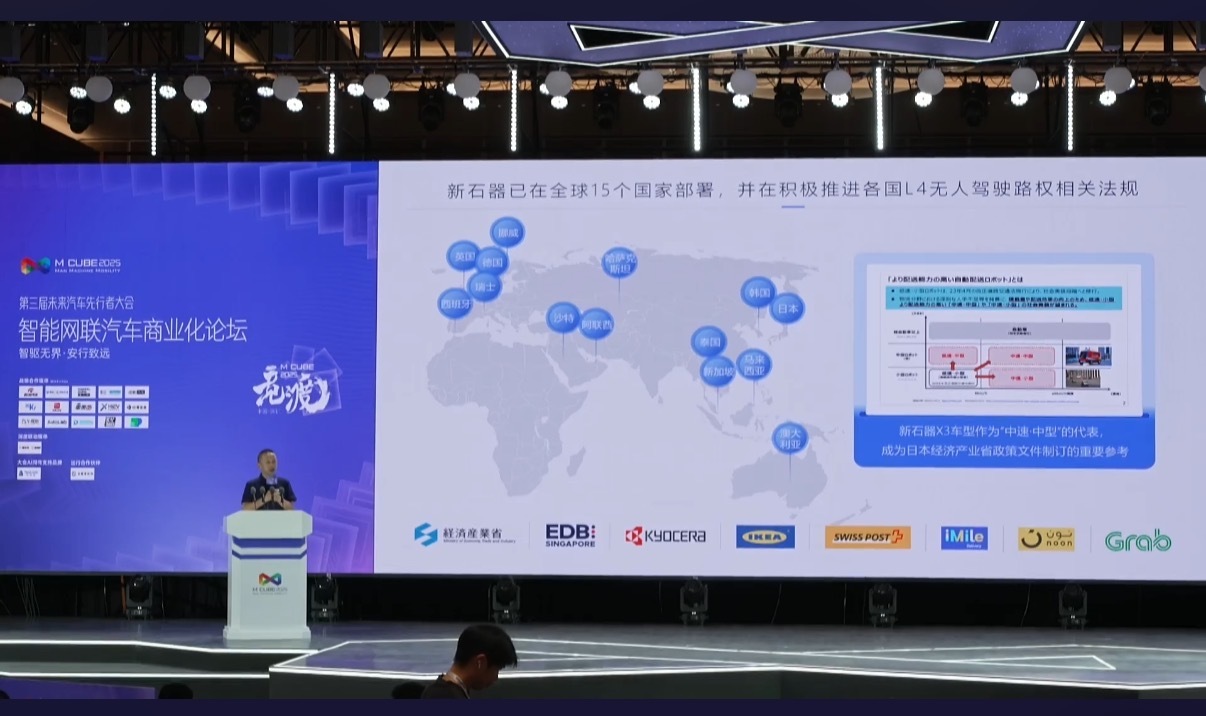
Core Insights - The autonomous delivery vehicle industry is experiencing rapid growth, with a development speed ten times that of the previous year [1] - New Stone's monthly delivery volume exceeds 1,000 units, with expectations to surpass 2,000 units per month from Q2 to Q3 [1] - In April, the monthly delivery volume exceeded the total for the entire year of 2024 [1]
新石器余恩源:无人配送车竞争刚刚开始,唯有竞争才能构建高效生态系统
Mei Ri Jing Ji Xin Wen· 2025-06-01 06:54
Group 1 - The unmanned delivery vehicle industry is expected to experience explosive growth in 2025, with a development speed reaching ten times that of the previous year [1] - The company, New Stone, is currently delivering over 1,000 unmanned vehicles per month, with expectations to exceed 2,000 units per month between Q2 and Q3, and April's delivery surpassing the total for the entire year of 2024 [1][3] - The application scenarios for unmanned delivery vehicles have expanded from densely populated urban areas to rural regions, with operational ranges extending from non-motor vehicle lanes to motor vehicle lanes [3] Group 2 - New Stone has developed various vehicle models, including 3 cubic meter small vehicles and 6 cubic meter medium vehicles, with larger capacity models currently in development [3] - The delivery distance has significantly increased, with routes of 70 to 80 kilometers now common, breaking the previous limitation of around 3 kilometers [3] - The core mission of the logistics industry is cost reduction and efficiency improvement, which New Stone aims to achieve through visual technology and algorithms [3] Group 3 - The company plans to implement a no-map technology based on visual algorithms in the second half of this year, expanding application scenarios from planned logistics in the express delivery sector to real-time logistics similar to ride-hailing services [3] - By the end of this year, New Stone expects to deploy 4,000 to 5,000 unmanned vehicles in scenarios outside of express delivery, primarily for real-time logistics scheduling [3] - The competition in the industry is just beginning, with major players like Meituan, JD.com, and Alibaba entering the market, emphasizing the need for competition to build an efficient ecosystem [3] Group 4 - The logistics industry inherently seeks cost optimization, and unmanned delivery vehicles must prioritize cost reduction as their core mission [3] - New Stone aims to release value in more scenarios, including express delivery, industrial clusters, and rural areas, ultimately achieving global scale operations [3]