
汽车媒体

Search documents
“玩花活”救不了汽车之家
3 6 Ke· 2025-08-29 06:44
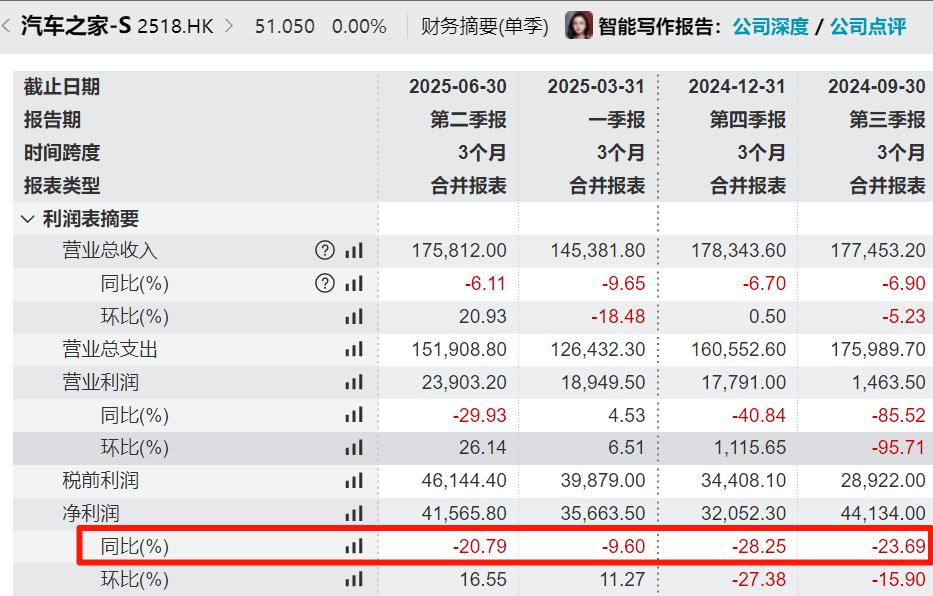
Core Viewpoint - The recent acquisition of Autohome by Haier highlights the company's struggles and the challenges it faces in transforming its business model amidst increasing competition and declining media revenue [1][2][14]. Group 1: Business Performance - Autohome's Q2 2025 net revenue was RMB 1.758 billion, a 6.14% decrease from RMB 1.873 billion in the same period of 2024 [3][4]. - The company's net profit for Q2 2025 was RMB 415.7 million, down approximately 20.79% from RMB 524.8 million in Q2 2024 [3][4]. - Autohome's media services revenue fell to RMB 279.4 million in 2025, a 35.46% decline from RMB 432.9 million in 2024, indicating a significant drop in advertising income [5][6]. Group 2: Competitive Landscape - Competitors like Dongchedi and Yiche are leveraging resources from ByteDance and Tencent, intensifying market competition and eroding Autohome's media revenue [7][8]. - The shift in advertising strategies among traditional fuel vehicle manufacturers towards more effective channels has further diminished Autohome's attractiveness as a media platform [6][8]. Group 3: Strategic Transformation - Under Haier's leadership, Autohome is focusing on AI technology and new retail models, but the increased operational costs from offline expansions pose significant challenges [2][13]. - The "offline space station" initiative aims to create a multi-brand display and experience platform, but the effectiveness of this strategy remains uncertain [9][11]. - Autohome's operational costs surged by 45.4% year-on-year to RMB 503 million in Q2 2025, primarily due to the costs associated with new business ventures [13]. Group 4: Ownership Changes and Historical Context - Haier's acquisition of a 43% stake in Autohome for approximately USD 1.8 billion marks another ownership change in the company's turbulent history [1][14]. - Autohome has undergone multiple ownership transitions, with significant strategic shifts and leadership changes impacting its long-term stability and execution [15][16].

汽车之家正式易主
Sou Hu Cai Jing· 2025-08-28 05:34
Group 1 - Haier Group's subsidiary, Katai Chi Holdings, has completed the strategic acquisition of a 43.0% stake in Autohome from Ping An's Yunchen Capital for approximately $1.8 billion, becoming the controlling shareholder of Autohome [2][4] - Ping An Property & Casualty will retain a 5.1% stake in Autohome through Yunchen Capital and maintain one board seat [2] - Following the acquisition, Autohome announced a management restructuring, with CEO Wu Tao resigning and Yang Song appointed as the new CEO [2] Group 2 - Yang Song, the new CEO of Autohome, assured employees that there would be no layoffs or changes to job stability and compensation as a result of the acquisition, and that business operations would continue normally [2] - The strategic focus post-acquisition will shift from being an automotive vertical media platform to an automotive ecosystem platform in collaboration with Haier and Ping An [2] - Autohome reported a net revenue of RMB 1.758 billion for Q2 2025, a decrease from RMB 1.873 billion in the same period of 2024, with a net profit of RMB 415.7 million compared to RMB 524.8 million in 2024 [3]


你说懂车帝不行,那你上
Hu Xiu· 2025-07-25 13:02
Core Viewpoint - The collaboration between Dongchedi and CCTV to conduct "intelligent driving" scenario tests on over 30 popular car models has yielded mixed results, highlighting the need for more rigorous and transparent testing in the automotive industry [1][2]. Group 1: Testing and Industry Response - Some car manufacturers have publicly criticized Dongchedi's testing, claiming it lacks professionalism and rigor, while others in the automotive media have also raised concerns about the validity of the tests [2]. - Dongchedi's tests are seen as the first public assessment of multiple models under realistic road conditions, contrasting with traditional closed-environment crash tests that do not adequately reflect the risks associated with autonomous driving [2][3]. - The automotive industry is urged to prioritize consumer safety over competitive marketing, emphasizing the importance of conducting more open and professional real-world tests [3][4]. Group 2: Legislative and Regulatory Considerations - The article advocates for the establishment of stricter automotive safety regulations in China, similar to the TREAD Act in the U.S., which mandates manufacturers to disclose critical safety data [5]. - It argues that the automotive industry must balance technological advancement with consumer safety, suggesting that more stringent legislation could help elevate industry standards [5][6]. - The necessity for a reasonable liability framework is highlighted, as the current lack of accountability could lead to consumer safety being compromised [6]. Group 3: Consumer Safety and Industry Accountability - The automotive sector is called upon to place consumer safety at the forefront of its operations, as the consequences of failures in this industry can be life-threatening [6]. - The article stresses that merely showcasing user statistics is insufficient to prove the safety and reliability of autonomous driving systems [6].