网文

Search documents
广东文化产业,让AI打上工了
2 1 Shi Ji Jing Ji Bao Dao· 2025-05-24 09:09
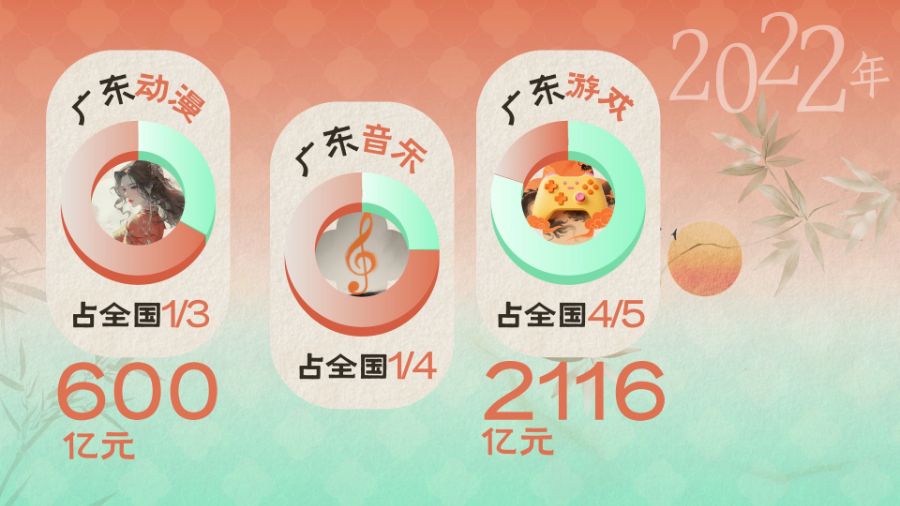
Core Viewpoint - The 21st China (Shenzhen) International Cultural Industries Fair has opened, featuring a new artificial intelligence exhibition area with over 60 AI companies participating, showcasing a more comprehensive and innovative range of exhibits [1] Group 1: AI Empowerment in Cultural Industries - AI has significantly empowered the cultural and creative sectors, with Guangdong leading the way, contributing 780.6 billion yuan to cultural and related industries in 2023, maintaining its position as the national leader for 22 consecutive years [1][15] - In 2022, Guangdong's animation output exceeded 60 billion yuan, accounting for one-third of the national total, while music and gaming outputs represented one-fourth and 80% of the national totals, respectively [1] Group 2: AI Applications in Gaming - 62% of game studios have adopted AI technologies, with AI NPCs in games like NetEase's "Nirvana in Fire" evolving to interact more dynamically with players [5][8] - AI technologies such as digital twins and model generation enhance game design, breaking the traditional "cost-efficiency-quality" triangle [10] Group 3: AI in Short Video and Script Creation - AI translation has enabled Guangdong-produced short dramas to reach international audiences, facilitating discussions on cultural themes [12][13] - AI has reduced script creation time by 60% and cut video editing from three days to three hours, streamlining the production process [13] Group 4: Cultural Industry Ecosystem in Guangdong - Guangdong's cultural industry benefits from a rich cultural heritage, a mature industry environment, advanced AI infrastructure, and strong policy support [15][17] - The province boasts over 20,000 online writers, a gaming industry valued over 100 billion yuan, and a thriving short video production base [17]

文艺圈大混战,谁先“变短”谁就赢?
Ge Long Hui· 2025-05-16 01:58
Core Viewpoint - The short drama industry is rapidly growing, attracting attention from various media companies and investors, despite being perceived as lowbrow content. The market is currently dominated by new entrants and MCN organizations, with established film and television companies cautiously exploring this segment [1][4]. Group 1: Industry Dynamics - The short drama market is experiencing significant interest, with companies like Huace Film & TV and Ningmeng Film & TV making notable strides in this area [1][5]. - Major streaming platforms such as Tencent, iQIYI, and Douyin have already invested in short dramas, indicating a competitive landscape [3]. - The regulatory environment is tightening, with new guidelines requiring platforms to register short dramas, which may impact the content and production strategies of companies [22][23]. Group 2: Company Developments - Huace Film & TV has established multiple production teams and plans to expand its workforce significantly, with five short dramas set to launch by November 2023 [5][6]. - Ningmeng Film & TV reported a revenue of 1.22 billion RMB in 2023, with a net profit of 227 million RMB, marking a year-on-year growth of 28.4% and 60.4% respectively [8][10]. - The short drama segment contributed 32.23 million RMB to Ningmeng's revenue, reflecting a growth of over 1200% [10]. Group 3: Web Literature and Short Dramas - Companies in the web literature sector, such as Zhongwen Online and Yuewen Group, are also entering the short drama market, leveraging their IP for adaptation [14][16]. - Zhongwen Online reported that its IP derivative products, including short dramas, generated significant revenue, with a 94.41% increase year-on-year [14][16]. - Yuewen Group has launched a "Short Drama Star Incubation Plan" to develop its presence in the short drama market, although it has been slower to adapt compared to its competitors [18][19]. Group 4: Market Size and Growth - The micro short drama market in China reached a scale of 37.39 billion RMB in 2023, growing by 267.65% year-on-year, nearing the total box office of films [22]. - The rapid growth of the short drama market has attracted various stakeholders, including government entities and state-owned enterprises, indicating a trend towards higher quality content [22].