金融中介

Search documents
金融“黑灰产”集群打击取得积极成效 金融监管总局表示 将持续加大对重点领域打击力度
Zhong Guo Zheng Quan Bao· 2025-12-25 22:12
Core Viewpoint - The Ministry of Public Security and the National Financial Regulatory Administration have launched a joint initiative to combat illegal financial activities, achieving significant results in curbing financial crime and protecting consumer rights [1][2]. Group 1: Achievements in Combating Financial Crime - Since June, nearly 60 operations have been conducted, resulting in over 1,500 cases of financial crime being investigated and more than 200 organized crime groups dismantled, with a total amount involved nearing 300 billion yuan [2]. - The initiative has effectively purified the financial market ecosystem and maintained national financial order and stability [2]. - Ten typical cases were disclosed, covering various financial sectors, including loan fraud, insurance fraud, and illegal agency rights protection, which severely harm consumer rights and disrupt financial market order [2]. Group 2: Regulatory Measures and Future Plans - The financial regulatory authority plans to intensify efforts against illegal loan intermediaries and unauthorized rights protection agencies, with a focus on enhancing the quality of law enforcement and regulatory collaboration [5][6]. - By the end of November, over 4,500 leads were transferred to law enforcement, involving amounts exceeding 210 billion yuan, and more than 1,700 reports were guided, involving over 170 billion yuan [4]. - The regulatory body aims to establish evidence transfer standards for illegal activities and conduct joint research on financial crime regulations to propose legislative recommendations [6]. Group 3: Consumer Protection and Awareness - Consumers are advised to remain vigilant against enticing offers such as "no repayment loans" and "full debt cancellation," and to avoid prepaying high fees [3].
金融“黑灰产”集群打击取得积极成效
Zhong Guo Zheng Quan Bao· 2025-12-25 21:11
Core Viewpoint - The Ministry of Public Security and the National Financial Regulatory Administration have launched a joint initiative to combat illegal financial activities, achieving significant results in curbing financial crime and protecting consumer rights [1][2]. Group 1: Key Actions and Results - Since the launch of the crackdown on illegal financial activities in June, nearly 60 operations have been organized, resulting in over 1,500 cases being filed and more than 200 criminal gangs dismantled, with a total amount involved reaching nearly 300 billion [2]. - The initiative has effectively purified the financial market ecosystem and maintained national financial order and stability, significantly protecting the legal rights of financial consumers [2]. - A total of 4,500 leads have been transferred to law enforcement by the financial regulatory system, involving over 210 billion, and more than 1,700 reports have been guided and urged by financial institutions, involving over 170 billion [3]. Group 2: Focus Areas for Future Regulation - The financial regulatory authority plans to intensify efforts against illegal loan intermediaries and unauthorized rights protection agents, maintaining a high-pressure joint enforcement stance with public security [4]. - There will be a focus on enhancing cross-departmental collaboration with market regulation and judicial departments to leverage the multiplier effect of joint enforcement [4]. - The regulatory body aims to improve institutional mechanisms by developing evidence transfer standards for illegal activities and conducting joint research on financial crime-related regulations to propose legislative recommendations [4].
金融领域“黑灰产”涉案近300亿元
Xin Lang Cai Jing· 2025-12-25 18:25
Group 1 - The core viewpoint of the article is the effectiveness of the joint efforts by the Ministry of Public Security and the National Financial Regulatory Administration in combating illegal activities in the financial sector, specifically targeting "black and gray" industries [1] - From June to November, over 1,500 cases of financial "black and gray" crimes were investigated, resulting in the dismantling of more than 200 professional criminal groups and involving nearly 300 billion yuan in illicit funds [1] - The operation aimed to purify the financial market ecosystem and protect the legitimate rights and interests of financial consumers [1] Group 2 - Challenges in identifying illegal intermediary behaviors in the financial sector include the use of advanced technology, complex legal relationships, and the difficulty in tracking information due to the networked nature of these activities [2] - The police have strengthened case studies to establish clear identification standards for illegal intermediaries and are working on a risk warning mechanism to share information about abnormal institutions [3] - New characteristics of "black and gray" crimes include industrialized operation models, professionalization of personnel involved, and increasingly covert methods of operation [4][5] Group 3 - The emergence of new forms of "black and gray" industries, such as "anti-collection alliances" and "professional debtors," poses significant threats to the financial order and has become a major industry issue [5] - The police will continue to enhance collaboration with financial regulatory bodies to maintain a consistent deterrent against illegal financial intermediary activities [5]
中国公安部通报打击金融领域“黑灰产”成效 涉案金额近300亿元
Zhong Guo Xin Wen Wang· 2025-12-25 05:23
Core Viewpoint - The Chinese Ministry of Public Security reported significant progress in combating financial-related "black and gray industry" crimes, with over 1,500 cases investigated and nearly 30 billion yuan involved from June to November this year [1]. Group 1: Crime Statistics and Actions - From June to November, over 1,500 financial-related "black and gray industry" criminal cases were filed, with a total amount involved reaching nearly 30 billion yuan [1]. - The Ministry of Public Security, in collaboration with the National Financial Regulatory Administration, initiated a six-month crackdown on financial-related "black and gray industry" crimes across 17 key provinces and cities [1]. - The operation led to the dismantling of over 200 professional criminal groups and nearly 60 organized crackdowns were conducted nationwide [1]. Group 2: Characteristics and Challenges of Financial Crimes - The operational model of financial-related "black and gray industry" crimes has become industrialized, forming a complete chain that includes false advertising, providing "counter" tutorials, and negotiating on behalf of clients [2]. - The personnel involved in these crimes have become professionalized, with some lawyers and collection agency professionals familiar with laws and regulations, contributing to illegal activities [2]. - The methods of committing these crimes have become more concealed, utilizing new technologies and smart generation tools, making detection challenging [3].
公安部通报打击金融领域“黑灰产”成效 涉案金额近300亿元
Zhong Guo Xin Wen Wang· 2025-12-25 05:22
Core Viewpoint - The Chinese Ministry of Public Security reported significant progress in combating financial "black and gray" market crimes, with over 1,500 cases investigated and nearly 30 billion RMB involved from June to November this year [1]. Group 1: Crime Statistics and Measures - From June to November, over 1,500 financial "black and gray" market crime cases were filed, with a total amount involved reaching nearly 30 billion RMB [1]. - The Ministry of Public Security and the National Financial Regulatory Administration launched a six-month crackdown on financial "black and gray" market crimes across 17 key provinces and cities [1]. - The operation has led to the dismantling of over 200 professional criminal groups involved in these crimes [1]. Group 2: Characteristics and Challenges of Financial Crimes - The operational model of financial "black and gray" market crimes has become industrialized, forming a complete chain that includes false advertising, providing "counter" tutorials, and creating fake documents [2]. - The personnel involved in these crimes have become professionalized, with some lawyers and collection agency professionals joining "anti-collection" teams, thus facilitating illegal activities [2]. - The methods of committing these crimes have become more covert, utilizing new technologies and intelligent generation tools, making detection challenging [3].
公安机关打掉金融领域“黑灰产”职业化犯罪团伙200余个
Xin Hua Wang· 2025-12-25 04:21
Core Viewpoint - The Chinese authorities have launched a six-month crackdown on illegal financial activities, resulting in over 1,500 cases being investigated and approximately 300 billion yuan involved in these crimes [1][2]. Group 1: Law Enforcement Actions - The Ministry of Public Security and the National Financial Regulatory Administration have collaborated to address illegal financial activities, leading to the dismantling of over 200 organized crime groups [1]. - The crackdown has focused on illegal loan intermediaries, fraudulent insurance claims, and improper credit card collection practices, aiming to eliminate the entire chain of illegal financial activities [1]. Group 2: Financial Regulatory Measures - As of the end of November, the financial regulatory system has transferred over 4,500 leads to law enforcement, involving amounts exceeding 21 billion yuan, and has prompted over 1,700 reports from financial institutions, totaling more than 17 billion yuan [2]. - New forms of illegal financial activities, such as "debt collection alliances" and "professional debtors," have emerged, posing significant threats to the financial order and consumer rights [2]. Group 3: Future Outlook - The authorities anticipate that as enforcement and regulatory measures intensify, illegal financial activities will become more covert and complex, necessitating ongoing collaboration between law enforcement and financial regulators [2].
通报公安部和国家金融监管总局联合部署开展金融领域“黑灰产”违法犯罪集群打击 工作举措成效情况
Jin Rong Jie· 2025-12-25 04:18
Core Viewpoint - The Ministry of Public Security and the National Financial Regulatory Administration have launched a joint initiative to combat illegal activities in the financial sector, particularly focusing on the "black and gray industry" that harms consumer rights and disrupts market order [1][2]. Group 1: Overview of Actions Taken - From June to November, a six-month crackdown on illegal financial activities was conducted across 17 key provinces and cities, resulting in over 1,500 cases being investigated and more than 200 criminal gangs dismantled, with a total amount involved nearing 300 billion yuan [2][3]. - The operation included nearly 60 organized actions by public security economic investigation departments, effectively purifying the financial market ecosystem and protecting consumer rights [2][3]. Group 2: Strategies Employed - The initiative emphasized targeted cleaning and precise analysis, focusing on illegal loan intermediaries, insurance fraud, and improper credit card collection practices [2][3]. - A comprehensive approach was adopted, involving cross-institutional and cross-regional investigations to uncover the entire chain of illegal activities, including financial information, funding, technology, and personnel [3][4]. - Enhanced collaboration between law enforcement and financial regulatory bodies was established, integrating regulatory, industry, and police data to improve the efficiency of crime detection and prosecution [3][4]. Group 3: Long-term Measures and Public Awareness - The initiative has led to the issuance of 39 recommendations to address systemic vulnerabilities and improve risk management within financial institutions [4]. - Public awareness campaigns were intensified, resulting in a noticeable decrease in financial dispute complaints and an increase in public satisfaction [4][5]. - The financial regulatory authority has published over 1,100 risk warnings and public statements to guide consumers in recognizing and avoiding illegal financial practices [6][7]. Group 4: Challenges and Future Directions - The characteristics of financial "black and gray" activities include industrialized operation models, professionalized personnel, and increasingly covert methods, making detection and prosecution challenging [9][10]. - The regulatory bodies recognize the need for ongoing efforts to combat these activities, as the methods employed by criminals continue to evolve and become more sophisticated [13][14]. - Future strategies will focus on enhancing inter-departmental collaboration, improving regulatory frameworks, and maintaining a high-pressure enforcement environment against illegal financial intermediaries [13][14].
公安部通报金融领域“黑灰产”违法犯罪集群打击工作举措成效情况
Yang Shi Wang· 2025-12-25 02:36
Core Viewpoint - The Ministry of Public Security and the National Financial Regulatory Administration have launched a six-month crackdown on illegal activities in the financial sector, resulting in significant achievements in combating "black and gray" industries that harm consumer rights and disrupt market order [1][3]. Group 1: Key Achievements - Over 1,500 cases of financial "black and gray" crimes have been investigated, with more than 200 organized crime groups dismantled, involving a total of nearly 30 billion yuan [1][3]. - The collaboration between law enforcement and financial regulatory bodies has led to the transfer of over 4,500 case leads to the police, involving amounts exceeding 21 billion yuan [3][4]. - The crackdown has resulted in a noticeable decrease in financial dispute complaints and an increase in public satisfaction and participation [3][6]. Group 2: Strategies Employed - The approach has shifted from "scattered operations" to "joint management," enhancing the mechanism for law enforcement collaboration [3][4]. - A focus on targeted enforcement has been established, utilizing data analysis to identify and investigate illegal activities in the financial sector [4][5]. - The integration of law enforcement and regulatory data has improved the efficiency of identifying and addressing illegal financial activities [2][3]. Group 3: Challenges and Responses - The complexity of identifying and prosecuting "black and gray" financial activities has been highlighted, with challenges including the obscurity of operations and the evolving nature of criminal methods [7][8]. - Measures have been implemented to enhance the identification standards for illegal intermediaries and to develop a risk warning mechanism to prevent illegal activities [8][11]. - Financial institutions are urged to strengthen their internal controls and risk management systems to mitigate exposure to illegal activities [11][12].
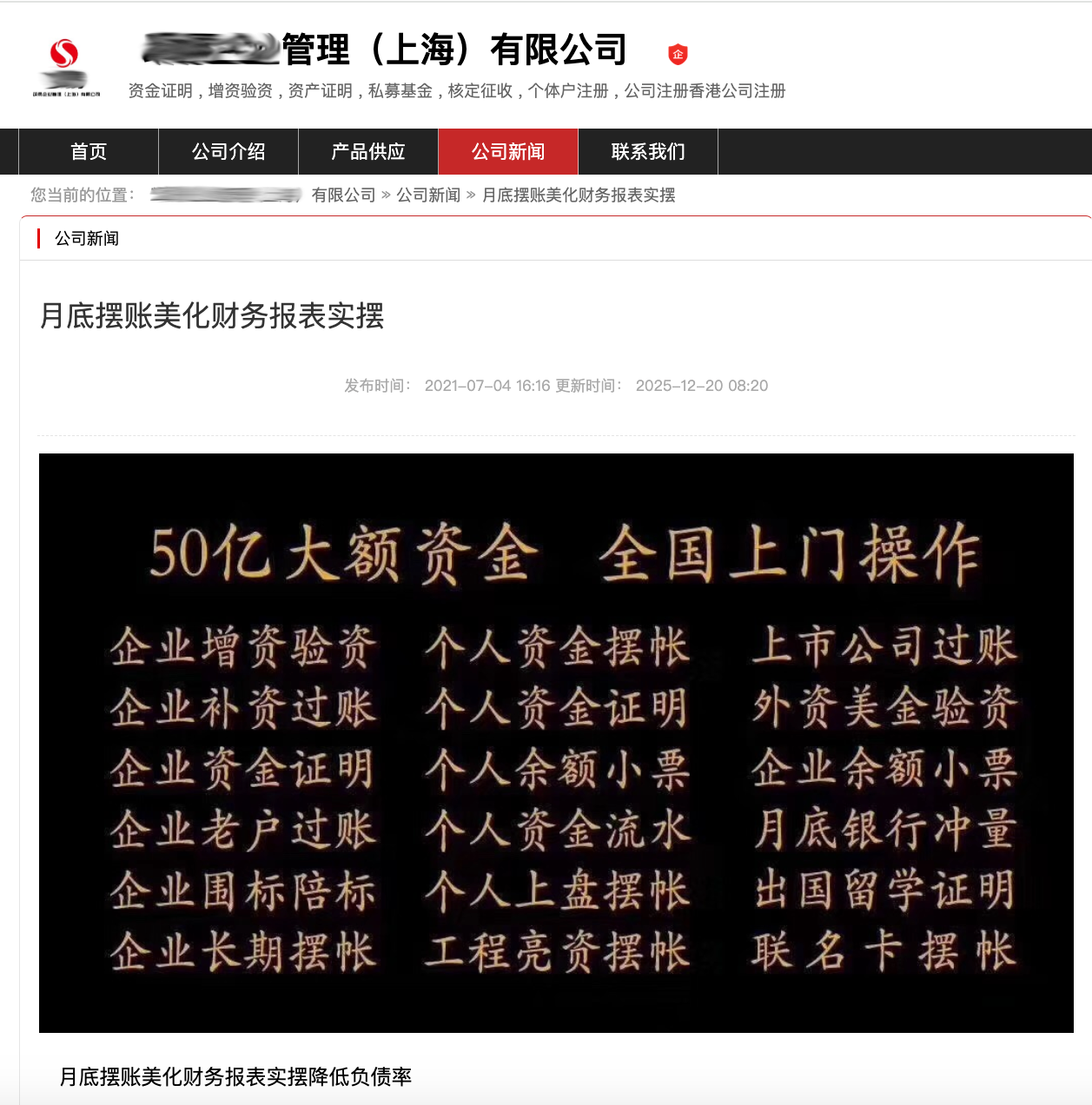
年末业绩压力催生“财报美化”业务,资金中介提供高息资金拆借或成造假“帮凶”
Mei Ri Jing Ji Xin Wen· 2025-12-24 01:45
Core Viewpoint - The article highlights the growing underground business of "financial statement beautification" among listed and pre-IPO companies, where short-term fund borrowing is used to artificially enhance financial metrics without real business backing [1][2][19]. Group 1: Business Operations - The core of the "year-end financial statement optimization" business involves financial intermediaries providing short-term fund borrowing services, allowing companies to manipulate key financial indicators like revenue and cash flow through circular fund transfers [1][2][12]. - Service providers openly promote their offerings in various financial communities and platforms, claiming to cover all sectors of the A-share market, with individual transactions reaching up to 10 billion [2][3]. - The operational process is standardized, involving the signing of dual agreements for confidentiality and fund management, with funds typically transferred in a manner that ensures rapid turnover [14][15]. Group 2: Legal and Regulatory Risks - The actions of financial intermediaries and companies involved in this practice are likely to violate securities laws, as they knowingly assist in financial fraud, which could lead to criminal liability [18][19]. - Regulatory bodies maintain a "zero tolerance" policy towards financial fraud, emphasizing strict enforcement and the potential for severe legal consequences for both companies seeking to beautify their financial statements and the intermediaries providing the funds [19]. - The high costs associated with these services, including interest rates that can exceed 70% annually, pose significant financial risks to companies already in distress [17][18].

网贷、信用卡“打折还贷”灰产调查:还款最低能打四折?
虎嗅APP· 2025-12-18 11:33
以下文章来源于时代周报 ,作者王苗苗 时代周报 . 记录大时代,深读全商业。互联网新闻信息服务许可证编号:44120230006 本文来自微信公众号: 时代周报 ,编辑:卢泳志,作者:王苗苗,原文标题:《18万债务9万结 清!网贷、信用卡"打折还贷"灰产调查:还款最低能打四折?》 "负债18万多元,最后协商只要还9万多元。"广西的杨女士看着手中"结清证明",仍觉得有些不真 实。在过去半年多的时间里,她通过一家自称有"内部渠道"的公司,以约五折的价格"结清"了六个网 贷与信用卡平台的欠款。 近日,时代周报记者注意到,在闲鱼等二手交易平台,一种以"高折扣还款"为诱饵的灰色服务悄然蔓 延。"还款优惠券""信用卡八二折起还卡优惠券""平台欠款减免四至五成真实结清"等极具诱惑力的广 告,吸引着大量深陷债务泥潭的借款人。 时代周报记者调查发现,这类服务的诱惑点十分明确:大部分还款优惠在七至八折,部分甚至低至四 至六折,即代还1万元仅需支付4000~6000元。折扣力度之大,远超常人理解。 这究竟是负债者的"救命稻草",还是精心包装的金融陷阱?时代周报记者历时数日,以消费者身份潜 入调查,并采访多名法律、金融领域专家,试图 ...