金融信息服务

Search documents
季琦 今天捐了1亿元!其实 也将捐出4.5亿元股票
Mei Ri Jing Ji Xin Wen· 2026-02-26 12:32
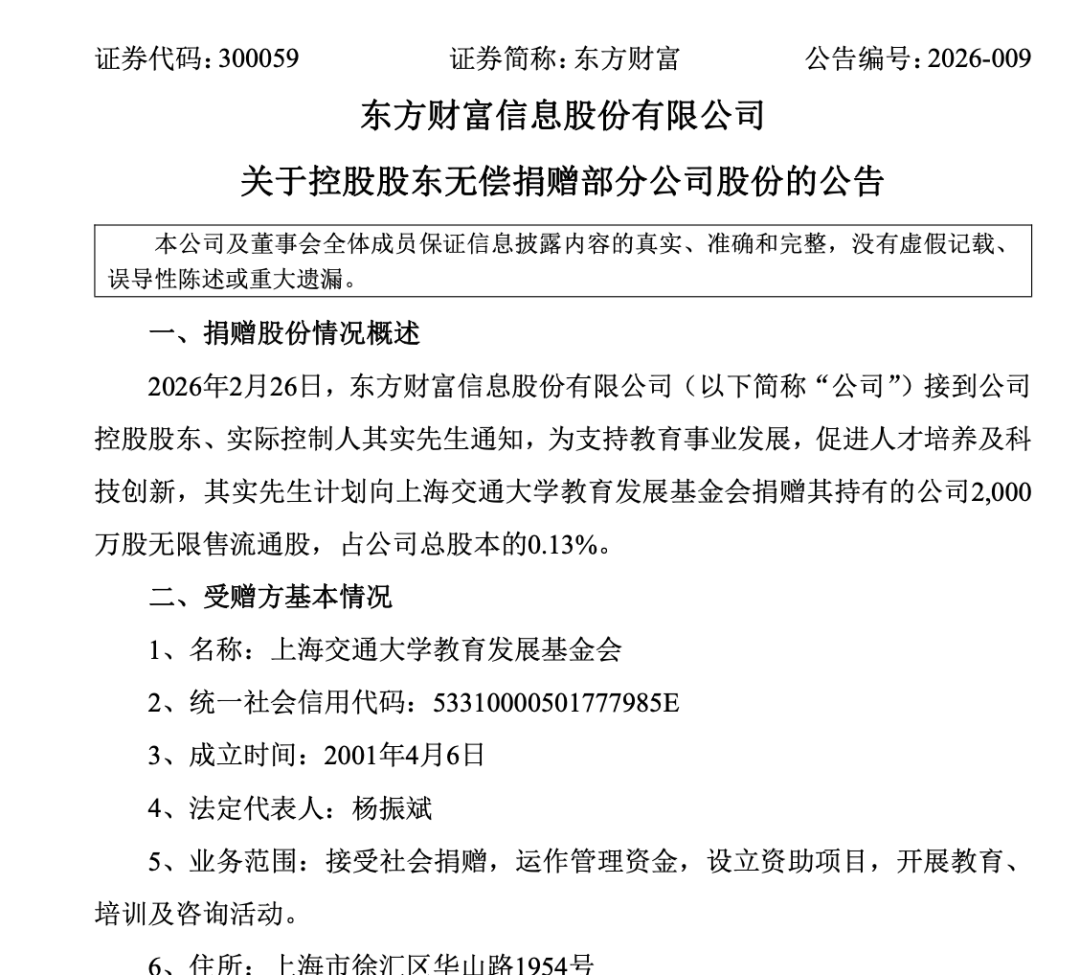
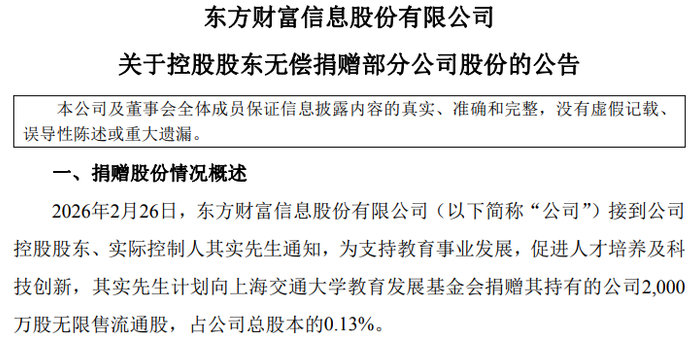
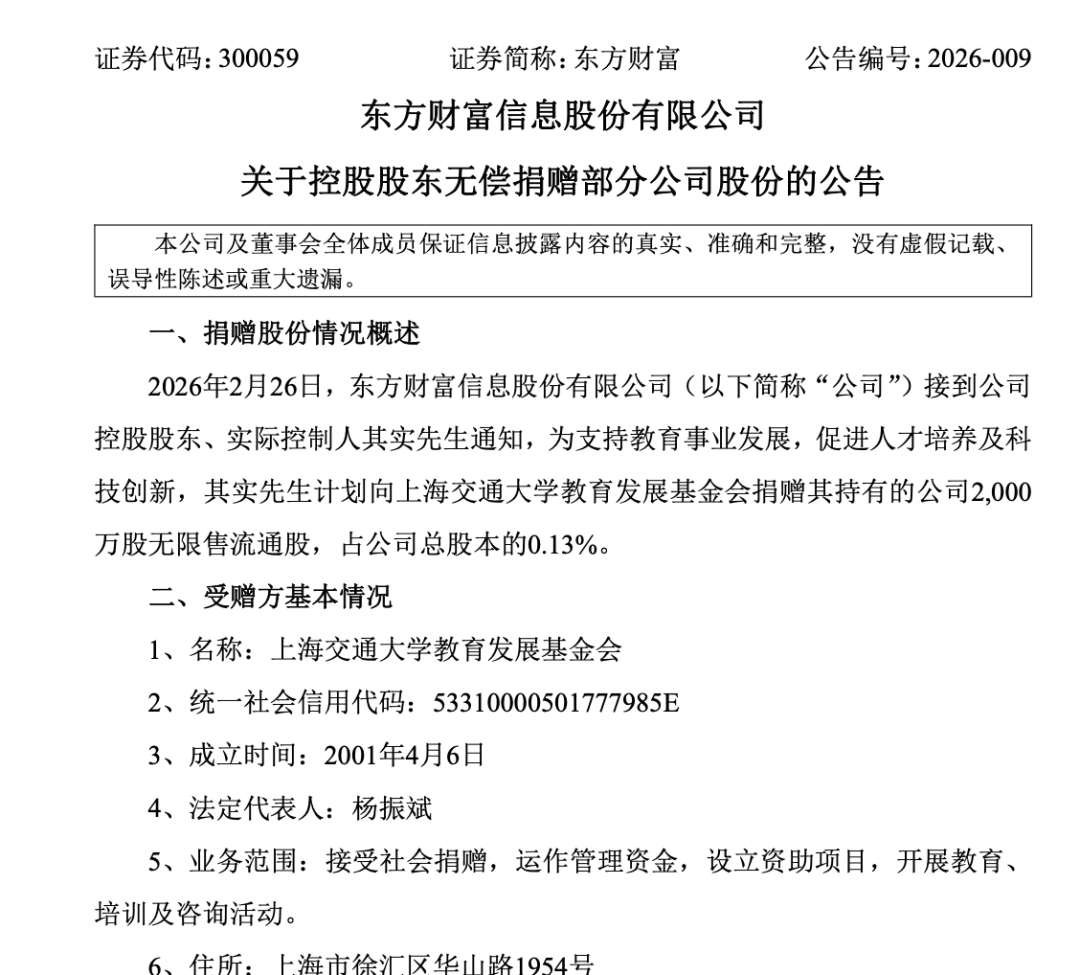
上海交通大学接连获校友大额捐赠。 东方财富今日(2月26日)公告称,接到公司控股股东、实际控制人其实通知,为支持教育事业发展,促进人才培养及科技创新,其实计划向上海交通大 学教育发展基金会捐赠其持有的公司2000万股无限售流通股,占公司总股本的0.13%。截至今日收盘,东方财富报22.50元/股,据此粗略估算,所捐赠的 2000万股约合4.5亿元。数据显示,截至2025年3季度末,其实位列东方财富第一大股东,持有30.62亿股,持股比例19.38%。 简历显示,其实出生于1970年10月,本科毕业于上海交通大学材料工程系,复旦大学博士研究生学历、新闻学博士学位,第十四届全国人大代表。2005年 创办东方财富。其实目前担任全国工商联常委、上海市总商会副会长、民建上海市委副主委、中国证券投资基金业协会副会长、上海市青年五十人创新创 业研究院理事长等社会职务。 另据"上海交通大学"微信公众号消息,2月26日,上海交大建校130周年之际,"全季人文发展基金"捐赠签约暨季琦校董聘任仪式在该校闵行校区举行。 "上海交通大学" 图 著名企业家、华住集团创始人,上海交大工程力学系1989届本科校友、机械工程系1992届硕士校 ...


东方财富其实,豪捐4.5亿元A股股份
Di Yi Cai Jing· 2026-02-26 12:04
2月26日晚,东方财富公告称,接到公司控股股东、实际控制人其实通知,为支持教育事业发展,促进 人才培养及科技创新,其实计划向上海交通大学教育发展基金会捐赠其持有的公司2000万股无限售流通 股,占公司总股本的0.13%。 编辑丨瑜见 截至今日收盘,东方财富报22.50元/股,据此粗略估算,所捐赠的2000万股约合4.5亿元。 公告显示,在本次捐款结束之后,其实、陆丽丽夫妇合计持有东方财富32.02亿股股份,持股比例从 20.39%降至20.26%。 东方财富表示,本次捐赠事项不会导致公司控股股东发生变化,不会对公司治理结构及持续经营产生重 大影响。 此外,据上海交通大学微信公众号消息,华住集团创始人、交大工程力学系1989届本科校友、机械工程 系1992届硕士校友季琦,也向母校捐资1亿元人民币,支持上海交通大学各项事业发展。 ...

季琦,今天捐了1亿元!其实,也将捐出4.5亿元股票
Mei Ri Jing Ji Xin Wen· 2026-02-26 12:03
每经编辑|程鹏 上海交通大学接连获校友大额捐赠。 东方财富今日(2月26日)公告称,接到公司控股股东、实际控制人其实通知,为支持教育事业发展,促进人才培养及科技创新,其实计划向上海交通大 学教育发展基金会捐赠其持有的公司2000万股无限售流通股,占公司总股本的0.13%。截至今日收盘,东方财富报22.50元/股,据此粗略估算,所捐赠的 2000万股约合4.5亿元。数据显示,截至2025年3季度末,其实位列东方财富第一大股东,持有30.62亿股,持股比例19.38%。 "上海交通大学" 图 著名企业家、华住集团创始人,上海交大工程力学系1989届本科校友、机械工程系1992届硕士校友季琦,向母校捐资1亿元人民币,支持学校各项事业发 展。 上海交大党委书记杨振斌,上海交大校长、中国科学院院士丁奎岭共同为季琦颁发校董聘书。 "上海交通大学" 图 杨振斌感谢季琦的慷慨捐赠。他表示,季琦"将自己独有的人生感悟、创业智慧与人文情怀,深深融入母校高质量发展的每一步,彰显了交大人以实际行 动践行'饮水思源,爱国荣校'校训的责任与担当"。此次设立"全季人文发展基金",将助力百年校园焕发人文新彩,丰富校园文化生活,厚植人文底蕴, ...
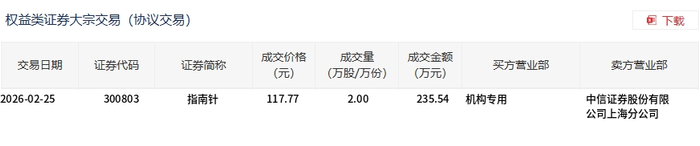
指南针今日大宗交易平价成交2万股,成交额235.54万元
Xin Lang Cai Jing· 2026-02-25 09:01
2月25日,指南针大宗交易成交2万股,成交额235.54万元,占当日总成交额的0.11%,成交价117.77 元,较市场收盘价117.77元持平。 | 交易日期 | 证券代码 | 证券简称 | 成交价格 | 成交量 | 成交金额 (万元) | 买方营业部 | 卖方营业部 | | --- | --- | --- | --- | --- | --- | --- | --- | | | | | (元) | (万股/万份) | | | | | 2026-02-25 | 300803 | 指南针 | 117.77 | 2.00 | 235.54 机构专用 | | 中信证券股份有限 公司上海分公司 | ...

港股互联网板块回调,港股互联网ETF国泰(513720)跌超4%,市场聚焦科技板块动态,回调或可布局
Mei Ri Jing Ji Xin Wen· 2026-02-24 05:40
国泰海通指出,AI大模型营销力度加大,提高AI普及率,共同强化AI在金融IT开发与场景落地能力。 数字人民币正以关键基础设施身份拓宽场景边界,智能合约已在农民工工资发放等新场景落地。境外 RWA监管框架明晰落地,境内虚拟货币属非法金融活动,资金向合规金融科技板块转移。金融信息服 务行业监管趋紧,再融资一揽子措施优化,利好优质高研发企业融资发展。第三方支付行业牌照加速集 中,市场资源向头部靠拢。消费金融行业需精准赋能内需释放,头部效应进一步凸显,监管对合规风控 与股东资质的审核将持续趋严。 风险提示:提及个股仅用于行业事件分析,不构成任何个股推荐或投资建议。指数等短期涨跌仅供参 考,不代表其未来表现,亦不构成对基金业绩的承诺或保证。观点可能随市场环境变化而调整,不构成 投资建议或承诺。提及基金风险收益特征各不相同,敬请投资者仔细阅读基金法律文件,充分了解产品 要素、风险等级及收益分配原则,选择与自身风险承受能力匹配的产品,谨慎投资。 港股互联网ETF国泰(513720)跟踪的是港股通互联网指数(931637),该指数从港股通范围内选取涉 及软件开发、家庭娱乐、互联网零售及服务等互联网相关业务的上市公司证券作为指 ...
金融科技行业双周报第二十三期:RWA 监管更加明晰,金融信息服务监管趋严
GUOTAI HAITONG SECURITIES· 2026-02-24 00:45
RWA 监管更加明晰,金融信息服务监管趋严 [Table_Industry] 综合金融 ——金融科技行业双周报第二十三期 | [姓名table_Authors] | 电话 | 邮箱 | 登记编号 | | --- | --- | --- | --- | | 刘欣琦(分析师) | 021-38676647 | liuxinqi@gtht.com | S0880515050001 | | 孙坤(分析师) | 021-38038260 | sunkun@gtht.com | S0880523030001 | 本报告导读: 国内大模型产品与营销均有亮点,带动金融科技相关标的受益,境外 RWA 监管明 细,金融信息监管趋严。合规金融机构更加受益。 投资要点: [Table_Report] 相关报告 综合金融《权益市场火热,居民边际配置权益资 产》2026.02.09 综合金融《境内虚拟货币违法,境外 RWA 监管 明晰》2026.02.08 综合金融《支付牌照缩减,多家投资咨询公司暂 停新增》2026.02.01 综合金融《消金监管趋严,行业加速出清》 2026.01.25 综合金融《业绩基准新规落地,助推行业长期发 展 ...
金融科技行业双周报第二十三期:RWA 监管更加明晰,金融信息服务监管趋严-20260224
GUOTAI HAITONG SECURITIES· 2026-02-24 00:35
Investment Rating - The report assigns an "Overweight" rating for the financial technology sector [4]. Core Insights - The domestic large model products and marketing have shown highlights, benefiting related financial technology stocks. The overseas RWA regulation has become clearer, and financial information regulation is tightening. Compliant financial institutions are expected to benefit more [2]. Summary by Sections 1. AI - From February 2 to February 20, 2026, the financial technology index decreased from 3116.08 to 3093.77, with a return of -0.72%. The Hong Kong financial technology index fell by 3.48% during the same period. Financial IT and third-party payment sectors performed well due to increased marketing efforts of major AI models and new regulations on virtual currencies [7][8]. 2. Overseas RWA Regulation - **2.1 Financial IT**: On February 6, the People's Bank of China and eight departments issued a notice to prevent risks related to virtual currencies and clarified the RWA regulatory framework for overseas issuance [12][13]. - **2.2 Financial Information Services**: On February 9, the Shanghai and Shenzhen Stock Exchanges announced optimized refinancing measures, benefiting high-quality R&D enterprises [14]. - **2.3 Third-party Payment**: New scenarios for digital currency have emerged, and the concentration of licenses in the third-party payment sector is accelerating [16]. - **2.4 Consumer Finance**: The head effect is evident, with a focus on promoting domestic demand through consumer finance [18]. 3. Individual Company News and Announcements - **3.1** Lakala is accelerating the development of intelligent payment through MOSS, while Tonghuashun's vertical model has gained high usage rates among brokers [19]. - **3.2** ST Rendo's net assets are expected to turn positive, and Jiufang Zhitu has initiated a stock buyback [21]. 4. Investment Recommendations - Digital RMB is expanding its application scenarios, indicating significant growth potential. AI is driving the upgrade of financial services, presenting new investment opportunities. Recommended core companies include: 1. Financial IT firms benefiting from digital currency upgrades: Changliang Technology, Yuxin Technology, Zhongke Software, and New Zhiyuan Software [24][28]. 2. Financial information service companies focusing on intelligent investment research: Jiufang Zhitu, Tonghuashun, and Dongfang Caifu [24][28]. 3. Payment institutions adapting to digital currency functionalities: Lakala, Yika, and Lianlian Digital [24][28]. 4. Consumer finance companies leveraging intelligent customer service and marketing: Yixin Group and Qifu Technology [24][28].




美国2月商业活动增速放缓 一季度经济增长或明显降温
智通财经网· 2026-02-20 16:11
Group 1 - The core point of the article indicates that U.S. business activity continued to expand in February, but the growth rate has dropped to the lowest level in nearly 10 months, signaling a notable cooling of economic momentum [1][2] - The U.S. Composite PMI output index fell to 52.3 in February from 53.0 in January, marking the lowest level since April of the previous year, although it remains above 50, indicating that the private sector is still in an expansion phase [1][2] - The Chief Business Economist at S&P Global, Chris Williamson, stated that the PMI data suggests an annualized GDP growth rate of approximately 1.5% for the U.S., indicating a significant cooling compared to the stronger growth seen in the second half of the previous year [1] Group 2 - The February services PMI decreased to 52.3 from 52.7 in January, falling short of the expected 53.0, while the manufacturing PMI dropped from 52.4 to 51.2, reaching a seven-month low and also below the market expectation of 52.6 [2] - Manufacturing new orders have declined for the second time in the past three months, reflecting ongoing pressure on the demand side [2] - Employment indices for both manufacturing and services have fallen close to the neutral line at 50.2, indicating that hiring activity among businesses is nearly stagnant, with a cautious attitude towards labor due to reduced orders and slowed business expansion [2]

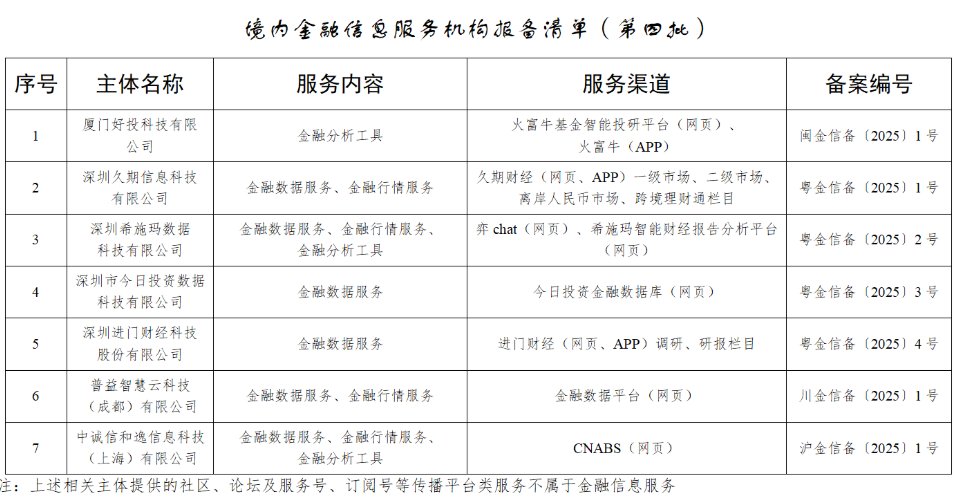
第四批境内金融信息服务机构报备编号公布
Xin Lang Cai Jing· 2026-02-15 06:21
金融信息服务机构应在所提供服务、产品的显著位置标明报备编号,并链接至报备系统网址 (http://fisbaobei.ifcert.cn),供用户查询核对。根据《金融信息服务管理规定》及有关政策,报备仅是 对境内机构提供金融信息服务行为的确认,不代表对机构服务能力的认可。相关机构应严格按照《金融 信息服务管理规定》要求提供金融信息服务,不得以报备为名,违规从事网络借贷、证券交易、证券投 资咨询、征信等各类金融业务。 贯彻落实《金融信息服务管理规定》有关要求,根据《关于开展境内金融信息服务报备工作的通知》, 为提高金融信息服务质量,促进金融信息服务业健康发展,国家互联网信息办公室组织开展境内金融信 息服务报备工作。现公开发布第四批7家金融信息服务机构的名称及报备编号。 国家互联网信息办公室关于发布第四批境内金融信息服务机构报备编号的公告 ...
国家网信办公布境内第四批7家金融信息服务机构
Xin Lang Cai Jing· 2026-02-15 05:19
格隆汇2月15日|根据《关于开展境内金融信息服务报备工作的通知》,国家互联网信息办公室组织开展境内金融信息服务报备工作。 近日已公布第四批7家金融信息服务机构名称及报备编号,进门财经、久期财经等机构在列。 | 序号 | 主体名称 | 服务内容 | 服务渠道 | 备案编号 | | --- | --- | --- | --- | --- | | 1 | 厦门好投科技有限 | 金融分析工具 | 火富牛基金智能投研平台(网页)、 | 闽金信备(2025)1号 | | | 公司 | | 火富牛(APP) | | | 2 | 深圳久期信息科技 | 金融数据服务、金融行情服务 | 久期财经(网页、APP)一级市场、二级市场、 | 粤金信备(2025) 1 号 | | | 有限公司 | | 离岸人民币市场、跨境理财通栏目 | | | 3 | 深圳希施玛数据 | 金融数据服务、金融行情服务、 | 弈 chat(网页)、希施玛智能财经报告分析平台 | 粤金信备(2025)2号 | | | 科技有限公司 | 金融分析工具 | (网页) | | | 4 | 深圳市今日投资数据 | 金融数据服务 | 今日投资金融数据库(网页) | 粤 ...