Food Service

Search documents
Forget SoundHound AI: This Walled‑Garden Superpower Is the Safer, Smarter Way to Profit From Voice AI
Yahoo Finance· 2026-01-28 19:25
Company Overview - SoundHound AI (NASDAQ: SOUN) is a developer of audio and speech recognition tools, experiencing rapid growth due to the rise of AI-powered voice services [1] - The company generates most of its revenue from Houndify, a platform for creating customized voice recognition applications [1] Market Position and Growth - SoundHound serves various sectors, including automakers like Stellantis, restaurants like Chipotle, and financial services like Mastercard [2] - The company has made several acquisitions to enhance its presence in the restaurant and AI chatbot industries, including SYNQ3, Allset, Amelia, and Interactions [2] Financial Performance - From 2020 to 2024, SoundHound's revenue is projected to grow at a CAGR of 60%, with expectations of a 49% CAGR from 2024 to 2027, reaching $283 million [3] - Adjusted EBITDA is expected to turn positive in 2027 [3] Valuation and Risks - SoundHound is valued at a market capitalization of $4.18 billion, trading at 18 times its 2026 sales [4] - The company is increasingly reliant on acquisitions to counteract slowing organic growth, with declining gross margins [4] - It is anticipated to remain unprofitable under GAAP through 2027, and its outstanding share count has more than doubled since its SPAC merger in April 2022, indicating potential dilution [4] Business Model Sustainability - SoundHound has not yet demonstrated a sustainable business model, leading to suggestions that investors may prefer more stable options like Apple for exposure to the voice AI market [5]


京东旗下七鲜小厨“落地”广州等五城,开启全国化布局新阶段
Guang Zhou Ri Bao· 2026-01-27 07:24
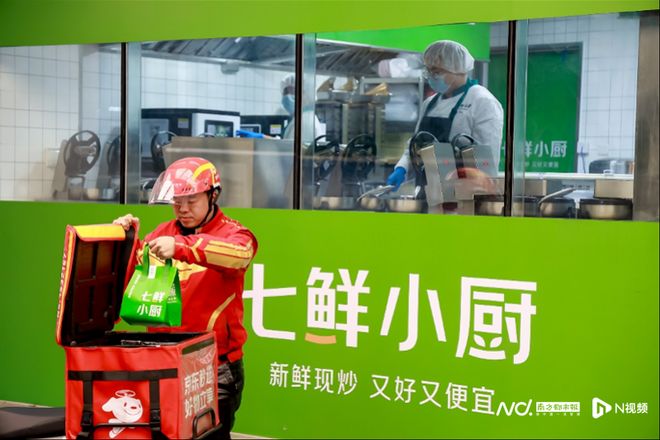
Core Insights - JD's Qixian Kitchen has officially launched in Guangzhou, marking a significant step in its nationwide expansion after opening 30 stores in Beijing within four months and its first store in Harbin [2] - The brand, which focuses on fresh and healthy dining, has three core selling points: fresh stir-fried dishes that are not overnight, full disclosure of brand ingredients, and 24-hour live streaming from the kitchen [2] - A promotional campaign offering free chocolate with orders led to over 20,000 daily orders in Beijing during December [2] Expansion Strategy - Qixian Kitchen has initiated a nationwide partner recruitment plan to deepen its presence in key urban clusters, specifically the Beijing-Tianjin-Hebei, Yangtze River Delta, and Pearl River Delta regions [2] - The company aims to establish a presence in all first- and second-tier cities in China by the end of 2026, providing fresh and healthy meals to a broader market [2] Promotional Activities - A themed promotional event titled "Laba Naxian Fushi Shishi Jie 'Zhou'" is being held from January 25 to January 27, offering free congee and rice with orders during specific times [2] - The event aims to distribute a total of 60,000 portions of the promotional items across five cities over three days [2]


Why the Labor Economy Turns to Credit to Keep Spending
PYMNTS.com· 2026-01-21 09:02
Core Insights - The U.S. Labor Economy, comprising roughly 60 million workers earning less than $25 an hour, significantly impacts consumer spending, accounting for about 15% of total U.S. consumer spending [1][5] - Recent data indicates a 0.81% month-over-month decline in average hourly wages for Labor Economy workers, leading to an estimated $14 billion annualized reduction in consumer spending [3][10] - Personal job-security sentiment among Labor Economy workers has sharply decreased by 6.7 points in one month, exacerbating financial pressures [3][10] Economic Impact - The Labor Economy serves as a stabilizing force for GDP due to its spending being tied to essential needs, with pullbacks in this group affecting demand in sectors reliant on consistent consumer traffic [5][10] - As wages fluctuate, spending becomes more about necessity rather than confidence, particularly for households with limited savings [5][10] Credit Utilization - Over one-third (33.8%) of Labor Economy workers typically carry a revolving credit card balance, compared to less than 25% of the broader population [6][10] - Average outstanding credit card balances for these workers exceed 22% of their annual income, indicating that credit is primarily used to manage cash flow rather than for discretionary spending [7][10] Spending Patterns - Labor Economy workers predominantly spend on local, necessity-driven categories such as groceries, fuel, food service, and basic retail [8][9] - Credit is utilized to cover essential expenses and offset inflation in unavoidable categories like food and utilities, allowing households to maintain their routines [8][10] Economic Resilience - The reliance on credit is increasing not due to excess but due to economic fragility, highlighting the importance of the Labor Economy's financial resilience for stable consumer demand and broader economic growth [10]

2026年中国学生营养配餐行业政策、市场现状、重点企业及未来展望研判:政策支持与居民生活水平提升共同发力,促进学生营养配餐市场规模有序扩张[图]
Chan Ye Xin Xi Wang· 2026-01-17 23:24
Core Insights - The student nutrition catering industry is rapidly growing, with the market size expected to increase from 381.1 billion yuan in 2015 to 609.5 billion yuan in 2024, reflecting a compound annual growth rate (CAGR) of 5.36% [1][14] - By 2025, the market size is projected to reach 642.1 billion yuan, driven by rising living standards and increasing parental awareness of children's health [1][14] Industry Overview - Student nutrition catering aims to provide balanced meals that support the physical development and learning activities of students, ensuring they receive essential nutrients like vitamins, minerals, and proteins [1][14] - The market is segmented into various educational levels, including university, high school, primary, middle school, and special education [3] Industry Policies - The government has implemented several policies to promote student nutrition catering, including guidelines for food safety and management in schools [8] - Local governments are also taking initiatives to improve nutrition among students, particularly in rural areas [8] Industry Chain - The industry chain consists of three main segments: upstream (food ingredient procurement), midstream (meal preparation), and downstream (delivery services) [10][11] - Upstream suppliers provide fresh and safe ingredients, while midstream companies focus on processing these ingredients into nutritious meals [10][11] Key Ingredients - Essential food categories for student nutrition include vegetables, grains, fruits, and meats, which collectively provide critical nutrients for students' growth [12] - In 2024, China's vegetable production is expected to reach 86.1 million tons, with grain production at 70.6 million tons and fruit production at 33.9 million tons [12] Competitive Landscape - The industry is characterized by regional concentration with local stronghold companies dominating specific areas, while some larger firms are exploring national expansion [15] - Key players include companies like Guangming Food Group, Hebei Qianxihe, and Dongguan Hongjun Catering Management [15][16] Future Trends - The focus of student nutrition catering is shifting towards personalized nutrition management based on individual health data [19] - Integration of the supply chain, including agricultural bases, central kitchens, and logistics, is expected to enhance food safety and quality [19][20] - Advanced technologies like AI and IoT will play a significant role in optimizing meal planning and ensuring food safety [20]

Orchestra PE signs deal to buy South Korea’s Mammoth Coffee Lab
Yahoo Finance· 2026-01-09 10:27
Group 1 - Orchestra Private Equity (Orchestra PE) has entered a share purchase agreement to acquire Mammoth Coffee Lab, a South Korean company operating the Mammoth Coffee franchise, through Orchestra Private Equity VII [1][2] - The deal includes the acquisition of all equity of Seojin Roasters, an affiliated coffee bean roasting business, with a total consideration of approximately Won100 billion ($68.5 million) [2][4] - Mammoth Coffee Lab generates around Won75 billion in annual revenue, while Seojin Roasters reported sales of Won14 billion [4] Group 2 - The acquisition is backed by global limited partners (LPs) from Europe, Australia, and Asia, indicating a strong international investment interest [2][5] - Following the acquisition, Orchestra PE plans to focus on increasing franchise openings, enhancing operational capabilities, and developing the digital customer experience in Korea [4][5] - The company aims to leverage its operational experience in the food service and franchise sectors to pursue growth opportunities in both Korea and Japan [5]
西宁重点商贸企业迎来新年开门红
Xin Lang Cai Jing· 2026-01-04 19:01
Core Insights - The consumer market in Xining has shown strong vitality during the New Year holiday, with a total sales revenue of 86.94 million yuan from 12 key commercial enterprises, marking a year-on-year increase of 6.05% [1] Group 1: Policy Initiatives - The Xining Municipal Bureau of Commerce launched a consumption promotion activity called "Heartfelt Xining, Winter Fire," distributing 5,000 consumption vouchers worth 20 yuan each for purchases over 60 yuan, which were quickly claimed by residents [2] - Various districts in Xining implemented differentiated consumption scenarios, with the West District investing 300,000 yuan in dining and accommodation vouchers, while the North District's initiatives generated direct consumption of 15 million yuan and indirectly boosted surrounding areas by over 39 million yuan [3] Group 2: Cultural and Commercial Integration - Major shopping districts in Xining integrated culture, commerce, and experience during the New Year holiday, creating a festive atmosphere with events like the "2026 Coming Red" theme at the New Kingfisher Life Plaza and various interactive experiences [4] - Activities such as the "Ice and Snow Welcome New Year" in the North District attracted significant participation, with 498,300 attendees across various events [5] Group 3: Restaurant Sector Performance - The restaurant market in Xining experienced a surge in demand driven by both online and offline channels, with family gatherings and social events being particularly popular during the holiday [6] - Online food delivery saw a significant increase, with searches related to "New Year" rising over 80% and orders for takeout growing nearly 20%, highlighting the popularity of hot pot, barbecue, and local dishes [6]
让甜城味 吸睛更吸金
Xin Lang Cai Jing· 2026-01-03 22:19
Core Insights - The article highlights the ongoing development of unique industries in Neijiang, focusing on events that promote local products and enhance marketing strategies [3][4][5][7][8] Group 1: Industry Events - Various industry events are taking place in Neijiang, including the 2025 China (Neijiang) White Catfish Industry Development Conference and the 2025 Zizhong Blood Orange Marketing Conference, showcasing local specialties [3][4] - The 2025 Blood Orange Marketing Conference saw an increase in participation and order volume, with a total of 56,000 tons of orders signed, including 24,000 tons for export to 14 countries and regions [4] - The White Catfish Industry Development Conference emphasized collaboration between government and research institutions, with partnerships established for the development of new catfish varieties [5][6] Group 2: Economic Impact - Neijiang's white catfish industry has a cultivation area of 10,000 acres, producing over 900 tons annually, with a total industry output value exceeding 200 million yuan [5] - The Weiyuan Lamb Soup industry has been recognized as a key agricultural industry chain, generating an annual output value of 1.6 billion yuan [7] - The Neijiang Black Pig industry has a total stock of 163,000 pigs and an output value of 3.8 billion yuan, positioning it as a benchmark for local pig farming in Sichuan [8] Group 3: Marketing and Promotion Strategies - Events like the Weiyuan Lamb Soup Food Festival and the Neijiang Black Pig Brand Promotion are designed to enhance local product visibility and stimulate consumer interest [7][8] - The integration of food experiences with marketing efforts aims to promote local specialties while fostering connections between breeding, processing, tourism, and sales [8] - Neijiang aims to strengthen its regional public brand "Sweet City Flavor" to support rural revitalization through its unique culinary culture [8]

京东七鲜小厨全国扩张,深圳、广州、上海等地门店下月开业
Nan Fang Du Shi Bao· 2025-12-29 08:11
Group 1 - JD's quality dining brand, Qixian Xiaochu, has officially launched a nationwide partner recruitment plan, focusing on key regions including Beijing-Tianjin-Hebei, Yangtze River Delta, and Pearl River Delta [1][3] - The first store of Qixian Xiaochu has opened in Harbin, with new stores set to debut in cities like Shenzhen, Guangzhou, Shanghai, and Tianjin in January 2026, aiming to complete its layout in all first- and second-tier cities within the same year [1][3] - Qixian Xiaochu emphasizes "fresh stir-fry, transparent ingredients, and kitchen live streaming" as its core initiatives, with pricing around 10-20 yuan [3] Group 2 - The brand has successfully opened 30 stores in Beijing, covering major areas within the Fifth Ring Road, and recently held a promotional event that led to a daily order volume exceeding 20,000 in the Beijing area [3] - The promotional activity not only attracted significant consumer interest but also boosted the delivery orders of nearby quality restaurants by nearly 10% in some business districts [3] - The partner recruitment model will provide a mature supply chain system, smart kitchen equipment, and unified food safety and operational management standards, while partners will be responsible for local operations [3]
Mercer China Unveils the Recipients of Its 2025 Star Employers Awards
Businesswire· 2025-12-19 03:27
Core Insights - Mercer, a business of Marsh McLennan, announced the recipients of the 2025 China Star Employers Awards at its Best Employers Summit [1] Group 1: Award Recipients - The recipients of the 2025 China Star Employers Awards include DBS Bank (China) Limited, Domino's Pizza (China), Ingersoll-Rand (China) Investment Company Limited, Shanghai Disney Resort, Starbucks China, and Universal Beijing [1]


'Appetizer economy': Food inflation is on restaurant table as diners go smaller with menu choices
CNBC· 2025-12-12 15:17
Core Insights - The current dining trend in the U.S. is characterized by an increase in appetizer orders, reflecting a shift in consumer behavior towards more affordable dining options amid food inflation [1][2][3] Restaurant Industry Trends - Appetizer orders have risen by 20% year over year, while orders for entrees and desserts remain flat or declining [2] - The "appetizer economy" is emerging, with some appetizers experiencing growth rates exceeding 30% [3] - Dessert orders have decreased by 2% year over year, indicating a shift in consumer preferences [3] Consumer Behavior - Consumers are increasingly opting for appetizers due to their association with promotions and drink specials, making dining out more affordable [4] - The trend towards frozen or shelf-stable appetizers is also growing, helping restaurant operators manage costs and reduce waste [4] Grocery and Private Label Trends - The food spending landscape reflects a K-shaped economy, with affluent consumers increasing spending on novel products while the majority shift towards private label brands [5][6] - Consumers can save 10-20% by switching to private label products, which have gained acceptance and are now perceived similarly to national brands [6] - Retailers like Albertsons, Costco, and Kroger are expanding their private label offerings, with expectations that private label could represent 30% of sales for some companies [7] Food Inflation and Pricing - Food inflation remains persistent, with food-at-home prices increasing between 1.9% to 2.7% year-over-year [9] - The consumer price index for September indicated a 3.1% increase in food prices, with specific categories like meat and poultry seeing a surge of 5.2% [10] - The "food away from home" sector is experiencing even higher inflation at 3.7%, prompting a shift towards private label spending in various dining establishments [11] Supply Chain Challenges - Tariffs and supply chain issues have contributed to price increases, particularly for perishable items, with no immediate relief expected [12] - The complexity of the food supply chain means that consumers may not understand the time required to stabilize supply after disruptions [13]