
IT

Search documents
Looking To Boost Your Income? These 10 Jobs Pay Six Figures in 2026
Yahoo Finance· 2026-02-15 15:06
Core Insights - The article highlights the emergence of "new-collar" jobs that provide lucrative career opportunities without requiring a four-year degree, bridging the gap between blue-collar and white-collar occupations [2]. Job Categories - **Marketing Manager**: Responsible for overseeing campaigns to build brands and grow customer bases, ideal for those with social media or SEO backgrounds [3]. - **Human Resources Manager**: Focuses on creating and implementing policies for hiring and managing personnel, ensuring compliance, and acting as a liaison between leadership and labor [4]. - **Sales Manager**: Organizes and oversees sales teams, sets targets, and manages client relationships [5]. - **Computer Network Architect**: Plans and implements digital networks for businesses, with opportunities for advancement through experience and certifications [6]. - **General and Operations Manager**: Oversees multiple departments, ensuring smooth operations and resource allocation [7][11]. - **Information Security Analyst**: Protects data and digital systems, with a projected job growth of 29% but also a 49% risk of job loss to AI [12]. Salary Information - **General and Operations Manager**: Median annual salary of $159,660, median hourly wage of $76.76 [8]. - **Human Resources Manager**: Median annual salary of $140,030, median hourly wage of $67.32 [9]. - **Sales Manager**: Median annual salary of $138,060, median hourly wage of $66.38 [10]. - **Computer Network Architect**: Median annual salary of $130,390, median hourly wage of $62.69 [10]. - **Information Security Analyst**: Median annual salary of $129,330, median hourly wage of $62.18 [13]. - **Other Positions**: Information Security Analyst has a median annual salary of $124,910 and a median hourly wage of $60.05 [14].
Calian Group Q1 Earnings Call Highlights
Yahoo Finance· 2026-02-13 14:08
Core Insights - Calian Group reported a record first quarter for fiscal 2026, driven by strong demand in defense and space operations, contributions from acquisitions, and margin expansion due to cost optimization initiatives [5][4][6] Financial Performance - Revenue reached CAD 208 million, marking a 12% year-over-year increase, with 6% organic growth; adjusted EBITDA totaled CAD 23 million, up 28%, resulting in an adjusted EBITDA margin of 11% [4][8] - Gross profit rose to CAD 71 million from CAD 59 million a year earlier, with gross margin increasing to 34.1% from 31.8% [2][4] Strategic Changes - The company simplified its operating structure from four segments to two: defense and space, and essential industries, to better align with customer purchasing behavior [1][7] - Defense and space now represent approximately two-thirds of revenue, while essential industries account for about one-third [8][7] Market Demand and Growth - Robust demand was noted in the defense and space segment, particularly in Europe and Canada, with new signings totaling CAD 171 million and a backlog of CAD 1.4 billion [3][8] - Essential industries experienced nearly 20% revenue growth, largely driven by the AMS acquisition and a rebound in U.S. commercial operations [13][8] Capital Allocation and Outlook - The company generated CAD 7 million in cash flow from operations, with net debt at CAD 102 million and available liquidity of approximately CAD 250 million [6][17] - Management reiterated guidance for 10-15% annual revenue growth and double-digit growth in adjusted EBITDA for fiscal 2026, with a focus on M&A as the top capital priority [6][18][20]
X @Bloomberg
Bloomberg· 2026-02-13 02:48
In today’s Markets Daily India, we look at investors braving the IT selloff, arbitrage in the banking system, and the rally in Lenskart’s shares. https://t.co/Gj5IbdyghD ...
Infosys ADRs plunge over 7%, Wipro down 5% as tech turbulence deepens on Wall Street
The Economic Times· 2026-02-12 16:28
Market Overview - The broader US tech sector experienced significant pressure, with the Nasdaq Composite dropping over 300 points, or more than 1%, trading at 22,764.90 [1] - The S&P 500 decreased by 0.6% to 6,902.80, while the Dow Jones Industrial Average fell by 249.27 points, or 0.50%, to 49,872.10 [1] Company Performance - Cisco's stock plummeted by 11%, while major companies such as Apple, Nvidia, and IBM saw declines of up to 6% [2] - Indian IT stocks faced a steep sell-off, with Infosys' American Depositary Receipts (ADRs) dropping more than 7% to an intraday low of $14.59, and Wipro's ADRs falling by 5.4% to $2.26 [3] - The Nifty IT index in India settled 5.5% lower, with all 10 stocks in the index slipping into negative territory [3]



【因AI挑战及美国降息担忧,印度IT板块大跌超4%】印度股市走低,Nifty 50指数下跌0.4%,至25,860.45点,或终结连续四天的上涨;Nifty IT指数一度下跌4.6%,创下自4月17日以来最低水平,今年累计跌幅达11%。市场对AI引发的行业颠覆产生忧虑,此外,美联储降息预期...
Sou Hu Cai Jing· 2026-02-12 06:07
Core Viewpoint - The Indian IT sector has experienced a significant decline of over 4% due to concerns over AI disruptions and delayed interest rate cuts by the Federal Reserve [1] Group 1: Market Performance - The Nifty 50 index fell by 0.4% to 25,860.45 points, ending a four-day streak of gains [1] - The Nifty IT index dropped by 4.6%, reaching its lowest level since April 17, with a year-to-date decline of 11% [1] Group 2: Investor Sentiment - Market concerns are primarily driven by the potential disruption caused by AI technologies [1] - The delay in expectations for interest rate cuts by the Federal Reserve has negatively impacted investor sentiment [1]
中国市场动能退潮 - 深度仍显不足-China Momentum Unwind – Not Deep Enough Yet
2026-02-11 15:40
Summary of Key Points from the Conference Call Industry Overview - **Industry**: China Equity Market, specifically focusing on the Momentum factor within the MSCI China universe [2][32] Core Insights and Arguments - **Momentum Factor Correction**: The China Momentum factor has experienced a significant correction of approximately **10.5%** since January 29, 2026, following a **40%** gain in under three months, indicating a sharp reversal from historical extremes [3][10] - **Historical Context**: Historical patterns suggest that unwinds of similar intensity typically require at least **one month** to find a bottom, with average drawdowns of around **16.5%**. The current decline of **10.5%** has occurred over just **six days**, suggesting further downside is likely [4][23] - **Sector Impact**: The Materials sector is expected to face the most pressure, followed by the Information Technology sector. Conversely, the Value sector, which is net long Financials and net short IT/Materials, is well-positioned to benefit from the rotation out of Momentum [4][24][25] Additional Important Insights - **Market Sentiment vs. Fundamentals**: The current market movements are driven more by sentiment and flows rather than company fundamentals, making historical patterns particularly relevant for predicting future behavior [12] - **Potential Drawdown Scenarios**: In the best-case scenario, it may take nearly **one month** for the Momentum factor to regain upward traction, while in the worst-case scenario, it could take over **two months** with drawdowns exceeding **50%** [19] - **Sector Concentration**: The Momentum factor is heavily concentrated in the Materials and IT sectors, which together represent only about **13%** of the benchmark index. This concentration means that a sharp reversal in these sectors will have a limited impact on the overall benchmark index, which is primarily driven by Consumer Discretionary, Communication Services, and Financials [32][33] Conclusion - The analysis indicates that investors should be cautious about bottom fishing in the Momentum factor, as historical patterns suggest that further declines are likely before a recovery can be expected. The focus should shift towards sectors that are positioned to benefit from the current market dynamics, particularly within the Value sector [4][10][25]
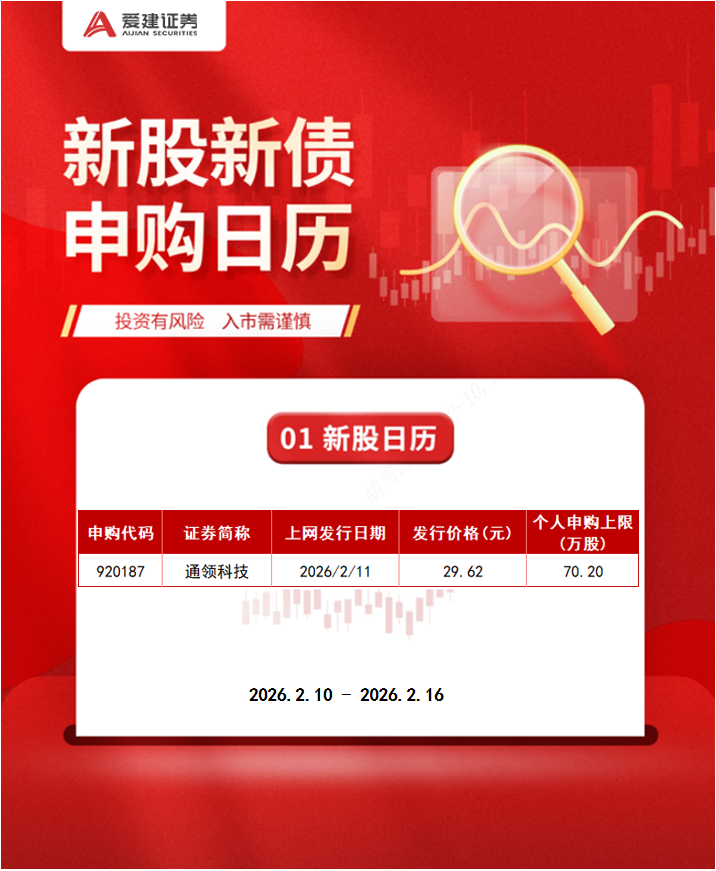
新股新债日历|2.10—2.16
Xin Lang Cai Jing· 2026-02-11 10:16
Summary of Key Points Core Viewpoint - The article provides information on the upcoming IPO of Tongling Technology, including its issuance date, price, and subscription limits. Group 1: IPO Details - The IPO for Tongling Technology is scheduled for February 11, 2026, with a subscription period from February 10 to February 16, 2026 [1][2]. - The issuance price for Tongling Technology is set at 29.62 yuan per share [1][2]. - The maximum personal subscription limit for investors is 70,200 shares [1][2].
Narrow market sees select stocks shine as broader earnings remain muted: Rohit Srivastava
The Economic Times· 2026-02-11 08:52
Market Overview - The current earnings season highlights a selective nature in the Indian equity market, with only a few stocks showing strong performance while broader indices struggle [5] - The market is characterized by narrow leadership, where isolated pockets of strength are driving gains rather than a broad-based rally [5] Company Performance - Mahindra & Mahindra (M&M) and State Bank of India have shown better-than-expected performance, helping these stocks reach new highs despite overall market pressure [5] - The Nifty 50's overall earnings for the quarter have not been impressive, indicating a lack of broad-based growth [5] Investment Strategy - A cautious and tactical approach is recommended, with investors needing to be highly selective in their stock choices [5] - There are opportunities in underperforming segments like sugar, which may offer deep value despite being vague [3][5] - Continued weakness is noted in the technology sector, suggesting that investors should avoid trying to buy the dip and consider short opportunities instead [4][5] Market Dynamics - The market is rewarding select stock-specific stories, while broad-based participation remains limited, necessitating sharper stock selection and adaptability in strategies [4][5]
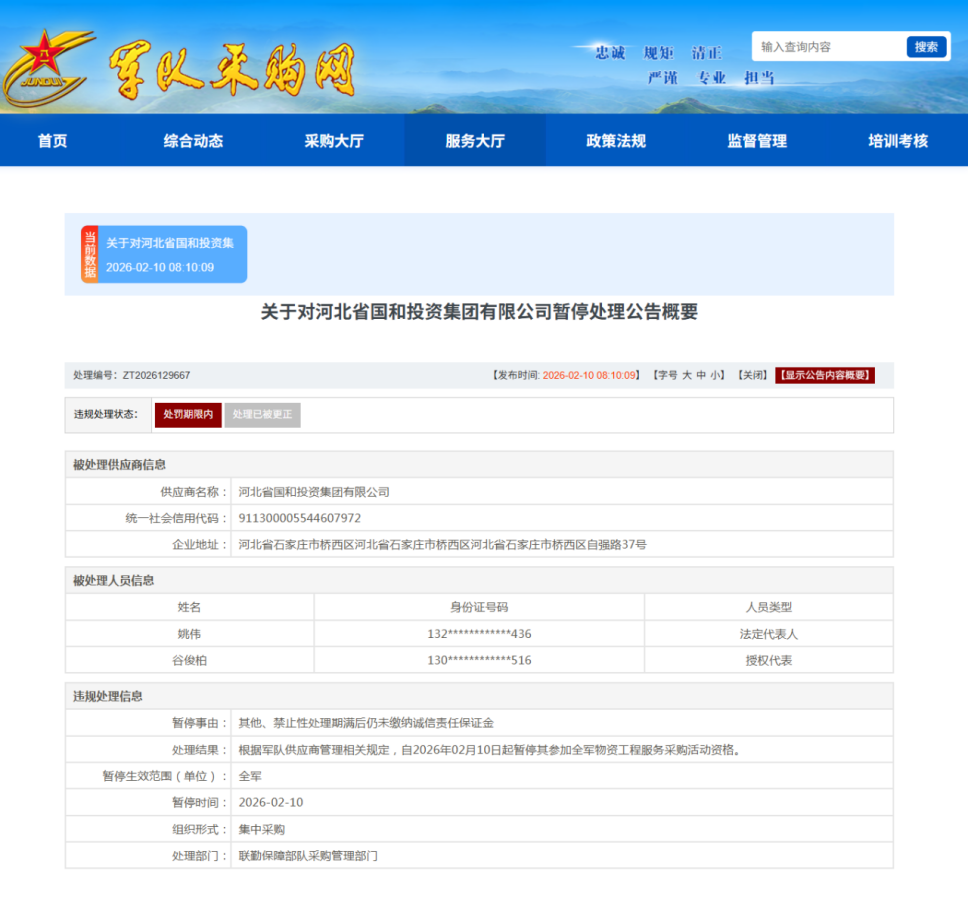
因违规失信,河北省国和投资集团有限公司被暂停军采
Qi Lu Wan Bao· 2026-02-10 10:10
Core Viewpoint - Hebei Guohe Investment Group Co., Ltd. has been suspended from participating in military procurement activities due to alleged violations of trust in procurement activities [1] Group 1: Company Overview - Hebei Guohe Investment Group Co., Ltd. was established in April 2010 and is funded by the Hebei State-owned Assets Supervision and Administration Commission [2] - The company is a wholly-owned subsidiary of Kailuan Group Co., Ltd. and was officially managed by the group in December 2014 [2] - As of 2020, the company underwent a merger and reorganization, managing 64 subordinate institutions with an annual revenue of 40 billion yuan and a registered capital of 1.8977 billion yuan [2] - The company employs over 1,400 staff and operates in various sectors including automotive sales and services, international and domestic trade of bulk commodities, IT, and hotel catering [2] Group 2: Legal and Financial Issues - The legal representative of Hebei Guohe Investment Group is Yao Wei, and the registered capital is approximately 189.78 million yuan [3] - On January 22, 2026, the company was listed as an executed party with an execution target of approximately 122.82 million yuan [3]
5 Well-Paying ‘New Collar’ Jobs in 2026
Yahoo Finance· 2026-02-09 09:55
Core Insights - The concept of "new collar" jobs is emerging, where skills and experience are prioritized over formal four-year degrees, particularly in tech and business sectors [1] Group 1: New Collar Jobs Overview - New collar jobs typically offer salaries exceeding $100,000 and are less susceptible to AI replacement [1] - These roles are characterized by a focus on practical skills rather than traditional educational qualifications [1] Group 2: Specific Job Roles and Data - **Sales Manager**: - Median annual pay: $159,660 - Median hourly pay: $76.76 - Top-earning pay: Approximately $239,200 - Projected job growth (2024-2034): 6% - Estimated AI replacement risk: 39% [6] - **Human Resources Manager**: - Median annual pay: $140,030 - Median hourly pay: $67.32 - Top-earning pay: Approximately $239,200 - Projected job growth (2024-2034): 5% - Estimated AI replacement risk: 24% [7] - **Computer Network Architect**: - Median annual pay: $138,060 - Median hourly pay: $66.38 - Top-earning pay: Approximately $239,200 - Projected job growth (2024-2034): 5% - Estimated AI replacement risk: 33% [7][8] - **General and Operations Manager**: - Median annual pay: $130,390 - Median hourly pay: $62.69 - Top-earning pay: Approximately $198,030 - Projected job growth (2024-2034): 12% - Estimated AI replacement risk: 39% [13] - **Additional Role**: - Median annual pay: $129,330 - Median hourly pay: $62.18 - Top-earning pay: Approximately $232,110 - Projected job growth (2024-2034): 6% - Estimated AI replacement risk: 36% [14]