计算机硬件

Search documents
联想蝉联三季度PC全球市占率第一:出货量同比增速超市场均值近2倍
IPO早知道· 2025-10-10 03:57
Core Viewpoint - The global traditional PC market is experiencing robust growth, with Lenovo significantly expanding its market share and leading the industry in Q3 2025 [2][3]. Market Performance - In Q3 2025, global traditional PC shipments reached 75.9 million units, a 9.4% increase from 69.3 million units in Q3 2024 [2][3]. - Lenovo's PC shipments totaled 19.4 million units, capturing a market share of 25.5%, up from 16.5 million units and 23.8% market share in the previous year, reflecting a 17.3% year-over-year growth [3][4]. - The gap between Lenovo and its closest competitor, HP Inc., has widened to 5.7 percentage points [3]. Competitive Landscape - Dell Technologies experienced only a 2.6% growth, with its market share declining from 14.2% to 13.3%, indicating Lenovo's superior execution in capturing high-value enterprise upgrade orders driven by Windows 11 [4]. - The current market dynamics highlight the importance of supply chain stability and operational flexibility for PC manufacturers [4]. Strategic Advantages - Lenovo's success is attributed to its efficient operations, including a unique ODM+ manufacturing model and a flexible "global/local" operational strategy, allowing for effective cost control and rapid delivery [4]. - The company's global resource and local delivery model has established a robust risk mitigation mechanism, enabling it to capitalize on global market demands while minimizing the impact of regional fluctuations [4]. Future Outlook - Lenovo's leading position in the PC market provides a solid foundation for its transition into the AI PC era, as the industry shifts from OS-driven cycles to innovation driven by AI capabilities [5][6]. - Canalys predicts that by 2028, AI PCs will account for 70% of shipments, with a compound annual growth rate of 44% from 2024 to 2028 [6]. - Lenovo is actively pursuing its "hybrid AI" vision, focusing on comprehensive AI solutions for both personal and enterprise applications, which includes high-performance AI PCs and cloud computing infrastructure [6][7]. - In the first quarter of FY 25/26, Lenovo's AI PC shipments constituted over 30% of its total PC shipments, positioning it as a leader in the Windows AI PC market [6][7].


IDC发布Q3全球PC市场报告:联想市占率达25.5%居首
Xin Lang Ke Ji· 2025-10-10 03:47
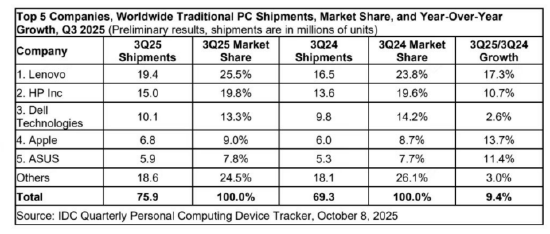
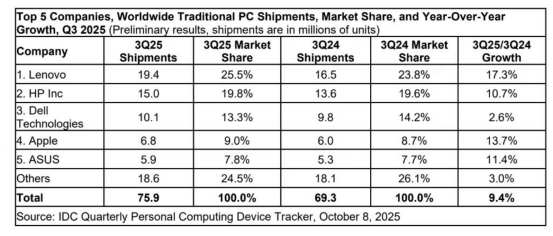
Core Insights - The global traditional PC market is projected to reach 75.9 million units in Q3 2025, reflecting a year-over-year growth of 9.4% from 69.3 million units in Q3 2024 [1][2]. Company Performance - Lenovo leads the global PC market with a shipment of 19.4 million units in Q3 2025, achieving a market share of 25.5% and a year-over-year growth of 17.3%, surpassing the overall market growth rate [2]. - HP Inc. follows with 15.0 million units shipped, holding a market share of 19.8% and a growth rate of 10.7% [2]. - Dell Technologies shipped 10.1 million units, with a market share of 13.3% and a modest growth of 2.6% [2]. - Apple and ASUS reported shipments of 6.8 million and 5.9 million units, respectively, with growth rates of 13.7% and 11.4% [2]. - The "Others" category accounted for 18.6 million units, representing 24.5% of the market share with a growth of 3.0% [2]. AI PC Market Trends - Canalys forecasts that AI PC shipments will account for 70% of the market by 2028, with a compound annual growth rate of 44% from 2024 to 2028 [3]. - Lenovo's AI PC shipments already represent over 30% of its total PC shipments, positioning the company as a leader in the Windows AI PC market [3]. - In China, AI PC shipments have reached 27% of total notebook shipments, highlighting significant growth potential in this segment [3].
戴尔上调长期收入增长预测,路透社提示竞争加剧对利润率构成压力
Huan Qiu Wang· 2025-10-10 00:53
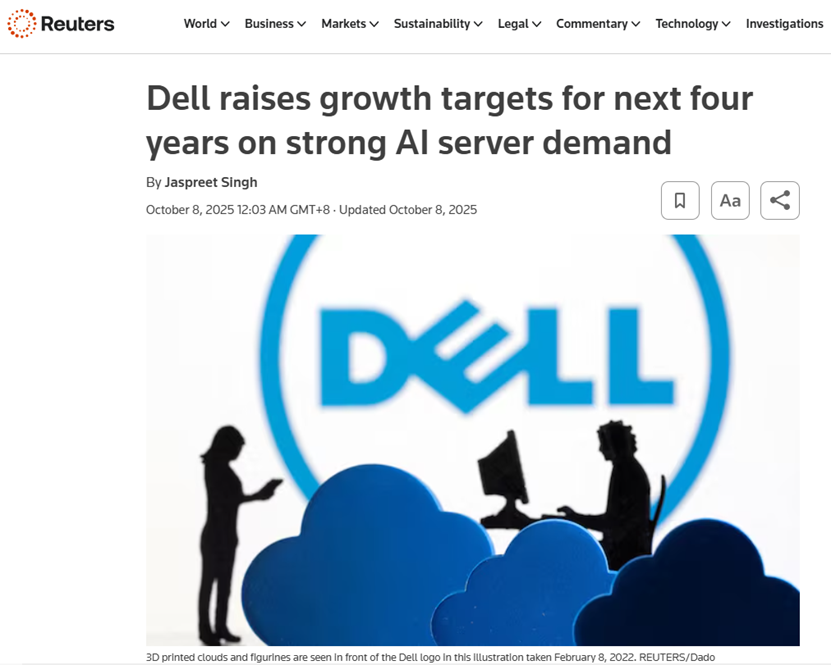
Core Insights - Dell Technologies has raised its long-term revenue and profit growth forecasts, with expected annual revenue compound growth rate increasing from 3%-4% to 7%-9%, driven by demand for AI products [1] - The company has nearly doubled its adjusted annual earnings per share growth forecast from 8% to at least 15% [1] - A strong personal computer upgrade cycle is anticipated as Microsoft ends support for Windows 10, benefiting PC manufacturers like Dell [1] Group 1 - The demand for AI and the company's offerings for large-scale deployment of intelligent computing, storage, and networking are key drivers of growth [1] - Despite strong demand for AI servers boosting revenue, increased competition and rising production costs are putting pressure on profit margins, raising investor concerns [3]

美国PC市场被关税“绊住” 全球其他市场双位数增长
Di Yi Cai Jing· 2025-10-09 09:45
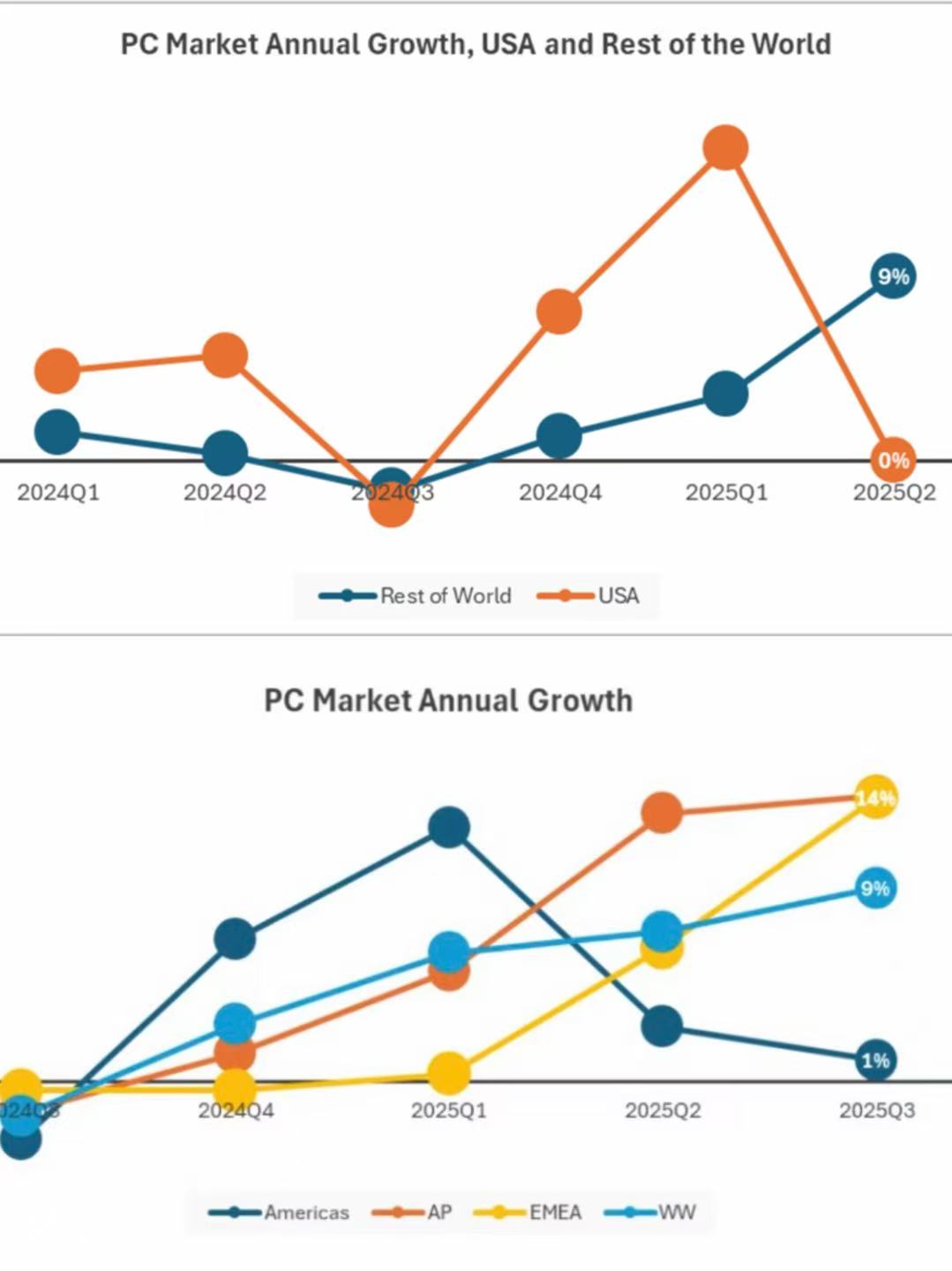
Core Insights - Global PC shipments are experiencing growth, with a 9.4% year-over-year increase in Q3 2025, totaling 75.9 million units. However, the U.S. market is facing stagnation due to tariffs and reduced consumer spending [1][4]. Market Performance - The U.S. PC market showed zero growth in Q2 2025, while other regions experienced a 9% increase. In Q3, the Americas saw only a 1% growth [1][3]. - The Asia-Pacific and EMEA regions reported robust demand, with both achieving a 14% growth in Q3 2025 [4]. Factors Driving Growth - Key drivers for global PC market growth include the migration to Windows 11, a refresh cycle initiated during the pandemic, and a new wave of demand driven by AI [4][6]. - The GIGA Education Project in Japan and government subsidies in China are contributing to increased PC sales in their respective markets [4]. Company Performance - Lenovo leads the global PC market with shipments of 19.4 million units and a market share of 25.5%, reflecting a 17.3% year-over-year growth. HP, Dell, Apple, and ASUS follow, with varying growth rates [5]. - HP's shipments reached 15 million units, growing by 10.7%, while Dell's growth was the lowest among the top five at 2.6% [5]. Market Dynamics - The current demand surge is benefiting leading manufacturers with efficient supply chains, while smaller brands face increased competitive pressure [6]. - Companies are considering shifting focus to emerging markets and enhancing supply chain flexibility in response to global trade complexities [6]. Future Outlook - AI is projected to be a significant growth driver, with expectations that AI PC shipments could account for 70% of the market by 2028, growing at a compound annual growth rate of 44% from 2024 to 2028 [6].
一度涨超10%!联想集团股价走高:收购Infinidat计划预计年底完成 PC市占率蝉联全球第一
Zhi Tong Cai Jing· 2025-10-09 09:18
Core Insights - Lenovo Group has demonstrated strong performance in the Hong Kong stock market, closing at HKD 12.56 with a 7.26% increase, significantly outperforming the Hang Seng Tech Index [1] Group 1: Acquisition of Infinidat - Lenovo's acquisition of high-end storage company Infinidat is progressing well, expected to be completed by the end of 2025, which is seen as a key move to enhance its data center infrastructure [2] - The acquisition will fill Lenovo's gap in high-end storage solutions, complementing its existing offerings in entry-level and mid-range storage, as well as AI servers [2] - Infinidat's new InfiniBox G4 product line features a 30% reduction in hardware size and a 29% decrease in entry price while maintaining low latency and enhanced security features [2] Group 2: PC Business Performance - Lenovo's PC business remains robust, with expectations of double-digit growth in Q4, supported by a market share increase to 25.5%, widening the gap with second-ranked HP to 5.7 percentage points [3] - The company has outperformed competitors like Dell, which saw only 2.6% growth, indicating Lenovo's superior execution in capturing high-value enterprise upgrade orders driven by Windows 11 and AI capabilities [3] - Lenovo's year-on-year growth rate of 17.3% surpasses the industry average of 9.4%, positioning it as a leading growth engine among the top five global PC manufacturers [3] Group 3: AI Strategy and Market Position - Lenovo's AI initiatives are beginning to show results in the PC sector, with innovations like the Tianxi personal super intelligent agent expanding the application scenarios and functionalities of AI hardware [4] - The company is expected to maintain double-digit sales growth over the next two years, driven by increasing demand for AI servers and an expanding market share in personal computers [6] Group 4: Institutional Confidence - Recent positive developments have led to widespread institutional support, with 15 investment banks issuing buy ratings and an average target price of HKD 14.63 [5] - Goldman Sachs has included Lenovo in its latest buy list, raising its target price from HKD 13.28 to HKD 14.9, reflecting a 23% increase in profit forecasts for FY2025 due to anticipated revenue growth from AI PC and server expansions [5] - CICC has also raised its target price to HKD 14.8, maintaining an "outperform" rating, with expectations of continued market share improvement in the edge AI market [6]
联想集团港股逆势大涨7.3% 收购Infinidat、PC出货量创新高等多利好加持
Ge Long Hui· 2025-10-09 09:13
Core Viewpoint - Lenovo Group's stock surged by 7.3% in the Hong Kong market, driven by positive developments including the acquisition of Infinidat and record-high PC shipment volumes, reflecting strong market confidence in the company's growth trajectory [1] Group 1: Acquisition of Infinidat - Lenovo's acquisition of high-end storage company Infinidat is progressing well, with completion expected by the end of 2025, seen as a key move to enhance its data center infrastructure [2] - The acquisition addresses Lenovo's previous gap in high-end storage solutions, complementing its existing offerings in entry-level and mid-range storage, as well as AI servers [2] - Infinidat's new InfiniBox G4 product line features a 30% reduction in hardware size and a 29% decrease in entry price while maintaining low latency and enhanced security features, indicating strong potential for market application [2] Group 2: PC Business Performance - Lenovo's PC business remains robust, with a projected shipment of 19.4 million units in Q3 2025, capturing a market share of 25.5%, widening the gap with HP to 5.7 percentage points [3] - The company's growth rate of 17.3% significantly outpaces the industry average of 9.4%, positioning Lenovo as a leading growth engine among top global PC manufacturers [3] - Lenovo's effective execution in capturing high-value enterprise upgrade orders driven by Windows 11 and AI capabilities further solidifies its market position [3] Group 3: AI Strategy and Market Outlook - Lenovo's AI initiatives, including the Tianxi personal superintelligence, are expanding the application scenarios and functional boundaries of AI hardware, enhancing its competitive edge in the AI PC market [4] - Analysts are optimistic about Lenovo's growth prospects, with 15 investment banks issuing buy ratings and an average target price of HKD 14.63, reflecting confidence in the company's AI PC and server expansion [5][6] - The data center segment is expected to rapidly grow, driven by strong AI server demand, with projections for double-digit sales growth over the next two years [6]
IDC三季度全球PC市场报告:整体出货量增9.4% 联想以17.3%增速领跑
Zheng Quan Shi Bao Wang· 2025-10-09 08:25
Core Insights - The global traditional PC market is showing sustained vitality with a shipment total of 75.9 million units in Q3 2025, reflecting a year-on-year growth of 9.4% compared to 69.3 million units in the same period last year [1] - Lenovo continues to lead the global PC market with a shipment volume of 19.4 million units and a market share of 25.5%, achieving a year-on-year growth of 17.3%, significantly outpacing the market average [1] - The competitive landscape indicates that Lenovo is effectively capturing market share from competitors, particularly in the high-value enterprise upgrade orders driven by Windows 11 [1] Group 1: Market Performance - The PC market is transitioning from an operating system-driven cycle to an innovation cycle driven by AI capabilities and new application scenarios [2] - Canalys predicts that by 2028, AI PC shipments will account for 70% of the market, with a compound annual growth rate of 44% from 2024 to 2028 [2] - Lenovo's AI PC shipments have surpassed 30% of its total PC shipments, positioning it as the leader in the global Windows AI PC market [3] Group 2: Strategic Initiatives - Lenovo's "global resources and local delivery" model has established an effective risk hedging mechanism, allowing the company to maximize benefits from global market demands while mitigating regional market fluctuations [2] - The company is actively executing its "hybrid AI" vision, focusing on a comprehensive stack of solutions that encompass personal and enterprise AI, covering high-performance AI PCs to cloud computing [2] - In the Chinese market, AI PC shipments account for 27% of total notebook shipments, highlighting the growing significance of AI in the region [3]
戴尔CEO迈克尔·戴尔:AI数据中心建设终有上限
Huan Qiu Wang Zi Xun· 2025-10-09 05:41
Core Insights - The CEO of Dell Technologies, Michael Dell, expressed that while there is a strong demand for computing power in AI data centers, the construction of these facilities will eventually reach a limit, although no signs of overcapacity are currently visible [1][4] - AI-related business is becoming a significant growth driver for Dell, with server networking revenue increasing by 58% last year and further accelerating to 69% in the last quarter [1][4] Market Performance - Dell raised its long-term revenue and profit forecasts, increasing the annual revenue growth expectation from 3%-4% to 7%-9%, and adjusted the diluted earnings per share expectation from $8 to $15 [4] - The company plans to achieve $20 billion in AI server shipments by fiscal year 2026, which would be double the volume from the previous year [4] Energy Supply Challenges - Energy supply issues are emerging as a significant constraint for the industry, with clients like OpenAI indicating that energy availability is a limiting factor for their operations [4][5] - The U.S. Energy Information Administration projects an addition of 63 gigawatts of electricity to the national grid by 2025, with OpenAI and NVIDIA's planned 10-gigawatt data center expected to consume about 16% of this new energy supply [5]

IDC发布Q3全球PC市场报告:联想以17.3%增速领跑行业 稳居全球市占率第一
智通财经网· 2025-10-09 03:53
Core Insights - The global traditional PC market is showing strong growth, with shipments reaching 75.9 million units in Q3 2025, a 9.4% increase from 69.3 million units in Q3 2024 [1][2] - Lenovo has maintained its position as the leading PC manufacturer, achieving a market share of 25.5% with shipments of 19.4 million units, reflecting a 17.3% year-over-year growth, significantly outpacing the market average [1][2] Company Performance - Lenovo's performance is highlighted by its ability to capture market share from competitors, with a notable increase in its lead over HP Inc., which holds a 19.8% market share [2] - HP Inc. and Apple also showed growth, with HP's shipments increasing by 10.7% and Apple's by 13.7%, while Dell's growth was only 2.6%, indicating a decline in market share from 14.2% to 13.3% [2][3] Market Dynamics - The current demand surge is attributed to a replacement cycle driven by Windows 11, with Lenovo demonstrating superior execution in capturing high-value enterprise orders [3] - Supply chain stability and operational flexibility are critical for PC manufacturers' market performance, with Lenovo's unique ODM+ manufacturing model and global/local operational strategy contributing to its success [3] Future Outlook - The AI PC segment is expected to grow significantly, with Canalys predicting that AI PC shipments could account for 70% of the market by 2028, and a compound annual growth rate of 44% from 2024 to 2028 [4] - Lenovo is actively pursuing its "hybrid AI" vision, which encompasses a comprehensive AI infrastructure aimed at providing secure and reliable AI-driven work environments [4][5] Competitive Advantage - Lenovo's current market leadership positions it well to lead in the emerging AI PC era, supported by strong financial and strategic foundations [3][4] - The company is leveraging its existing market advantages through increased R&D investment to ensure long-term competitive advantages in the AI PC growth segment [5]
投行集体唱多,戴尔股价目标接连上调,股价单日大涨9%
美股IPO· 2025-10-08 23:59
Core Viewpoint - Analysts are optimistic about Dell's leadership in the enterprise AI sector, which is expected to translate into sustainable revenue and profit growth, leading to multiple target price increases from various investment banks [2][3][15]. Price Target Adjustments - UBS raised Dell's target price from $155 to $186, a 20% increase, while maintaining a buy rating [2][3]. - Mizuho Securities increased its target price from $160 to $170 [2][3]. - Melius Research set a target price of $200, reflecting strong confidence in Dell's AI business growth prospects [2][3]. Financial Guidance and Performance - Dell has significantly raised its long-term financial guidance for fiscal years 2026 to 2030, projecting a compound annual growth rate (CAGR) of 7-9%, up from the previous 3-4% forecast [7]. - The company has also increased its non-GAAP diluted earnings per share (EPS) growth target to 15% or higher, nearly doubling the previous target [8]. - Dell plans to return approximately 80% of its annual free cash flow to shareholders and aims for at least a 10% annual increase in quarterly dividends until fiscal year 2030 [9]. Capital Structure and Funding - Dell successfully completed a $4.5 billion issuance of senior notes, maturing between 2029 and 2036, to support its financial strategy and optimize its capital structure [10]. Growth Drivers - The core growth driver for Dell's performance is its Infrastructure Solutions Group (ISG), particularly the AI server business, which is expected to grow at a CAGR of 11-14%, with the AI server segment projected to grow at an impressive 20-25% [11]. - Analysts from Mizuho noted that Dell's leading position in the enterprise AI market could lead to even higher growth than currently anticipated, as approximately 85% of customers are expected to deploy generative AI on-premises within the next two years [12]. Client Solutions Group Performance - In contrast, Dell's Client Solutions Group (CSG) is expected to achieve stable annual growth of 2-3%, focusing on gaining market share in the high-end commercial PC segment [13]. Analyst Sentiment - Investment banks are generally optimistic about Dell's strong performance in the AI sector and its revised financial guidance [15]. - UBS raised its long-term EPS CAGR forecast for Dell from 7% to at least 12% [16]. - Melius Research believes that the adoption of AI by enterprises will drive Dell's EPS growth faster than expected [17]. - Mizuho maintained an "Outperform" rating while raising its target price, emphasizing Dell's strong momentum in enterprise and sovereign AI [18]. - Raymond James maintained its "Outperform" rating with a target price of $152, noting that Dell's AI-related business activities have significantly exceeded expectations [20].