保险经纪

Search documents
AI“淘汰焦虑”愈演愈烈!华尔街如今的交易逻辑:只要怕被AI替代,先抛了再说
美股IPO· 2026-02-11 04:01
Core Viewpoint - The market is experiencing heightened anxiety regarding the potential disruption caused by artificial intelligence (AI), leading to significant stock sell-offs across various sectors, particularly those perceived to be at risk of being replaced by AI technologies [1][3][4]. Group 1: Market Reactions - A recent sell-off was triggered by the launch of a tax strategy tool by Altruist Corp, resulting in stock price declines of over 7% for major firms like Charles Schwab, Raymond James, and LPL Financial, marking some of the largest single-day drops since last April [3]. - The market sentiment has shifted from seeking AI winners to rapidly withdrawing from any companies that exhibit even a slight risk of being replaced by AI [8]. - The introduction of AI products has led to widespread panic, with significant declines in stock prices across software, financial services, asset management, and legal services sectors [9][10]. Group 2: Industry Perspectives - Gabelli Funds manager John Belton noted that companies facing potential disruption are experiencing indiscriminate sell-offs, reflecting a broader market fear [4]. - The software industry is particularly affected, with AI companies like Anthropic launching new tools that have caused stock prices to plummet across multiple sectors [9]. - There is skepticism regarding the market's rapid shift from fearing an AI bubble to fearing its disruptive potential, with some experts suggesting that the actual impact of technological disruption often unfolds more slowly than anticipated [11][12]. Group 3: Future Outlook - The future of AI technology adoption remains uncertain, with historical challenges in the banking sector from cryptocurrencies and electronic services failing to disrupt its dominance [10]. - Experts caution against premature conclusions about AI's impact, emphasizing that the AI revolution is still in its early stages and that the market is eager to make judgments without sufficient evidence [13].


周一保险经纪崩了、周二财富管理崩了,美股遍寻“下一个AI受害者”
华尔街见闻· 2026-02-11 03:38
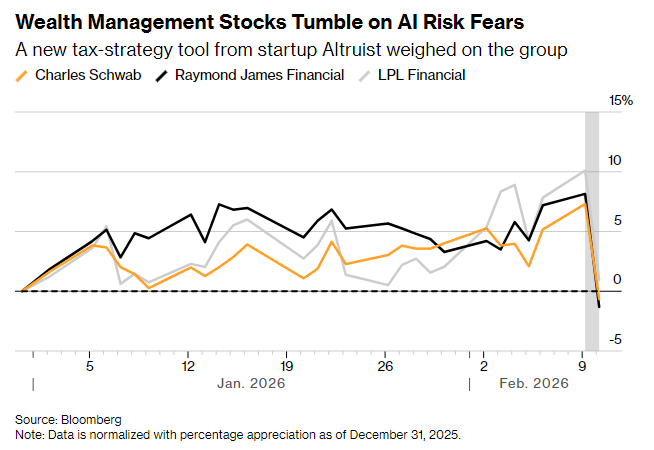
Core Viewpoint - The launch of Altruist Corp.'s AI tool for tax strategy planning has raised concerns about the future of traditional wealth management firms, indicating a potential disruption in their core business model [1][2][4]. Group 1: Market Reaction - Following the announcement of Altruist's AI tool, shares of major wealth management firms experienced significant declines, with Charles Schwab (SCHW) dropping 9.5% intraday and closing down 7.4%, while Raymond James Financial Inc. (RJF) and LPL Financial Holdings Inc. (LPLA) saw declines of over 9% and 11% respectively [2]. - The sell-off in wealth management stocks reflects broader market anxieties regarding AI's potential to disrupt financial advisory and wealth management services, leading to fears of efficiency gains being eroded by competition and long-term fee compression [4][6]. Group 2: Broader Industry Impact - The threat posed by AI to traditional business models is spreading across various sectors, with wealth management stocks being the latest to feel the impact [5]. - Prior to the wealth management stock declines, insurance brokerage stocks had already faced significant losses, with the S&P 500 Insurance Index dropping 3.9%, marking its largest single-day decline since October 2025 [7]. - The introduction of new AI tools by companies like Insurify has raised concerns about the potential threat to the consulting business of insurance brokers, although some analysts view these tools as efficiency enhancers rather than existential threats [9]. Group 3: Market Trends and Analyst Insights - The recent sell-off in stocks across software, financial services, and asset management sectors resulted in a combined market value loss of $611 billion [10]. - Since the launch of OpenAI's ChatGPT, the potential for AI disruption has been a hot topic, with investors previously focusing on beneficiaries of AI advancements, such as semiconductor and network equipment companies [12]. - Despite the current market turmoil, analysts project a 19% growth in earnings for S&P 500 software and services constituents by 2026, indicating a potential recovery in the sector [14].




AI“淘汰焦虑”愈演愈烈!华尔街如今的交易逻辑:只要怕被AI替代,先抛了再说
智通财经网· 2026-02-11 02:49
Core Viewpoint - The market is experiencing heightened fear regarding the potential disruption caused by artificial intelligence (AI), leading to significant stock price declines across various sectors, particularly in wealth management and software companies [1][3]. Group 1: Market Reaction - A recent sell-off was triggered by the launch of a tax strategy tool by Altruist Corp, resulting in stock price drops of over 7% for major firms like Charles Schwab, Raymond James, and LPL Financial [1]. - This sell-off reflects a broader market sentiment of "sell first, ask questions later," as concerns grow over the potential for AI to disrupt entire industries [1][3]. - The stock market has seen significant volatility, with companies facing indiscriminate selling if they are perceived to have any risk of being replaced by AI [3][4]. Group 2: Industry Impact - The introduction of AI products has shifted investor focus from identifying AI winners to quickly exiting any companies that may face replacement risks [3]. - The software industry is particularly affected, with stock prices plummeting across various sectors, including financial services and legal services, following the launch of new AI tools [3][4]. - Altruist's CEO highlighted that the technology used in their product could potentially replace many roles in wealth management, emphasizing the competitive threat posed by AI [4]. Group 3: Market Sentiment and Future Outlook - There is skepticism among analysts regarding the rapid shift from concern over an AI bubble to fear of its disruptive potential, with some suggesting that technological disruption often takes longer to materialize than anticipated [4][5]. - The current market reaction indicates a heightened sensitivity to any negative signals, with stock prices dropping significantly on minor adverse news [5]. - Experts caution against making premature conclusions about the long-term impact of AI, noting that the AI revolution is still in its early stages [5].
未知机构:美股收盘平静归来标普500指数收盘上涨47个基-20260211
未知机构· 2026-02-11 02:15
Summary of Key Points from Conference Call Industry Overview - The conference call discusses the performance of the U.S. stock market, particularly focusing on major indices such as the S&P 500, Nasdaq 100, and Russell 2000, indicating a generally positive market sentiment with slight fluctuations in various sectors [1][2][5]. Core Insights and Arguments - The S&P 500 index closed up by 47 basis points at 6,965 points, while the Nasdaq 100 index rose by 77 basis points to 25,268 points, reflecting a recovery in the market [1][2]. - Bitcoin experienced a decline of 29 basis points, trading at $70,455, amidst a calm market environment following previous volatility [3]. - The software sector showed a rebound of 3%, with a notable increase in buy orders as the market stabilized after heavy selling pressure the previous week [3]. - Upcoming economic data releases, including retail sales, non-farm payrolls (NFP), and consumer price index (CPI), are anticipated to impact market dynamics significantly [3]. - Goldman Sachs' economic team projected a lower-than-expected increase in January employment numbers, estimating a rise of 45,000 jobs compared to the market consensus of 70,000 [3]. Additional Important Content - Asset management firms and hedge funds emerged as net buyers, driven by increased demand for technology stocks and a lack of selling pressure in financial stocks [4]. - The insurance brokerage sector faced declines due to uncertainty surrounding the implications of AI applications approved for use in the industry [4]. - Bell Company’s stock fell by 7% post-earnings report, despite meeting expectations, as it lowered revenue guidance for the upcoming quarter by approximately 3% [4]. - The derivatives market indicated a bearish sentiment towards S&P 500 futures, with estimated net selling ranging from $800 million to $11.2 billion depending on market scenarios [4]. - The overall trading activity in U.S. stock exchanges was lower than the average daily volume for the year, with 17.76 billion shares traded [5]. - The volatility index (VIX) decreased by 225 basis points to 17.35, suggesting a reduction in market anxiety [5]. - A significant portion of S&P 500 constituents, 65%, are currently in a buyback window, expected to rise to 75% soon, indicating increased corporate buyback activity [6]. - The market is showing signs of stabilizing, with a return to a bullish sentiment in options trading, particularly for short-term call options on the S&P 500 [6].
财富管理公司全线暴跌 新AI工具引发对行业前景忧虑
Xin Lang Cai Jing· 2026-02-10 18:22
Core Viewpoint - The launch of an AI tool by Altruist Corp. for tax strategy formulation has raised concerns in the market about the potential disruption to traditional financial advisors, leading to a significant drop in tax planning and wealth management stocks [1][2]. Group 1: Market Reaction - Charles Schwab experienced a decline of 8.1%, while other wealth management stocks also suffered losses, including Raymond James Financial Inc. down 8.5%, LPL Financial Holdings Inc. down 8.4%, and Stifel Financial Corp. down 7.2% [1][2]. - The sell-off appears to be linked to market fears regarding the disruption of financial consulting and wealth management models by artificial intelligence [1][2]. Group 2: Investor Concerns - Investors are primarily worried about the potential erosion of efficiency gains due to increased competition, long-term fee compression, and possible shifts in market share [1][2]. - Similar concerns were observed in the insurance brokerage sector, which faced significant declines following the introduction of a rate comparison AI tool by Insurify [1][2].
移动营业厅也卖保险?通信运营商正在切入保险分销新场景
2 1 Shi Ji Jing Ji Bao Dao· 2026-02-10 03:26
Core Insights - China Mobile has launched two insurance products, "Mobile Medical Insurance" and "Mobile Family Insurance," in select offline service centers, marking a significant move towards integrating insurance into its service offerings [1][2] - The insurance products are designed to leverage China Mobile's extensive customer base and service frequency, aiming to create a "communication + finance + life services" ecosystem [1][4] Product Overview - "Mobile Medical Insurance" focuses on basic medical coverage and cost reimbursement, with annual fees ranging from 199 yuan to 699 yuan [2] - "Mobile Family Insurance" targets comprehensive family protection and daily risk management, with annual fees between 69 yuan and 199 yuan [2] Strategic Positioning - China Mobile's entry into the insurance sector is supported by its long-standing involvement in insurance brokerage since 2001, establishing a foundation for its current offerings [2][3] - The company has developed a product matrix that includes personal accident, health, and family property insurance, differentiating its offerings by closely aligning them with communication and daily life scenarios [3][4] Channel Advantages - China Mobile utilizes its insurance brokerage license to implement its insurance business, allowing it to embed insurance into its core operations without assuming underwriting risks [4] - The company benefits from a vast user base, stable app engagement, and extensive offline service center coverage, enabling low-cost access to underserved markets [4][5] Technological Integration - Advanced technologies such as 5G, big data, and AI support precise pricing, intelligent underwriting, and fraud prevention, facilitating a seamless integration of insurance into communication services and other digital platforms [5] Market Context - The insurance market in China is rapidly evolving, with significant growth potential, particularly in internet insurance, which aligns well with China Mobile's strategic objectives [3][9] - The telecommunications industry is facing challenges such as user growth slowdown and increased competition, prompting operators like China Mobile to explore insurance as a new growth avenue [9] Competitive Landscape - Other major telecom operators in China, including China Unicom and China Telecom, are also entering the insurance market, albeit with different strategies and levels of engagement [7][8] - China Mobile's approach appears more integrated and robust compared to its competitors, maintaining a strong presence in the insurance sector without showing signs of decline [8]

科技股,大涨!谷歌200亿美元大动作,加码AI支出!
Xin Lang Cai Jing· 2026-02-10 00:24
大型科技股多数上涨,甲骨文大涨超9%。 投资者还关注劳工统计局推迟至本周三(2月11日)将发布的1月份就业报告。该报告原定于上周五(2 月6日)发布,但因部分政府关门而推迟。 谷歌拟发行200亿美元债券加码AI支出 当地时间2月9日(周一),美股三大指数集体收涨,道指涨0.04%,再创历史新高,纳指涨0.9%,标普 500指数涨0.47%。大型科技股多数上涨,甲骨文涨超9%,AMD、微软、博通涨超3%,英伟达、Meta 涨超2%,特斯拉、台积电涨超1%。 美股财报继续密集出炉,可口可乐和福特汽车均定于周二公布财报。分析师称,如果本周的企业财报表 现良好,市场近期从科技股轮动的趋势可能会再次上演。 大型科技股多数上涨,甲骨文涨超9%,AMD、微软、博通涨超3%,英伟达、Meta涨超2%,特斯拉、 台积电涨超1%。美光科技跌近3%,苹果跌超1%,奈飞、亚马逊、安森美半导体小幅下跌。 谷歌微涨0.4%。据媒体报道,谷歌母公司Alphabet计划通过其美元债券发行筹集200亿美元,规模高于 最初预计的150亿美元。知情人士称,Alphabet周一进行的美元债券发行已吸引超过1000亿美元的订 单。 债券最多分为七个期 ...






科技股,大涨!谷歌200亿美元大动作,加码AI支出!
证券时报· 2026-02-10 00:21
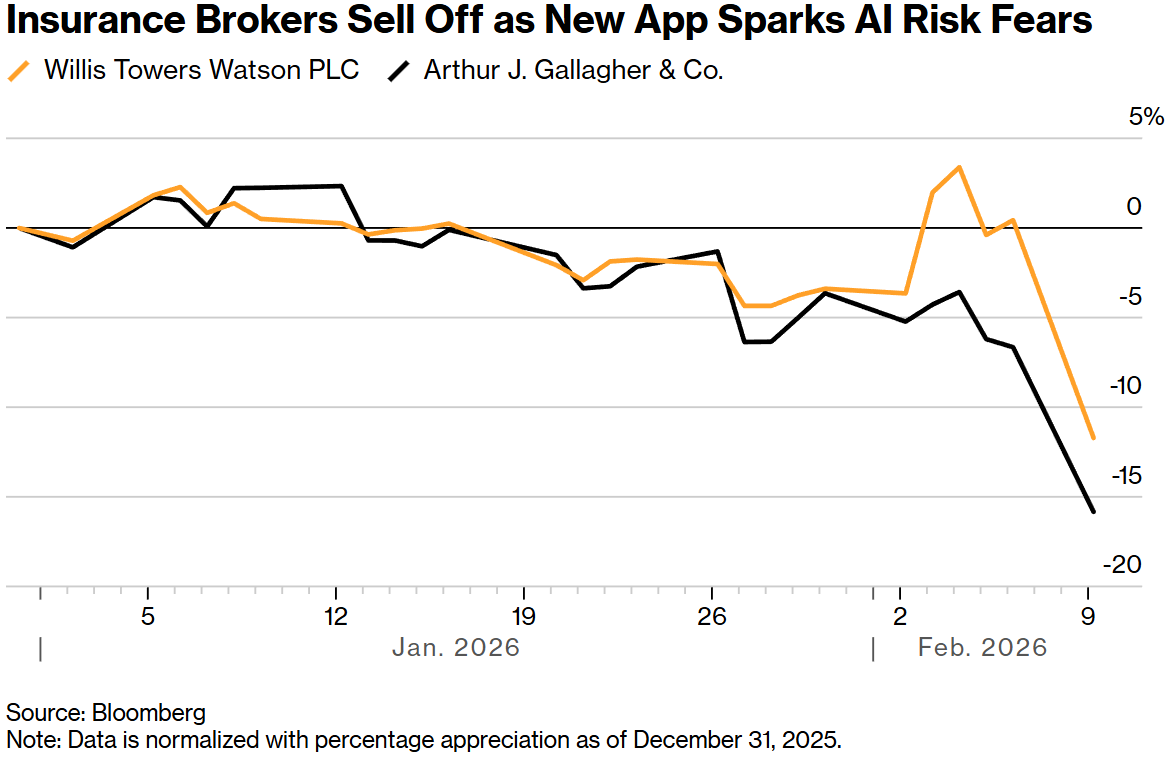
Group 1: Market Performance - Major tech stocks mostly rose, with Oracle up over 9%, AMD, Microsoft, and Broadcom up over 3%, Nvidia and Meta up over 2%, and Tesla and TSMC up over 1% [1][3] - The Dow Jones Industrial Average rose 0.04%, reaching a new all-time high, while the Nasdaq increased by 0.9% and the S&P 500 rose by 0.47% [1] Group 2: Corporate Earnings and Reports - Coca-Cola and Ford are scheduled to release their earnings reports on Tuesday, with analysts suggesting that strong corporate earnings this week could lead to a resurgence in tech stock rotation [1] - The U.S. Labor Department's January employment report, originally set for release on February 6, has been postponed to February 11 due to a government shutdown [1] Group 3: Google and AI Investments - Alphabet plans to issue $20 billion in bonds to fund AI expenditures, exceeding the initial estimate of $15 billion, with the bond offering attracting over $100 billion in orders [2][3] - The bond issuance will be divided into seven parts, with the longest maturing in 2066, priced at a spread of 0.95 percentage points over U.S. Treasuries [3] - Alphabet's capital expenditures for the year could reach $185 billion, significantly higher than Wall Street's expectations [3] Group 4: Capital Expenditure Plans - Major tech companies including Google, Meta, Microsoft, and Amazon are expected to collectively spend $650 billion this year, primarily on expanding AI infrastructure [4] Group 5: Oracle's Bond Issuance - Oracle raised $25 billion through a bond issuance, with peak orders reaching $129 billion, setting a record [5] Group 6: OpenAI Financing - OpenAI is in discussions for a funding round potentially reaching $100 billion, with Microsoft, Nvidia, and Amazon expected to contribute, including a possible $50 billion investment from Amazon [6] - Additional funding may come from SoftBank, which has discussed investing an additional $30 billion [6] Group 7: Insurance Sector Impact - U.S. insurance brokerage stocks fell sharply due to concerns over AI tools from Insurify, with the S&P 500 insurance index dropping 3.89%, marking its largest single-day decline since October [8] - Willis Towers Watson saw the worst performance, down 12.10%, followed by Arthur J Gallagher down 9.84% and Aon down 9.27% [8]


美东时间周一美股三大指数集体收涨 甲骨文涨超9% Vista黄金涨超14%
Jin Rong Jie· 2026-02-10 00:04
Market Performance - The three major U.S. stock indices closed higher, with the Dow Jones Industrial Average up 0.04%, the S&P 500 up 0.47%, and the Nasdaq up 0.9% [1] Sector Performance - Most large tech stocks saw gains, with Oracle rising over 9%, Microsoft up 3%, and Nvidia up 2.5% [2] - The cryptocurrency mining, precious metals, and non-ferrous metals sectors performed well, with Vista Gold up over 14%, Hut 8 up over 7%, Pan American Silver up over 6%, Alcoa and Royal Gold both up over 5%, and Southern Copper up over 4% [2] - Conversely, the department store and insurance brokerage sectors showed weakness, with Macy's and Kohl's both down over 5%, and the American Reinsurance Group down over 2% [2] Chinese Stocks - The Nasdaq Golden Dragon China Index rose by 0.12%, with Century Internet and Pony.ai among the top gainers, while Li Auto and Bilibili experienced declines [2]

AI颠覆潮席卷金融业:Insurify新工具上线,美国保险经纪股遭遇“黑色星期一”
智通财经网· 2026-02-09 23:27
Group 1 - The core concern is the market's reaction to Insurify's launch of an AI tool, which has raised fears of disruption in the insurance industry, leading to significant stock sell-offs among U.S. insurance brokerage firms [1][4] - The S&P 500 insurance sector index closed down 3.9%, marking the largest decline since October of the previous year [1] - Willis Towers Watson PLC experienced the worst performance, with a closing drop of 12%, the most severe trading day since November 2008 [1] Group 2 - Following Willis Towers Watson, Arthur J Gallagher & Co. and Aon Group saw declines of 9.9% and 9.3%, respectively [1] - Analyst Matthew Palazola noted that while the new AI tools may pose a threat to some consulting aspects of insurance brokerage firms, they are more likely to act as "efficiency multipliers" rather than existential threats [4] - Insurify's application, which utilizes ChatGPT to compare auto insurance rates based on various inputs, was launched on February 3 [4]