
Trade

Search documents
中国实地观察_聚焦义乌-H125 出口同比增长 25%,而中国整体出口增长 6%-China on the ground _Yiwu in focus—H125 exports up 25% YoY vs China's 6%..._
2025-08-05 03:19
Summary of Yiwu's Export Performance and Company Outlook Industry Overview - **Industry**: Yiwu's export market - **Key Performance**: Yiwu's exports increased by 25% year-over-year (YoY) in the first half of 2025, significantly outperforming China's overall export growth of 6% YoY [1][2] Core Insights - **Export Growth**: - Yiwu's exports reached Rmb 359 billion in H125, with market procurement trade exports making up 83% of this total [1] - The growth rate is expected to sustain around 20% YoY in July 2025 [1] - Yiwu's imports also saw a rise of 28% YoY to Rmb 47 billion [1] - **Comparative Growth**: - From 2018 to 2022, Yiwu's export growth was approximately 1.5 times that of China. Since 2023, this has accelerated to over 2 times [2] - The growth is attributed to Yiwu's focus on labor-intensive products, which have high production costs overseas, leading to low replaceability [2] - **Product Categories**: - The top five export categories from Yiwu include miscellaneous products (20%), textiles (18%), base metals (13%), machinery (13%), and plastics (12%) [3][10] - Popular products within miscellaneous categories include toys, thermos cups, and plastic toys [11] - **Export Destinations**: - The primary export destinations are the US (22%), Iraq (6%), Mexico (4%), Saudi Arabia (3%), and Chile (3%) [3] Company-Specific Insights - **Yiwu CCC (600415.SH)**: - The company is projected to achieve a 30% compound annual growth rate (CAGR) in earnings per share (EPS) from 2025 to 2027, driven by visible rental income growth and expanding trade-service and import businesses [4][20] - **Market Position**: - Yiwu is recognized as the "world's supermarket," with over 2.1 million products available and more than 50% of merchants having nearby factories, enhancing merchant stickiness [2] Additional Considerations - **Economic Context**: - Despite the strong performance, potential risks include ongoing macroeconomic weaknesses, possible rent increases below expectations, and higher-than-expected US tariff hikes [20] - **Future Outlook**: - Yiwu's exports are expected to maintain double-digit growth in 2025, contrasting sharply with the broader Chinese economic forecast of only 1% growth [2] This summary encapsulates the key points regarding Yiwu's export performance and the outlook for Yiwu CCC, highlighting both opportunities and risks in the current economic landscape.

中国的三件事-China_ Three things in China
2025-10-20 01:19
Summary of Key Points from the Conference Call Industry Overview - The conference call primarily discusses the **Chinese manufacturing sector** and its economic indicators, particularly focusing on the **PMI (Purchasing Managers' Index)** and trade performance in Q2 2025. Core Insights and Arguments - **PMI Decline**: Both the NBS and S&P Global China manufacturing PMIs fell in July, with NBS dropping from 49.7 to 49.3 and S&P Global from 50.4 to 49.5, indicating a contraction in manufacturing activity [6][12][10] - **Trade Performance**: Despite escalating trade tensions with the US, total Chinese exports increased by **8.6% year-over-year in Q2**, with strong performance across most manufactured products [7][8] - **Economic Policy Outlook**: The July Politburo meeting indicated limited near-term easing measures, with a focus on curbing price competition and managing local government debt, suggesting a tightening impulse in some sectors [6][12] - **Government Support Initiatives**: Recent policies aimed at supporting consumption include childcare and elderly care subsidies, as well as the gradual rollout of free preschool programs [6] Additional Important Insights - **Impact of Weather on Activity**: Adverse weather conditions, including heat waves and heavy rainfall, negatively impacted July's economic activity, contributing to a notable decline in the NBS construction PMI from 52.8 to 50.6 [6] - **Future Expectations**: The expectation is for China's real GDP growth to slow in the second half of 2025 due to softening exports and a lack of significant policy easing, although there remains a risk of upside surprises in export performance [7] - **Sector-Specific Trends**: The report highlights that the increased efforts to reduce excessive price competition are affecting output and pricing dynamics within the manufacturing sector [6] This summary encapsulates the key points discussed in the conference call, providing a comprehensive overview of the current state and outlook of the Chinese manufacturing industry and its economic environment.
Indian Commerce Minister: Free trade is not about immigration
Bloomberg Television· 2025-07-24 20:10
That's uh completely wrong propaganda that's been discussed in the United Kingdom. I have often said on record that free trade agreements are not about immigration. >> Mhm.>> Now of course business visas to further providing goods or to do business or to provide some service in the short term is a different matter and unfortunately the debate in UK went into the wrong direction. Uh I'm glad that now more and more clarity is coming to everybody. Uh this was never about immigration.It was about free trade bot ...


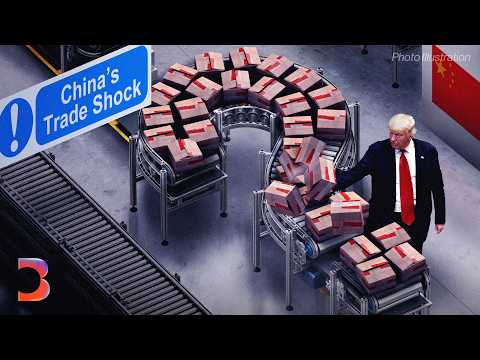
How China's Factories Are Being Rocked by Trump
Bloomberg Originals· 2025-07-18 08:00
Trade War Impact on Chinese Manufacturers - US-China trade tensions, driven by tariff increases, create uncertainty for Chinese manufacturers, forcing them to focus on short-term survival rather than long-term strategies [1][2][4] - The trade war has led to reduced revenue for some Chinese manufacturers, with one example showing a 20% decrease in revenue [5] - Tit-for-tat tariff hikes between the US and China have raised tariffs up to 145% for Chinese goods going to the US and 125% for US goods coming to China [6] - Despite trade tensions, China's GDP expanded by 52% in the second quarter, but exports to the US fell by 24% during the same period [11] - The US imported approximately 439 billion USD worth of goods from China, while US exports to China totaled approximately 143 billion USD, resulting in a trade deficit of approximately 295 billion USD [7][8] Strategies and Adaptations - Chinese manufacturers are exploring the "China-plus-one" model, shifting production to countries like Cambodia, India, and Southeast Asia to avoid tariffs and take advantage of lower labor costs [19][20] - Some companies are considering shifting focus to other markets like Europe, but find it difficult to replace the US consumer market due to its size and openness to new trends [21][22][23] - The uncertainty in US trade policy, including on-again, off-again tariffs and the closure of the de minimis tariff loophole, has disrupted manufacturers' planning and order cycles [15][18] Economic Concerns - Concerns exist that reduced access to the US market could lead to price cuts, job losses, and lower wages in China, potentially dampening consumer sentiment [9] - China faces persistent deflation, which reduces company earnings and discourages investment and hiring [11][12] - The loss of jobs, lower wages, and potential price cuts due to trade tensions could lead to a deflationary spiral in China [13] Market Dynamics - The US consumer market is considered essential and difficult to replace due to its size and spending power [3][23][25] - Despite tariffs, Chinese companies are not entirely deterred from the US market, but are focused on managing the uncertain relationship and planning for potential decoupling [25]
X @Bloomberg
Bloomberg· 2025-07-15 04:22
Malaysia remains on track to reach its trade growth target for the year even as it expects the pace of expansion to moderate in the second half, according to Investment, Trade and Industry Minister Zafrul Aziz. https://t.co/cvd2pffuI0 ...