
城市轨道交通

Search documents
晚高峰时段乘客滞留2.5小时,苏州有轨电车1号线突发故障
Qi Lu Wan Bao· 2025-10-15 08:47
齐鲁晚报·齐鲁壹点记者 朱洪蕾 李家澍 15日上午,苏州高新有轨电车有限公司有轨电车运营热线工作人员向齐鲁晚报·齐鲁壹点回应称,故障 点位于狮子山站附近,属于线路故障,对于具体原因并不知情。故障时间从14日17时许一直持续到19时 30分左右,"目前线路已经恢复正常运营。" 公开资料显示,苏州高新有轨电车1号线是苏州市首条城市有轨电车线路,也是国内单线运营里程最长 的有轨电车线路。其一期工程(狮子山站至龙康路站)于2014年10月26日开通试运营。 据多位网友14日下午发布视频爆料,苏州有轨电车1号线发生故障后。视频显示,线路途经的狮子山站 内有许多市民在等待;另有车内乘客拍摄画面称,列车因前方车辆受堵停滞,自己已在车厢内等待半小 时,站内站外都是人,该网友最终选择下车就餐后再返程。 10月14日晚高峰时段,苏州高新有轨电车1号线突发线路故障,导致狮子山站及沿线站点大量乘客滞 留。15日上午,苏州高新有轨电车有限公司运营热线工作人员回应称,故障已于当日19时30分左右排 除,线路恢复正常运营。 ...
地铁6号线栖霞山站装修接近尾声
Nan Jing Ri Bao· 2025-10-15 00:08
Core Viewpoint - Nanjing Metro Line 6 is advancing its construction, focusing on station and interval civil engineering, equipment installation, and station decoration, with a design concept that integrates the city's natural geography and historical context into an underground artistic space [1] Group 1: Construction Progress - The construction of Nanjing Metro Line 6 is in full swing, with ongoing civil engineering work and simultaneous equipment installation and station decoration [1] - The starting station, Qixia Mountain Station, is nearing completion, featuring a decorative ceiling that mimics traditional architectural styles [1] Group 2: Design and Aesthetics - The design philosophy of the stations is based on "mountain, water, city, and forest," creating a unique underground artistic environment [1] - A striking art installation of maple leaves, made of thousands of realistic-looking pieces, enhances the station's atmosphere, reflecting the autumn scenery of Qixia Mountain [1] Group 3: Connectivity and Impact - Metro Line 6 spans 32.365 kilometers, connecting various districts including Qixia, Xuanwu, Qinhuai, Yuhuatai, and Jiangning, linking key areas such as Qixia Mountain and Nanjing South Station [1] - Once operational, the line is expected to alleviate traffic pressure in Nanjing's city center and reduce travel time between the main urban area and surrounding regions, enhancing the city's rail transit network [1]
一拍过闸 广州地铁实现境外银行卡“拍卡过闸”
Yang Shi Xin Wen Ke Hu Duan· 2025-10-14 04:06
Core Points - The 138th China Import and Export Fair will commence on the 15th, prompting enhancements in transportation for foreign visitors in Guangzhou [1] - Guangzhou Metro has upgraded its ticketing system to include four types of international bank cards for contactless payment [3] Group 1 - Guangzhou Metro has added international bank card support to its existing payment options, which previously only included China UnionPay [3] - The supported card types include overseas-issued Mastercard, American Express, Visa, and JCB cards, as well as domestic Mastercard and American Express cards that support RMB transactions [4] - All metro stations in Guangzhou now accept payments from five major card organizations, allowing passengers to pass through gates without prior ticket purchase or app downloads [4]

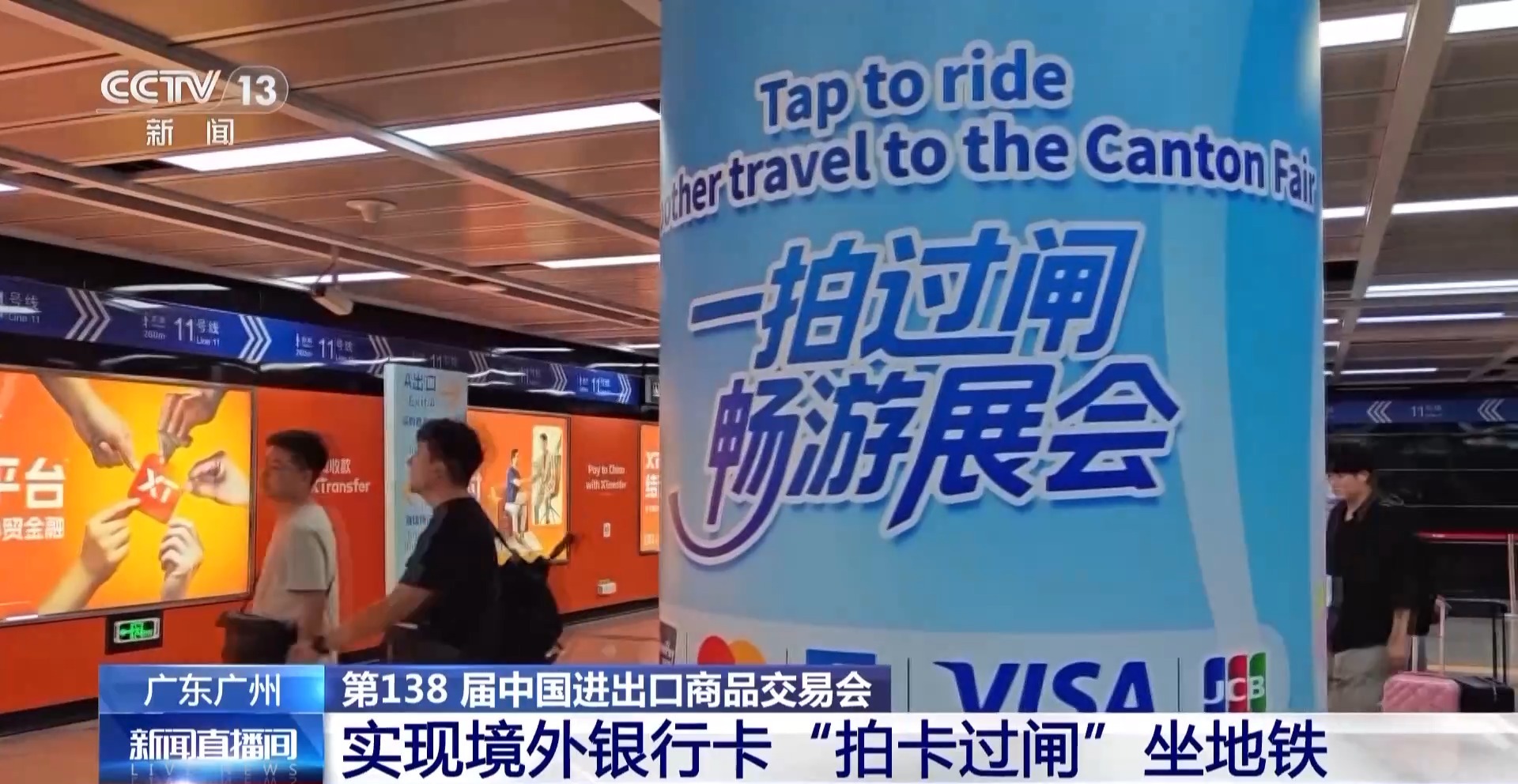
广交会便利服务再+1!丝滑“拍卡过闸”提升外籍人士出行体验
Yang Shi Wang· 2025-10-14 03:37
Core Points - The 138th China Import and Export Fair will commence on October 15, and Guangzhou Metro has upgraded its gate equipment and systems to enhance the travel experience for foreign visitors [1] - Guangzhou Metro has added international bank card contactless payment services, supporting cards from major organizations including Mastercard, American Express, Visa, and JCB [4] - All stations of Guangzhou Metro now support payment services from five major card organizations, allowing passengers to pass through gates quickly without the need for prior ticket purchase or special applications [6]
9月中国城市轨道交通客运量26.9亿人次
Zhong Guo Xin Wen Wang· 2025-10-13 11:56
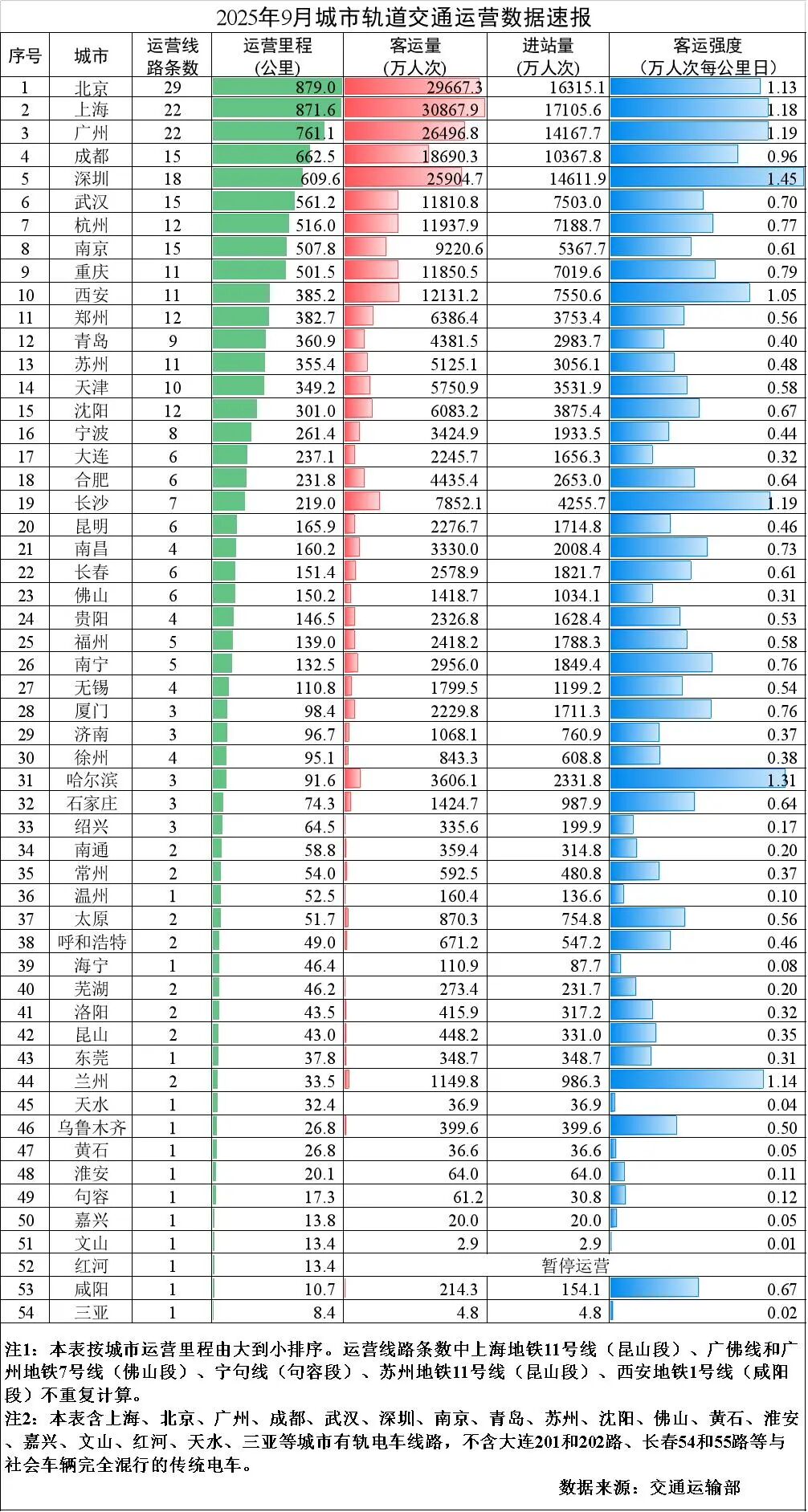
Core Insights - In September, China's urban rail transit system recorded a passenger volume of 2.69 billion trips, with an entry volume of 1.6 billion trips [1] - The Ministry of Transport reported a year-on-year increase of 110 million trips, representing a growth of 4.3% [1] Summary by Category Operational Data - A total of 54 cities across 31 provinces and regions, including Xinjiang Production and Construction Corps, operated 333 urban rail transit lines with a total operational mileage of 11,330.5 kilometers [1] - In September, 43 cities operated 274 subway and light rail lines, covering 9,839.3 kilometers, achieving a passenger volume of 2.6 billion trips and an entry volume of 1.54 billion trips [1] - Additionally, 16 cities operated 25 monorail, maglev, and regional rapid transit lines, with a total mileage of 970.7 kilometers, resulting in a passenger volume of 77.57 million trips and an entry volume of 52.21 million trips [1] - Furthermore, 18 cities operated 34 tram and automated guided rail lines, covering 520.5 kilometers, with a passenger volume of 9.62 million trips and an entry volume of 9.08 million trips [1] Growth Metrics - The average passenger intensity for the total operational mileage in September was 0.799 million trips per kilometer per day [1] - The month saw an addition of 119.8 kilometers in operational mileage and the launch of 2 new lines, specifically the southern section of Tianjin Metro Line 7 and the first phase of Xuzhou Metro Line 6 [1]
凯发电气:拟向特定对象增发募资不超过3亿元
Mei Ri Jing Ji Xin Wen· 2025-10-13 11:48
Group 1 - The company, Kaifa Electric (SZ 300407), announced on October 13 that its plan to issue shares to specific investors has been approved by the 2024 annual general meeting and authorized by the board of directors [1] - The share issuance will involve no more than 35 specific investors, with the issuance price set at no less than 80% of the average trading price of the company's shares over the 20 trading days prior to the pricing benchmark [1] - The total amount of funds to be raised from this issuance is expected to be 300 million yuan [1] Group 2 - For the first half of 2025, the company's revenue composition is as follows: 65.91% from the railway industry, 33.81% from urban rail transit, and 0.28% from other businesses [1] - As of the report date, Kaifa Electric has a market capitalization of 3.4 billion yuan [1]

交通运输部:9月城市轨道交通客运量环比减少1.9亿人次
Zheng Quan Shi Bao Wang· 2025-10-13 08:25
Core Insights - The Ministry of Transport released the urban rail transit operation data for September 2025, indicating significant activity in the sector [1] Group 1: Operational Data - In September 2025, 54 cities across 31 provinces (including autonomous regions and municipalities) and the Xinjiang Production and Construction Corps opened a total of 333 urban rail transit lines [1] - The total operational mileage reached 11,330.5 kilometers, with 3.64 million train trips conducted [1] - The passenger volume for the month was 2.69 billion trips, with an entry volume of 1.6 billion [1] Group 2: Performance Metrics - The passenger volume decreased by 190 million trips month-on-month, representing a decline of 6.6%, but increased by 110 million trips year-on-year, showing a growth of 4.3% [1] - The average passenger intensity for the total operational mileage in September was 0.799 million passengers per kilometer per day, which is a decrease of 3.9% month-on-month and 3.3% year-on-year [1]
交通运输部:9月城市轨道交通客运量同比增长4.3%
Yang Shi Wang· 2025-10-13 08:20
Core Insights - By September 2025, a total of 54 cities across 31 provinces (including autonomous regions and municipalities) and the Xinjiang Production and Construction Corps will have operational urban rail transit lines totaling 333, with a combined operational mileage of 11,330.5 kilometers [1] - The actual number of train operations reached 3.64 million, with a completed passenger volume of 2.69 billion and an entry volume of 1.6 billion [1] - In September, the passenger volume decreased by 190 million compared to the previous month, a decline of 6.6%, but increased by 110 million year-on-year, reflecting a growth of 4.3% [1] - The average passenger intensity for the total operational mileage in September was 0.799 million passengers per kilometer per day, which represents a month-on-month decrease of 3.9% and a year-on-year decrease of 3.3% [1]
交通运输部:9月城市轨道交通客运量环比减少1.9亿人次 降低6.6%
智通财经网· 2025-10-13 08:19
Core Insights - The Ministry of Transport reported that by September 2025, 54 cities in China will have opened 333 urban rail transit lines, covering a total operational mileage of 11,330.5 kilometers, with a total of 364 million train operations and a passenger volume of 2.69 billion [1][3] Group 1: Operational Data - In September, the passenger volume decreased by 190 million from the previous month, a decline of 6.6%, but increased by 110 million year-on-year, a growth of 4.3% [1] - The average passenger intensity across the national operational mileage was 0.799 million passengers per kilometer per day, which represents a decrease of 3.9% month-on-month and 3.3% year-on-year [1] - Among the 54 cities, 43 cities have opened 274 subway and light rail lines, with an operational mileage of 9,839.3 kilometers and a passenger volume of 2.6 billion [1] Group 2: New Operational Lines - In the current month, 119.8 kilometers of new operational mileage were added, along with 2 new operational lines, including the first phase of Tianjin Metro Line 7 and the first phase of Xuzhou Metro Line 6 [2] - Nine new operational sections were introduced, including segments of Chengdu Metro Line 10, Chengdu Metro Line 17, and others in various cities [2] Group 3: City-Specific Data - Major cities such as Beijing, Shanghai, and Guangzhou have significant operational lines and passenger volumes, with Beijing operating 29 lines and a passenger volume of 29.67 million, while Shanghai has 22 lines with 30.87 million passengers [3] - The operational intensity varies across cities, with Shenzhen showing a high intensity of 1.45 million passengers per kilometer per day, while cities like Dalian and Foshan have lower intensities of 0.32 and 0.31 million respectively [3][4]
南京规划建设七处机场
Jiang Nan Shi Bao· 2025-10-13 07:24
Core Points - Nanjing's comprehensive transportation planning aims to establish an international transportation hub by 2035, featuring a "123" travel circle for efficient connectivity [1][2] - The plan includes the construction of seven airports, with a focus on the main Nanjing Lukou International Airport and auxiliary Ma'anshan Airport, targeting an annual passenger throughput of 80 million by 2035 [2] - A significant investment in a 1000-kilometer urban rail transit network is planned, enhancing public transportation and connectivity across the city [2][3] Transportation Goals - By 2035, Nanjing aims for a one-hour reach to central cities in the metropolitan area, two hours to major cities in the Yangtze River Delta, and three hours to key cities nationwide [1] - The city plans to achieve a "4155" spatiotemporal goal, ensuring 15-minute access to national and provincial highways, and limiting car usage in central areas to no more than 15% [1] Airport and Multi-modal Transport Development - The aviation layout includes one main and one auxiliary airport, along with five general airports, with a total cargo throughput target of 140,000 tons by 2035 [2] - The integration of high-speed rail, urban rail, and major highways into the airport infrastructure is emphasized, promoting a multi-modal transport hub [2] Public Transportation System - Nanjing's public transport system will consist of urban, rural, and intercity buses, creating a multi-tiered network that includes express, trunk, branch, and micro-circulation services [3] - The city aims to develop a smart public transport system to enhance service efficiency and connectivity [3]