
智能驾驶

Search documents
多条主线蓄势待发“春季行情提前开启”渐成机构共识
Shang Hai Zheng Quan Bao· 2025-12-28 13:28
Group 1 - The core consensus among institutions is that the "spring market" has begun early, with a rebound in the market since mid-December, driven by significant global events affecting liquidity and fundamental expectations [1][2] - Institutions believe that the current market conditions, including overall valuation and sector direction, are favorable for investment, particularly in growth sectors such as technology, lithium batteries, smart driving, commercial aerospace, and domestic consumption [1][2] - Historical patterns suggest that the spring market typically starts when indices are at relatively low levels, which is currently the case, indicating a potential for upward movement [2][3] Group 2 - Specific sectors of interest include AI-driven industries, the high prosperity of the non-ferrous metals sector, cash flow value of dividend assets, and the valuation recovery of consumption and non-bank financials [3] - In the consumer sector, opportunities are expected to arise from the consolidation of the tourism industry, while in the chemical sector, companies maintaining profitability and actively expanding their businesses are of interest [3] - The healthcare sector is also highlighted, with a focus on consumer service-oriented assets such as pharmacies and home medical services [3] Group 3 - In technology stocks, significant attention is directed towards breakthroughs in application areas, particularly in AI infrastructure and smart hardware, with potential investment opportunities in humanoid robots and smart driving [3][4] - The robotics sector is anticipated to transition from ornamental value to functional value, while smart driving is expected to see high-level intelligent driving becoming a standard feature in vehicles priced above 200,000 yuan, a trend currently underestimated by the market [4]
A股分析师前瞻:多头势力聚集,“春季躁动”有望抢跑
Xuan Gu Bao· 2025-12-28 13:08
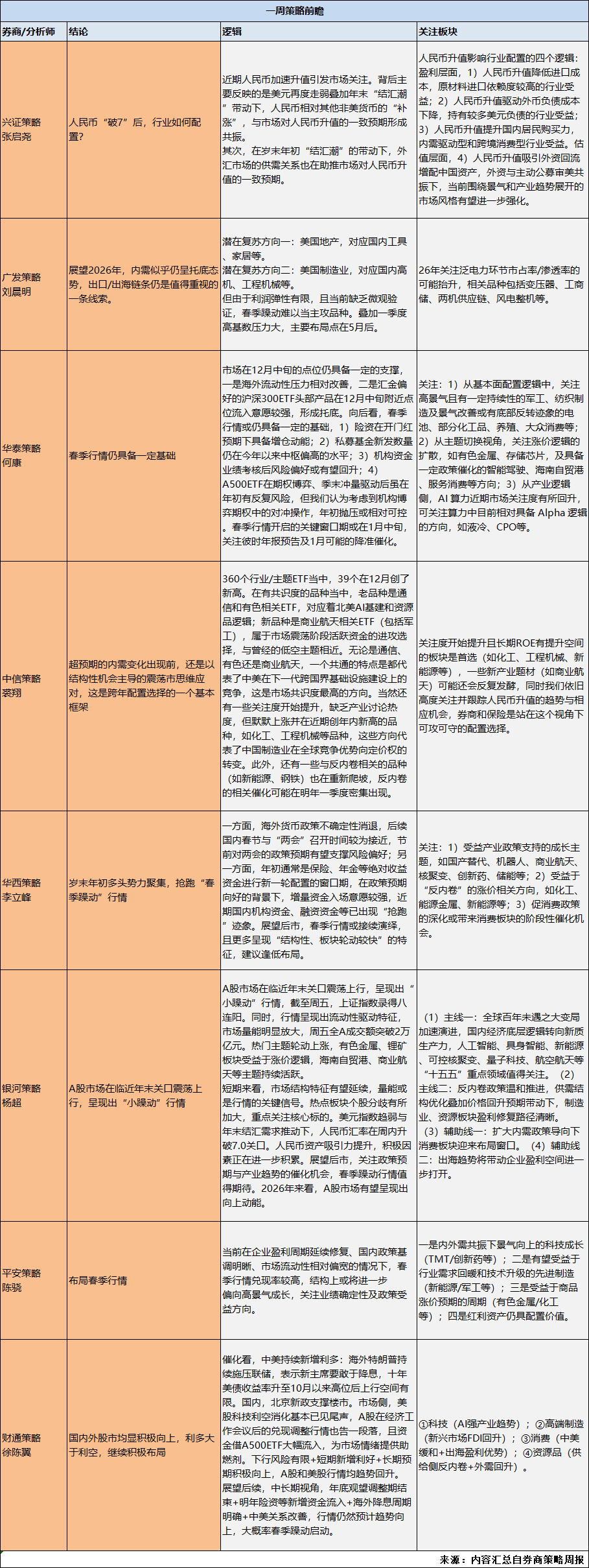
Core Viewpoint - Overall optimism remains among brokerage strategy analysts, with expectations for a "spring rally" as domestic policies and market conditions align favorably [1] Group 1: Market Trends - The A-share market is experiencing a "small rally" as it approaches year-end, with the Shanghai Composite Index recording eight consecutive days of gains [1] - Market liquidity is increasing, with total trading volume in the A-share market exceeding 2 trillion yuan on Friday [1][3] - Analysts suggest that the current market structure may continue, with trading volume being a key indicator of market trends [3] Group 2: Currency Impact - The recent appreciation of the RMB is drawing market attention, with four key implications for industry allocation: 1. Lower import costs benefiting industries reliant on imported raw materials [2] 2. Decreased foreign currency debt costs benefiting industries with significant USD liabilities [2] 3. Enhanced domestic purchasing power benefiting demand-driven and cross-border consumption industries [2] 4. Attraction of foreign capital back to Chinese assets due to RMB appreciation, potentially reinforcing market styles focused on economic trends [2][3] Group 3: Sector Focus - Analysts highlight several sectors for potential investment, including: - High-demand sectors such as military, textiles, and chemicals, which may show signs of recovery [3] - Industries benefiting from policy support, such as domestic substitution, robotics, and commercial aerospace [4] - Growth sectors like advanced manufacturing and technology, which are expected to benefit from economic recovery and policy clarity [5]

震荡有韵,结构为舟
Orient Securities· 2025-12-28 10:13
Market Strategy - The market is expected to maintain a range-bound oscillation, with a focus on precise timing to capture excess returns within the established range around 3900 points [2][4] - The strategy emphasizes selecting mid-cap blue-chip stocks that show marginal improvements in performance, particularly in sectors with moderate valuations and low institutional allocations [2][4] Industry Strategy - The public utility sector is anticipated to benefit from the pricing of electricity commodities, which is expected to enhance the industry's valuation [2][4] - The report highlights the need for further reforms in electricity market pricing to support the increasingly complex new energy system in China, allowing for better pricing of various attributes of electricity commodities [2][4] Thematic Strategy - The smart driving industry is experiencing positive developments, with the approval of L3 autonomous driving vehicles by regulatory bodies, which is expected to accelerate the industrialization of L3 autonomous driving by 2026 [3][4] - Companies involved in smart driving hardware and software are likely to benefit from the growing market demand and supportive regulatory environment [3][4]
市场变了!多家巨头从美国私有化退市,中概股加速回归!
Zheng Quan Shi Bao Wang· 2025-12-28 06:49
Core Viewpoint - The Chinese concept stock market is undergoing significant changes in 2025, characterized by a wave of privatizations and delistings from U.S. exchanges, while a number of small and medium enterprises continue to seek global financing opportunities, reflecting a complex interplay of withdrawal and entry in the global capital market landscape [1]. Group 1: Privatization and Delisting - Geely Automobile has completed the privatization of Zeekr, which is now a wholly-owned subsidiary, and has delisted from the NYSE, with 70.8% of Zeekr shareholders opting for shares and 29.2% for cash, totaling $701 million [2]. - Dada Group, part of the JD ecosystem, was privatized at a valuation of $520 million, with the acquisition price set at $2.0 per ADS, allowing for strategic adjustments and deeper collaboration with JD in the instant retail market [3]. - Fintech company OneConnect has pioneered dual delisting, having been listed on both the NYSE and HKEX, and has now completed its delisting from both exchanges, privatized for approximately HKD 1.69 billion due to long-term low stock prices and liquidity issues [3]. Group 2: Trends in U.S. Listings - In 2025, 63 Chinese companies went public in the U.S., raising approximately $1.12 billion, marking a 41% decrease in total financing compared to 2024, despite a 7% increase in the number of new listings [4]. - The largest IPOs this year were from consumer company Bawang Chaji, raising $411 million, and pharmaceutical company Ascentage Pharma, raising $126 million, indicating a shift towards smaller enterprises in the U.S. market [4][5]. - Ascentage Pharma, which focuses on developing new small molecule drugs, became the first Chinese biotech company to list in 2025, with its stock price rising by 61.62% post-IPO [5]. Group 3: Return to Hong Kong - The trend of Chinese companies returning to Hong Kong is evident, with companies like Pony.ai and Hesai achieving dual primary listings, reflecting a shift towards this model as a means to better integrate into the Hong Kong market [6]. - Hesai's IPO in September 2025 was the largest in the global lidar industry to date, raising over HKD 4.16 billion (approximately $533 million) [6]. - Other companies, such as Tianjing Biopharma, are also planning to pursue dual listings in Hong Kong, indicating a broader trend of returning to Asian markets [6]. Group 4: Future Outlook - Some analysts suggest that certain Chinese companies may pursue privatization and then re-list in Hong Kong or A-shares to escape U.S. regulatory pressures, potentially leading to better valuations and diversified financing channels [7].


智能驾驶细分龙头月内涨超95% 梳理产业链激光雷达等环节市占率居前A股名单
Xin Lang Cai Jing· 2025-12-28 02:08
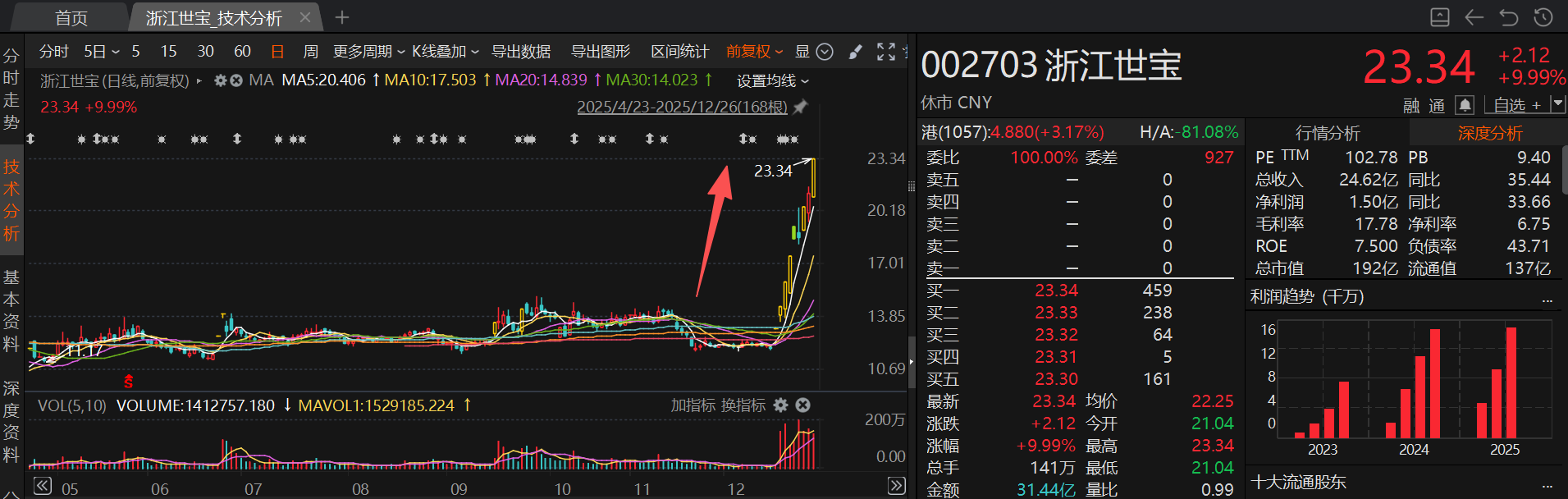
Core Viewpoint - The intelligent driving industry is entering a commercialized era, with the approval of L3-level autonomous driving marking a shift from technical validation to commercial application, enhancing expectations for policy, industry, and performance transmission [1] Industry Developments - Recent key policy breakthroughs and industry advancements in intelligent driving include the approval of China's first L3-level autonomous driving vehicles and Tesla's initiation of unmanned Robotaxi road tests, indicating a transition to large-scale application [1] - The intelligent driving sector is becoming a core engine for the transformation and upgrading of the automotive industry, fostering a collaborative ecosystem across the entire industry chain [1] Market Performance - In the secondary market, Zhejiang Shibao, focusing on steer-by-wire technology, recorded a maximum increase of 96.8% within the month, while Wanji Technology, focusing on lidar technology, saw a maximum increase of 52.7% [1] Company Insights - **Wanji Technology**: The company’s 128-line lidar has received approval from a major passenger vehicle manufacturer, and its 192-line lidar has passed validation from multiple mainstream automakers. The lidar products are being applied in leading commercial vehicles like Robobus [8] - **Zhejiang Shibao**: As a leader in electric power steering systems, the company has established long-term partnerships with several domestic traditional and new energy vehicle manufacturers, indicating a robust order book and normal operations [6][7] - **Bertley**: A leader in the automotive brake sector, the company holds a 12.59% market share in electronic parking brake systems in China and has received awards for its innovative small-diameter caliper technology, which enhances vehicle performance [7] - **Yongxin Optical**: The company specializes in lidar optical components and is expected to ship nearly one million units by the first half of 2025, with strong partnerships with leading lidar manufacturers [8]



出行观 | 智驾出关“水土不服”,当内地算法遇上香港法律
Xin Lang Cai Jing· 2025-12-27 10:26
Group 1 - The "Yue Che Nan Xia" policy aims to facilitate cross-border transportation between Guangdong Province and Hong Kong, allowing vehicles from specific cities to enter Hong Kong via the Hong Kong-Zhuhai-Macao Bridge starting December 23 [2] - The Hong Kong Transport Department is investigating a mainland driver for violating the policy by using an unauthorized driving assistance system, which may lead to penalties including fines or imprisonment [1][3] - The initial implementation of the policy has revealed discrepancies in traffic regulations and technology between the two regions, highlighting the need for a "pressure test" to address potential issues before broader implementation [2][3] Group 2 - There is a significant difference in the regulation of driving assistance systems between mainland China and Hong Kong, with Hong Kong enforcing stricter controls that require drivers to maintain full control of their vehicles [3] - The establishment of a cross-border violation handling mechanism may mean that traffic violations in one region could affect driving privileges in the other, necessitating awareness among mainland drivers [3] - Continuous improvement of infrastructure and services is required to accommodate mainland drivers, including updates to navigation applications and enhancements to parking facilities [3]
天瞳威视拟港股上市 中国证监会要求补充说明控股股东认定标准等
Zhi Tong Cai Jing· 2025-12-26 13:48
Group 1 - The China Securities Regulatory Commission (CSRC) issued supplementary material requirements for overseas listing applications, specifically addressing 19 companies, including Suzhou Tiantong Vision Technology Co., Ltd. [1] - Tiantong Vision is required to clarify the reasons and standards for inconsistent identification of its controlling shareholder, as well as provide a conclusive legal opinion on this matter [1][2] - The company must also explain the pricing basis and fairness of the share acquisition prices for new shareholders in the past 12 months, addressing any discrepancies and potential related-party transactions [1][2] Group 2 - Tiantong Vision is a software-centric provider of intelligent driving solutions, offering comprehensive solutions for L2-L2+ and L4 automation levels, with significant commercial achievements across various automation tiers [3] - The company ranks as the second-largest provider of L2-L2+ level driving and parking solutions in China, and the third-largest provider of Driver Monitoring System (DMS) solutions, based on installation volume projected for 2024 [3]
新股消息 | 天瞳威视拟港股上市 中国证监会要求补充说明控股股东认定标准等
智通财经网· 2025-12-26 12:51
Group 1 - The China Securities Regulatory Commission (CSRC) issued supplementary material requirements for 19 companies, including Tian Tong Vision, which needs to clarify inconsistencies in the identification of its controlling shareholder [1] - Tian Tong Vision has submitted a listing application to the Hong Kong Stock Exchange, with joint sponsors including China International Capital Corporation, HSBC, and Huatai International [1] - The CSRC requests Tian Tong Vision to provide a clear conclusion on the identification of its controlling shareholder and the basis for the pricing of new shareholders' investments over the past 12 months [1][2] Group 2 - Tian Tong Vision is a software-centric provider of intelligent driving solutions, offering comprehensive solutions for L2-L2+ and L4 automation levels, with significant commercial achievements in various automation fields [3] - The company is the second-largest provider of L2-L2+ level driving and parking solutions in China, based on installation volume in 2024, and the third-largest provider of Driver Monitoring System (DMS) solutions [3]
从“特斯拉门徒”到“赋能滴滴”:智驾江湖中场,在夹击中爆发
Di Yi Cai Jing Zi Xun· 2025-12-26 11:35
Core Insights - Nullmax, founded by a former Tesla executive, received a strategic investment in the C1 round from a domestic automotive-grade chip company, highlighting its credibility in an industry focused on "software-hardware integration" and "vertical integration" [1] - The company aims to position itself as an AI company rather than just a supplier for automotive firms, with a vision of expanding its technology beyond the automotive sector [1][2] - Nullmax's approach combines a "vision-centric" strategy with multi-sensor fusion, allowing it to stand out as a leading independent AI company capable of achieving "software-defined intelligent driving" [1][5] Company Development - The founder, Xu Lei, transitioned from Qualcomm to Tesla, where he played a key role in developing Autopilot, before establishing Nullmax in 2016 to focus on the rapid growth of ADAS in China [2][3] - The company initially collaborated with Didi on a project that faced challenges due to Didi's strategic shift, leading to a focus on a more flexible "platformization" strategy [3][6] - Nullmax has developed a middleware layer that abstracts hardware interfaces, allowing its software to be compatible across various chip platforms, enhancing deployment flexibility [5][6] Business Model - Nullmax's business model is more adaptable compared to traditional Tier 1 suppliers, focusing on high-margin, low-inventory risk "pure software licensing" [6] - The company aims to leverage its software platform to deploy solutions across different regions and chip platforms, emphasizing a pragmatic approach to business development [6][9] - The potential for rapid scalability is evident, with expectations of reaching a million vehicle scale in the next five years through partnerships with leading Tier 1 companies [7][9] Future Prospects - Nullmax is exploring applications beyond automotive, including industrial AGVs, agricultural machinery, and specialized robots, indicating a strategy to diversify its market presence [9][10] - The company is expanding into international markets, including Europe and Southeast Asia, through localized partnerships with Tier 1/OEMs to adapt to regional traffic regulations and chip ecosystems [9][10] - As the industry evolves, Nullmax aims to capitalize on its visual AI capabilities to drive innovation across various sectors, positioning itself for future growth opportunities [10]


承泰科技递表港交所 国泰君安国际为独家保荐人
Zheng Quan Shi Bao Wang· 2025-12-26 00:20
Core Viewpoint - Chengtai Technology has submitted an application for a mainboard listing on the Hong Kong Stock Exchange, with Guotai Junan International as its sole sponsor [1] Group 1: Company Overview - The company specializes in the design, research and development, manufacturing, and commercialization of millimeter-wave radar products [1] - Chengtai Technology operates production bases in Shenzhen and Suzhou [1] - The company employs a "business three-ring" model, focusing on high-quality hardware, agile software, and rapid delivery to provide OEM customers with high-quality and quickly deployable intelligent driving products and services [1] Group 2: Product Offerings - Chengtai Technology has developed multiple generations of millimeter-wave radar product matrices that support intelligent driving needs from L0 to L2+, including competitive 5th generation 4D radar and 5.5th generation high-resolution 4D radar products [1] - The company has established partnerships with over 20 automotive industry clients, including several leading Chinese OEMs, and its high-resolution products have been adopted by major clients [1] - Chengtai Technology is currently in discussions with leading European automotive brands [1] Group 3: Competitive Advantages - The company demonstrates significant advantages in delivery efficiency, with an average product delivery cycle for customized software ranging from 6 to 9 months, which is considerably lower than the industry average of 12 to 24 months [1] - Some collaborative projects can even be delivered within one month [1]