
保险业

Search documents
【智库圆桌】发展科技金融激发创新活力
Xin Lang Cai Jing· 2026-01-11 00:40
Core Viewpoint - The development of technology finance is crucial for promoting the dual advancement of technology and finance, as emphasized in China's economic planning and regulatory frameworks [1][3][4]. Group 1: Importance of Technology Finance - Technology finance is positioned as a key support for achieving high-level technological self-reliance and building a strong technological nation [2][3]. - The development of technology finance helps accelerate breakthroughs in critical core technologies and supports the transformation and upgrading of traditional industries [3][4]. - It broadens the boundaries of financial services, creating new growth points for financial institutions amid narrowing net interest margins [3]. Group 2: Policy and Structural Developments - The implementation of the "14th Five-Year Plan" emphasizes the construction of a financial service system that aligns with technological innovation [4][6]. - By the end of 2025, the banking and insurance sectors are expected to enhance their financial service mechanisms to better support technological innovation [4]. - The scale of technology finance continues to expand, with significant increases in loan balances for high-tech enterprises and technology-based SMEs, indicating a growing financial service coverage [4][5]. Group 3: Enhancements in Financial Services - The People's Bank of China has introduced various financial tools to support major technological projects and SMEs in their growth phases [5]. - Financial support for advanced manufacturing, high-tech manufacturing, and strategic emerging industries has been continuously strengthened, with notable annual growth rates in relevant loans [5]. - The establishment of multiple technology finance reform pilot zones aims to reduce financing costs for technology enterprises and optimize financial resource allocation [13][14]. Group 4: Role of Patient Capital - Patient capital is essential for supporting long-term technological innovation, focusing on projects with long-term returns rather than short-term profits [8][9]. - The development of patient capital is crucial for guiding production factors towards new quality productivity, which is characterized by high technology and efficiency [9][10]. - Initiatives to encourage patient capital investment in technology innovation include increasing the investment ratio of pension and insurance funds in early-stage hard technology funds [11][12]. Group 5: Challenges and Future Directions - Despite the potential of patient capital, challenges such as an unbalanced supply structure and a lack of market-driven capital remain [11][12]. - Future efforts should focus on optimizing the market ecosystem, enhancing incentive mechanisms, and strengthening cross-cycle capabilities to attract more long-term capital into technology innovation [12][17]. - The establishment of technology finance reform pilot zones has shown promise, but further improvements in policy support and market mechanisms are necessary to enhance the sustainability of financial support for technology innovation [17].
中国人寿五家分支机构被罚 保险代理人培训管理不到位
Xi Niu Cai Jing· 2026-01-10 02:37
Core Viewpoint - The China Life Insurance Company Xi'an Branch and its associated marketing service departments have been penalized for inadequate training management of insurance agents, indicating ongoing compliance issues within the company [1][2]. Summary by Category Administrative Penalties - The Xi'an Branch of China Life Insurance received a warning and a fine of 10,000 yuan for violations related to insurance agent training management [2]. - The Shuyuanmen Marketing Service Department was fined 20,000 yuan, while the Economic and Technological Development Zone Marketing Service Department also received a fine of 20,000 yuan [2]. - The Chang'an South Road Marketing Service Department and the Zhonglou Business Department were each fined 10,000 yuan [2]. - Related responsible personnel, including Party Jin Ning, Fan Ye, Wang Yan, Wang Hanxiao, Li Jiangfeng, Yang Qingbo, and Wang Xiaoming, were also warned and fined 10,000 yuan each [2]. Historical Context - A year prior, on January 7, 2025, the Xi'an Branch was similarly penalized for the same issue of inadequate training management, receiving a warning and a fine of 10,000 yuan [3]. - In September 2025, the China Life Group reported on the progress of central inspection rectification, emphasizing the need for a transformation in the business model and stricter management of agents [3].



国资再退出?中国铁建投资拟3.3亿元出售国任保险全部股权
Nan Fang Du Shi Bao· 2026-01-09 08:14
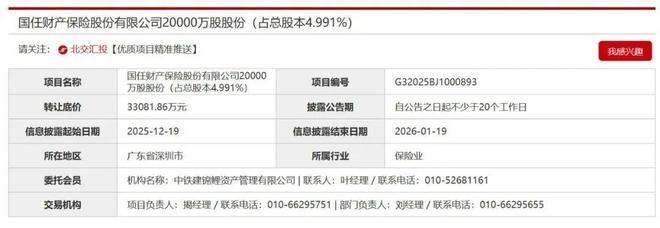
Core Viewpoint - The transfer of 200 million shares (4.991% of total equity) of Guoren Property Insurance Co., Ltd. is being offered for sale at a base price of approximately 331 million yuan, marking a strategic adjustment by the shareholder China Railway Construction Investment Group Co., Ltd. [1][2] Group 1: Share Transfer Details - Guoren Insurance's shares are being listed for transfer on the Beijing Property Exchange, with a minimum transfer price of 331.86 million yuan [2] - The transfer is part of a broader trend where state-owned enterprises are gradually exiting non-core financial investments, as mandated by the State-owned Assets Supervision and Administration Commission [3] Group 2: Company Background and Financial Performance - Guoren Insurance has a registered capital of 4.007 billion yuan and is the only property insurance company controlled by Shenzhen's state-owned assets [3] - The company reported insurance business revenue of 9.341 billion yuan for the first three quarters of 2025, a decrease from 10.275 billion yuan in the same period last year, while net profit increased to approximately 337 million yuan [5] - The comprehensive cost ratio for the first three quarters of 2025 was 102.8%, up nearly 3 percentage points from 99.82% year-on-year [5] Group 3: Shareholder Structure - The largest shareholder, Shenzhen Investment Holdings Co., Ltd., holds 41% of Guoren Insurance, followed by other significant shareholders including Union Beauty Holdings and Shenzhen Luohu Investment Holdings [4] - The current shareholder structure includes 18 state-owned and private enterprises, indicating a diverse ownership base [3][4] Group 4: Regulatory and Management Changes - Guoren Insurance has faced over 2 million yuan in fines since 2025 due to compliance issues, including penalties for inaccurate data reporting and improper use of insurance terms [5] - The management team has undergone significant changes, becoming younger, with the current chairman, Fang Yongbin, having led the company for over seven years [7]

发展科技金融激发创新活力
Jing Ji Ri Bao· 2026-01-08 21:43
Core Viewpoint - The development of technology finance is crucial for promoting the mutual enhancement of technology and finance, as emphasized in China's economic planning and regulatory frameworks [1][3]. Group 1: Importance of Technology Finance - Technology finance is positioned as a key support for achieving high-level technological self-reliance and building a strong technological nation, being recognized as the foremost area in financial development [2]. - The evolution of technology finance in China dates back to 1985, with a focus on integrating financial services with technological innovation through diverse financial tools and systems [2]. - The current phase of the "14th Five-Year Plan" is critical for advancing technology finance, which aids in overcoming key technological challenges and supports the transformation of traditional industries [3]. Group 2: Policy and Structural Developments - Significant policy initiatives have been introduced to enhance financial support for technology innovation, including the establishment of a comprehensive technology finance system that aligns with national technological goals [4]. - By the end of Q3 2025, loans to high-tech enterprises reached 18.84 trillion yuan, with a loan growth rate surpassing the average for all loans, indicating a robust expansion of technology finance [4]. - The establishment of multiple technology finance reform pilot zones aims to reduce financing costs for technology enterprises and optimize the allocation of financial resources [12][13]. Group 3: Role of Patient Capital - Patient capital, characterized by a long-term investment outlook and a higher risk tolerance, is essential for supporting technology innovation, particularly in high-risk, long-cycle projects [7][8]. - The government encourages the development of patient capital through various investment vehicles, which can provide stable funding for technology projects and help bridge the gap between short-term financial returns and long-term innovation goals [9][10]. - The growth of patient capital is seen as a vital driver for directing resources towards new quality productivity and addressing the challenges faced by technology enterprises in securing financing [10]. Group 4: Challenges and Future Directions - Despite the potential of patient capital, challenges such as an imbalanced supply structure and inadequate market ecology hinder its effectiveness in supporting technology innovation [10]. - Future efforts should focus on broadening the sources of patient capital, enhancing market mechanisms, and improving incentive structures to encourage investment in technology innovation [11][16]. - The establishment of a robust policy framework and the integration of market-driven approaches are necessary to enhance the sustainability and coverage of financial support for technology innovation [16].
逆周期监管等多重因素助推 险企发债规模连续三年超千亿元
Zheng Quan Shi Bao· 2026-01-08 18:08
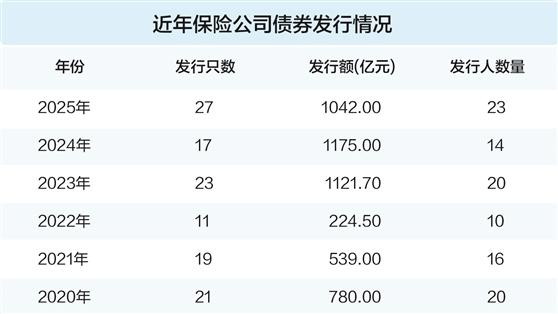
Core Viewpoint - The insurance industry in China has seen a continuous increase in bond issuance, with 2025 marking the third consecutive year that the total issuance exceeded 100 billion yuan, driven by various factors including low interest rates and regulatory support [1][2]. Group 1: Bond Issuance Trends - In 2025, 23 insurance companies issued a total of 27 bonds, amounting to 104.2 billion yuan, following previous years' issuances of 112.17 billion yuan in 2023 and 117.5 billion yuan in 2024 [2][3]. - The bond issuance peaks in the insurance sector have historically been linked to regulatory changes and capital adequacy requirements, with significant peaks noted in 2011-2012, 2015, and 2020 [2][3]. - The current wave of bond issuance is attributed to the implementation of stricter capital recognition rules and a strong demand for capital replenishment due to declining solvency ratios [3]. Group 2: Regulatory Support and Market Expansion - Regulatory support has played a crucial role in expanding the bond issuance capabilities of insurance companies, particularly for smaller firms, as part of a counter-cyclical regulatory approach [4][5]. - The number of insurance companies issuing bonds has increased, with notable first-time issuers like Dongfang Jiafu Life and Dongwu Life entering the market in recent years [5]. - The introduction of perpetual bonds has provided additional financing tools for insurance companies, with 18 firms having issued a total of 127.47 billion yuan in perpetual bonds by the end of 2025 [5]. Group 3: Default and Risk Management - The bond market witnessed its first defaults from insurance companies in 2025, with Tianan Insurance and Tianan Life unable to meet their debt obligations, marking a significant shift in the industry's previously unblemished record [6][7]. - The defaults highlight the importance of investor awareness regarding the governance and risk management capabilities of insurance firms, especially in light of the evolving financial landscape [6][7]. - Investors are advised to focus on core financial indicators and the implications of potential insolvency or restructuring on their rights and interests [7].
L3级自动驾驶来了,车险会涨价吗?
第一财经· 2026-01-08 10:41
Core Viewpoint - The introduction of L3-level conditional autonomous driving in China is expected to significantly impact the auto insurance industry, but traditional car insurance will remain dominant for the foreseeable future, with a dual-track model of "traditional car insurance + intelligent driving insurance" emerging [3][4][6]. Group 1: Current State of Auto Insurance - Auto insurance is the most important type of property insurance, with a total premium income of 843.2 billion yuan, accounting for 52.19% of total property insurance premiums in the first 11 months of 2025 [5]. - The current insurance model for fuel and electric vehicles includes mandatory insurance, vehicle damage insurance, third-party liability insurance, and additional coverage, while intelligent driving insurance is an innovative supplement [6][7]. Group 2: Transition to L3-Level Autonomous Driving - L3-level autonomous driving allows vehicles to perform all dynamic driving tasks under certain conditions, but the driver must be ready to take over when necessary, creating a need for new insurance responsibilities [6][7]. - The insurance landscape is expected to evolve, with traditional car insurance covering driver-related liabilities and intelligent driving insurance addressing system failures and new risks associated with L3 technology [9][10]. Group 3: Changes in Insurance Products - The insurance products for L3 vehicles will include traditional car insurance combined with intelligent driving liability insurance, shifting the core protection logic from "covering driver errors" to "covering system failures and ensuring safety" [10][11]. - The introduction of L3 technology is anticipated to lead to new insurance products, such as system liability insurance for manufacturers and accident insurance for users, creating significant growth opportunities for insurance companies [12][15]. Group 4: Pricing and Risk Assessment - The transition to L3-level autonomous driving may lead to changes in premium pricing, with the influence of human factors diminishing and vehicle-related factors becoming more prominent [15]. - In the short term, risks associated with L2 and L3 transitional phases may cause a slight increase in insurance risks due to human-machine interaction and cybersecurity issues, but long-term advancements in L3 technology could significantly reduce overall insurance risks [15][16]. Group 5: Legal and Regulatory Challenges - The shift to L3 autonomous driving raises complex liability issues, as existing laws regarding traffic accident responsibility are not yet fully developed, leading to potential disputes in claims [17][18]. - The insurance industry is exploring solutions to these liability challenges, including the use of big data models for intelligent liability determination and the development of a standardized regulatory framework for L3 technology [18].

董责险走热:1700多家上市公司投保,理赔有多少?
Xin Lang Cai Jing· 2026-01-08 08:08
Core Viewpoint - The increasing awareness of investor rights and the rise in civil compensation lawsuits have led to a significant growth in the purchase and payout of Directors and Officers Liability Insurance (D&O Insurance) among listed companies in China, with the market penetration rate rising from 28% in 2024 to 32% in 2025 [1][14]. Group 1: D&O Insurance Market Overview - As of December 31, 2025, a total of 1,753 listed companies had purchased D&O Insurance, marking a 16% increase from 1,509 companies in 2024 [3][15]. - The number of companies purchasing D&O Insurance in 2025 reached 643, a year-on-year increase of 19% [3][15]. - The average premium rate for D&O Insurance in the A-share market has decreased to below 0.05% by the end of 2025, indicating a "price trough" in the market [11][23]. Group 2: Industry and Sector Insights - The highest D&O Insurance penetration rates are found in the real estate, wholesale, and electricity sectors, all exceeding 60%, indicating a correlation between industry risk and insurance demand [4][16]. - Among different stock exchanges, the Shenzhen Main Board has the highest penetration rate at 44%, followed by the Shanghai Main Board at 37% and the Sci-Tech Innovation Board at 34% [4][16]. - Companies with assets over 50 billion yuan have a D&O Insurance purchase rate of 68%, significantly higher than the 20% rate for companies with assets below 2 billion yuan [4][16]. Group 3: Legal and Regulatory Context - The implementation of the new Securities Law and the increase in civil liability cases have heightened the risk exposure for directors and officers, leading to a greater focus on D&O Insurance among listed companies [7][19]. - The number of companies receiving warning letters and previously purchasing D&O Insurance has rapidly increased, totaling 366 over the past five years [20]. - The rise in administrative penalties and investigations has led to a significant increase in the number of lawsuits filed by investors, further driving the demand for D&O Insurance [2][21]. Group 4: Claims and Payouts - The total amount of claims paid out for D&O Insurance has exceeded 10 billion yuan, with 26 claims totaling 390 million yuan in 2024 and 13 claims totaling 89.47 million yuan in the first three quarters of 2025 [10][21]. - The case of Jintongling, which resulted in a court ruling for compensation of 775 million yuan to investors, highlights the potential for significant payouts under D&O Insurance [6][18]. - The long-tail effect of D&O Insurance claims means that while regulatory scrutiny and potential claims are increasing, large-scale payouts have not yet fully impacted insurance companies' financial statements [12][24].

证券市场周刊-第1期2026
2026-01-08 02:07
Summary of Key Points from the Conference Call Industry Overview - The focus is on the Chinese stock market and its potential for a "comprehensive bull market" in 2026, driven by multiple favorable factors including policy benefits, a moderately loose liquidity environment, and continuous improvement in the fundamentals of listed companies [3][15][66]. Core Investment Themes 1. **AI Computing and Applications**: - AI computing is expected to be a core investment theme, with significant growth anticipated in the AI server market, projected to reach $158.7 billion by 2025, with a compound annual growth rate (CAGR) of 17.3% [78]. - Companies like Haiguang Information are leading in AI computing, with their DCU deep computing chips receiving bulk orders from major internet firms [79]. 2. **Traditional Cyclical Industry Recovery**: - The recovery of traditional cyclical industries is highlighted as a key investment area, with expectations for improved profitability in sectors such as steel, cement, and chemicals due to policy support and market demand [69][70]. 3. **High Dividend Yield Assets**: - High dividend yield assets, particularly in banking, insurance, and coal sectors, are expected to attract long-term investors, providing a stable income during the anticipated bull market [14][15][66]. Market Dynamics - The Shanghai Composite Index has shown strong performance, breaking the 4000-point mark, indicating a return of profitable investment opportunities [12]. - The market is expected to experience a "spring rally," with strong performance anticipated in sectors like non-ferrous metals and technology [17]. Policy Environment - The Central Economic Work Conference emphasized the need for a more proactive fiscal policy and a moderately loose monetary policy to support economic growth and stabilize prices [68][70]. - Key tasks for 2026 include building a strong domestic market and enhancing support for technological innovation and industrial upgrades [69][70]. Economic Indicators - The manufacturing Purchasing Managers' Index (PMI) rose to 50.1 in December 2025, indicating expansion, driven by policy support and improved external demand [49]. - Industrial profits for large-scale enterprises showed a slight increase, with total profits reaching 66,268.6 billion yuan, a year-on-year growth of 0.1% [50]. Investment Recommendations - Investors are advised to focus on three main sectors for 2026: 1. **Technology Growth Stocks**: Emphasizing AI and semiconductor industries. 2. **Core Blue-Chip Stocks**: Including traditional consumer sectors like liquor and real estate. 3. **High Dividend Stocks**: Expanding beyond banks to include insurance and coal sectors [12][14][15]. Conclusion - The combination of favorable policies, improved company fundamentals, and a supportive liquidity environment is expected to create a robust foundation for a comprehensive bull market in 2026, with significant opportunities in AI, traditional industries, and high dividend yield assets [3][15][66].
上证深一度 | 具身机器人也有自己的保单 险企竞逐机器人保险业务
Shang Hai Zheng Quan Bao· 2026-01-08 00:06
Group 1 - The core viewpoint of the articles highlights the rapid growth of the robot rental market, which is expected to reach a scale of 100 billion yuan by 2026, leading to increased demand for insurance products tailored for robots [1][2] - The first "insurance + rental" policy for humanoid robots has been launched by Ping An Property & Casualty Insurance, which includes comprehensive coverage such as third-party liability and product quality liability, addressing the limitations of traditional insurance models [3][4] - Major insurance companies like PICC and Taikang are actively developing robot insurance products, offering flexible coverage options to meet diverse market needs, indicating a shift towards a dynamic financial ecosystem that supports the entire lifecycle of the robot industry [4][5] Group 2 - The development of robot insurance faces challenges such as data barriers, difficulty in risk assessment, and unclear liability definitions, which need to be addressed through collaboration and innovation within the industry [6][7] - Experts suggest that establishing a data-sharing platform involving regulatory bodies, technology companies, and insurance institutions is crucial for overcoming pricing and data challenges in robot insurance [6][7] - The insurance sector is moving from providing static risk coverage to creating a comprehensive financial ecosystem that supports the dynamic needs of the robot industry, reflecting a fundamental upgrade in the financial industry's support logic for robotics [4][5]


福州电梯专项保险可用住宅专项维修资金购买
Xin Lang Cai Jing· 2026-01-07 23:22
本报讯 (记者 张文奎) 日前,福州市关于使用住宅专项维修资金(以下简称"维修资金")购买电梯专 项保险的新政落地,明确已交存维修资金的住宅小区,可按规定申请使用维修资金购买电梯专项保险, 保障范围为电梯保修期满后的维修、更新和改造。 电梯专项保险的保险周期为1年,到期后双方可视情况选择是否续保。电梯专项保险生效期间,申请人 不得再为已购买同类型维修项目保险的电梯申请使用维修资金(因自然灾害等因素导致保险不予赔付的 除外)。投保单元(楼栋)的维修资金应足够支付该电梯专项保险的1年费用。对于电梯保修期未满需 投保的,申请人可提前准备相关材料,在保修期届满前1个月提交保险合同、保费发票等材料至福州市 各区住建(房管)局申请审核,审核通过后由福州市住宅专项维修资金管理中心予以拨付。 据了解,电梯专项保险仅对电梯保修期满后的维修、更新和改造进行保障。电梯日常维护及电梯第三者 责任险仍由物业服务企业或其他管理单位按照合同约定承担。按照"谁受益、谁投保"原则,电梯专项保 险由福州市已建立维修资金账户的住宅小区相关业主、业主委员会、物业服务企业或者村(居)民委员 会(以下统称"申请人")提出申请。经专有部分面积占比三分之二 ...